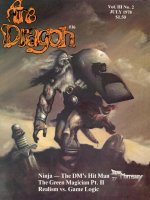
dragon magazine số 077
Bạn đang xem bản rút gọn của tài liệu. Xem và tải ngay bản đầy đủ của tài liệu tại đây (11.19 MB, 86 trang )
D RAGON 1
Vol. VIII, No. 3
September 1983
SPECIAL ATTRACTION
KING OF THE TABLETOP . . . . . . .33
A new game, not about furniture,
from Tom and Rob and Tramp
OTHER FEATURES
The Tarot of Many Things . . . . . . . . . . . .
.6
All decked out and ready to play
Curses! 18
Greenwood at his most devious
Creative cursing . . . . . . . . . . . . . . . . . . .20
Magic to make characters sorry
Elemental Gods . . . . . . . . . . . . . . . . . . .22
Deities that almost defy description
A new game with a familiar name . . .26
Frank words on D&D® game revisions
Spys Advice. . . . . . . . . . . . . . . . . . . . . . .32
For TOP SECRET® game players
DRAGON Readership Survey . . . . . . .55
Fill it out and fill us in
REGULAR OFFERINGS
Out on a Limb 3
Letters from readers
The ecology of the Unicorn 14
Previously known only to a few
Figure Feature
30
Game reviews:
HARN
campaign package
66
Plague of Terror module 67
Gamers Guide
68
Whats New 74
Snarfquest
77
Wormy 80
Publisher: Mike Cook
Editor-in-Chief: Kim Mohan
Editorial staff: Marilyn Favaro
Roger Raupp
Patrick L. Price
Mary Kirchoff
Roger Moore
Business manager: Mary Parkinson
Office staff: Sharon Walton
Mary Cossman
Layout designer: Kristine L. Bartyzel
Contributing editor: Ed Greenwood
National advertising representative:
Robert Dewey
1409 Pebblecreek
Glenview IL 60025
Phone (312)998-6237
This issues contributing artists:
Jerry Eaton
Phil Foglio
Roger Raupp
Dave Trampier
Tom Wham
DRAGON Magazine (ISSN 0279-6848) is pub-
lished monthly for a subscription price of $24 per
year by Dragon Publishing, a division of TSR,
Inc. The mailing address of Dragon Publishing
for all material except subscription orders is P.O.
Box 110, Lake Geneva WI 53147.
DRAGON Magazine is available at hobby
stores and bookstores throughout the United
States and Canada, and through a limited
number of overseas outlets. Subscription rates are
as follows: $24 for 12 issues sent to an address in
the U.S. or Canada; $50 U.S. for 12 issues sent via
surface mail or $95 for 12 issues sent via air mail
to any other country. All subscription payments
must be in advance, and should be sent to Dragon
Publishing, P.O. Box 72089, Chicago IL 60690.
A limited quantity of certain back issues of
DRAGON Magazine can be purchased from the
Dungeon Hobby Shop. (See the list of available
issues printed elsewhere in each magazine.) Pay-
ment in advance by check or money order must
accompany all orders. Payments cannot be made
through a credit card, and orders cannot be taken
nor merchandise reserved by telephone. Neither
an individual customer nor an institution can be
billed for a subscription order or a back-issue
purchase unless prior arrangements are made.
The issue of expiration for each subscription is
printed on the mailing label for each subscribers
copy of the magazine. Changes of address for the
delivery of subscriptions must be received at least
six weeks prior to the effective date of the change
in order to insure uninterrupted delivery.
All material published in DRAGON Magazine
becomes the exclusive property of the publisher
upon publication, unless special arrangements to
the contrary are made prior to publication.
DRAGON Magazine welcomes unsolicited sub-
missions of written material and artwork; how-
ever, no responsibility for such submissions can
be assumed by the publisher in any event. Any
submission which is accompanied by a self-
addressed, stamped envelope of sufficient size will
be returned if it cannot be published.
DRAGON® is a registered trademark for
Dragon Publishings monthly adventure playing
aid. All rights on the contents of this publication
are reserved, and nothing may be reproduced
from it in whole or in part without prior permis-
sion in writing from the publisher. Copyright©
1983 by TSR, Inc.
Second-class postage paid at Lake Geneva,
Wis., and additional mailing offices.
POSTMASTER: Send address changes to
Dragon Publishing, P.O. Box 110, Lake Geneva
WI 53147. USPS 318-790. ISSN 0279-6848.
DRAGON, DUNGEONS & DRAGONS, ADVANCED DUNGEONS & DRAGONS, ADVANCED D&D,
TOP SECRET, BOOT HILL, and GAMMA WORLD are registered trademarks owned by TSR, Inc.
designates other trademarks owned by TSR, Inc., unless otherwise indicated.
Were listening
Hmmm. With 1984 more or less around
the corner, maybe thats a bad way to start
a column. But Ill let it stand, because it
sums up the point of this months ser-
mon: Why All of You Should Fill Out
and Return the DRAGON Magazine
Readership Survey (pages 55-56).
As is always the case with a magazine
and its readers, you know us, the maga-
zine, a whole lot better than we know
you, the group who reads us. We think
we know what you like, and we try to fill
up the magazine with Good Stuff. If
youre happy, we all win. If youre not,
vice versa.
We think we know you based on two
things we get a lot of: Letters, and re-
sponses to other readership surveys weve
published. The letters expressing indi-
vidual readers opinions, numerous
though they are, represent only a small
fraction of you. And its been a while
since we printed a survey; a lot of you
werent even with us the last time. (But
those of you who were with us helped
contribute to a couple of tremendous
response totals. Keep it up.)
We need to know more, about all of
you, than weve ever known before. We
need to ask some standardized questions,
because thats the best way to get exact
readings of fact and opinion from a large
group of people. And the larger, the bet-
ter. The more people we hear from, the
more sure we can be that you are really
talking to us.
The picture of you that we get from
analyzing the returned surveys will be
used to shape the future of this magazine.
You better believe that we are listen-
ing, and well try to do whatever you say
you want.
No, I cant say well be able to handle
everything you, the individual, might
want us to do. But well try to give the
greatest benefit to the greatest number,
because (a) it seems like the lawful good
thing to do, and (b) its worked pretty
well so far.
We know our readership has changed
and continues to change. We try, by pay-
ing attention to letters and doing some
educated guessing, to keep changing with
you. But sometimes we have to make a
really formal check of our position. We
need you to help us navigate when the
horizon starts to look too much the same
let us sight on you, like a star, to keep
ourselves on course. And, to complete the
nautical analogy, then we can all really
start sailing. KM
2 SEPTEMBER 1983
ou may have been King of
the Mountain when you
were a little kid. If youre
one of our older readers, you
may have been King of the
Drive-In once upon a time. But not until
now has anyone ever had the chance to be
KING OF THE TABLETOP.
Our latest game offering, in the center
of this magazine, is a mixture of things: a
combat game, an economic game, and
above all a prestige game. (Youll see
what we mean.) It is brought to you by a
mixture of people: Tom Wham, who has
more game designs in his head than most
people have in their houses; Rob Kuntz,
known throughout the land for his work
on Greyhawk articles and the DEITIES &
DEMIGODS book; and Dave Trampier,
author of Wormy, who will illustrate
every counter sheet we publish from now
on if I have anything to say about it.
Weve heard from people who think the
games we print would be fun, but they
never play them because they dont want
to destroy the magazine by pulling out
the innards. Well, this is one time when
anyone who feels that way should make
an exception its a regally good game.
If the scene on the cover reminds you of
something from your minds eye, that
means artist Jerry Eaton did his job to
perfection. The painting is his interpreta-
tion, using the Players Handbook as a
guide, of the appearance and effect of a
magic-users wall of fire spell. Although
this is Jerrys first cover painting for us,
his signature is also on some striking
color illustrations done for fiction stories
in earlier issues.
The next time anyone asks your AD&D
character to play cards, youd better find
out exactly what he means before you
look at your hand. Presented across lots
of pages inside is an article on a 78-in-1
magic item, The Tarot of Many Things.
Every campaign with characters who are
gamblers at heart should have one (but
only one) deck of Tarot cards, as de-
scribed by author Michael Lowrey for
incorporation into the AD&D game.
Things may never be the same again. . . .
Obviously, there are times when we
cant exactly go to the source in prepar-
ing an article on The Ecology of some-
thing. But Roger Moore managed to get a
friendly neighborhood dryad to talk
about The Ecology of the Unicorn for
this months issue, and he got more than
he bargained for.
Also inside is a somewhat unusual arti-
cle intended for non-gamers, as well as
for all of you who usually buy this maga-
zine. Frank Mentzer tells the story of the
new, improved version of the D&D® Basic
and Expert Sets that are expected to
attract even more people into the hobby
of fantasy role-playing games. After
youve read the article, lend it to some
friends who dont play and be sure to
tell em who sent you. KM
He or she?
Dear Editor:
I enjoyed Mr. Greenwoods article concern-
ing the Nine Hells [issue #75]. However, I
found one apparent mistake. In the article,
Sekolah is described as a female. The Deities &
Demigods Cyclopedia states that the deity is a
male. Can you explain?
Greg Lewis
North Augusta, S.C.
Yep, the article was technically in
error. But I think we can figure out where Ed
Greenwood was coming from when he referred
to Sekolah as a female shark (see page 31 of
issue #75). In the entry for sahuagin in the
Monster Manual, it is noted that the religious
life of these creatures is dominated by the
females. The reference to females in that
passage specifically concerns female sahuagin,
who are the clerics of the race.
But, carrying the interpretation of that
statement a little further, it makes sense for a
religion dominated by females to have a
female deity at the top of their hierarchy, and
it seems safe to assume that this was how Eds
reasoning worked when he called Sekolah a
she. In light of the fact that the Monster
Manual is part of the official AD&D rules and
the DEITIES & DEMIGODS Cyclopedia is
not a rule book in the same sense, it might be
argued that the MM takes precedence over the
DDG book on this point. Fortunately, for the
purposes of playability, it makes no difference
(that we can see) whether Sekolah is male or
female. We wont disagree with anyone who
thinks the article was in error, and you can cer-
tainly change she to he anywhere the arti-
cle talks about Sekolah if youre more comfort-
able with that. KM
Same module?
Dear Editor:
One of the events listed in the insert on Gen
Con in issue #74 of DRAGON seems to be very
similar to the AD&D module I entered in the
Dragon Publishing Module Design Contest.
Do you use the modules from the contest that
you dont plan to publish in DRAGON for
events at Gen Con and possibly other gaming
conventions?
Darren Butler
Orem, Utah
In a word: NO! We do NOT use entries to
our module contest for convention tourna-
ments or any other purpose. Only a very small
number of people, all of them associated with
DRAGON® Magazine, even see module contest
entries that dont get published. In this case,
Darrens question is very understandable, since
the title of his contest entry (The Lair of the
Minotaurs) is almost identical to the title of
a tournament event, called Into the Lair of
the Minotaur but that is where the similar-
ity ends. We know that to be absolutely true,
and I hope that any of you who might also
have been wondering about what happens to
contest entries will believe us. A module sub-
mitted to the Dragon Publishing contest
doesnt leave our hands in any way, unless and
until it is published in the magazine. KM
Weather words
Dear Kim:
I enjoyed reading the various letters youve
published in issues #70 and #73 about my arti-
cle on the weather of Greyhawk in issue #68.
For one thing, I (like any author) cannot help
but take pleasure in the knowledge that there
are people out there who have read my work,
even if only to then disagree with it. Id like to
respond to some of the comments, both gener-
ally and specifically.
The generality is this: My article, like many
others published in your magazine, is not
intended to be taken as gospel truth, but
should be applied with what is termed DMs
discretion. In short, the DM has not only the
right, but also the responsibility to ensure that
all the rules, official or otherwise, are applied
in a reasonable and fair way to the world he or
she presents to the players. If something in my
weather system doesnt work in someone elses
world, that person should modify the system,
remembering to keep things fair for both char-
acters and monsters.
Now, the specifics. First, Im pleased that all
three letter writers complained only about the
Appendices, which dealt with topics that, to be
honest, deserved detailed articles of their own,
done by someone more expert than myself. Its
nice to know that the body of the article got
the approval of DRAGONs readership.
The issue that received the most comment is
that of developing tidal systems for a fantasy
world. Im afraid that both Jonathan Roberts
and Dan Laliberte have, in part, misunder-
stood what I was describing. The article notes
that there are, for a planet with a single moon,
a lunar high and low tide plus . . . a match-
ing pair of high and low tides . . . of a solar
nature; i.e., a total of four tides which may
cancel and/or reinforce each other, depending
on the relative positions of sun, moon, and
planet. In essence, I was describing all three of
the varieties of tide (mixed, diurnal, and semi-
diurnal) that Dan mentions, though in terms
that were perhaps too general. Since Dan is
clearly more knowledgeable on this topic than
I am, perhaps you could get him to write more
on this field, as well as on such related topics
as the development of navigational techniques
in a fantasy environment. (Hmmm, how
would adventurers know where they were at
sea if there were no stars at all . . . ?)
Lois Sparlings letter, on the other hand,
D RAGON
3
takes me (and another author) to task for a lack
of experience with cold weather. Well, though
I do live in Philadelphia, I happen to be half
Canadian and have spent several winters in
Toronto, which has weather of the type that
Ms. Sparling thinks I ought to get to know
first-hand. Will that do?
The unpleasant experience of having ones
teeth break while drinking a hot beverage in
an extremely cold climate, however, is not a
fantasy. Several journals of various Arctic and
Antarctic explorers actually report such events
happening to members of their parties.
As for Ms. Sparlings claim that, in the win-
ter, life in the Hudson Bay area . . . generally
carries on normally . . . for those who live in
this area, well, I think shes vastly underrat-
ing the effects that several centuries of Euro-
pean technology has had on the way all the
areas residents, Inuit and Caucasian alike,
now deal with the weather. Yes, its true that
to a person properly clad and out of the wind,
-20° F. is quite pleasant in a dry climate and
horrible in a humid climate, but the items
which make todays Hudson Bay resident
properly clad are not necessarily those
which would be available to a character in a
fantasy world with medieval technology.
In other respects, though, her comments and
descriptions are right on target. I, too, would
like to see an article on the effects of tempera-
ture extremes, as well as extremes of other cli-
matic phenomena such as moisture, dust, and
the like. Much of the information she men-
tions, such as the boiling and melting points
of various materials, is readily available at the
nearest library; perhaps some enterprising
author will soon fill us in on the details.
Finally, my thanks again to all who took the
time to read and comment on the article.
Should it ever see re-printing, these comments
may lead to a bit of fine tuning.
David M. Axler
Philadelphia, Pa.
‘Personal survival’
After reading Roger Moores article in issue
#73 (All for all, not one for one), I feel I
must disagree. In many fantasy games, the idea
is personal survival. In many instances, player
characters have tried to work in a group effort,
and have found that running into a trap to
save a fighter of low level actually wastes time
and valuable hit points required to fight mon-
sters or overcome traps later.
While I can see that Mr. Moore has a point
about no character being proficient in all
fields, this is rarely necessary in the campaign I
master. Often, when a character survives to
much higher levels, magic weapons and cur-
rent abilities negate the need for a group effort.
Even at low levels, the PC is often concerned
not with the group, but with individual
achievement.
Where Mr. Moore complained of an evil
thief killing the paladin at the outset of the
adventure and blaming it on alignment, his
feelings are justified. In my campaign this
would have been disruptive to play.
As for Mr. Moores comments about PCs
attacking PCs that were new, outcasts, or trou-
blesome, I dont see his point. In my cam-
paign, it always provided a competitive spirit.
Often, PCs who no longer served the head
Dear Editor:
Dear Sirs:
honchos purpose were simply eliminated. It
added intrigue, rivalry, and mystery to the
gaming sessions. And all the people behind the
characters still get along. After all, Roger
should keep in mind that its just a game.
D. Klisiewin
Easthampton, Mass.
Roger Moores reply:
When I wrote the article, I was not trying to
preach to people about how they should con-
duct their role-playing games. Everyone has
different tastes and likes in gaming. It has been
my experience, however, that groups that are
cohesive and help their members stand much
better chances of survival, and also are able to
work more closely and coherently together.
Such groups also seem to be more fun to game
with, from my viewpoint anyway, and while
some people may find it interesting to have
their characters compete in some war-to-the-
death scenarios, many of those Ive gamed with
have avoided doing this because of the hurt
feelings and problems it generates. Granted, of
course, it is only a game. The article expressed
my views on what in my experience has made
the game more fun, and I hope some people
found it helpful in making their games more
enjoyable, too. RM
‘Extremely accurate’
While reading issue #73 of DRAGON Maga-
zine, I came across something peculiar, and I
wondered if you noticed the same thing. If you
turn the map of the Lands of Launewt so that
the top is east, you get an extremely accurate
map of Brittany, including even the scale and
the rivers. It excluded only some canals and the
cities (and the name).
Allen Tulchin
New York, N.Y.
Congratulations for your perception, Allen.
(We hoped someone would notice. . . .) The
coastline described in the map is Brittany we
stole that shape for the Lands of Launewt
because (a) the map needed to be redrawn and
(b) its easier to use Mother Natures ideas than
come up with our own. Look for other famous
geographical features in upcoming maps
inside your favorite magazine. . . . KM
Missing address
In issue #72 you reviewed Myth Directions
by Robert Asprin, published by Starblaze Edi-
tions. I want to get all three books in this ser-
ies, but the Stars & Stripes Book Stores dont
carry them. Can you tell me how to reach the
publisher so I can order the books?
Russell McKenzie
APO New York, N.Y.
We got a lot of requests for the address, and
decided to print it in this space in case even
more of you are wondering. Information about
Starblaze Editions books can be obtained from
The Donning Company Publishers, 5659 Vir-
ginia Beach Blvd., Norfolk VA 23502. We
dont normally print publishers addresses in
book reviews; we always figure anyone whos
interested can find it out easily enough even
if that involves writing us a letter. KM
Dear Sirs:
4 SEPTEMBER 1983
D RAGON 5
TAROT
OF
MANY
THINGS
by Michael J. Lowrey
Although the deck of many things in
the AD&D game is a powerful and inter-
esting device, it is but half a reflection
(the other being ordinary playing cards)
of the original on which all such objects
are based the Tarot. This article de-
scribes the nature and meaning of the
Tarot, and of that most potent and
hazardous artifact known as the Tarot of
many things.
The 78-card Tarot deck consists of two
parts. The Major Arcana include the card
known as the Fool, which is unnum-
bered, and the twenty-one numbered
cards I (The Magician) through XXI
(The World); these twenty-two cards are
also known as the Greater Trumps. The
Minor Arcana, or Lesser Trumps, are
divided into the four suits of Wands,
Cups, Swords, and Pentacles; each suit
includes the pip cards (Ace through
Ten) and the court cards (Page, Knight,
Queen, and King).
Although their history and origin are
unclear, Tarot decks are known to have
existed in Europe by the end of the 14th
century. Their origins have been traced
to sources as diverse as the lost continent
of Atlantis and a sonnet by Petrarch; but
little hard evidence is available. Their
curiously evocative symbolism has
inspired and intrigued intellects ever
since, from Jung to Yeats to T. S. Eliot.
Today dozens of decks are in print, some
of them reprints of 15th-century versions,
others new designs made within the past
decade. For further historical data and
detailed information concerning the di-
vinatory uses of the Tarot, the reader is
referred to the bibliography.
If a Tarot of many things exists in a
given AD&D universe, it will be the only
one of its kind. Such a deck is normally
the creation and/or the property of the
most powerful deity of Fate in that uni-
verse, and will certainly expose a user of
the deck to more than the usual amount
of scrutiny from such beings. Under no
circumstances will the deck be left
unguarded, carried around in an orcs
knapsack, or used for sheepshead games
between high-level wizards. It is a most
6
SEPTEMBER 1983
awesome and puissant object, and will be
treated as such.
The deck itself is a series of plaques or
cards, fashioned of precious and rare sub-
stances: ivory, gold, vellum made from
dragon skin, carved bulette scales, or the
like, painted with costly pigments,
gilded, or even jeweled. These will be
wrapped in silk or other simple but costly
cloth, and placed within an elaborate box
or coffer of at least 5,000 gp value, expen-
sively decorated with Tarot symbols, and
with the holy symbol(s) of the deity who
is the master of the deck. It could be sold
unused for 39,000 gp plus the value of the
box or coffer, but if anyone does more
than look upon the backs of the cards, he
will be compelled (no saving throw for
any being below a lesser god) to draw
from it.
A person who wishes or is compelled to
draw from the deck will be allowed to
announce an intention of drawing one,
two, three, or four cards; when the last
member of the party who wishes to do so
has drawn, or if one hour elapses without
any draw, the deck will disappear
unless the party is on the plane of the
Tarots master deity, which is not the par-
tys own home plane.
It is suggested that if player characters
are at all likely to encounter the Tarot,
the DM obtain a real deck which has
symbolism and imagery that harmonize
with his campaigns cultures, familiarize
himself with it, and shuffle it thoroughly.
The person making draws, hereafter
called the drawer, should shuffle the
cards well, in such a manner that the
images on almost one-half of the cards
are inverted or reversed in relation to
the others (which are termed upright).
Each card is then turned over along the
long axis of the card, and presented to the
DM (from whose viewpoint upright
and reversed are judged). After each
person finishes drawing, the drawn cards
are returned to the deck, and it is
reshuffled by the next drawer (if any).
[In case the DM cannot obtain a real
Tarot deck, each card has been given a
number for the use of percentile dice; a
card will be reversed or upright on a 50%
chance. No card can be received more
than once by the same drawer.]
The effects of the Tarot are instantane-
ous unless noted otherwise, and should be
noted immediately by the DM (to him-
self); characters will not notice any
change until they perceive it in terms of
how it alters their abilities or activities.
The effects are irrevocable unless other-
wise stated, short of a full wish for the
Major Arcana, or a limited wish for the
Lesser Arcana.
If the effects of a card would raise or
reduce a characteristic score to a level out-
side racial limitations, the change will
affect another characteristic if possible
within those same limits, in this order:
constitution, charisma, wisdom, dexter-
ity, intelligence, strength. If a character
loses 1 point or more from an ability
score and is therefore no longer qualified
to be a member of the class he was pursu-
ing, then the character loses the right to
be in that class and (if not multi-classed
to begin with) must begin anew as a first-
level character in some other class. Even
if the lost points are replaced later by
some other means, the character cannot
resume study in the class that he was
forced to abandon; but he may re-enter
that class at first level if, and only if, res-
toration of the lost point(s) takes place
within 24 hours of the loss.
[If a player declares that his character is
performing an action whose only con-
ceivable motivation is the exploitation of
a card effect which the characters have no
way of knowing about, the DM should
ask for an explanation; and if it becomes
clear that the player has information
which the character should not have, the
DM must exercise his right and duty (as
always in such cases) to veto character
actions based on illicit player knowledge
(this is colloquially called a mindbar).
Tricks, traps, and variations, designed to
deceive players who remember things
their characters shouldnt know, must
be a part of every DMs arsenal.]
Above all, bear in mind that this is an
artifact, not the tool of a chaotic game for
foolhardy or suicidal characters; it should
be handled with respect and gravity.
(Whether the random aspects of the Tarot
make its use an act of chaotic nature is a
matter decided between lawful characters,
their deities, and the DM.)
The effects and values of the individual
cards in AD&D terms, given in the fol-
lowing text, are based on their divinatory
and symbolic meanings. (The effects of
draws made by characters are printed in
italic type, with upright effects always
given first.) Space does not allow for
fuller explanation of details; the inter-
ested reader is referred to the bibliography
at the end of this article.
THE MAJOR ARCANA
00: The Fool
The Fool is a quirky and variable char-
acter; he may be clad in the fools cap and
motley of a jester (or joker), or in gor-
geous, elaborate, and costly (though not
cumbersome) vestments. A staff and
pouch over his shoulder, a little dog
behind him, he strides blithely into the
World. The Fool is often seen dancing at
the brink of the precipice, for his is the
folly (and the wisdom) of childhood, the
untrammeled innocence of the babe and
the mischief of a child.
Upright, he signifies unformed poten-
tial, the need to make choices and the
necessity of making the right choice, the
wisdom of fools and follies of the wise.
Drawer gains one more draw, but the
new draw will not count unless and until
the card drawn is one with an effect that
is mostly good for the drawer.
Reversed, he signifies thoughtless
action, folly; choices must be made, but
may well be faulty.
Effect as above, but the subsequent card
must be mostly bad in effect.
01: The Magician
The Magician stands by or over a table
on which are various articles: swords,
wands, pentacles, cups, dice, balls, bells,
or others. One hand holds a double-ended
wand toward the heavens, the other
points to the earth; over his head is a
lemniscate curve, the symbol of eterni-
ty/infinity. The table, which resembles
an altar, is surrounded by growing
things. Represented here is the rational
mind, confident in its power and right to
use the forces of the infinite to reshape
the world of matter.
Upright, The Magician signifies will,
mastery, the ability to manipulate the
universe through rational thought, self-
confidence, ability to manipulate others.
Drawer gains 1 point of intelligence,
2 points if a magic-user or illusionist.
Reversed, he signifies ineptitude, fail-
ure of will, indecision; abuse of power;
disquiet; mental illness.
Drawer loses 1 point of intelligence,
2 points if a magic-user or illusionist.
02: The High Priestess
The High Priestess sits enthroned in
her temple, dressed in flowing robes that
obscure the scroll or book of secret laws
and wisdom she holds securely. She is the
mother of wisdom, sometimes identified
with Isis or Diana; the queen-protector of
hidden knowledge and occult mysteries.
Upright, she signifies serene knowl-
edge, sagacity, intuition, foresight, inspi-
ration; the power of the inner mind to
heal, create, enlighten, and inform.
Drawer gains 1 point of wisdom,
2 points if a cleric or druid.
Reversed, she signifies superficiality,
conceit, shallowness, a lack of depth, of
perception, or of understanding; an
acceptance of external and superficial
knowledge, of trivialities.
Drawer loses 1 point of wisdom,
2 points if a cleric or druid; in the latter
case, the drawer will receive one new
secondary skill from the Secondary Skills
table (DMG, page 12).
03: The Empress
Royal and matronly, the Empress sits
enthroned among rich fields, clad in rich
garments, and crowned with a starry open
crown. Befitting her position, she bears a
sceptre, for hers is the realm of universal
fecundity and wealth.
Upright, she signifies material wealth,
productivity for farmers and creative
workers, profitability for merchants; prac-
tical application of knowledge.
The next time treasures are divided, the
drawer will receive some item which will
turn out to be worth an extra 3d6 thou-
sand gold pieces; but even the drawer will
not notice until at least three days later.
Reversed, she signifies poverty, sterility,
inability to produce; waste or dissipation
or resources.
The next time treasures are divided, the
drawer will receive an item which will
prove to be worthless (a seemingly magi-
cal mace which actually has Nystuls
magic aura on it, a ruby which is actu-
ally cut glass, etc.) as the largest part of
his treasure share, but will not notice for
at least three days.
Regal and fatherly, the Emperor sits
upon his throne, with open space sur-
rounding him for a domain. He wears
kingly robes, and in his hands bears a
sceptre and/or orb of rulership. His
crown is simple but majestic. He is the
active principle, the ruler of the visible,
material world through law.
Upright, he signifies leadership,
strength of mind, dominance, law, con-
trol of natural drives, stability, power,
conviction, protection, and the like.
A lawful drawer gains 2 points of cha-
risma; a chaotic drawer must successfully
save vs. poison or suffer confusion for 2d4
months; a neutral drawer is unaffected.
Reversed, he signifies immaturity, con-
fusion or loss of control, ineffectiveness,
lack of self-control, irrationality, attempts
to destroy ones authority or rights.
Unless the drawer saves vs. death magic
at -4 (-2 for neutral characters, no
penalty for chaotics), over the course of
four days he will gradually become
insane in one of the following ways:
manic-depressive, schizoid, dementia
praecox, or hebephrenic.
05: The Hierophant
Established in state within his temple,
the Hierophant is the embodiment of the
church in the world, the external pomp
04: The Emperor
D
RAGON 7
and circumstance of organized religion;
his elaborate crown, ornate robes, and
sceptre of power establish him as a hier-
arch and potentate. He is the link be-
tween deity and worshiper, his is the role
of mediator and medium. As the High
Priestess is mistress of the hidden myster-
ies, The Hierophant is the master of
external, manifest religion, law, and
morality, usually depicted ministering to,
adventure he will be demoted for ineffec-
tuality and lack of authority. If
drawer is a chaotic cleric, he will gain 1
point of intelligence.
06: The Lovers
A winged supernatural being hovers
over a man and a woman, behind each of
whom flourishes a different tree. The
man looks at the woman, but she, though
or being attended by, two lesser clerics,
upon whom he bestows a blessing.
Upright, he signifies the outer form of
religion; social relations with the world,
ritualism; conformity, traditionalism, and
orthodoxy; retention of outmoded ideas
and attitudes; orderly hierarchies; mercy
and forgiveness.
Drawer gains 1 point of charisma (2
points if a lawful cleric); clerics also gain
1 point of intelligence. If drawer is a
cleric who belongs to any body of a hier-
archical nature, religious or secular,
which does not base rank solely on levels
of ability, he will be promoted therein
soon (5-25 days) after returning from this
adventure/expedition. The Hierophant
also serves as a remove curse spell for a
drawer who is in need of one.
Reversed, he signifies overkindness,
weakness; unconventionality, openness to
novelty, unorthodoxy.
Drawer gets a permanent -2 on saving
throws against charm, suggestion, and
other mental attack forms involving will
force; he will also have a permanent +20%
on his reaction roll to all persons and
beings. If drawer is a member of any hier-
archic body (as described above), within
5-25 days of returning from the current
open to him, looks up at the supernatural
messenger. The Lovers are emblematic of
the necessity for the conscious mind
(intelligence) to approach the super-
natural and transcendent through the
unconscious (wisdom), for a harmoni-
ous and loving life depends on the coop-
eration of both ports of the mind.
(In older decks the Lovers are often
shown as a young man standing between
two women; some different divinatory
meanings relate to this older symbolism.)
Upright, they signify attraction, ama-
tiveness, love; difficulties overcome, tests
and trials passed.
The drawers charisma increases by 1
point for every 6 points of wisdom or
intelligence (whichever is lower), round-
ing down; in addition, the drawers reac-
tion rolls increase 1% for each point of
wisdom or intelligence (whichever is
lower), toward all persons (now known or
encountered later) to whom she or he
might be romantically inclined (based on
race, gender, etc.).
Reversed, they signify tests failed; fick-
leness, unreliability, infidelity; a need to
stabilize and harmonize the self, the pos-
sibility of a wrong choice.
The drawers charisma is reduced by 1
point for every 6 points by which his wis-
dom or intelligence (whichever is lower)
falls short of 18, rounding losses up; reac-
tion rolls increase as above, but based on
whichever ability score is higher, and if
the drawer already has a loved compan-
ion or spouse, the reaction roll toward
her or him is reduced by half the amount
that other reaction rolls are increased by
(round reduction up).
07: The Chariot
A youthful and triumphant figure (a
conqueror rather than a hereditary ruler)
stands in a chariot, covered over by a
starry canopy and drawn by two steeds
(horses or sphinxes) of opposing colors
and pulling in somewhat opposing direc-
tions. The charioteer bears a sceptre of
dominion, but no reins; the Chariot must
be controlled through dominion of mind.
Here is represented the conqueror of the
outer world, victorious yet not truly in
control of the fullness of reality.
Upright, the Chariot signifies triumph,
success, conquest over the physical plane
(including illness and ones own weak-
nesses) by the rational mind, intelligence
rather than wisdom; also travel in com-
fort, state visits.
Drawer is cured of all diseases, lycan-
thropy, deafness, blindness, curses,
charms, etc., of which he is a victim, and
will be 15% less susceptible to them
hereafter. Also, the drawer will be able to
coax an extra 3 of movement out of any
vehicle, mount, or other mode of travel,
as long as his mind is clear and free to
concentrate on doing so.
Reversed, it signifies decadence, ill
health, restlessness, victory through foul
means, disputes, failure.
Drawer, over the next seven days, will
begin to manifest a severe and chronic
disease, which can only be cured by a
potion made from the brains of two dif-
ferent kinds of sphinxes. The disease will
not prove fatal for at least 49 days.
08: Strength
A calm and self-contained, yet clearly
quite human, woman controls the jaws of
a lion with her bare hands. Strength is
both hers and the lions. They are not
struggling, for she has already subdued
the beast, and they are now in a harmony
of opposites: Hers is the Strength of the
mind at one with itself; his is the
Strength of passion and the carnal needs,
which is unable to withstand a con-
sciousness aware of its link with the infi-
nite, and must submit to its control.
Upright, the card signifies spiritual
power overcoming material power, the
fortitude of the self-aware mind; courage
and magnanimity; the triumph of love
over hate.
The drawer gains +4 to saving throws
against fear, charm, suggestion, illusion
and other mental attack forms involving
will force.
Reversed, it signifies the dominance of
the material and physical, lack of faith
and moral force, failure of self-control,
giving in to temptation, failure of will.
Drawer suffers a -4 to saving throws
against the attack forms listed above.
09: The Hermit
A robed figure, the archetypal Old
Wise Man, the Hermit stands alone. He
leans on a pilgrims staff and holds up
the lantern of wisdom, offering light to
those who are humble enough to seek it.
He illuminates the path to wisdom for
those who want to emerge from darkness
Upright, he signifies prudent counsel,
receiving wisdom or instruction from one
8 S
EPTEMBER 1983
D RAGON
9
more knowledgeable, guidance on the
path to ones goal; circumspection and
caution; a solitary nature.
Within nine days of returning home
from this adventure or expedition, drawer
will meet a visiting cleric of his own
faith, of a level higher than his own, who
will offer religious instruction to the
drawer, for the improvement of the
mind, with a warning that the instruc-
tion will not be quick. After one month
of study (if the drawer accepts the offer;
this should be a decision of the player),
the drawer will emerge with a 2-point
increase in wisdom, but a 1-point loss in
charisma. The cleric will then give the
drawer a hint to the location of a magic
item, and depart for places unknown.
Reversed, he signifies immaturity,
folly, refusal to accept aging and growth.
Drawer loses one third of his accumu-
lated age, gains 1 point of charisma and
loses 2 points of wisdom. When the
drawer next seeks to gain a level, the pro-
cess will be three times as long and
expensive as usual, because of his refusal
to heed the instructor.
bringing the great to naught and the
humble to power, for a time. Descending
(on the left) is an evil creature (often iden-
tified with Typhon or Set); ascending is a
canine-headed being (often identified
10: The Wheel of Fortune
The Wheel of Fortune rotates eternally,
with Anubis, or Hermes Trismegistus);
yet with another turn of the Wheel, the
ascendant will descend and the descend-
ant will ascend. Resting atop the Wheel
(yet undisturbed by its rotations) is a
sphinx casually holding a weapon,
emblematic of the equilibrium which the
enlightened mind manifests even in the
midst of fortunes everchanging rounds.
The sphinx, like the four winged beings
of the apocalypse which occupy the
corners of the field, is also a denial of the
apparent randomness of the universe, and
of the fatalism such false beliefs induce.
Upright, it signifies success, fortune,
felicity, an unexpected bit of luck, a
change for the better.
Reversed, it signifies unexpected bad
fate, ill luck, setbacks or interruptions in
plans, unwanted change.
Drawer suffers a -2 penalty on all sav-
ing throws; in addition, one magic item
Drawer gains a permanent +2 on all
saving throws; in addition, the next trea-
sure discovered by the party will include a
magic item of not less than 800 nor more
than 8,000 experience-point value, on
which the arms, image, and/or name of
the drawer are ineradicably engraved or
otherwise incorporated, in such a way as
to mark it as predestined only for that
person. If the drawer sells the item, both
the card and the materials used to pur-
chase it will disintegrate, and the drawers
saving-throw bonus will be negated.
10
SEPTEMBER 1983
(at random) belonging to the drawer will
disintegrate (if he owns no magic, this
will not apply).
11: Justice
Like the High Priestess and the Hiero-
phant, Justice sits crowned and
enthroned between pillars. In her right
hand she bears a two-edged sword, its
point toward the heavens; in her left
hangs a set of balances. Firm and reso-
lute, hers is the power of moral strength
and integrity, of righteousness (good)
rather than rectitude (law).
Upright, she signifies justice, virtue,
right judgments, the triumph of the
good, just rewards, purity.
Drawer of good alignment gains 8,000
experience points; drawer of evil align-
ment loses 8,000 experience points or
three fourths of all experience points,
whichever is greater; neutral drawer will
be unaffected. The DM may reduce these
gains or losses by up to 50% if the drawer
has not been entirely consistent in follow-
ing his alignment.
Reversed, she signifies bias, injustice,
excessive severity; legal complications.
Unless drawer has been acting in very
strict conformance with his alignment
(the DM should be very rigid in this eval-
uation), he is stripped of all property,
effects, wealth, allegiance or loyalties of
followers (those over 50% base loyalty),
etc., except for non-magical clothing
being worn; and all but one eighth of his
experience points. Drawer will also forget
all spells received or memorized.
12: The Hanged Man
From a gibbet or tau-cross of living
wood a youth is suspended by one leg; his
arms form a triangle behind his back, and
his free leg is placed behind his first one
to form a cross (if viewed upside down, he
seems to be dancing a jig). He represents
Everyman, suspended by his own consent
as a pause and decision point in the crea-
tion of an enlightened self. He is clearly
in a contemplative state, not one of suf-
fering, suspended between the old life and
the new; he must create his new self
knowingly and willingly.
Upright, he signifies a pause, or sus-
pension of ordinary activities; transcen-
dence of material temptation; surrender
to the purification of the self; spiritual
wisdom, prophetic power; regeneration.
Drawer goes into a contemplative state
for 24 days, in which he is open-eyed, can
walk (at 3 rate), drink, and eat (lightly),
but will not fight or otherwise interact
with the mundane world; during this
period he will also regenerate as if wear-
ing a ring of regeneration. At the end of
this period, the drawer will lose 1 point
of strength, but will gain 2 points of wis-
dom. For a year and a day thereafter, he
will refuse all wealth, whether earned or
offered, except that necessary for his mod-
est needs and those of his henchmen.
Reversed, he signifies absorption in the
ego and material matters, unwillingness
to sacrifice; false prophecies.
Drawer goes into a trance as described
above, but will snap out of it after 5d5
rounds, having lost 2 points of wisdom,
but gained 1 point of charisma. He will
seem to show a new ability to prophesy
the contents of rooms, intentions of
strangers, etc., but after five such detailed,
correct visions, the supposed new abil-
ity will go tragically awry (and will com-
pletely vanish after being discredited).
13: Death
Death, represented as a skeleton,
regards a desolate plain strewn with his
victims, who are of all ages and condi-
tions, for Death has no favorites. He is
sometimes shown wielding a scythe,
sometimes terrible with banners.
Upright, he symbolizes transit to the
next stage of being, transformation;
abrupt and unexpected change of the old
self (not usually physical death), the end
of security and old situations and the
beginning of a new kind of life.
Drawer dies. Body and effects burst into
flame (which will do l0dl0 points of
damage if a character is foolish enough to
go into it; after 1-8 rounds the flames will
die down and from the ashes the character
will step, reborn according to the follow-
ing table (roll d%):
01-02 bugbear
31-36 halfling
03-08 dwarf
37-42 half-orc
09-14 elf
43-44 hobgoblin
15-16 gnoll
45-94 human
17-22 gnome 95-96 kobold
23-24 goblin
97-98 orc
25-30 half-elf
99-00 ogre
Note: A very good or very evil person
will not be reborn as a creature whose
alignment is the opposite. Regardless of
the form in which the character is rein-
carnated, allow the new form to progress
as far as possible in characteristics and
abilities. Someone reborn as a gnoll
might eventually gain hit dice up to 3,4,
or even 5, plus bonus points for a high
constitution; the figure would be eligible
to wear armor, could use magic items
available to fighters, and would have the
intelligence level of its former incarna-
tion (or racial minimum), If the new
form is of a player-character race, the
character must be generated as a new
character; the new form may be a member
of any player-character class for which he
is eligible, except the old characters
former class (unless that is the only pos-
sible choice), and will be of 1st level, with
no experience points.
Reversed, he signifies stagnation, mere
existence, inertia or immobility, lethargy,
sleep, petrification.
Drawer falls under a permanent slow
spell and will receive no experience
points for this adventure (while slowed,
drawer will age at half the normal rate).
14: Temperance
A solemn angelic figure, a flower or
sun emblem on its forehead, pours a fluid
from one of a pair of different-colored
chalices to the other; behind the figure
are growing plants, and distant hills. The
card represents the inner self, enabling
one to balance the forces of the mind, to
illuminate intelligence by wisdom and to
clarify wisdom with intelligence.
Upright, it signifies control of self,
adaptation, tempering of extremes; har-
monious and fruitful combinations, wise
management of resources; cooperation.
Drawer will gain 2 points of intelli-
gence or wisdom (whichever of the two is
presently the lowest) but will lose 1 point
in whichever of the two is higher. If the
two scores are equal, he will gain 1 point
in whichever of his other characteristics is
the lowest, with ties settled by player
preference. Also, the drawer will never
again injure a companion through care-
lessness, ill timing, bad luck, or the like.
Reversed, it signifies discord, hostility,
failure to communicate, conflicts of inter-
ests, unfortunate combinations.
Drawer gains 1 point in whatever char-
acteristic is most useful for his class (cler-
ics and druids gain wisdom; fighters,
paladins, and rangers gain strength;
magic users and illusionists gain intelli-
gence; thieves and assassins, and monks
gain dexterity; and bards gain charisma),
but loses 2 points from whichever of his
characteristics is the lowest. If there is a
tie for lowest, the loss will be from the
one of the lowest characteristics which
the DM judges to be most generally use-
ful for the drawers class. In addition,
from now on the drawer will have a reac-
tion roll adjustment of from -10% to -15%
(ld6+9) to all persons.
15: The Devil
Bat-winged, horned, donkey-eared,
with hairy legs and eagles feet, the Devil
stands or squats upon a blocky pedestal
(which sometimes resembles an altar,
sometimes an anvil). His right hand gives
a cryptic salute; in his left is a weapon
held in a bizarrely useless manner (a
sword held by the blade, a torch which is
upside down or burnt out). Connected by
ropes to the altar are two figures (usually
a man and a woman), mostly human but
with certain animal characteristics such
as horns and tails; they are much smaller
D
RAGON
11
than the Devil, and appear strangely
serene about their bondage.
Upright, the card signifies the bondage
of human nature to its own lowest needs
and impulses, desires of greed and domi-
nation, sensation without understanding;
fatality, disaster, violence; weird and de-
structive experiences; evil influences.
Drawer is attacked by the Devil of the
Tarot (see below).
Reversed, it signifies release from bond-
age to the material; conquest of pride and
greed; the first steps toward spiritual
enlightenment; freedom.
Drawer gains 1 point of wisdom and is
freed of all charms, suggestions, posses-
sions, and other spells subjecting him to
the will of another; he will give away all
nonessential possessions at the end of this
expedition (clothing and jewelry items of
less than 500 gp value may be given to
player characters or NPCs; all else will go
to religion and charity).
THE DEVIL OF THE TAROT
FREQUENCY: Unique
NO. APPEARING: 1
ARMOR CLASS: See below
MOVE :
9/15
HIT DICE/POINTS: See below
% IN LAIR: Nil
TREASURE TYPE: Nil
NO. OF ATTACKS: 4 or by weapon type
DAMAGE/ATTACK: 1-4/1-4/1-2/1-2
SPECIAL ATTACKS: Feet claw for
1-4/1 -4; surprise (see below)
SPECIAL DEFENSES: Can be attacked
only by drawer
MAGIC RESISTANCE: 15%
INTELLIGENCE: See below
ALIGNMENT: Neutral evil
SIZE: See below
PSIONIC ABILITY: Nil
Attack/Defense Modes:
Nil
The Tarot Devil appears as shown on
the deck being used except that it has the
face and gender of the drawer. It has the
armor class, hit points, to hit rolls,
weapons and magic items, intelligence,
and size of the drawer as well. If the
drawer fails to save vs. death magic, he
will be surprised by the Devil, for as
many segments as the saving throw was
short. The devil fights with a claw/claw/
horn/horn routine, and if it scores two
claw hits during a single round of melee
it will also rake with its feet claws in that
round for 1-4 points each. When either
the drawer or the devil is slain, the devil
will disappear with all of its effects, but
the drawer will receive 15,000 experience
points. If the drawer is killed in this
combat, the experience-point gain is ap-
plied to the characters total if and when
he is raised from the dead.
16: The Tower
A tall square Tower topped with a
crown is being struck by lightning, which
topples the crown but leaves the tower
standing. Hurtling (from its windows; it
has no doors) earthward are two persons
(presumably a man and a woman) in rich
garments, along with showers of sparks
and debris; they are stunned to see their
Tower of isolation and pride broken open
by a stroke of fire from the heavens.
Upright, it signifies the overthrow of
existing notions, the fall of pride; sudden
and unlooked-for change; a perceived
catastrophe which may bring enlighten-
ment in its wake; the destruction of false
concepts and ideas.
Drawer loses one level (from the most
advanced if a multi-classed character of
uneven levels, choose randomly if equal;
first- level drawer has experience points
reduced to zero), all magic items, and all
wealth, but drawer gains +1 to saving
throws in a column of players choice.
Reversed, it signifies the same to a
lesser degree; but also oppression, false
imprisonment or accusations; living in a
rut, inability to effect worthwhile change,
being stuck in an unhappy situation.
Reversed: Drawer loses one level (as
above); also, for a year and a day he will
not be able to gain a new level, regardless
of experience points accumulated.
A vast, flamboyant Star of eight points
is surrounded by seven similar stars. In
the foreground, a young woman rests one
foot on land and one upon the waters, as
from two identical jugs she pours the
Water of Life both upon the land and
into the larger body of water. Behind her
is rising ground and a tree with a bird in
it; in the distance are mountains.
Upright, it represents inspiration freely
flowing, the gifts of the spirit, the fruits
of meditation, understanding, hope; good
health and pleasure; granting of wishes.
The next time the drawer, after having
earned enough experience points to
advance to the next level, spends an hour
or more under a clear and starlit sky, he
will feel inspiration pour down upon
himself from the very stars, and will find
that the next level has been gained with-
out formal tutoring. Drawer also gains a
+2 to saving throws vs. mental illness.
Reversed, it signifies pessimism, doubt;
chance of illness; arrogance, haughtiness,
stubbornness; lack of perception.
Drawer becomes so smug, arrogant,
and skeptical a pupil, he will require
17: The Star
twice the usual amount of tutoring before
any new level can be obtained. This
change is permanent.
18: The Moon
The crescent Moon radiates its decep-
tive brightness upon a dim and forebod-
ing landscape. In the pool which fills the
foreground lurks a crayfish (or other crea-
ture from the abyss); beyond this two
dogs (or a dog and a wolf) bark and howl
at the Moon, which sheds a cryptic dew
upon them. In the background are two
towers, and a path leads from the pool to
the goal beyond these towers.
Upright, it signifies the dark night of
the soul: trickery, deception, secret foes;
unforeseen perils; bad luck for a loved
one; danger, darkness, terror, occult forc-
es; danger of falling into a trap or being
misled, great danger of making an error.
Drawer must make a saving throw vs.
death magic or fall prey to lunacy at the
next full moon (see DMG, p. 84). If the
save is made, drawer must then save vs.
polymorph or succumb to lycanthropy
(as a werewolf) upon the next full moon.
If both saves are made, a henchman or
servitor (at random) will become disloyal
over the next five turns (reduce loyalty
and reaction rolls by 21-54% [3d12+18]).
Reversed, it signifies peace gained at a
cost; instability; lesser degrees of decep-
tion or betrayal, trifling errors.
The best magic item in the possession
of the drawer is permanently drained of
all magical properties; if drawer has no
magic, he will lose 20% of all experience
points earned on this adventure.
19: The Sun
The Sun in its splendor shines benevo-
lently down, either upon a pair of chil-
dren playing blithely and simply
together, or upon a single child riding a
white horse and waving a scarlet banner.
The innocent children (pair or single) are
playing in front of a walled-in garden
which they have left behind.
Upright, it signifies happiness, success,
contentment (particularly in marriage);
achievements and studies completed, lib-
eration to enjoy the simple pleasures;
devotion, friendship.
Drawer receives enough experience
(Continued on page 50)
12
SEPTEMBER 1983
D RAGON 13
The ecology
of the
unicorn
by Roger Moore
You would know about the unicorn?
asked the dryad. Her green eyes widened.
You are a hunter?
After I assured her that I bore no weap-
ons or armor, and sought to learn about
the unicorn for my own curiosity, the
dryad looked at me with head tilted.
Most of the mortal folk hunt the Free
One for its horn, the magical horn, they
would slay it, take its horn, iron in their
hands and ice in their hearts, and we who
loved it are left with the body, such is the
way of the mortal folk. Long the Free
One runs, far the Free One travels, deep
the Free One hides from the mortal folk.
The horn is its heart as the unicorn is the
forests heart, would you run if mortals
chased you for your heart? In such a way
did the dryad speak, her words and sen-
tences running together like water in a
stream.
I bowed my head to hear this; I was not
a killer. It seemed the dryad saw this: she
bade me sit with her on a mossy stone for
a while, and she told me of the unicorn.
The unicorn, she said, is many things.
No two people will see the same unicorn,
though one may be seen by many. Mor-
tals see it and call it shy, fierce, proud,
free, the spirit of magic, the spirit of
unconformity, the symbol of purity,
truth, change, goodness, chaos, inno-
cence, grace, beauty, secrecy, and a thou-
sand other things. There is truth in each
of these, but each of them alone is not
enough, and all the words that could be
spoken would not a unicorn describe.
To human eyes the unicorn is less like
a horned horse than is generally believed;
it is smaller and more graceful than a
horse, and far more beautiful. Unicorns
are generally white in color, though some
claim to have seen gray, black, silver and
gold ones, and one or two adventurers
speak of spotted ones. Their horns are
most often a mother-of-pearl color, giv-
ing off a rainbow of hues in the sunlight;
again, there are reports of silver, gold,
and black horns as well. The cloven
hooves of the creature are gray or silver.
All unicorns have a wild silken mane that
flashes in the wind as they run, a tail like
a lion or wild boar, and a beard like a
goat. Some say, though, that the strangest
part of a unicorn is its eyes, for they are
many colors at once and change even as
one looks at them. No one can well
remember the color of a unicorns eyes.
You will find in the world learned
sages who tell you the unicorn is not
exceptionally bright, and that if you
could converse with one you would get
14 SEPTEMBER 1983
little more than if youd spoken with an
average man who had lived in the woods
all of his life. Yet little do mortal folk
know of what a unicorn truly thinks.
They are older than the calendars most
mortals keep, and wiser than most sages.
Their knowledge is not of building fires
and laying stone, but of the nature of liv-
ing things, the wisdom learned from
watching the stars pass in the night, the
endless cycle of nature repeated again and
again yet differently every time. They
know what is in the heart of a man or a
woman, and can read meaning into the
turn of the wind, the fall of a leaf, the
sigh of a child, meanings no one else
knows. Dearly they love secrets, and
dearly they keep them.
It may be said that a unicorn lives for
itself. It will defend its wood and its
friends, but it exists for its own sake and
serves no one but its own will. Even
magic is powerless to control them; their
wildness is too great to be constrained by
a dweomer. They eat when it pleases
them and sleep when they like; they feast
on tender grasses and honeysuckle, sweet
roots and bark, and some say they can
draw energy from drinking the winds if
they need. It is known that the best place
to see a unicorn is near a still pond, for
they love to look at themselves reflected
therein; a vanity, perhaps, but they are
entitled to it as well as anyone.
It is true, too, that unicorns are strong.
Theirs is an endless strength; they may
run for days without tiring at full speed,
passing the winds and flashing through
even the densest forest growth. Chasing
the unicorn, the common folk say when
they mean someone is wasting time;
catching a unicorn, they say of some-
one doing the impossible.
The powers of the unicorns horn are
debated by serf and king alike. It is
known that unicorns cannot be poisoned,
and that the horn will protect a man,
though to lesser effect, from toxins of all
kinds. Yet there are always tales of other,
hidden magicks that the horn can per-
form. A ranger will remember a unicorn
coming upon him as he lay dying in the
woods of a goblins arrow; the unicorn
but touches the infected wound and it is
healed at once. A lost child, when found,
will tell of seeing a one-horned deer
who cured his sicknesses from eating wild
mushrooms or berries with a tap of its
horn, then guided the child home again.
There is even a legend that two lovers,
chased into a forest by their enraged fami-
lies, fell from a low cliff and one of them
was slain; the survivor would have died of
grief but heard a low sound, and beheld a
unicorn coming, who touched the other
one once and restored the lost one to life
before fleeing. What can be made of all
this is beyond even the sages to say; but
clearly, one should never take a unicorn
for granted.
A unicorn runs more like a deer than a
horse, travelling in great leaps that clear
the height of a man at times. Because of
their speed, there are precious few crea-
tures who will ever get close to one with-
out its permission, and fewer still since
unicorns have a magical intuition about
the approach of anyone who has evil
thoughts or has the intention of harming
them. Unicorns avoid all but those of
good heart and those who love the forests;
the rest see little more than their tails
flicking as they leap into the distance,
and often they will see nothing of them at
all; unicorns love to hide and can be more
quiet than an empty cathedral when they
want to be.
No one knows how old unicorns be-
come. The dryads say that it is rarer for
the moon to turn blue than for unicorns
to mate, and the birth of a foal is cause
for riotous joy among all the inhabitants
of a unicorns wood. Some elven folk
remember tales of their ancestors of gen-
erations before, telling of the same uni-
corn those elves see now, which if true
means that unicorns live for thousands of
years. The dryad I spoke with had known
two unicorns, and neither of them knew
how old they were, much less how much
time had passed since the week before. If
time means little to elves, it means
nothing at all to unicorns, and each day
to them is special and new. The chaos in
them casts boredom aside; a unicorn can
watch the same event over and over, and
each time will see something new about it
to hold its interest.
Who befriends a unicorn? Everyone
knows that a maid, old or young, who is
good at heart will stand a fair chance of
seeing and perhaps even touching a uni-
corn. Sometimes it happens that the maid
may even gain the unicorns agreement to
serve her as a steed, and the unicorn will
be faithful to her for as long as the maid
is good; the unicorn will suffer no one
else to ride it, however, and may not even
let the maid ride it if the maid comes to
believe she is the unicorns master. No
one is the master of a unicorn.
Druids also like unicorns, not so much
for their goodness (druids also like green
dragons) but because unicorns are so
much a part of the forests the druids pro-
tect. At times a unicorn may give aid to a
druid, but always it is because the uni-
corn chooses to do so, not from any com-
pulsion the druid may exert by charm.
Rangers and unicorns seem to do well
together, and unicorns will even let them-
selves be seen by male rangers and
touched by them, though only female
rangers may ride them. Good bards are
known to chase after unicorns, and mad
chaotic bards as well; the sight of a uni-
corn brings bards to tears, and they will
write volumes and volumes of poems and
tales and songs about their beauty, and
recite them every chance they get.
Of the true woodland folk, faeries and
elves are among a unicorns closest
friends, and some of them even have
speech with unicorns. Dryads, satyrs,
nymphs, pixies, and sprites see them
often enough, and it is said that treants,
who may be the only beings to live longer
than unicorns, know more unicorns per-
sonally in their lifetimes than any human
could guess at. All of the true wood folk
except the evil ones love the unicorn and
would throw down their lives for it, and
even the evil ones would not cause it
harm; unicorns are fearful when aroused
for fighting, and have slain ogres and
worse with a single thrust of their
whorled horns.
Who is a unicorns foe? It is true that
they avoid all who are evil, and who
would cause them harm. Yet it is also
true that those who are selfish and petty,
who desire dominion over their fellows,
and who are blind to the goodness and
innocence of childhood will never see the
horned one. If one cannot see beyond the
reach of his own grasping hands, he will
wander the forests of the world and see
nothing at all but trees.
Such was the tale the dryad told me,
and I was utterly silent as I heard it, and
afterward. I felt the wonder in me rising
and my thoughts were adrift; the dryad
seemed to know it and she laughed.
Stranger, I have told you that a thou-
sand words could not say what the sight
of one unicorn can, and you look as if
youve seen one aready.
Your story has caused it, I replied,
embarrassed. I am no one like a bard or
a prince or a ranger; I am a wanderer and
the road is my home. I have heard many
tales and seen many strange beings in my
years, but never such a creature as you
have told me.
The dryads eyes twinkled merrily.
And if you were to see one, what would
you do?
I thought for a moment and laughed
myself. In truth I have no idea. Perhaps
all in all, I would do nothing but wonder
at it. Beautiful things are rare in the
world, and, for myself, to be lucky
enough to see a unicorn would be all I
could ask.
Lucky thou are, then, said the dryad.
Look over your shoulder, slowly and
with care. Her eyes were shining like
stars and her face glowed with awe. She
was looking behind me.
For all of my life I remembered that
moment, as I watched her face and it
dawned on me what she meant. In that
moment I had an awareness of someone
near me, very close to me, someone I had
sought all my life. Even though I am
older now than almost any man, I still
remember the last few seconds before I
turned around, and in the light filtering
through the leaves and in the silence of
the primeval wood, beheld the unicorn.
APPENDIX
Unicorns are also known as alicorns,
monocorns, and have the technical name
of monoceros in sages texts.
If desired, the awe effect of seeing a
unicorn may be simulated by giving them
a charismatic power that causes all crea-
tures and beings with less than one hit
die to be rendered immobile upon seeing
one for 1-3 rounds; more powerful crea-
tures will be able to act normally, but the
sight of a unicorn will still affect them
deeply in some manner. Good beings will
love and admire them, neutral ones will
seek to control or capture them, and evil
D
RAGON
15
ones usually hate them, for the unicorns
beauty reminds them of the ugliness of
their souls.
Unicorns may be treated as having a 25
wisdom for purposes of immunity to
charm and hold spells or powers, as per
the DEITIES & DEMIGODS Cyclope-
dia; animal friendship, snare, trip, and
sleep spells, as well as any other
enchantment/charm spells, do not affect
them either. They will note a hallucina-
tory forest for the illusion that it is. Being
immune to death spells covers all
enchantment/charm, conjuration/sum-
moning, or necromantic spells that cause
death with or without saving throws
(including finger of death, destruction,
symbol of death, and power word, kill).
If desired, a unicorn may be able (once
per day or less often than that) to simu-
late one beneficial clerical spell of any
level with a touch of its horn. The effect
of this touch will take place instantly.
Unicorns will only use this power if
another creature or being is in extremis;
DMs should use this power with care.
The dimension door power of a uni-
corn will only rarely be used, but it takes
effect instantly at the unicorns desire. A
unicorn could, for instance, vanish just a
moment before being struck by an arrow
or weapon if it was aware of the objects
approach, and could even evade a fireball
as it travelled on its way.
The druid spell call woodland beings is
not considered a charm-type spell; it does
not put the unicorn under any compul-
sion to obey the druid, any more than any
other creature called must obey the druid.
A summoned unicorn will be aware that
a druid is calling for assistance and
may decide to help (represented by the
saving throw vs. spell). In no case will a
unicorn approach nearer than 24 from a
druid if the presence of any enemy (an
evil character or a hunter of unicorns) is
sensed, and a unicorn will dimension
door away if necessary to escape a trap.
Interestingly, lower-level druids have a
marginally better chance to summon a
unicorn for aid (using call woodland
beings) than higher-level druids; this says
something (indirectly, at least) about the
unicorn. The way the spell is moderated,
a lower-level druid has a better chance of
failing to attract those woodland crea-
tures mentioned ahead of the unicorn on
the list, which means the chances for that
druid to succeed in calling a unicorn (the
last entry in the sequential list of possible
creatures) are correspondingly better. And
in the long run, a unicorn is more liable
to heed the summons of a lower-level
druid because (a) the druid is relatively
more likely to need help and (b) a lower-
level druid would not be seen as much of
a potential threat to a creature as power-
ful and versatile as the unicorn.
for Cassandra and all the others,
with our love
16 S
EPTEMBER 1983
DRAGON
17
CURSES!
by Ed Greenwood
The excitement of curses in the AD&D
game danger and uncertainty for char-
acters, and fun for the Dungeon Master
can contribute much energy to humdrum
dungeon exploration, and unsettle those
all-powerful, expert characters (to say
nothing of their players!).
But, some of the curses suggested in the
rules are more grim than exciting (cf. be-
stow curse spell description), and many
others, such as those suggested for cursed
scrolls and the flask of curses, are a mite
too powerful for low-level characters,
tending to be instantly fatal or having
long-lasting effects on play. Here are
some suggested curses of lesser power, for
DMs who wish to be relatively fair and
want to continue to be tolerated by their
players:
1) Recipient of curse (character read-
ing scroll or otherwise directly activating
a curse, or who is touched by a bestow
curse)
is surrounded by a vivid yellow or
orange faerie fire that lasts up to 2 turns
unless dispelled (for which dispel magic,
limited wish, or similar magic is
required).
2) Most valuable magic item(s) of
party (DMs choice as to which and how
many) teleport away. These items should
not travel far, and their new location
in the same dungeon, or perhaps in a
nearby but unexplored area should be
revealed in hazy visions to characters
employing augury, etc. A locate object
spell would have its usual effect.
3) All drawn or held weapons are
snatched from every characters grasp and
levitate upward to the ceiling (if no ceil-
ing, continue upward for 100 feet or
more, at the DMs option), remaining
aloft there for 1-4 turns. If a creature is hit
by a falling weapon, the item should do
Twenty good ideas
for bad tidings
considerable damage (5d6 base suggested,
more if falling from a great height; those
who save vs. dexterity on d20 by rolling
their dexterity or less take no damage).
4) Reverse gravity takes effect on curse
recipient (one character), lasting for
2 rounds, with attendant injury (ld6 per
10 feet fallen, or refer to issue #70 of
DRAGON® magazine for the new,
more severe damage system) unless fall
avoided.
5) One (or more) spell casters in the
party forget a spell (DMs choice), los-
ing it instantly from their minds.
6) A slithering tracker close by is
alerted to the partys presence and
location.
7) Any gold carried by the party when
the curse is activated turns instantly to
lead; anything inside a magic item such
as a bug of holding, Bucknurds everfull
purse, or Leomunds tiny chest is
unaffected.
8) One piece of paper (scroll, map,
page of spell book, etc.) carried by the
party (or in the same room at the time) is
erased, becoming instantly blank.
9) A familiar or similar animal
accompanying the party (pack mule,
paladins warhorse, etc.) is promptly
injured in a freak accident such as a fall,
being struck by aerial debris or driven
into an obstruction by a gust of wind,
pricked and/or torn by thorns, struck by
falling stones or caught on collapsing
pavement or stairs. This accident should
disable the beast, inconveniencing the
party.
10) One charge is lost from a magic
item (perhaps with a visible aura bursting
into light about the item to give away the
event or, conversely, the loss can occur
without warning or apparent effect).
11) One character (DMs choice or at
random) is confused (6 rounds) or
feebleminded or loses consciousness (2-8
rounds) immediately, in all cases with
total spell loss if the affected character is a
spell caster.
12) One or more characters (DMs
choice or at random) begin to halluci-
nate. Such visions will include at least
one monster (treat as illusionist spell
shadow monster, of up to 12 hit dice, but
invisible to others).
13) Constant noise accompanies party
for 1-4 turns (or days!); for example,
thunderous echoes of any words anyone
in the party speaks.
14) Any one magical item (of the DMs
choice) carried by the party will act as a
wand of wonder (see table in DMG for
effects) when next activated.
15) Recipient of curse is turned to
stone. (This state lasts only 1-4 turns, but
to withstand the initial transformation,
the recipient must make a system shock
survival roll.)
16) One magic item in the partys pos-
session (DMs choice or at random) is
activated and/or animated to attack the
party or members thereof, for one dis-
charge or one successful to hit with
full normal effects.
17) One or more protective magic items
(i.e. ring of regeneration, ring of protec-
tion, bracers of defense, magic armor)
will cease to magically function for 2-12
rounds.
18) One party member will blink (as in
the third level magic user spell) for 5-20
rounds, unable to stop and with no con-
trol over locations reached.
19) If individual or party is in open ter-
rain, an uncontrollable storm is brought
into being within 3-6 rounds; it will
break with multiple lightning bolts (3d6
variety) discharging at random. Roll d6
once per round for 8 rounds; on every
result of 5 or 6, a bolt comes to earth;
every armored party member must save
vs. breath weapon at +2 to avoid being
struck. A bolt may fork and strike more
than one party member in a round.
20) One member of the party is
instantly paralyzed for 4-16 rounds (rig-
idly immobile, can breathe and blink
eyes, but not speak).
The possibilities are endless; each DM
knows his own players best, and can
devise curses that are intriguing and add
color and flavor to play. Dont let a curse
be simply gloom and doom; make it
interesting!
18 SEPTEMBER 1983
DRAGON 19
Nasty additions to a DMs arsenal
by Richard Fichera
Have you as a DM ever spent your crea-
tive energies putting a really fun (for you)
cursed magic item in your dungeon, only
to be faced with a player who can give
you a complete inventory of them from
the Dungeon Masters Guide? Even with-
out this problem, there are so few
malignly charmed articles that you could
conceivably run out of tricks from the
book to pull on your players. To fill this
vacuum, here are a few additional items
to pop into your campaign:
Ring of gaseous form What would
normally be a boon in potion form
becomes the opposite when in the shape
of a ring. It will operate exactly like the
liquid, turning any character and all of
his equipment, carried or worn, into an
indefinable mist. While at first the player
may be excited, his enthusiasm will
quickly wane once he realizes that he
cant find his finger to remove the ring.
He will remain in gaseous form until the
proper magics can be cast. While wearing
the ring, the affected character will have
all the abilities, and lack thereof, that are
usually attributed to the potion, i.e., base
movement at 3/round; unharmable
except by magical fires, lightning, or
whirlwinds; no combat ability; no spell
casting abilities. The only way to remove
this cursed ring is to cause the character
to return to solid form by a remove curse
spell cast upon the gaseous character
(which will suppress the rings effect for
one turn) followed by a second remove
curse before the character turns gaseous
again. A single wish spell, properly
worded, will also suffice, as will two
limited wishes or a pair of castings of
alter reality.
Medallion of protection from thieves,
30 radius This ornately jeweled
medallion, an item no greedy thief could
possibly resist, is actually quite beneficial
to the party everyone, that is, except
the thief. It is most effective if the filcher
of the group is the first to spot it and
decides to lift a little extra treasure for
himself. Regardless of who is carrying
this item, it will cause the thieving abili-
ties (including back stabbing) of any thief
or assassin character within 30 to drop to
zero percent. Under no circumstances
should the players be told of this predic-
ament; all attempts by thieves to use their
abilities should be rolled by the Dungeon
Master as normal, but all dice results
should be ignored. Note that thieves will
still have the usual 20% chance over the
base rate (now zero percent) of going
undetected on a pickpocketing attempt,
although the actual attempt will still fail.
Back stabbing becomes a normal rear
attack (at +2) for purposes of the medal-
lions effects. It is always possible to take
this item off, although it functions
whether it is worn or carried.
Helm of enemy nondetection This
helm radiates magic if such is detected
for, and is curious only in the fact that
while it has a hinged visor, the visor is
immovable, apparently stuck in the up
position. The helmet can easily be put on
and taken off until it is triggered,
which happens the first time any fighter
wears it into actual combat. At this point,
the visor will snap shut, and since it has
no slits in it, this leaves the wearer
blinded. Attacks will be made at -4 to
hit, and all attacks against the user are
at +4 to hit. The visor will automati-
cally open once the battle ends or the
character loses consciousness; however, at
20 SEPTEMBER 1983
this point the helm is not removable
without a remove curse spell.
Dagger of monster calling This little
weapon operates just like a standard +l
dagger until it comes within sighting dis-
tance of any evil-intentioned monster.
Then it will begin calling out, in a very
loud, high-pitched voice, to these nearby
evil creatures in their native tongue, and
will curse and insult them intolerably. If
the encountered creature does not speak
any language, the dagger will emit a
screaming wail sounding remarkably like
a poor, defenseless animal waiting to be
eaten. This dagger can easily teleport
into a characters possessions, like any
cursed weapon, if the owner makes a
simple attempt to discard it.
Ring of hypochondria This ring
may frustrate the most thorough of trial-
and-error examinations, since it will do
nothing for one week after the owner be-
gins wearing it, although it will radiate
magic (an identify spell may work to
reveal its talents). Unlike most cursed
rings, this ring is always removable. After
the wearer has had the item on for the
requisite week, he will believe himself to
be suffering the symptoms of a randomly
determined disease (see page 14 of the
DMG). The symptoms will continue to
be felt for one entire week once begun
whether the ring is worn or not; note,
however, that the disease itself is not
actually present. If the ring is still worn
after the second week, a new randomly
determined disease will be believed to
plague the individual, but as before no
actual disease will be present. This pro-
cess will continue indefinitely, with the
symptoms changing each week until the
ring is taken off and left off permanently.
Of course, there wont be a doctor any-
where who will be able to find anything
wrong with the character. Other rings of
this sort might provide +l protection or
some other minor magical benefit, mak-
ing them of debatable usefulness.
Arrows of conscientious objection
These magical arrows absolutely refuse to
fight. Once placed in a quiver or con-
tainer with a characters regular arrows,
they will transmute themselves to look
exactly like the other arrows. Their dif-
ference will become obvious as soon as an
archer attempts to use them. When one is
fired, it will vanish only inches before
striking a hostile target (doing no damage
to the target). Since the cursed arrows
have changed their appearance, it should
be impossible to separate the mundane
from the magical without a detect magic
spell (and not even then, if the cursed
arrows are in the same container with
regular magical arrows). Twenty percent
of these arrows will not vanish, but will
turn into daisies just before reaching their
destination (also doing no damage, of
course, unless the creature has an allergic
reaction).
DRAGON 21
Elemental
gods
A four-part
approach to
campaign deities
by Nonie Quinlan
Most role-playing game referees, in laying out their cam-
paigns, have no trouble finding suitable gods. For good-bloody-
fun campaigns, which include most FRP worlds, the general
rule is: The more gods the merrier, and the more wars between
the gods the better. In these warlike universes, gods should be
killable by high-level characters and they should be clearly rec-
ognizable as belonging to one race and one alignment, On the
other hand, campaigns designed for medieval authenticity will
tend to reproduce the medieval church: a highly organized
clergy, with a single abstract deity who never takes a direct part
in
the action.
But there is a third, rarer type of campaign that could be called
the high fantasy style. It tends to involve consistent, non-
anachronistic worlds; you will never hear Frodos Pizza Parlor,
may I help you? or You . . . you mean this whole dungeon is
one big pool hall? The characters have real motivations, and
will not jump into an abyss just to see how deep it is. They are
part of an ongoing history which they respect; upon discovering
a great heros tomb, they will pour libations and pray for him,
not try to figure out how to loot the tomb. The role-playing is
well thought out, consistent and realistic, and the highest part of
the game is not the loot and experience, but the sense of wonder.
Gods for such a campaign are hard to find. It is necessary that
they be of a kind that a real person could take seriously, because
the characters are going to be serious about their religious
beliefs. The gods must be more than super-powered beings,
because a strong and independent adventurer is not likely to
worship a god just because the deity has more hit points than
any others and better powers. On the other hand, it must be
remembered that in the campaign world the gods are real, not
simply manifestations of cultural religious beliefs; why would
there be one god for gnomes and another for orcs? Fire is fire.
For the gods to be taken seriously by both the players and their
characters, it is necessary that they be all-powerful, all-knowing,
and truly immortal. For this reason they should not be assigned
formal attributes; they need no armor class or hit points, because
no creature of this world could harm them. They have infinite
strength and unlimited power, and only the nature of what they
rule constrains them; a god of fire will rarely control water.
22 S
EPTEMBER 1983
Because they are so powerful, it is clear that they must not be
hostile toward each other, or the world would have been de-
stroyed in their first conflict. Their powers must be balanced,
equal, and approximately at peace. For this reason, the four ele-
ments seem a good model for the nature of the gods, because the
elements have always existed together without serious conflict.
(Certainly water and fire, for example, may be mutually destruc-
tive on contact, but neither seems dedicated to locating and de-
stroying the other, and both still exist as they always have.)
The requirement that the gods be at peace with one another
also calls into question the assumption that a god has an abso-
lute alignment. If there are truly good gods and truly evil gods,
they will not endure each others existence. But the elements, like
any force of nature, unite both positive and negative aspects in
themselves; without fire, civilization would barely exist, and yet
fire is the great destroyer. And what could be more ambivalent
than the life-giving, life-taking sea?
It is for these reasons that our local D&D® gaming group has
developed a pantheon based loosely on the four elements and
given them the characteristics described below.
There are four gods: those of Earth, Air, Fire, and Water. They
are not hostile to each other, or to each others followers. Each
may be worshipped by someone of any race or alignment; they
have many natures, and every worshiper may see them differ-
ently. They encompass opposites; good characters and evil ones
may worship the same god, even if they pray at different fanes.
The gods are not limited in gender any more than in align-
ment; they may tend to be associated with one sex, but certain
aspects will be of the opposite gender, or both, or none.
The nature of the gods
They rarely take an active hand in matters; they give power to
their clerics and may answer prayers, but they do not wake up in
the morning and decide to start a war. They are all-powerful,
non-corporeal beings, but once in a while one aspect of a god
may take apparently physical form and walk on the earth; even
in that form they cannot be injured or constrained. The average
character stands a good chance of seeing a god at least once in
his life, which may seriously affect his religious beliefs.
The nature of religion
In developing religion within a culture in a campaign using
elemental gods, it must be remembered at all times that the gods
are real and the people know it. Oaths sworn to the gods must be
honored, or retribution will fall on the oathbreaker; this is an
absolute law, as certain as a law of nature.
The gods do not demand worship. It is the nature of men to
worship the divine, and so most men will perform religious ritu-
als, offer prayer, and otherwise deliberately affirm their relation-
ship to the gods. Other men may never perform an act of wor-
ship in their lives, but they too are aware that the gods exist.
When the gods are clearly real, there can be no atheists.
In my campaign, I assume that each character has a closer tie
to one of the gods than to the rest. It is to this god that the char-
acter prays most often, and this god is most likely to help the
character in times of need. However, characters are not therefore
hostile to the gods they dont worship, or even to other aspects of
their own gods. They know the gods exist and they honor them,
but each characters greatest devotion is given to his own deity.
An analogy to this in our own world might be the tradition of
patron saints.
Members of the priesthood, both spell-casting clerics and the
little village priests who perform marriages and bless the crops,
must be sincere in their beliefs, not hypocritical and avaricious,
because the gods know the truth of their oaths of service. This is
also true of such people as knights, kings, and judges; they may
be mistaken or misled, but they must be true to their vows.
Details of religions vary from culture to culture, but the aver-
age mans life is much like what we would expect. He asks the
priests help with the rituals of birth, marriage, and death, and
the priests blessing on the spring planting or the launching of
the fishing fleet, and he will later offer thanks for the harvest or
the catch. With his family, he shares the lesser rituals of the table
and the days task, and alone in the night, or when he is greatly
moved, he will speak to his god in spontaneous prayer. Belief
will not dominate his life and his actions, but it will always be
present, because he knows the gods are real.
The Elements
A system of gods based precisely and exactly on the four ele-
ments is actually likely to be both dull and confusing. How
worked up can someone get about the divinity of granite? And
on the other hand, what element is a thunderstorm? The rain is
Water, the wind Air, the lightning Fire. Is a volcano Earth or
Fire? And what possible element is a human?
In our local gaming community, we have three established
Dungeon Masters using a system of elemental gods, and several
others just beginning. In no two campaigns are the gods entirely
alike, because no DM uses a technically pure elemental system; if
it were not colored by the personality of the gods and of their
worshipers, it would be not a religion but a science. In the de-
scriptons of the mythologies below, two campaigns versions of
each god are given to show how they can be varied according to
each referees desires.
A word of caution, from experience: Be careful about the ten-
dency to use standard god-figures. It is almost automatic to
assume that the Earth is a fertility god, the Fire a sun god, and so
on. But these set-ups will degenerate quickly into monotony for
players and DM unless the DM has a complete understanding of
how they work, what opposed natures they represent, and how to
make these facts real to the players. While I have had success
with an Earth fertility goddess myself, it is an uphill struggle,
and I have never seen a sun god well and interestingly handled
in a fantasy campaign. A certain amount of originality, if
handled consistently, will yield a much richer and more fascinat-
ing system.
The aspects of the gods
The Earth: In my campaign, the Earth is the goddess of birth
and growth. She is primarily a deity of live soil rather than
stone, and is responsible for farming and fertility. Called the
Mare, she rules most animals except the wildest beasts that
belong to the Air, and the animals of highest intelligence that
share mans ability to choose their own gods. She is most wor-
shipped by humans and halflings, but the elves know that she
gives them their beloved forests, and the dwarves know that it is
her strong hand that holds the stone roof over their heads and
shelters them.
In her evil aspect, she rules the darker side of fertility; plague,
poison and decay, and on the other hand sterility and famine.
Animals particuarly associated with her are the mare, the bull,
and the serpent, and her tree is the apple. Religious symbols and
other objects made in her honor will often be made of copper or
bronze, set with jade, carnelian, or amber. Her colors are green,
brown, blood red, and harvest gold. In prayer, she might be
addressed as Allmother, Giver of Gifts, Earthshaker, Bearer of
Burdens, Mother of Horses, Shepherd of the Trees; in her darker
aspects, Pourer of Poison, Barren Field, Mother of Vipers.
Another campaign in our group has a very different Earth
goddess called the Bear, who is primarily a protector and
defender; she is the goddess of good warriors (who in this world
are gentle rather than fanatical), and she is the youngest and
most personal and friendly of all the gods; not a mother goddess,
but a beloved sister.
The Air: The Air god of my campaign is called the Raven, and
he has two natures; even in his good aspects, he is the god of
both the still air and the storm. In the first, he is the god of
thought and speech, and thus of learning and music. Clerics who
worship this aspect of the Air god tend to live contemplative
lives of meditation.
In his second aspect, he is the god of storms and of wild
things; stags and hawks, werewolves, berserkers, and the Wild
Hunt. It is not far from this to his evil aspect, which rules insan-
ity and the love of destruction. (It may seem difficult to unite
poetic wisdom and cruel violence in one god, but a close look at
Odins character in Norse mythology will show a similar
contradiction.)
The Ravens animals are primarily the wolf, the stag, and the
hawk, and his tree is the pine. His metal is iron, his tones grey
quartz and obsidian. His colors are grey and black; midnight
blue in his sky aspects, pine-green and red as the Hunter. Some
of his titles are: Shapeshifter, Teacher, Father of Wolves, Mask,
Masterbard, Hunter, the Dark-Winged One.
In contrast to the wolf-like, masculine aspect of the Raven,
another campaign sess the Air god more as a cat-figure, more
Dionysus than Odin. This Air god is androgynous, playful, often
malicious, and treacherous when angered.
The Fire: The Fire god in my campaign is worshipped as the
Dragon, god of the forge. He is the patron of craftsmen, and
especially of smiths. Dwarves have a particular love for the
Dragon, but he is also responsible for the humans plowshare
and the elfs harp. The Fire god is in many ways the god of civil-
ization, because he is the god of tools; not just the hammer but
also tools such as the loom, the saw, the net, and the cookfire.
The Earth may be the goddess of creation, but the Fire rules
creativity.
In his evil aspect he is the volcano and the forest fire; blind,
uncaring destruction that can overwhelm a man or a city with-
out noticing.
The animals of the Fire god are the dragon, the griffon, and
the nightmare; his tree is the oak. Gold is his metal, and his
stones are ruby, topaz, and all clear fire-colored gems. His colors
are red, gold, and white. The Fire god is sometimes called Master
D
RAGON 23