Astm e 1480 92 (2013)
Bạn đang xem bản rút gọn của tài liệu. Xem và tải ngay bản đầy đủ của tài liệu tại đây (97.6 KB, 6 trang )
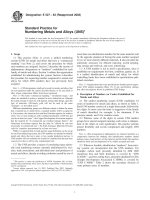
Designation: E1480 − 92 (Reapproved 2013)
An American National Standard
Standard Terminology of
Facility Management (Building-Related)1
This standard is issued under the fixed designation E1480; the number immediately following the designation indicates the year of
original adoption or, in the case of revision, the year of last revision. A number in parentheses indicates the year of last reapproval. A
superscript epsilon (´) indicates an editorial change since the last revision or reapproval.
adjusted serviceability score—see serviceability score.
ambient light—see lighting.
architectural program—see facility program.
area—see space categories.
as-built drawing—see drawing.
assignable area—see space categories.
base building, n(immeuble de base)—a general-purpose office
building intended, but not yet adapted, to suit the operational
requirements of a specific tenant.
1. Scope
1.1 This terminology consists of terms and definitions
pertaining to the description, measurement, prediction,
improvement, and management of buildings and buildingrelated facilities, and, in particular, terms related to the standards generated by ASTM Committee E06 on Performance of
Buildings.
1.2 The purpose of this terminology is to provide meanings
and explanations of technical terms, written for both the
technical expert and the non-expert user.
DISCUSSION—Facility management is concerned primarily with the
use of office buildings as facilities. When other than office buildings are
meant, the term would be modified to, for example, warehouse base
building.
1.3 This terminology is one of a group of special
terminologies, subsidiary to the comprehensive Terminology
E631.
basement—see space categories.
brief (of a facility)—see facility program.
building, n(bâtiment) —a shelter comprising a partially or
totally enclosed space, erected by means of a planned
process of forming and combining materials. Compare
building construction.
E631
1.4 Terms are listed in alphabetical sequence. Compound
terms appear in the natural spoken order. Where definitions
herein are adopted from other sources, they are copied exactly.
The source is identified at the right margin following the
definition and is listed in Section 2. The equivalent term in
French is listed in parentheses after the English term.
building component, n (composant de bâtiment)—a building
element using industrial products that are manufactured as
independent units capable of being joined with other
E631
elements.
2. Referenced Documents
2.1 ASTM Standards:2
E344 Terminology Relating to Thermometry and Hydrometry
E631 Terminology of Building Constructions
E833 Terminology of Building Economics
E1334 Practice for Rating the Serviceability of a Building or
Building-Related Facility (Withdrawn 2013)3
DISCUSSION—Examples include an air handling unit; a cooling tower;
an electrical transformer; a door.
building construction, n (construire de bâtiment)—(1) the act
or process of making or forming a building by assembly or
combining elements, components or systems. (2) the structure or part thereof so formed. Compare building. E631
3. Terminology
building core and service area—see space categories.
building envelope, n (enveloppe d’un immeuble)—perimeter
elements of a building, both above and below ground, that
divide the external from the internal environment.
3.1 Definitions:
active hours—see hours of operation.
DISCUSSION—Commonly included are exterior walls, windows,
doors, roofs, and subfloors.
1
This terminology is under the jurisdiction of ASTM Committee E06 on
Performance of Buildings and is the direct responsibility of Subcommittee E06.25
on Whole Buildings and Facilities.
Current edition approved Jan. 1, 2013. Published January 2013. Originally
approved in 1992. Last previous edition approved in 2004 as E1480 – 92 (2004).
DOI: 10.1520/E1480-92R13.
2
For referenced ASTM standards, visit the ASTM website, www.astm.org, or
contact ASTM Customer Service at For Annual Book of ASTM
Standards volume information, refer to the standard’s Document Summary page on
the ASTM website.
3
The last approved version of this historical standard is referenced on
www.astm.org.
building gross area—see space categories.
building occupant—see occupant.
building performance, n (rendement d’édifice)—the behavior
in service of a construction as a whole, or of the building
E631
components. Compare facility performance.
durability, n(durée) —the capability of a building, assembly,
component, product, or construction to maintain serviceability
Copyright © ASTM International, 100 Barr Harbor Drive, PO Box C700, West Conshohocken, PA 19428-2959. United States
1
E1480 − 92 (2013)
for at least a specified period of time. Compare facility
E631
durability.
evaluate, v(évaluer (installations))—(a facility) to assess the
capability of a facility to perform the function(s) for which
it is designed, used, or required to be used.
serviceability, n(fonctionnalité)—the capability of a
building, assembly, component, product, or construction to
perform the function(s) for which it is designed or used, or
E1334
both. Compare facility serviceability.
DISCUSSION—Facility evaluation includes the assessment of facility
performance in use. Facility evaluation is a general term, which
incorporates a range of methods and levels of precision.
building projection, n (saillie d’un immeuble)—pilaster,
convector, baseboard heating unit, radiator, or other building
element located in the interior of a building wall that
prevents the use of that space for furniture, equipment,
circulation, or other functions.
evaluation—see facility evaluation.
fabric, n(édifice)—of a building, all the elements, components,
parts, and materials of a building, at any scale and of any
E1334
age.
historic fabric, n(édifice historique)—those portions of the
E1334
building fabric that have historic significance.
building service area—preferred term is building core and
service area. See space categories.
facility, n(facilité)—a physical setting used to serve a specific
E1334
purpose.
DISCUSSION—A facility may be within a building, or a whole
building, or a building plus its site and surrounding environment; or it
may be a construction that is not a building. The term encompasses both
the physical object and its use. Compare building.
building space—see space categories.
building subsystem, n (sous-système d’immeuble)—
complete, integrated set of parts that functions as a unit
E631
within the finished building.
facility durability , n—(durée de facilité)— of a facility, the
capability of a facility to maintain serviceability for at least
a specified period of time. Compare durability—of a
E1334
building.
building system, n(système d’immeuble)—collection of
equipment, facilities, and software designated to perform a
E833
specific function.
facility evaluation, n—comparison of the qualitative and
quantitative results of judgments, observations,
measurements, analyses, or other tests against performance
criteria established for a specified purpose, and to a specified
precision and reliability. (see also requirement statement.)
E1334
Compare rating process.
capital cost, n(coût en capital (frais d’immobilisations))—
costs of acquiring, substantially improving, expanding,
changing the functional use of, or replacing, a building or
E833
building system.
cellar—see space categories.
circulation space—see space categories.
classes of buildings, adj (catégories d’immeubles)—buildings
categorized by selected attributes concerning facility serviceability and performance.
facility-in-service, n (installation en service)—facility as completed and operational; for example, an occupied building or
a road in service.
facility operator, n (exploitant d’installations)—organization
or agency having a contract with the owner or investor to
operate a facility.
combination of features, n—see feature—of a facility.
component—see building component.
criterion—see requirement statement.
design program—see facility performance.
drawing, n(dessin)—
record set drawing (as-built drawing), n(dessin de l’ouvrage
fini (dessin d’après exécution))—construction drawing revised
to show changes made during the construction process, usually
based on marked-up prints, drawings, and other data furnished
by the contractor.
DISCUSSION—The facility operator assumes responsibility after
completion of the implementation phase and during and after the
commissioning phase.
facility performance, n (rendement d’installations)—behavior
in service of a facility for a specified use.
DISCUSSION—The scope of this performance is of the facility as a
system, including its subsystems, components, and materials and their
interactions such as acoustical, hydrothermal, air purity, and economic,
and the relative importance of each performance requirement. E631
working drawing, n(dessin d’exécution)—detail drawing,
usually produced by a draftsperson under direction of an
architect, engineer, or other designer showing the form,
quantity, and relationship of construction elements and materials and indicating their location, identification, grades,
E631
dimensions, and connections.
facility program, n (programme d’installations)—
design program,n(programme de conception)—(design
brief) document specifying what facilities will be provided to
the occupants, and confirming to the owner the requirements
for the facility.
functional program, n (programme fonctionnel—document
that specifies functional facility servicability requirements of
occupants and owner.
durability—see building performance.
dwelling, n(logement)—building designed or occupied as the
living quarters for one or more families or households. E631
DISCUSSION—It is normally prepared by the occupants or owner, or
their consultant.
engineering economics, n (économie du génie)—application
of engineering, mathematical, and economic techniques to
the economic evaluation of engineering alternatives. E833
project brief, n(exposé de projet)—document describing the
required facility serviceability in detail sufficient for the
project to proceed.
2
E1480 − 92 (2013)
functional, adj(fonctionnel)—performing or able to perform a
regular function; designed or developed chiefly from the
point of view of use. E1334; Webster’s New Collegiate
Dictionary (1980)
facility project brief (statement of work), n (exposé de projet
d’installations (exposé de travaux))—document describing
services to be provided by the design consultant (architect,
engineer, or interior designer) for a facility, in detail sufficient for the design to proceed.
functionality, adj(fonctionnalité)—being suitable for a particular use or function.
DISCUSSION—Included is general project information specifically
related to the project, such as functional, technical, and design
requirements; time plan; cost plan; and technical design data. E631
functional program—see facility program.
functional requirement, n—see serviceability requirement.
function performance, n—see facility serviceability.
glare—see lighting.
gross floor area—see floor area.
guide for rating, n (guide d’évaluation)—a document which
explains how to rate the serviceability of an existing or
planned facility for a specific purpose. A guide identifies
typical requirements and provides a rating scale for comparison with the relevant combinations of features present in
the facility.
E1334
facility servicability, n (fonctionnalité d’installations)—
capability of a facility to perform the function(s) for which
E631
it is designed, used, or required to be used.
facility serviceability profile, n(profil de fonctionnalité
d’installations)—graphic display, usually as a bar chart, of
the set of rating scores for aspects of the serviceability of a
facility.
DISCUSSION—Used to summarize the functional capability of a
facility for selected aspects of serviceability.
facility use, n(utilisation d’installations)—functions and activities that take place in a facility.
E631
historic fabric—see fabric.
hours of operation, n (heures d’exploitation)—
active hours, n(heures d’activité)—times when a facility is
normally fully occupied and operational.
feasibility study, n (étude de faisabilité)—study of a planned
scheme or development, the practicality of its achievement,
and its projected financial outcome.
feature, n(élément caractéristique)—of a facility, a building
element, building component, building subsystem, unit of
furnishing or equipment, or aspects of design, arrangement,
form of color, which helps or hinders the satisfaction of a
E1334
requirement for serviceability.
silent hours, n(heures d’inactivité)—period when a facility is
essentially unoccupied and only security and building operations staff are present.
transitional hours, n (heures de transition)—times in the
morning after the first workers normally arrive, until a facility
is fully operational, and in the evening from the end of normal
work until the occupants have left.
DISCUSSION—A feature may be a physical feature or design feature, or
both. It may only have effect on meeting a requirement when some
other feature is also present; for example, a wall with a specified sound
transmission coefficient may only have effect on meeting a requirement
when sound above a specified level is produced in an adjacent space.
house, n(maison)—building intended in its entirety as a
E631
dwelling.
combination of features, n(éléments caractéristiques
combiné)—of a facility, features which, when present together
in a facility, affect satisfying a requirement for serviceability.
E1334
importance factor, n (coefficient d’importance)—of a facility
requirement, a numerical indication of the relative importance of a requirement for serviceability, expressed on a
scale of 0 to 9, with 0 being not related, 1 being relevant but
least important, and 9 being most important.
fit-up, n(aménagement)—alterations and improvements to the
base building and to the building systems including
demolition, where required, to prepare the accommodation
for occupancy.
DISCUSSION—The scale of 0 to 9 has been selected for rating relative
importance of requirements and for rating each combination of features. This does not imply that a scale of 0 to 9 should necessarily be
used for purposes other than preparing a rating of serviceability of
facilities. For example, this would not necessarily apply to questionnaires used in general survey research about the built environment.
floor, n(plancher)—(in a building) supporting structure (generally horizontal) and constituting the bottom level of each
E631
story.
floor area, n(superficie de plancher)—
gross floor area(superficie brute de plancher)—entire area
within the inside perimeter of the exterior walls.
lease (bail)—contract between the owner of real property
(lessor) and another party (lessee) for the possession and use
of the property for a specified term in return for rent or other
income.
DISCUSSION—Only courts and shafts not under the roof are excluded.
E631
net floor area(superficie nette de plancher)—that part of the
gross floor area located within occupiable space.
E631
lighting (éclairage)—
ambient light(lumière ambiante)—surrounding light, such as
that reaching an object in a room from all light sources in the
room.
function, n(fonction)—the action for which a person or thing
is specially fitted or used or for which a thing exists. E1334;
Webster’s New Collegiate Dictionary (1980)
glare(éblouissement)—effect of brightness or brightness differences within the visual field sufficiently high to cause
annoyance, discomfort, or loss of visual performance.
DISCUSSION—Accessory areas and thicknesses of walls are excluded.
3
E1480 − 92 (2013)
indicate a specific level of serviceability on a scale from the
lowest to the highest level likely to be encountered.
task lighting(éclairage (de travail) localisé)—localized lighting system consisting of a functional arrangement of luminaires to accommodate the specific visual task or work area
needs.
rating score (résultat d’évaluation)—result (expressed as a
number) of finding the combination of features described in
a specified rating scale (for one aspect of serviceability) that
matches most closely the attributes present in a facility.
maintainability (entretenabilité)—capability of a system or
facility to be maintained to a specified level of reliability, at
a specified measure of cost or economy.
record set drawing—see drawing.
regulation, n(règlement)—rule prescribing a set of conditions
and requirements that have been made mandatory for those
under its control, by an executive (administrative) authority.
E631
net assignable area—see space categories.
net floor area—see floor area.
net programmable area—see space categories.
occupancy, n(occupation)—discouraged term, to be used only
in connection with building codes, where the term refers to
the number of occupants in a space, or other specific
classification of use.
reliability, n(fiabilité)—the probability of performing without
failure a specified function under normal conditions for a
E344
specified period of time.
occupancy instrument (OI) (accord d’occupation (AO))—
agreement between a prospective or current occupant and the
manager or owner of a facility concerning occupancy in that
facility.
requirement statement (enoncé de boisons)—for a facility,
the serviceability requirements for a facility, together with
applicable performance criteria, performance test methods,
and optional explanatory comments.
criterion, n(critéré)—an established precedent, rule,
measure, norm, or code upon which a decision may be based.
E631
performance criterion, n(critére de rendement)—a quantitative statement of the level of performance needed to satisfy a
E1334
serviceability requirement.
occupant (occupant)—(1) Department, agency, corporation, or
other organization, or a part thereof, that is or will be
occupying space in a particular facility. (2) Individual or
family living in a housing dwelling.
building occupant(occupant d’un immeuble)—one who has
certain rights to, possession of, or control over the premises
occupied, such as tenant or owner.
DISCUSSION—This may be expressed as a threshold value, a range, or
a point value.
overall serviceability score—see serviceability score.
performance—see building performance. (see also facility
performance)
performance criterion, of a facility—see requirement statement.
performance test method of a facility—see requirement statement.
physical protection (protection physique)—barriers that will
delay or deter someone attempting unauthorized physical
access to assets at a specific location.
performance test method, n (méthode d’essai de
rendement)—a method of determining whether the performance of a facility is in accordance with a specified perforE1334
mance criterion.
serviceability requirement, n(besoin de fontionalité)—for a
facility, a qualitative statement of the serviceability required
E1334
from a facility.
DISCUSSION—Examples include: smoke control for life safety; removal of heat from computer equipment; relocation of workplaces in
rapidly changing organizations; resistance to insect damage; maintenance of the temperature within a specified range at a specified
location; acoustical, visual, thermal, and air quality performance.
DISCUSSION—(1) These barriers may be physical, such as walls or
locked doors, possibly monitored by technical systems; or they may be
provided by persons with specific responsibility for physical security,
such as guards or authorized personnel of the organizational unit
working at the location, or both. (2) Physical protection is an aspect of
physical security.
score, n—see serviceability score.
secondary circulation area—see space categories.
serviceability, n—see facility serviceability. (see also building performance.)
serviceability requirement—see requirement statement.
serviceability requirements profile (SRP) (profit de besoins
génériques de fonctionnalite (PBGF))—listing of the levels
of serviceability (capability to perform, including quality)
required in a facility.
portfolio (portefeuille)—group of securities, buildings, or
other properties held by an individual or institutional investor.
primary circulation area—see space categories.
project (projet)—resources and activities used to achieve a
specific set of objectives within a specified time schedule.
shop drawing—see drawing.
silent hours—see hours of operation.
space categories, n (catégories de locaux) (see also floor
area)—
assignable area, n (zone assignable)—floor areas of a
facility assigned to or available for assignment to occupant
groups of functions, including interior walls, building columns,
and building projections, and excluding circulation.
project brief—see facility program.
rating process, n(processus d’évaluation)—the process of
determining the serviceability of a facility for a specified
E1334
purpose.
rating scale (échelle d’évaluation)—(for an aspect of facility
serviceability) set of descriptions of combinations of
features, in which each combination has been selected to
4
E1480 − 92 (2013)
cellar(cave)—space wholly or partly below average grade
having more than one half of its clear height (measured from
floor level to ceiling level) below average grade.
E631
DISCUSSION—Assignable area includes the area of all enclosed rooms,
open work areas, and other support spaces. It does not include the areas
of circulation or exterior walls. Assignable area can be measured for
buildings, floors, departmental areas, individual rooms, or work areas.
Assignable area is measured to the center of all interior walls and to the
inside finished surface of the outer building walls. In open plan
workspace, it is measured to the center of furniture panels. If assignable
area has been measured to exclude the areas of columns, interior walls,
or building projections, note the exception to the practice with an
appropriate qualifying phrase as follows: (1) assignable area without
columns, (2) assignable area without building projections, or (3)
assignable area without columns or building projections.
circulation space—see primary circulation; secondary
circulation.
primary circulation area (aire de circulation principale)—
portion of a building that is a public corridor, lobby, or atrium;
or is required for access by all occupants on a floor to stairs,
elevators, toilet rooms, or building entrances.
secondary circulation area (aire de circulation secondaire)—
portion of a building required for access to some subdivision
of space, whether bounded by walls or not, that does not serve
all occupants on a floor, and that is not defined as primary
circulation area.
basement(sous-sol)—space partly below average grade having less than one half of its clear height (measured from floor
level to ceiling level) below average grade.
E631
building core and service area, n(noyau d’un immeuble et
aire de service)—floor area of a facility necessary for the
general operation of a building that is not available for general
occupancy, including: primary circulation areas, mechanical,
electrical, telephone, and custodial rooms serving individual
floors; toilet rooms, building lobbies and atria, stairways,
elevators, vertical shafts and chases, loading docks; and also
central, mechanical, electrical, telephone, and custodial spaces
and penthouses, but excluding interstitial area.
support space(locaux de soutien)—(in offıces) part of usable
area not assigned or dedicated to a specific task or function.
Support space includes meeting rooms, waiting areas, storage,
lounges, operational equipment (for example, computer
rooms), copy areas, libraries, and similar areas.
usable area, n(superficie utilisable)—floor area of a facility
assigned to, or available for assignment to, occupant groups or
functions, including interior walls, building columns and
projections, and secondary circulation.
DISCUSSION—Building core and service area is measured to the center
of all interior walls except in the following cases: where a stair,
elevator, vertical shaft or chase adjoins a mechanical room, electrical
room, custodial room, toilet room, building lobby, or primary circulation; the area of the wall should be included in the area of the stair,
elevator, vertical shaft, or chase. Where a building core or service area
space adjoins a space designated as usable area, the area of the wall
should be included in the building core or service area space. An
alternative method of classifying building core and service areas may
be used, which is not compatible with ANSI Z65.1: measure to the
center of interior walls for all spaces. The use of this alternative method
should be noted when reporting area measurements. Toilet rooms that
are accessible to all of the occupants on a floor of a building or that
serve the general public should be classified as building core and
service areas. A toilet room that is accessible only from a private office,
or that is not available to all occupants on a floor, would be classified
as a private toilet room and included in usable area for the tenant or
occupant that it serves.
DISCUSSION—Usable area includes the areas of all enclosed rooms,
open work areas, support areas, secondary circulation, and interior
walls, columns, and building projections in those spaces. Usable area
does not include building core and service areas or exterior wall area.
Usable area can be determined for buildings, floors, and departmental
areas. Usable area for a floor is measured to the inside finished surfaces
of the outer building walls. From this is deducted the area for the
building core and service area for that floor, and the area of enclosed
shafts. When determining the usable area of the portion of a floor
occupied by a department or leasehold, measure to the center of walls
dividing departments or leaseholds.
workplace(poste de travail)—part of a usable area, intended
for an individual or group to work in.
DISCUSSION—A workplace is identified by having been assigned to, or
intended for, an individual or a group or team. It may be an enclosed
office; a part of an open plan office; or a combination of enclosed and
open plan spaces.
building gross area, n (superficie brute d’un immeuble)—
sum of the floor areas of a building included within the outside
face of outer building walls for all stories.
workspace(aire de travail)—part of usable area, intended for
a specific function or type of work.
DISCUSSION—A workspace is identified by the function or type of
work for which it is intended. It may include workplaces, and it may
include some area that is not intended for individuals or groups and
therefore is not a workplace.
DISCUSSION—Building gross area includes basements, enclosed
porches, penthouses, mechanical equipment, floors, lobbies,
mezzanines, and corridors, provided they are within the outside face of
the building. The areas of stairways, elevator shafts, mechanical service
shafts, and ducts are to be included in building gross area for each floor
through which they pass. Building gross area is measured from the
outside face of exterior walls on each floor, disregarding comices,
pilasters, buttresses, etc., that extend beyond the wall face. The building
gross area of basement space includes the area measured to the outside
face of basement or foundation walls. For enclosed open courts,
enclosed light wells, enclosed atria, or other interior spaces more than
one story in height, only the area on the lowest floor is included, not the
void above on upper levels. Interstitial areas and unfinished attics are
excluded.
workstation(poste de travail) (aménagement ouvert)—all or
part of a workplace, suitable for carrying out one function or
type of work.
DISCUSSION—Workstation(s) may be included in a workplace and in
a workspace. The boundaries of workstations may overlap, or there
may be gaps between workstations. For example, a workplace for an
individual might include: (1) a workstation for computer work,
equipped with personal computer, visual display unit, keyboard, and
reference material; (2) a workstation for desk-work and reference to
documents; and (3) a workstation for telephoning (the latter two
workstations would likely overlap).
building service area (aire de service d’un immeuble)—use
preferred term building core and service area.
silent hours—see hours of operation.
5
E1480 − 92 (2013)
transitional hours—see hours of operation.
typical serviceability score—see serviceability score.
usable area—see space categories.
use— of a facility—see facility use.
specification, n(caractérisation (caractérisation technique))—
precise statement of a set of requirements to be satisfied by
a material, product, system, or service.
DISCUSSION—It is desirable that the requirements, together with their
limits, should be expressed numerically in appropriate units. E631
visitor (visitor)—(in a facility) person present who is not an
occupant of that facility.
support space—see space categories.
system— of a building—see building system.
DISCUSSION—(1) This includes: personnel of other organizational
units who visit; contractor personnel; cleaning and maintenance staff;
and other persons who are authorized to visit the facility, such as
members of the public who are authorized in the reception and public
zones. (2) This also includes persons who are authorized only in special
circumstances, such as those permitted to pass through during an
emergency. (3) Persons who are present without authorization are
intruders.
task lighting—see lighting.
technical
performance—discouraged
term
for
performance—of a building or performance—of a facility.
E1334
tenant (locataire)—organization that has rights and obligations
of occupancy in a facility, as specified in a lease or
occupancy agreement.
working drawing—see drawing.
workplace—see space categories.
workspace—see space categories.
workstation—see space categories.
DISCUSSION—An occupant organization may also be a tenant; or, it
may be a unit that is part of a larger tenant organization. Typically, the
official who commits the tenant to the terms of a lease or occupancy
agreement is either an occupant or a member of a larger organization of
which the occupant organization is also a part.
4. Keywords
4.1 building; building performance; definitions; facility;
facility management; terminology
test (performance test of a facility)—see requirement statement.
This standard is subject to revision at any time by the responsible technical committee and must be reviewed every five years and
if not revised, either reapproved or withdrawn. Your comments are invited either for revision of this standard or for additional standards
and should be addressed to ASTM International Headquarters. Your comments will receive careful consideration at a meeting of the
responsible technical committee, which you may attend. If you feel that your comments have not received a fair hearing you should
make your views known to the ASTM Committee on Standards, at the address shown below.
This standard is copyrighted by ASTM International, 100 Barr Harbor Drive, PO Box C700, West Conshohocken, PA 19428-2959,
United States. Individual reprints (single or multiple copies) of this standard may be obtained by contacting ASTM at the above
address or at 610-832-9585 (phone), 610-832-9555 (fax), or (e-mail); or through the ASTM website
(www.astm.org). Permission rights to photocopy the standard may also be secured from the Copyright Clearance Center, 222
Rosewood Drive, Danvers, MA 01923, Tel: (978) 646-2600; />
6