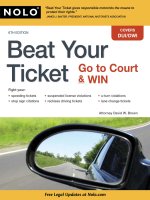
beat your ticket, go to court and win 6th (2010)
Bạn đang xem bản rút gọn của tài liệu. Xem và tải ngay bản đầy đủ của tài liệu tại đây (3.71 MB, 256 trang )
COVERS
DUI/DWI
“Beat Your Ticket gives responsible motorists the means to
protect their rights.”
JAMES J. BAXTER, PRESIDENT, NATIONAL MOTORISTS ASSOCIATION
Beat Your
Ticket
Attorney David W. Brown
• speeding tickets
• stop sign citations
6TH EDITION
Go to Court
&
WIN
Free Legal Updates at Nolo.com
N O L O
®
Fight your:
• u-turn violations
• lane change tickets
• suspended license violations
• reckless driving tickets
e Story
Dear friends,
Founded in 1971, and based in an old clock factory in
Berkeley, California, Nolo has always strived to off er clear
legal information and solutions. Today we are proud to
off er a full range of plain-English law books, legal forms,
software and an award-winning website.
Everything we publish is relentlessly researched and
tested by a dedicated group of in-house legal editors,
who together have more than 150 years’ experience. And
when legal changes occur after publication, we promptly
post free updates at Nolo.com.
Tens of millions of Americans have looked to Nolo to
help solve their legal and business problems. We work
every day to be worthy of this trust.
Ralph Warner
Nolo co-founder
Emma Cofod
Books & Software
Get in-depth information. Nolo publishes hundreds of great books
and software programs for consumers and business owners. ey’re all
available in print or as downloads at Nolo.com.
Legal Encyclopedia
Free at Nolo.com. Here are more than 1,400 free articles and answers to
common questions about everyday legal issues including wills, bankruptcy,
small business formation, divorce, patents, employment and much more.
Plain-English Legal Dictionary
Free at Nolo.com. Stumped by jargon? Look it up in America’s most
up-to-date source for defi nitions of legal terms.
Online Legal Documents
Create documents at your computer. Go online to make a will or living
trust, form an LLC or corporation or obtain a trademark or provisional
patent at Nolo.com. For simpler matters, download one of our hundreds
of high-quality legal forms, including bills of sale, promissory notes,
nondisclosure agreements and many more.
Lawyer Directory
Find an attorney at Nolo.com. Nolo’s unique lawyer directory provides
in-depth profi les of lawyers all over America. From fees and experience
to legal philosophy, education and special expertise, you’ll fi nd all the
information you need to pick a lawyer who’s a good fi t.
Free Legal Updates
Keep up to date. Check for free updates at Nolo.com. Under “Products,”
fi nd this book and click “Legal Updates.” You can also sign up for our free
e-newsletters at Nolo.com/newsletters/index.html.
Products
&
Services
“ In Nolo you can trust.”
THE NEW YORK TIMES
“ Nolo is always there in a jam as the nation’s premier publisher
of do-it-yourself legal books.”
NEWSWEEK
“ Nolo publications…guide people simply through the how,
when, where and why of the law.”
THE WASHINGTON POST
“ [Nolo’s]…material is developed by experienced attorneys who
have a knack for making complicated material accessible.”
LIBRARY JOURNAL
“ When it comes to self-help legal stuff , nobody does a better job
than Nolo…”
USA TODAY
“ e most prominent U.S. publisher of self-help legal aids.”
TIME MAGAZINE
“ Nolo is a pioneer in both consumer and business self-help
books and software.”
LOS ANGELES TIMES
e Trusted Name
(but don’t take our word for it)
6th edition
Beat Your
Ticket
Go to Court & Win
Attorney David Brown
SIXTH EDITION AUGUST 2010
Editor BETSY SIMMONS HANNIBAL
Cover Design SUSAN PUTNEY
Production MARGARET LIVINGSTON
Proofreading ELAINE MERRILL
Index SONGBIRD INDEXING
Printing DELTA PRINTING SOLUTIONS, INC.
Brown, David Wayne, 1949-
Beat your ticket : go to court & win / by David Brown. 6th ed.
p. cm.
Includes index.
Summary: "A complete how-to manual on fi ghting your ticket, with specifi c and detailed chapters
on how to research legal issues, develop defenses, conduct jury voir dire, cross-examine witnesses,
and make opening and closing statements. All rules, statistics, and traffi c laws have been
updated" Provided by publisher.
ISBN-13: 978-1-4133-1251-5 (pbk.)
ISBN-10: 1-4133-1251-9 (pbk.)
1. Traffi c violations United States Popular works. 2. Traffi c courts United States Popular
works. 3. Pro se representation United States Popular works. I. Title.
KF2231.B76 2010
345.73'0247 dc22
2010008695
Copyright © 1999, 2002, 2003, 2005, 2007 by David Brown. Copyright © 2010 by Nolo.
All rights reserved. The NOLO trademark is registered in the U.S. Patent and Trademark Offi ce.
Printed in the U.S.A.
No part of this publication may be reproduced, stored in a retrieval system, or transmitted in any
form or by any means, electronic, mechanical, photocopying, recording, or otherwise without prior
written permission. Reproduction prohibitions do not apply to the forms contained in this product
when reproduced for personal use. For information on bulk purchases or corporate premium sales,
please contact the Special Sales Department. Call 800-955-4775 or write to Nolo, 950 Parker Street,
Berkeley, California 94710.
Please note
We believe accurate, plain-English legal information should help you solve many of your own
legal problems. But this text is not a substitute for personalized advice from a knowledgeable
lawyer. If you want the help of a trained professional—and we’ll always point out situations in
which we think that’s a good idea—consult an attorney licensed to practice in your state.
Acknowledgments
For their substantial contributions to the sixth edition of this book, sincere
thanks to:
• StephenR.Elias,Noloauthor,originaleditorofNolo’sCriminal Law Handbook,
and part-time criminal defense attorney
• J.DavidMarkham,CertiedCriminalLawSpecialist,certiedbytheStateBarof
California Board of Legal Specialization
Thanks also to the many cherished Noloids who contributed to the publication
of previous editions.
Your Legal Companion for Beating Your Ticket
1
First ings
A Tale of a Ticket 4
Are Tickets Impossible to Beat? 5
How is Book Is Organized 6
2
What Are You Charged With?
What Does the Law Say? 8
Finding Support Using Legal Research 10
3
Should You Fight Your Ticket
Understanding Traffic Offenses 16
Negative Consequences of Getting a Ticket 18
e Traffic School Option 20
Deciding Whether to Fight Your Ticket 21
Putting It All Together—How to Decide Whether to Fight or Fold 24
Defenses at Rarely Work 25
4
Lawyers and What ey Can Do for You
What Lawyers Can Do 28
Types of Lawyers 29
Getting the Most Out of Your Lawyer 32
Firing Your Lawyer 32
5
Speed Violations: Understanding the Laws of Your State
ree Types of Speed Limits 34
“Absolute” Speed Limits 35
“Presumed” Speed Limits 35
e “Basic” Speed Law 39
Table of Contents
6
Speed Detection: Pacing, Aircraft, VASCAR, Radar, and Laser—
How ey Work, How to Fight em
Getting Caught 42
How Was Your Speed Measured? 43
7
Other Moving Violations
Not Stopping at Stop Signs 69
Not Stopping at a Stoplight 71
Automated Enforcement Devices (“Red Light Cameras”) 73
Improper Turning 75
Right-of-Way Violations 81
Driving Too Slowly 86
Tailgating 88
Unsafe Lane Changes 90
Improper Passing 91
Non-DUI/DWI Alcohol-Related Offenses 92
8
Driving Under the Influence
e Standard Charges 102
e Arrest 105
e Arraignment 112
Interpreting the Police Report 114
Do You Need a Lawyer? 118
After the Arraignment 122
Pleading Guilty 123
Going to Trial 124
All About Alcohol 127
Additional Resources 130
9
First Steps to Fight Your Ticket
So You’ve Decided to Fight 132
Taking the First Steps 132
Using “Discovery” to Build Your Case 142
10
Preparing for Trial—Your Case
Asking for a “Continuance” (Postponement) 148
Gathering Your Notes and Research 150
Diagrams, Maps, and Pictures 150
Preparing Your Testimony 154
Preparing Your Witnesses 158
Preparing for the Prosecution’s Cross-Examination 159
11
Preparaing for Trial—e Officer’s Testimony and Cross-Examination
When and How to Object to Testimony 162
How to Cross-Examine the Officer 165
12
Trial Before a Judge (No Jury)
Introduction 192
Trial Procedure 196
Appealing for a New Trial 210
13
Jury Trials
Introduction 214
Try to Settle Your Case 214
Selecting the Jury 216
Trial Procedure 221
Preparing Jury Instructions 226
e Judge Instructs the Jury 227
Appeals From a Jury Verdict 227
Index
Your Legal Companion for
Beating Your Ticket
S
peeding, running stop signs, and
making illegal U-turns can jeopardize
the safety of everyone on the road—
you, your passengers, other drivers, and
pedestrians. Ticketing unsafe drivers is
one means of deterring these dangerous
activities.Butasyou’reprobablyaware,the
process of citing traffic violators is not fool-
proof, and tickets are sometimes issued for
the wrong reasons. A police officer may make
a mistake, a camera may malfunction, or a
local government—in its zeal to generate
revenue—may encourage overticketing.
You’reprobablyreadingthisbook
because you received a traffic ticket. Should
you just go ahead and pay the ticket—and/
or go to traffic school—and move on? If
you are without-a-doubt guilty or consider
the hassle factor too high, paying the ticket
is probably the best course of action. For
example, if you just got your first ticket in
ten years and are determined that it will be
tenmoreyearsbeforeyougetanother,it’s
probably best to cough up the money and
forget it.
On the other hand, if, through bad luck
or indiscretion, you are facing your second
ticket in three to five years, you may
decide to fight it to avoid higher insurance
premiums or other problems described
inside. No one can guarantee your success
fighting a ticket. But this book can offer
some useful information that will help you
assess your odds of success and make your
task—should you choose to challenge your
ticket—far easier. With a little research and
preparation, there is a chance that a ticket
you consider “unbeatable” can be beaten.
Nomatterwhetheryou’vereceivedyourrst
or 22nd ticket, it is always worth carefully
checking out the motor vehicle law and
your potential defenses before writing out a
check.
Consider these facts:
•Inasmallminorityofcases,thepolice
officer fails to show up in court. If so,
you usually win.
•Inmanystates,speedlimitsarenot
“absolute.” If you show the judge
it was reasonable to drive over the
posted limit, you win.
•Ifyougobacktothesceneofthe
violation, you may find that it was
not possible to see what the officer
claimed to see from where he or she
claimed to have seen it.
•Manytrafclawshave“wiggleroom,”
and the officer issuing the ticket is
oftenmakingajudgmentcall.Aswe’ll
explain, these types of tickets can
sometimes be beaten.
2
|
BEAT YOUR TICKET
If you received an unjust ticket, or if
youjustcan’taffordanotherticketonyour
record, it may be worth trying to get out
of it—and this book can be your guide. It
explains how to research and understand
the motor vehicle law of your state and how
to assess the odds of beating your ticket.
It also explains also how to challenge the
ticket—from pleading not guilty to cross-
examining the officer in court. It discusses
when a lawyer might be useful and how
togetthemostoutofalawyer’sservices,
without paying a fortune. If you received a
ticket for driving under the influence (DUI),
this book will help you understand the
chargesagainstyou,howstrongthestate’s
case is, and why it may make sense to hire
a lawyer if you decide to challenge the
ticket in court.
Fighting a traffic ticket is not for the faint
of heart. It requires legwork, diligence, and
grace under fire when dealing with the
court system. But the reward of having the
charges dropped can be well worth your
effort. Good luck!
●
First ings
1
C H A P T E R
A Tale of a Ticket 4
Are Tickets Impossible to Beat? 5
How is Book Is Organized 6
4 | BEAT YOUR TICKET
A Tale of a Ticket
It’slate.You’redrivinghomefromaparty.
You’rethinkingaboutwhatagoodtimeyou
had.Thenyourealizeyou’vemissedaturn.
You’reinthemiddleofaquietresidential
district with no other cars moving in either
direction. All you see is a car parked a few
blocks away with its lights on. You make a
U-turn.
Suddenly, in your rearview mirror, you
see flashing lights racing toward you. You
pull over to let the police car pass. Instead,
itfollowsyoutothecurb.Yourealizeyou’ve
just been pulled over. Even before your car
is fully stopped, the officer has a spotlight
pointed at you. Then you hear a door
slamming, the sound of pavement under
boots.
Beforeyougetachancetoask,“What’s
the problem?” the officer says, “May I see
yourdriver’slicense,please?”Youfumble
through your wallet and you hand over your
license.
The officer returns to the patrol car.
The police radio crackles in the night. A
few minutes later the officer comes back,
returns your license on a clipboard that also
holds a traffic ticket, and says, “You made
an unlawful U-turn in a residential district;
please sign on the dotted line.” When
the officer goes on to explain that your
signature is not an admission of guilt but
merely a promise to appear in court, you
meekly do as the officer asks. A moment
later, as the officer pulls away, you eye your
ticket,stunnedathowquicklyyou’vebeen
ensnared in the justice system.
Chances are, as you drive the rest of the
wayhome,you’llrepeatedlywonder,“Why
is it illegal to make a perfectly safe turn on
an empty road?” Which will lead you to
consider the following:
•ShouldIjustpaytheticketandforgetit?
•Isthereawaytowipethisticketoff
my record?
•IfIpaytheticket,willmyinsurance
rates go up?
•DoIhavelegalgroundstoghtthe
ticket?
•CanIlosemylicense?
If you decide to fight the ticket, several
things will happen:
•Youwillspendatleastseveralhours
and probably many more preparing to
fight the ticket.
•You’llworryaboutmakingagood
court presentation.
•You’llspendhalfadayormoregoing
back and forth to court and arguing
your case.
Ifyoudon’tghttheticket,youcould
end up doing some or all of the following:
•spendingmoneyandmanyhoursin
traffic school to clear your record
•payingaheftyneandhavingthe
ticket appear on your driving record
•Ifyouhavehadanotherrecentticket,
paying higher insurance premiums for
the next three to five years, or
•ifyouhavehadseveralrecenttickets,
losing your driving privileges.
CHAPTER 1 | FIRST THINGS | 5
Are Tickets Impossible to Beat?
The answer is: absolutely not. Many tickets
are given in situations where even the
officer knows that a motorist who puts up a
spiriteddefensemightwin.Butthisdoesn’t
necessarily mean the officer will cut back in
handingoutmarginaltickets.That’sbecause
the officer also knows that only about 3% of
ticketed drivers contest their citations. And
furthermore, many of those who do fight
are so unprepared and nervous that they
beat themselves, not their citation.
Getting a Ticket Doesn’t Equal Guilt
Here is an example of why you shouldn’t
just assume you are guilty because you
are ticketed. In San Francisco, police
use automatic cameras at some busy
intersections to catch red-light runners.
About 30% of all those pictures used to be
thrown out by the police because the picture
was fuzzy, blurred, or otherwise deemed
to be unusable. But in 1998 the police chief
decided that everyone photographed would
get a ticket—no ifs, ands, or buts. at means
that 30% of these tickets are so marginal they
used to be thrown away because the police
themselves believed the evidence was not
strong enough for a conviction.
Does it make sense for you to fight a
parti cular ticket? Common sense would say
“no” if there is a small chance of winning
and “yes” if the officer clearly screwed up.
Still, for most tickets, guilt or innocence is
notsoclearcut,meaningthatyou’llnormally
want to consider a number of factors,
including the consequences of paying your
fine—which is the same thing as pleading
guilty.
Beforeassumingtheticketcan’tbe
beaten and resigning yourself to writing
out that check, we encourage you to take
a hard look at the facts to see if you have
a reasonable chance of success. You may
be surprised at the variety of legal grounds
available for defeating your ticket. For
example, in about one-third of the states—
including California, Colorado, Texas, and
Massachusetts—many posted speed limits
are not “absolute.” This means if you were
driving slightly above the posted speed limit
but can convince a judge you were driving
safely, you may be found not guilty. And
to take another common example, where a
ticket is given for an “unsafe lane change” it
may be possible to show that you changed
laneswithreasonablesafety.That’sbecause
it involves a quick judgment call on the part
of the cop to cite you—a decision you may
be able to successfully challenge if the lane
change did not result in an accident.
To test the legality of the ticket you
received, you must learn how to research
the law and court procedure. Because of the
Internet, researching the law is fairly easy.
Once you locate the law you are accused
of violating, you should closely examine its
words and phrases because sometimes, the
officer did not fully understand all of the
technical aspects of the law, or worse, the
officer has taken inappropriate liberties in
interpreting the law.
6 | BEAT YOUR TICKET
If you are uneasy searching for legal
technicalities to keep your record clear, then
follow your conscience, pay your ticket,
and accept the consequences. But keep in
mind that exploiting legal technicalities is a
common, legitimate practice for avoiding the
consequences of a traffic ticket.
Ticketed in California?
If you were ticketed in California, you’ll find
detailed, state-specific information about
fighting your ticket in Fight Your Ticket & Win
in California, by David W. Brown (Nolo).
How is Book Is Organized
Chapters 2 and 3 provide the information
you need to sensibly decide whether to
fight your ticket, attend traffic school, or
simply pay your fine. To help you make
these decisions, Chapter 2 will also explain
howtolocatethelawyou’rechargedwith
violating, so you can analyze it and decide
for yourself whether you committed the
offense.
In Chapter 4 we discuss when you should
hire a lawyer to represent you, particularly
in serious cases like reckless driving and
driving under the influence of alcohol or
drugs. We also discuss how to evaluate
lawyers and get help from an expert at an
affordable price.
Chapters 5, 6, and 7 summarize what
lawyers call the “substantive law” on most
common types of traffic violations, and these
chapters provide tips on how to challenge
your ticket. Because speeding tickets are by
far the most common, Chapter 6 focuses on
how to defend yourself when your ticket
is based upon various methods used by
police to monitor speed, including pacing,
VASCAR, radar, and laser devices.
Chapter 8 gives a few basics on the
law of drunk driving, which we prefer to
call Driving Under the Influence (DUI) or
Driving While Intoxicated (DWI). It is not
intended, however, as a complete guide to
the subject of defending your own DUI or
DWI case—something that would take a
whole book in its own right.
Chapter 9 is devoted to initial court
procedures required when preparing your
case—forexample,obtainingtheofcer’s
notes to build your defense.
Chapter 10 helps you prepare for your
day in court, including preparing your
testimony and the testimony of your
witnesses.
Chapter 11 helps you prepare to cross-
examine the police officer.
Chapters 12 and 13 prepare you for jury
and nonjury trials.
Because we want to keep this book brief,
we do not cover:
•themostseriousoffenses,likehit-and-
run; most people should not represent
themselves against these and other
charges that could land them in jail
•contestingthelossorsuspensionof
yourdriver’slicensesbythestate
department of motor vehicles, or
•thedetailsofappealingtohigher
courts after a guilty verdict.
●
What Are You Charged With?
2
C H A P T E R
What Does the Law Say? 8
Use the Internet 8
Use Public and Law Libraries 9
Read the Law Carefully 9
Finding Support Using Legal Research 10
Finding Case Decisions 10
Analyzing Court Decisions 11
Can Other Laws Help Your Case? 12
8 | BEAT YOUR TICKET
What Does the Law Say?
The first thing you need to do is find out
what you are charged with—not just what
your ticket says, but the exact words of the
law you are charged with breaking. In some
states, traffic laws are set out in a “Vehicle
Code,” while in others they are gathered
as part of a “Transportation Code,” “Motor
Vehicle Laws,” or under some similar name.
No two states have exactly the same traffic
laws, but most are very similar.
Look for a number on your ticket that
corresponds to the law (often called a
“statute” or “vehicle code section”) you are
charged with violating. Sometimes it will
be hand printed by the officer in a box or
blank;othertimesit’spreprintedonthe
ticket, with the officer simply checking the
appropriate box. In either case, near the
statute number you will often find a very
short description of the law (for example,
“VC [Vehicle Code Section] 22350—
exceeding posted speed”). For speeding
violations,inmoststatesyou’llalsondthe
speed the officer claims you were going, as
well as the posted speed limit on the road
where you were stopped.
Now you must look up and read the law
the officer claims you violated.
Use the Internet
Thefastestwaytondyourstate’strafc
lawsistosearchonline.Onyourstate’s
website, you can either do a search for
the code number of the law or you can
scroll through the index of laws usually
highlightedonthestate’shomepage.
Useful Internet Resources
Here is a list of some websites you can use to
help you research your case:
• eLegalInformationInstitute
website at Cornell Law School has
links to many states’ motor vehicle
(traffic) codes, at
.cornell.edu/wex/table_motor_
vehicles.
• eLegalResearchCenteronNolo’s
website has information about
conducting legal research and links to
other online legal research resources,
at />research/.
• FindLaw’sTracTicketCenter
provides links to state motor vehicle
laws and more information about
fighting traffic tickets. Go to http://
public.findlaw.com/traffic-ticket-
violation-law.
ere are several other websites where
groups and individuals provide traffic-ticket
fighting strategies and information. e ones
we like best are:
• www.motorists.org
• www.speedtrap.org,and
• www.radartest.com
Another option is to google the name of
your state and the name of the code or
the title of the law. For example, googling
“Vermont excessive speed” results in several
entries for Vermont Code § 1097, which sets
out the law regarding excessive speed.
CHAPTER 2 | WHAT ARE YOU CHARGED WITH? | 9
CAUTION
Be sure you are reading current law.
Once you’ve found your state’s motor vehicle
laws, make sure you have your hands on the latest
version. is is particularly important if you use
books, as described, below. Republished fairly
infrequently, these law books are updated with
paperback supplements inside the front or back
cover.
Use Public and Law Libraries
Mostlibrarieshavecopiesoftheirstate’s
vehicle laws. This could range anywhere
from a single dog-eared volume containing
just the fine-print text of traffic laws to a
completemultivolumesetofallthestate’s
laws. The bigger the library, the more
likely it is to have a more comprehensive
collection.It’sagoodideatocallthe
referencelibrariantoseewhat’savailable
before making a trip. In most states you
can usually use a courthouse or public law
school law library, which will almost surely
have a complete set of laws. Often the
easiest way to find the text of the law you
are charged with is to show your ticket to
the research librarian and ask for directions
to the proper book.
Read the Law Carefully
Once you find the law you are charged
with, study it carefully to determine which
facts the prosecution will have to prove
to convict you. Many laws are complex.
In fact, they are often so convoluted that
it’snotuncommontond,uponcareful
reading, that what you did was not,
technically speaking, a violation of the exact
words of the statute. Always ask yourself
the question: What are the elements (or
parts) of the offense I am charged with
committing?
For example, in most states the law
making U-turns illegal reads like this:
No person in a residence district shall make a
U-turn when any other vehicle is approaching
from either direction within 200 feet, except at an
intersection when the approaching vehicle is con-
trolled by an official traffic-control device.
You should break this law down into its
elements by drawing a line between each
clause, like this:
No person in a residence district / shall make a
U-turn / when any other vehicle is approaching
from either direction / within 200 feet / except at
an intersection / when the approaching vehicle / is
controlled / by an official traffic-control device.
Focusing on each element of a law is
often the key to unlocking an effective
defense.That’sbecausetobefoundguilty
of having made this illegal U-turn, the state
must prove you violated every element of
the offense. In this case, the state would
have to show specifically that:
1. You were driving in a “residence
district”
2. You drove your vehicle in a 180- degree
turn, or “U-turn”
3. Another vehicle was approaching
within 200 feet or fewer, in front of or
behind you, and
4. An “official traffic-control device” at an
“intersection” was not controlling the
vehicle approaching you.
10 | BEAT YOUR TICKET
Ifyoucanshowthatyourconductdidn’t
violate any element of a traffic law, then the
law was not violated and the charge should
be dismissed. For example, you should be
found not guilty if the area where you were
ticketed was not a “residence district,” or the
vehicle the officer claims was approaching
was more than 200 feet away, or you were
at an intersection controlled by an “official
traffic control device.”
This type of word-by-word reading of
statutes may seem hyper-technical, but it is
commonly employed by lawyers and judges.
The American legal system is built on the
concept that you are innocent unless the
state can prove you committed some clearly
defined conduct—for example, driving
a motor vehicle faster than 65 mph on a
public road. (Note that even if you conclude
you really have violated every element of a
law, your case is not hopeless. In Chapter 3
we discuss other legal challenges you can
make.)
Finding Support Using
Legal Research
As discussed, our first step is to dissect the
wording of the violation you are charged
with to see if you committed every element
of the offense. If, after doing this, you are
not certain you can challenge the law on
this ground, there are further steps you
can take to build a strong defense. The
key skill to build your defense is knowing
how to research and understand the laws
that apply to the particular legal problem.
Fortunately,legalresearchisn’tdifcult;
youcertainlydon’tneedalawdegreeto
do it. The techniques needed for even
fairly sophisticated legal research on traffic
tickets can be learned in several hours.
An excellent tool for helping you do this
is the book Legal Research: How to Find
& Understand the Law, by Steve Elias and
theeditorsofNolo.BelowI’llbrieycover
several key research techniques.
Finding Case Decisions
Once a law is written, judges use real-life
situations to interpret it. Sometimes these
decisions (called cases) will make a huge
difference to your situation. For example, in
all states, speeding for the purpose of being
a show-off is a crime called “exhibition of
speed.” But an appeals court in California
expanded the law to include screeching a
car’stires(orburningrubber)toimpress
listenerswhocan’tnecessarilyseeyou.This
unusual expansion of the words “exhibition
of speed” is something you would never
know by reading the law alone.
Inanotherexample,Ohio’sspeedinglaw
says you must drive at a “reasonable and
prudent” speed. But it does not say whether
it is legal to drive over the posted speed
limit. A state appeals court ruled, however,
that the wording of the law allowed
motorists to drive above the posted speed
if they are being “reasonable and prudent.”
Without reading the appeals court decision,
the average person would not know that it
was legal to drive above the posted speed
limit in Ohio.
CHAPTER 2 | WHAT ARE YOU CHARGED WITH? | 11
TIP
Don’t waste time researching a law
that is simple and clear.
If you are charged with
failure to make a complete stop at a stop sign,
you probably do not need to research case law.
Reading the law itself is probably enough. It’s
usually a pretty clear law and unlikely to have been
changed through court decisions. On the other
hand, if the law you’re charged under is a bit more
complex, case law research can help you answer
questions that the statutes or laws themselves
don’t address. For example, this could be true in a
case involving a “presumed” speed law where your
right to see a copy of the officer’s notes in advance
of the trial has been denied.
To learn more about how a law has been
interpreted,lookforyourstate’sannotated
codes. Annotated codes are a set of laws
that contain summaries of court decisions
beneath each entry.
The simplest way to find annotated
codes is through the Internet. Private
Internet services such as LexisNexis (www
.lexisnexis.com), Versuslaw (www.versuslaw
.com), and FindLaw (www.findlaw.com)
provide annotated codes—as well as case
decisions—butyou’llhavetopayafeeto
access them. (We recommend Versuslaw,
as it is the least expensive service, and you
can use your credit card to pay for services.)
You may also be able to find case law
regarding certain types of motor vehicle
statues by using an Internet search engine
such as Google.
You can also find actual hard copy sets of
annotated laws in law libraries, at publicly
funded law schools, at principal county
courthouses (usually open to the public),
and at private law schools where the public
is sometimes allowed access. Some larger
public libraries also stock sets of annotated
codes. Annotated codes are indexed by
topic and are kept up to date each year
with paperback supplements (called “pocket
parts”), located in a replaceable pocket in
the front or back cover of each volume. If
you decide to go to the library to look up
thecodes,don’tforgettolookthroughthese
pocket parts for any law changes or case
decisions occurring since the hardcover
volume was printed.
Analyzing Court Decisions
Once you find the law you are accused of
violating in the annotated law books, skim
the brief summaries of the court decisions
that interpret the law. Look first for relatively
recent cases that involve situations similar
to yours where a judge ruled in favor of the
defendant because of some circumstances
that you, too, might be able to prove.
Assuming you find a summary that you
thinkmightapplytoyou,you’llneedto
readthecourt’sfullwrittenopiniontosee
if it really makes a point that helps you beat
your ticket.
Make note of the “citation” for the rele-
vant case. This consists of a shorthand
identification of the page, volume, and
set of law books where the decision or
case can be found. (See “How Citations
Work,” below.) In most states, there are
two different sets of volumes of books
containingthecourtdecisions,andyou’llbe
12 | BEAT YOUR TICKET
given a citation to each, one after the other.
It makes no difference which one you use.
If you find annotations to several cases
that fit your facts, look first at the most
recent one (newer cases often reinterpret
or supersede older ones) decided by your
state’shighestcourt(calledthesupreme
court in every state except New York
andMaryland).Casesfromyourstate’s
intermediate level appeals courts are valid
unlessoverruledbythatstate’ssupreme
court.
Finally, you should look at the actual
case (not just the summary in the annotated
codes). If you are doing your research
online using one of the for-pay services,
such as Versuslaw, there will probably be
a link to the case within the annoted code.
Or you can find it by typing the citation into
thesite’ssearchengine.Ifyouaredoing
your research in a law library, take the
citation to the librarian and ask for help.
•Inthelawlibrary—Showthelaw
librarian your citation, and
•Online—Ifyouuseoneofthefor-
pay services, such as Versuslaw, you
should be able to locate it by typing
thecitationintothesite’ssearchengine.
For some helpful free information online,
checkoutNolo’swebsite(www.nolo.com),
which contains detailed information on how
to do legal research, including how to find
and interpret cases.
Can Other Laws Help Your Case?
Understanding the specific law you violated—
and the cases that interpret that law—is just
part of your job. Since each law is written
to deal with a very specific action (for
example, exceeding the speed limit), other
laws may also have a bearing on your case.
Or put another way, the legal interpretation
of one traffic law can sometimes affect
another.
How Citations Work
Decisions of a state’s highest court look like
this: 155 Cal 422. e first number refers
to the 155th volume of California Supreme
Court decisions (Cal = California), and the
second number directs you to page 422.
Similarly, 55 Pa. 345 refers to the 55th volume
of the decisions of the Pennsylvania Supreme
Court, page 345. In addition, many case cita-
tions also may list a 2d, 3d, or 4th afterthe
state abbreviation. Each refers to one of the
chrono logical series of case volumes for that
state. For example, the 2nd series might
cover cases from 1960 to 1985, and the 3rd
series 1986 to the present.
CHAPTER 2 | WHAT ARE YOU CHARGED WITH? | 13
Here are some examples:
•Section123.45.678ofyourstate’s
motor vehicle law forbids exceeding
25 mph in a residential district. But
section123.45.605saysallyourstate’s
speed limits are “presumed” limits.
This means even though you may
have technically violated Section
123.45.678, you might be able to
successfully claim that it was legal
to do so because Section 123.45.605
allows you to exceed the speed
limit when driving safely under the
circumstances (see Chapter 5 for more
on “presumed” speed limits).
•Youareticketedforaviolationof
Section123.45.654ofyourstate’s
vehicle code for making a U-turn in
a “residential district.” But Section
123.45.666 defines a residential district
as an area with at least four houses
per acre of land. Since you made your
U-turn in an area with fewer houses
per acre than are listed in statute
123.45.666, you can argue you are not
guilty of every element of Section
123.45.654 and are, therefore, not guilty.
•Youarechargedwithspeedingbased
on the reading of a radar gun used
by the police officer. Your ticket says
you are charged with a violation of
Section 123.45.765 of the vehicle code,
speeding. But Section 345.67.898 of
the vehicle code says an officer must
follow certain procedures in using
radar, and you can prove the officer
did not follow the proper procedures
(see Chapter 6 for more on radar
defenses).
To find information about other laws
related to your case, like these here, you
will have to search the annotated codes
using terms that you believe relate to your
ticket.(Ifyou’redoingyourresearchusing
the hard copy books in the library, look up
relevant subjects in the index.) Then you
need to look up the laws related to those
subjects and look for the “annotated” cases
listed below the code, just as you did above.
●