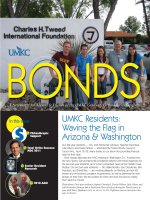
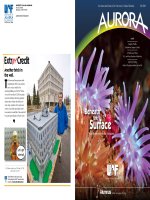
BENEATH THE SURFACE - NEW DISCOVERIES IN THE ALEUTIANS pptx
Bạn đang xem bản rút gọn của tài liệu. Xem và tải ngay bản đầy đủ của tài liệu tại đây (7.03 MB, 14 trang )
UNIVERSITY OF ALASKA FAIRBANKS
P.O. Box 757505
Fairbanks, AK 99775-7505
ADDRESS SERVICE REQUESTED
WWW.uaf.edu
Extr
Credit
T
y Keltner used his spare time while
completing his M.B.A. last academic
year to create a model of the
Gruening Building out of LEGO
®
bricks.
At a cost of more than $1,100, the project
was more ambitious than many graduate
student theses. Keltner also built a web
comic strip, complete with construction
workers, local media personality Darryl
Lewis and Gov. Sarah Palin. The model will
be on permanent display in Wood Center.
Another brick in
the wall.
@
View Keltner’s web comic strip
chronicling his LEGO® construction
project at www.uaf.edu/aurora/.
UAF alumni in this story: Ty Keltner, ’02, ’08,
and Darryl Lewis, ’88
New discoveries in the Aleutians
inside
Campus Profile
Kuskokwim Campus in Bethel
A ‘Real Good’ Story
R.G. and Onnie Bouchum Scholarship
Learn by Doing
Alaska 4-H prepares students for real life
For alumni and friends of the University of Alaska Fairbanks Fall 2008
America’s Arctic University
Alumnus within: see pages 21 – 24
FROM THE CHANCELLOR
Alumni and friends,
It’s September again, one of the best months of the year for watching
the aurora borealis. The aurora is beautifully varied and constantly
evolving. It inspires a sense of curiosity and mystery. Scientists try
to capture its essence, artists its evanescence. This blending of art
and science, of many strands into a spectacular whole, makes Aurora
a fitting name for the new magazine of the University of Alaska
Fairbanks.
Aurora, some of you may recall, was also the name of a UAF magazine
years ago, but that is also fitting: we look north to the future but we
never forget the past.
We can’t get too carried away by the aurora metaphor. The real aurora
is elusive and fickle. It never shows up when you want to impress
visitors. It flares up suddenly and brilliantly, then disappears just
as quickly. UAF, on the other hand, is here to stay — constantly
changing, yes, but with purpose and care. Our inspiration comes from
the limitless heights of the northern sky, but our progress is firmly
grounded in Alaska itself.
To our readers in Alaska, celebrate the return of the northern lights in
the cool September air, then come inside where it’s warm and enjoy
this first issue. To our friends Outside, I hope the colorful mix of
stories reminds you of the vibrancy of Alaska and its premier university.
Welcome to Aurora.
Brian Rogers
Chancellor
Colorful sea anemones are found
near hydrothermal vents in the
Islands of the Four Mountains in the
Aleutian chain. Researchers from
UAF made more than 400 dives and
explored 1,000 miles of coastline
during a two-year assessment
program. Story begins on page 6.
Photo by Shawn Harper.
ABOUT THE COVER
@
Learn about Chancellor Rogers at
www.uaf.edu/chancellor/.
Volume 1 No. 1
Published semiannually
for alumni and friends of the
University of Alaska Fairbanks
Cover Story:
Beneath the Surface
New discoveries in the
Aleutians
By Carin Bailey Stephens
6
departments
On the web
Contents
The Magazine of
the University of Alaska Fairbanks
June 2008
In this Issue
t-PSFNJQTVNEPMPSTJU
t-PSFNJQTVNEPMPSTJU
t-PSFNJQTVNEPMPSTJU
t-PSFNJQTVNEPMPSTJU
America’s Arctic University
www.uaf.edu
12
14
A ‘Real Good’ Story
R.G. and Onnie
Bouchum Scholarship
By LJ Evans
18
2 Around Campus
21 Alumnus
25 Events Calendar
Vice Chancellor for
University Advancement
Jake Poole
Director of
Marketing and Communications
Scott McCrea
Assistant Director
Jackie Stormer
Managing Editor
Kim Davis
Creative Director
Jan Stitt
Features Editor
LJ Evans
Around Campus Editor
Marmian Grimes
Editor
Tori Tragis
Designers
Jenn Baker
Phil Raymond
Andrea Swingley
Photo Manager
Todd Paris
Web Designer
Jenn Baker
Multimedia Coordinator
Megan Otts
@
Look for this icon for information about
enhanced content, including multimedia, online.
Opinions expressed are those of the
authors and do not necessarily reflect
official positions of the University of Alaska
Fairbanks.
Send comments or letters to the editor to:
Visit us on the web at
www.uaf.edu/aurora/.
The University of Alaska Fairbanks is
accredited by the Northwest Commission
on Colleges and Universities. UAF is an
affirmative action/equal opportunity
employer and educational institution.
Photos by Todd Paris, ’83, UAF Marketing
and Communications, unless otherwise
noted. 09/2008
Learn by Doing
Alaska 4-H prepares
students for real life
By Debbie Carter
Campus Profile:
Kuskokwim Campus
in Bethel
35 years of enterprise
P
h
o
t
o
c
o
u
r
t
e
s
y
o
f
O
w
e
n
A
l
a
Agriculture
in action
S
ummer visitors to
Fairbanks were able
to see agricultural
research in progress via a
collaborative project between
the School of Natural
Resources and Agricultural
Sciences and the greenhouse
at Pike’s Waterfront Lodge.
Research professional Jeff
Werner (pictured above)
and Professor Meriam
Karlsson headed the project,
which examined how
to grow sustainable
food crops in rural
communities. Werner
and Karlsson designed
the greenhouse and a
teaching tool to explore
planting and operating
techniques. Local
members of the youth
organization Future
Farmers of America
planted and maintained
a crop of hydroponically
grown tomatoes, cucumbers,
celery and other vegetables.
The greenhouse was open
to the public throughout
the summer season; FFA
members planned to sell the
vegetables as a fundraiser for
the local organization.
Decades of observing the restless Earth
For the last 20 years, Alaska has been a safer place, despite being home to more than 50 histori-
cally active volcanoes. This security comes from the service and research conducted by a team
of scientists with the Alaska Volcano Observatory, a joint project among the UAF Geophysical
Institute, the U.S. Geological Survey and the Alaska Division of Geological and Geophysical
Surveys. The observatory was founded in 1988, just 18 months before the eruption of Mount
Redoubt in Southcentral Alaska.
Susan Butcher Institute names
founding director
UAF has created the Susan Butcher Institute, a program that aims to cultivate public service
and leadership skills in Alaska residents. Butcher’s husband, David Monson (pictured below),
will serve as the institute’s
fi rst executive director. He will
develop a range of programs
intended to inspire people,
especially youths and emerging
leaders, to improve their own
communities through public
service, volunteerism and
taking on new challenges. The
institute expects to offer a
wide variety of workshops and
seminars starting in fall 2010.
Photo by Nora Gruner
UAF photo by Kay Koerner
LARS opens barn doors
M
uskoxen, caribou and reindeer greeted more than 600 visitors at the spring open house at
the Institute of Arctic Biology Robert G. White Large Animal Research Station.
The station hosts the annual event to
give the public a chance to see
the spring calves and learn
about large-animal science
before the station offi cially
opens for the summer.
Visitors saw how ultrasound
is used to assess animal
body condition and
witnessed how muskoxen
digest the coarse woody
plants that make up their diet
at interactive science displays
hosted by scientists and students.
Guides stationed along the tour path
provided a running commentary of natural
history about the animals and the facility.
@
See David Monson discuss the new
institute at www.uaf.edu/aurora/.
Digging up the past
S
tudents at this summer’s archaeological fi eld school
near the Gerstle River spent fi ve weeks sifting through
thousands of artifacts dating back to some of the continent’s
fi rst inhabitants.
Assistant Professor Ben Potter, who’s been involved with
the site since the mid-90s, said their discoveries are globally
signifi cant.
“The site has a number of qualities that are extremely rare
in the subarctic, whether in North America or Asia,” Potter
said. “First of all, we have incredibly good preservation of
organic materials that typically deteriorate in acidic soils of
boreal forest settings. Another reason it’s important is that it’s
extremely well stratifi ed. The soil lays down like a layer cake,
which helps us identify specifi c occupations and the artifacts
that are associated with each other."
Potter also said that the site is unusual in the number of
artifacts unearthed.
“To this point I think we have around 10,000 to 12,000 fragments
of stone tools and some of the tools themselves,” he said.
“We’ve probably got about 500 tools that we’ve found so far
in our excavations. For all of these reasons, it’s an extremely
signifi cant site.”
“
Stones and bones are cool, but what
they can actually tell you about what
people were doing here 10,000 years
ago, that’s really why I’m out here.
”
— omas Allen, anthropology major
For their work at the site, which consisted of digging eight
hours a day, six days a week for fi ve weeks, students earned
six academic credits.
Thomas Allen, an undergraduate anthropology major from
Fairbanks, was particularly impressed with what he was
helping to fi nd at the Gerstle River site.
“Stones and bones are cool, but what they can actually tell you
about what people were doing here 10,000 years ago, that’s
really why I’m out here.”
@
Watch an audio slideshow of the Gerstle
River dig at www.uaf.edu/aurora/.
@
Watch Okmok volcano erupt in July 2008
at www.uaf.edu/aurora/.
AROUND CAMPUS AROUND CAMPUS
Agriculture
in action
S
ummer visitors to
Fairbanks were able
to see agricultural
research in progress via a
collaborative project between
the School of Natural
Resources and Agricultural
Sciences and the greenhouse
at Pike’s Waterfront Lodge.
Research professional Jeff
Werner (pictured above)
and Professor Meriam
Karlsson headed the project,
which examined how
to grow sustainable
food crops in rural
communities. Werner
and Karlsson designed
the greenhouse and a
teaching tool to explore
planting and operating
techniques. Local
members of the youth
organization Future
Farmers of America
planted and maintained
a crop of hydroponically
grown tomatoes, cucumbers,
celery and other vegetables.
The greenhouse was open
to the public throughout
the summer season; FFA
members planned to sell the
vegetables as a fundraiser for
the local organization.
Decades of observing the restless Earth
For the last 20 years, Alaska has been a safer place, despite being home to more than 50 histori-
cally active volcanoes. This security comes from the service and research conducted by a team
of scientists with the Alaska Volcano Observatory, a joint project among the UAF Geophysical
Institute, the U.S. Geological Survey and the Alaska Division of Geological and Geophysical
Surveys. The observatory was founded in 1988, just 18 months before the eruption of Mount
Redoubt in Southcentral Alaska.
Susan Butcher Institute names
founding director
UAF has created the Susan Butcher Institute, a program that aims to cultivate public service
and leadership skills in Alaska residents. Butcher’s husband, David Monson (pictured below),
will serve as the institute’s
fi rst executive director. He will
develop a range of programs
intended to inspire people,
especially youths and emerging
leaders, to improve their own
communities through public
service, volunteerism and
taking on new challenges. The
institute expects to offer a
wide variety of workshops and
seminars starting in fall 2010.
Photo by Nora Gruner
UAF photo by Kay Koerner
LARS opens barn doors
M
uskoxen, caribou and reindeer greeted more than 600 visitors at the spring open house at
the Institute of Arctic Biology Robert G. White Large Animal Research Station.
The station hosts the annual event to
give the public a chance to see
the spring calves and learn
about large-animal science
before the station offi cially
opens for the summer.
Visitors saw how ultrasound
is used to assess animal
body condition and
witnessed how muskoxen
digest the coarse woody
plants that make up their diet
at interactive science displays
hosted by scientists and students.
Guides stationed along the tour path
provided a running commentary of natural
history about the animals and the facility.
@
See David Monson discuss the new
institute at www.uaf.edu/aurora/.
Digging up the past
S
tudents at this summer’s archaeological fi eld school
near the Gerstle River spent fi ve weeks sifting through
thousands of artifacts dating back to some of the continent’s
fi rst inhabitants.
Assistant Professor Ben Potter, who’s been involved with
the site since the mid-90s, said their discoveries are globally
signifi cant.
“The site has a number of qualities that are extremely rare
in the subarctic, whether in North America or Asia,” Potter
said. “First of all, we have incredibly good preservation of
organic materials that typically deteriorate in acidic soils of
boreal forest settings. Another reason it’s important is that it’s
extremely well stratifi ed. The soil lays down like a layer cake,
which helps us identify specifi c occupations and the artifacts
that are associated with each other."
Potter also said that the site is unusual in the number of
artifacts unearthed.
“To this point I think we have around 10,000 to 12,000 fragments
of stone tools and some of the tools themselves,” he said.
“We’ve probably got about 500 tools that we’ve found so far
in our excavations. For all of these reasons, it’s an extremely
signifi cant site.”
“
Stones and bones are cool, but what
they can actually tell you about what
people were doing here 10,000 years
ago, that’s really why I’m out here.
”
— omas Allen, anthropology major
For their work at the site, which consisted of digging eight
hours a day, six days a week for fi ve weeks, students earned
six academic credits.
Thomas Allen, an undergraduate anthropology major from
Fairbanks, was particularly impressed with what he was
helping to fi nd at the Gerstle River site.
“Stones and bones are cool, but what they can actually tell you
about what people were doing here 10,000 years ago, that’s
really why I’m out here.”
@
Watch an audio slideshow of the Gerstle
River dig at www.uaf.edu/aurora/.
@
Watch Okmok volcano erupt in July 2008
at www.uaf.edu/aurora/.
AROUND CAMPUS AROUND CAMPUS
2
uNIVeRSITY Of aLaSKa faIRBaNKS
3
✰ ✰ ✰ ✰ ✰ ✰ ✰ ✰ ✰ ✰ ✰ ✰ ✰
U
A
F
p
h
o
t
o
b
y
K
e
r
y
n
n
F
i
s
h
e
r
Home ice advantage
UAF alumnus Dallas Ferguson is the new head
coach for the Alaska Nanook hockey team.
Ferguson was a four-year letter winner in his
days as a player for the Nanooks and served as
team captain during his senior year in 1996.
His post-college career
includes four years as
a pro, two years as an
assistant coach for the
Fairbanks Ice Dogs
and four years as the
Nanooks’ assistant coach.
Geophysical Institute photo
New ‘Nook leaders
“
Darryl’s passion for teaching and
learning is instantly recognizable.
”
— UAF athletic director Forrest Karr
“
Dallas has the plan, passion
and broad support necessary to
provide a foundation that Nanook
hockey has been missing.
”
— UAF athletic director Forrest Karr
KUAC captures gold
K
UAC TV producers added to their gold cache in
June, bringing home television’s top honors for the
third consecutive year. Produc-
ers Claudia Clark and Deb Lawton
and writer/editor Aaron Elterman
won an Emmy Award for their
KUAC TV production of “Alaska-
One Image Spots,” where viewers
share their commitment to public
television. e trio received the award
at the National Academy of Television
Arts and Sciences Northwest chapter
award ceremony held June 7 in
Sea le. e station also received
two other Emmy nomina-
tions. is is the fourth
consecutive year the sta-
tion has been nominated
for Emmy Awards.
“
Winning three years in a row
is an honor and a tribute to
the talent found at KUAC.
”
— Claudia Clark, KUAC producer
T
his summer, UAF installed a refurbished version of
West Ridge’s iconic milepost sign. The sign was
originally erected on West Ridge in 1973 as a symbol
of UAF’s Geophysical Institute’s global reach in terms of
research and collaboration. The original milepost
sign was taken down in 2002 due to a major
construction project. The current monument
is an updated version of the original design.
Miles from where?
Cut, colored and coiff ed
N
early two dozen students joined the student body of the UAF
Tanana Valley Campus this spring as the inaugural
cohort in the campus’ licensed cosmetology pilot
program. The students spent the spring semester learning
basic cosmetology theory and moved on
to practical training at local salons during
the summer. They are expected to
complete the three-semester program
in December and will be eligible
for state licensure upon gradua-
tion. TVC created the pilot program
in response to reports from local
salon owners of a serious shortage of
licensed hairdressers in the greater
Fairbanks area. At the time, owners
reported at least 70 openings for
licensed hairdressers.
10 20 30 40
Tasty tome
H
istory Professor Carol Gold became a minor
celebrity in Denmark a er her 2007 book,
Danish Cookbooks: Domesticity and National
Identity, 1616 – 1901, made headlines throughout the
country. Gold did several interviews in Denmark
about the book, which off ers insight on gender roles,
literacy, identity and nationalism via three
centuries of cookbooks. e book was published
in both the United States and Europe and won a
design award from the American Association of University
Presses and a third place award from Gourmand, an international
association devoted to promoting publishing on cooking, in the category
“Best Culinary History.”
By the numbers:
TOTE Family Fun Fest
UA Museum of the North – June ,
✰ 1 circus tent ✰ 600 kids and parents
✰ 400 Alaska Native paper doll outfi ts
✰ 120 pounds of homemade casting dough
✰ 300 owl pellets ✰ 1,600 Popsicle sticks
✰ 1 PBS celebrity ✰ 4 hours of family fun
Growing our own
A
fi ve-year, $700,000 gift from the Andrew W. Mellon Foundation
will help support Native students seeking doctoral degrees at UAF.
The money will fund up to four competitive graduate fellowships each
year for students in the dissertation-writing phase of their studies. The
goal of the program is to increase the number of Native people holding
doctorates and in turn increase the number of Native faculty members
at colleges and universities.
Icy climate clues
Institute of Northern Engineering Assistant Professor Ma Nolan and an
international team of researchers pulled a 150-meter-long ice core from
McCall Glacier in the Arctic National Wildlife Refuge this summer. “ e
ice core is the longest extracted from an arctic glacier in the United States,”
Nolan said, “and may off er researchers their rst quantitative look at up to two
centuries of climate change in the region.”
“
e need for programs like this is vital across the United States,
where there is signi cant under-representation of indigenous
peoples on the faculties of colleges and universities.
”
— Brian Brayboy, president’s professor of education
@
View an EarthSLOT movie
of the McCall Glacier at
www.uaf.edu/aurora/.
UAF photo by Ma Nolan
Seasoned veteran
joins the team
Darryl Smith, a 17-year coaching veteran, was
selected in July
as the new
head coach for
the women’s
basketball team.
Smith’s experience
includes 15 combined
years as a head coach at
Metropolitan State College of Denver, Wichita
State University and Butler Community College.
Most recently, he served as assistant coach for
the NCAA Division I University of Nevada.
Smith has a 267-163 career record, including
four conference championships and four NCAA
tournament bids.
AROUND CAMPUS AROUND CAMPUS
✰ ✰ ✰ ✰ ✰ ✰ ✰ ✰ ✰ ✰ ✰ ✰ ✰
U
A
F
p
h
o
t
o
b
y
K
e
r
y
n
n
F
i
s
h
e
r
Home ice advantage
UAF alumnus Dallas Ferguson is the new head
coach for the Alaska Nanook hockey team.
Ferguson was a four-year letter winner in his
days as a player for the Nanooks and served as
team captain during his senior year in 1996.
His post-college career
includes four years as
a pro, two years as an
assistant coach for the
Fairbanks Ice Dogs
and four years as the
Nanooks’ assistant coach.
Geophysical Institute photo
New ‘Nook leaders
“
Darryl’s passion for teaching and
learning is instantly recognizable.
”
— UAF athletic director Forrest Karr
“
Dallas has the plan, passion
and broad support necessary to
provide a foundation that Nanook
hockey has been missing.
”
— UAF athletic director Forrest Karr
KUAC captures gold
K
UAC TV producers added to their gold cache in
June, bringing home television’s top honors for the
third consecutive year. Produc-
ers Claudia Clark and Deb Lawton
and writer/editor Aaron Elterman
won an Emmy Award for their
KUAC TV production of “Alaska-
One Image Spots,” where viewers
share their commitment to public
television. e trio received the award
at the National Academy of Television
Arts and Sciences Northwest chapter
award ceremony held June 7 in
Sea le. e station also received
two other Emmy nomina-
tions. is is the fourth
consecutive year the sta-
tion has been nominated
for Emmy Awards.
“
Winning three years in a row
is an honor and a tribute to
the talent found at KUAC.
”
— Claudia Clark, KUAC producer
T
his summer, UAF installed a refurbished version of
West Ridge’s iconic milepost sign. The sign was
originally erected on West Ridge in 1973 as a symbol
of UAF’s Geophysical Institute’s global reach in terms of
research and collaboration. The original milepost
sign was taken down in 2002 due to a major
construction project. The current monument
is an updated version of the original design.
Miles from where?
Cut, colored and coiff ed
N
early two dozen students joined the student body of the UAF
Tanana Valley Campus this spring as the inaugural
cohort in the campus’ licensed cosmetology pilot
program. The students spent the spring semester learning
basic cosmetology theory and moved on
to practical training at local salons during
the summer. They are expected to
complete the three-semester program
in December and will be eligible
for state licensure upon gradua-
tion. TVC created the pilot program
in response to reports from local
salon owners of a serious shortage of
licensed hairdressers in the greater
Fairbanks area. At the time, owners
reported at least 70 openings for
licensed hairdressers.
10 20 30 40
Tasty tome
H
istory Professor Carol Gold became a minor
celebrity in Denmark a er her 2007 book,
Danish Cookbooks: Domesticity and National
Identity, 1616 – 1901, made headlines throughout the
country. Gold did several interviews in Denmark
about the book, which off ers insight on gender roles,
literacy, identity and nationalism via three
centuries of cookbooks. e book was published
in both the United States and Europe and won a
design award from the American Association of University
Presses and a third place award from Gourmand, an international
association devoted to promoting publishing on cooking, in the category
“Best Culinary History.”
By the numbers:
TOTE Family Fun Fest
UA Museum of the North – June ,
✰ 1 circus tent ✰ 600 kids and parents
✰ 400 Alaska Native paper doll outfi ts
✰ 120 pounds of homemade casting dough
✰ 300 owl pellets ✰ 1,600 Popsicle sticks
✰ 1 PBS celebrity ✰ 4 hours of family fun
Growing our own
A
fi ve-year, $700,000 gift from the Andrew W. Mellon Foundation
will help support Native students seeking doctoral degrees at UAF.
The money will fund up to four competitive graduate fellowships each
year for students in the dissertation-writing phase of their studies. The
goal of the program is to increase the number of Native people holding
doctorates and in turn increase the number of Native faculty members
at colleges and universities.
Icy climate clues
Institute of Northern Engineering Assistant Professor Ma Nolan and an
international team of researchers pulled a 150-meter-long ice core from
McCall Glacier in the Arctic National Wildlife Refuge this summer. “ e
ice core is the longest extracted from an arctic glacier in the United States,”
Nolan said, “and may off er researchers their rst quantitative look at up to two
centuries of climate change in the region.”
“
e need for programs like this is vital across the United States,
where there is signi cant under-representation of indigenous
peoples on the faculties of colleges and universities.
”
— Brian Brayboy, president’s professor of education
@
View an EarthSLOT movie
of the McCall Glacier at
www.uaf.edu/aurora/.
UAF photo by Ma Nolan
Seasoned veteran
joins the team
Darryl Smith, a 17-year coaching veteran, was
selected in July
as the new
head coach for
the women’s
basketball team.
Smith’s experience
includes 15 combined
years as a head coach at
Metropolitan State College of Denver, Wichita
State University and Butler Community College.
Most recently, he served as assistant coach for
the NCAA Division I University of Nevada.
Smith has a 267-163 career record, including
four conference championships and four NCAA
tournament bids.
AROUND CAMPUS AROUND CAMPUS
4
uNIVeRSITY Of aLaSKa faIRBaNKS
5
New discoveries in the Aleutians
Héloïse Chenelot could feel the Steller sea lion’s sharp teeth through her dive hood. She was 30 feet
underwater, on a dive near Tigalda Island in Alaska’s eastern Aleutian Islands. Six divers were in the
water, but Chenelot and her colleague, Max Hoberg, seemed to be particularly
attractive to the young marine mammals.
Hoberg ducked his head down into the kelp and held still. Three
sea lions surrounded him. Juvenile or not, the animals were huge
— each probably weighed around 300 pounds. One of the animals
gently wrapped its mouth around Hoberg’s head, too.
“If they wanted to, they could crush your head in their jaws, but
they didn’t. They were just curious, and they were amazingly
gentle,” Chenelot said later. “A lot of thoughts go through your
mind right then … but bolting to the surface in panic is obviously
not an option. So you just have to think positive, calming
thoughts.”
The researchers eventually cut the dive short and swam slowly to
the surface.
It was the first of 440 dives the team made in the little-explored
Aleutian Island chain during the summers of 2006 and 2007.
There were more than 1,000 miles of coastline to explore, from
near Unalaska-Dutch Harbor in the east all the way to Attu Island
at the western end of the chain.
As he climbed aboard the R/V Norseman, a 108-foot converted
crab fishing vessel and the “topside” headquarters for the divers,
Stephen Jewett wondered whether sea lions would be a problem
on every dive. The lead diver on the expedition and chief dive
officer for the University of Alaska for the past two decades, Jewett
was in charge of the divers’ safety, and curious sea lions were just
one of many factors he had to consider.
The divers never had any problems with sea lions again. In fact,
they saw relatively few of the endangered animals on the two-year
expedition. What they did see, however, was an underwater world
that none of them will ever forget.
Jewett and the rest of the UAF dive team, which included Reid
Brewer, Chenelot, Roger Clark, Roger Deffendall, Shawn Harper
and Hoberg, were part of a larger team of scientists aboard the
Norseman, all with a mission to assess the overall health of the
coastal waters of the Aleutian Islands. Sponsored by the U.S.
Environmental Protection Agency and managed jointly by the
Alaska Department of Environmental Conservation and UAF, the
project focused on measuring contaminants in the water around
the Aleutians and determining the productivity and biodiversity of
the underwater flora and fauna of the region. The project was part
of the nationwide EPA Environmental and Monitoring Assessment
Program, where regions are characterized by surveys of 50
randomly selected sites. Doug Dasher, a water quality scientist with
ADEC, was the principal investigator on the project.
Although the region may appear remote and pristine, the islands
and their coastal waters are not immune from human activity.
Concerns that numerous areas in the vast Aleutian region may be
contaminated, principally by petroleum products and some PCBs
and heavy metals, were an impetus for the study. Many of these
sites are related to World War II and Cold War activities. One is
midway along the Aleutian Arc at Amchitka Island, where the
United States conducted multiple nuclear tests. The largest of those
tests, Project Cannikin, resulted in a 5-megaton underground blast
in 1971.
Many scientists are concerned that contaminants pose potential
threats to the marine ecosystems in the Aleutian and Bering Sea
regions.
By Carin Bailey Stephens
SCHOOL Of fISHeRIeS aNd OCeaN SCIeNCeS
UAF alumni featured in this story: Héloïse Chenelot, ’03; Max Hoberg, ’75; Stephen Jewett, ’77, ’97; Reid Brewer, ’03; Shawn Harper, ’99.
BENEATH
THE SURFACE
Background: A colorful Triopha catalinae
nudibranch, or sea slug, glides along the seafloor in
the Aleutian Islands. Photo by Héloïse Chenelot.
Inset (left): A newly discovered sea anemone species
is called a “walking” or “swimming” anemone
because it can detach and drift with ocean currents
as it feeds. Photo by Héloïse Chenelot.
Inset (right): A kelp the scientists discovered, called
golden V kelp (Aureophycus aleuticus) because of
the color and shape of its blades, represents a new
species and genus. Photo by Max Hoberg.
uNIVeRSITY Of aLaSKa faIRBaNKS
7
and preventing light from penetrating. Typical good visibility
underwater in Alaska is about 30 feet, so 100 feet is just amazing,
Jewett said.
Even though the seawater is clear, it is packed with nutrients —
inorganic and organic material that help provide sustenance for
all marine creatures. Along the southern shore of the Aleutian
Islands, the cooler, nutrient-rich waters from the deep ocean
continuously replace the warmer, nutrient-depleted surface water.
Jewett says the upwelling on the south side of the islands is part
of the reason the area is so biologically productive.
“The diversity out there is unbelievable,” added Jewett. “The
mixture of invertebrates, fishes and kelps in that nearshore zone
was head-and-shoulders above anywhere else I’ve dived in my 35
years of diving in Alaska.”
Working at depth presented challenges
Each person had a different job underwater. The first diver,
usually Jewett, connected a 90-foot section of surveyor’s tape
to the skiff’s anchor line and ran it out parallel to shore. As
he or another diver videotaped the flora and fauna along the
underwater line, a second pair of divers set along it three sets
of quadrats, squares made out of white PVC pipe. The quadrats
varied in size from about a yard square to less than a foot across.
Meanwhile, Mandy Lindeberg, an algae expert with the National
Oceanic and Atmospheric Administration, walked the same area
in the intertidal zone, where she collected seaweeds from tide
pools and exposed beach.
Divers counted the number of organisms found in each quadrat,
photographed them and collected samples. The area in the
smallest quadrat, about 10 inches by 10 inches, was collected
using a suction dredge. The underwater “vacuum” sucked the
organisms into a collecting bag.
Collecting animals and seaweed from the seafloor offered
challenges. One form of kelp is connected to the rocks with what
scientists call a “holdfast.” The divers carried paint scrapers to
remove the stubborn attachments. Sea urchins were also hard to
collect without the sharp spines piercing the divers’ thick gloves.
Working topside
After up to an hour underwater and with collection bags attached
to their waists, the divers returned to the Norseman, or as they put
it, went “topside.” Once on the vessel, they labeled their sample
collections, organized photos and videos, and prepared samples
for future study.
“There really wasn’t any downtime,” said Chenelot. “If there was,
we usually spent it talking to our fellow researchers about the
interesting things we’d found and seen.”
Pink algae, a Coke bottle
and a world war
Stephen Jewett saw it on the bottom, among the seaweed
and marine creatures — a pink thing shaped
like an old-fashioned glass soda
bottle. He picked
it up with
the rest of his
collection and
brought it to the
surface.
The team was
diving in Massacre
Bay on Attu
Island, the site
of the only World
War II combat
on United States
soil. Thousands
of Japanese and
hundreds of Americans
were killed during the
battle.
The Norseman had run into bad weather and the crew
was anchored for protection from the winds. Unable to
sample where they had planned because of weather, the
divers decided to investigate Massacre Bay.
World War II artifacts were strewn on the seafloor,
including coffee cups, silverware, ammunition and
ammo casings, and even fully loaded shells. Among the
artifacts were lots and lots of old Coca-Cola bottles.
According to Jewett, Coke was the main soft drink
available during the World War II era. “This is what
soldiers and sailors drank out here,” said Jewett.
Many of the submerged artifacts were coated with the
hard pink crust of a coralline algae that grows extremely
slowly. The Coke bottle Jewett found might have been
discarded by a serviceman in the early 1940s, making
the thin coating about 60 years old.
The pink algae is one of the oldest living plants on Earth.
According to Jewett, a thickness of 8 inches can be up
to 700 years old. The algae, called Clathromorphum
nereostratum and Lithothamnion sp., are found
throughout the Aleutian Islands, and lend a bright rosy
hue to the rocks and boulders of the seafloor.
Another unique feature of these coralline algae is that
they are extremely vulnerable to disturbances in the
marine ecosystem. Some of them are especially
sensitive to ocean acidification, and may
provide important clues to changes in marine
ecosystems due to global warming.
“Oh, my God, the beauty”
Shawn Harper, a UAF graduate student, photographer and
amateur underwater videographer, grasps the rope attached to
the rubber skiff and flips backwards, splashing into the water.
It’s a graceful movement, slow and controlled, but nevertheless
requires a total commitment from the diver as he tumbles into
the 45-degree water. With one hand still holding the rope, Harper
checks that his regulator and tank are working, and then he slips
beneath the surface. He sinks slowly towards the bottom, about
40 feet beneath the skiff, bubbles trailing quietly behind him.
As he adjusts the buoyancy in his dive suit to hover a couple
of feet above the seafloor, Harper’s camera captures a bouquet
of dramatic colors — reds, oranges, yellows and pinks. Most of
the seafloor in the region is composed primarily of boulders and
rocks.
These rocky areas are completely covered with assemblages of
brightly colored creatures and plants — sea stars, urchins, sea
cucumbers, sponges, anemones, chitons and algae. Among this
throng, a small fish or shrimp might suddenly appear, although
it is often hidden within the brilliant colors. In many areas, it
appears that the bottom has been painted pink because of a
layer of coralline algae that grows as a hard crust on the rocky
substrate. This organism, officially a plant, contains enough
calcium carbonate to make it rigid and rock-like. Sea urchins,
mollusks, chitons and other animals all feed on it, and entire
mini-ecosystems are built upon this unique algae species. (See
sidebar on p. 9.)
Harper’s dive buddy, Max Hoberg, a marine taxonomist with
UAF, says that when he first sank to the bottom on a dive in the
Aleutian Islands, he was stunned by what he saw.
“I’d never seen anything like this before, other than in the tropics.
It was just amazing. The sponges were bright reds, oranges,
yellows. In some ways it is indescribable. You’re sitting there and
your mind is going, ‘Oh, my God, the beauty,’” said Hoberg.
It wasn’t just the colors that made diving along the Aleutian coast
unique. The divers would not have been able to see the vibrant
hues if it weren’t for the outstanding underwater visibility. The
seawater, in many places, was practically clear — or as clear as
seawater can get. According to dive leader Jewett, the visibility
was what made the underwater scenes so exceptional.
“Diving in the nearshore zone of the Aleutians is the best
diving I’ve ever experienced in North America, especially from
the standpoint of it being a cold-water dive. Visibility was just
incredible. There were times when visibility approached 100
feet,” said Jewett.
Jewett adds that this kind of visibility is unusual, especially
during summer in Alaska, where large glacier-fed rivers bring
tons of sediment into the nearshore waters. The particles remain
suspended in the water column, making it appear murky
Diver Reid Brewer swims through dragon kelp (Alaria fistulosa). Photo by Shawn Harper.
8
uNIVeRSITY Of aLaSKa faIRBaNKS
9
2006 Eastern Dives
2007 Western Dives
A
l
e
u
t
i
a
n
I
s
l
a
n
d
s
P a c i f i c O c e a n
B e r i n g S e a
ATTU
DUTCH
HARBOR
AKUTAN
ADAK
ATKA
A L A S K A
“We were completely accident-free. We had
six to seven divers and almost every diver
was in the water almost every day. Our UAF
divers are really top-notch,” added Jewett.
For the most part, the team was alone out
in the Aleutians.
“There is no traffic out there. One day we
anchored up on a bad weather day, and
there was a halibut fishing boat there.
Occasionally we would see off in the
distance a large ship going by,” said Jewett.
“You’re on your own in the Aleutians. If
you need help, it may be a long ways away.”
Carin Bailey Stephens is the public information
officer for UAF’s School of Fisheries and Ocean
Sciences.
Opposite: Reid Brewer hands an underwater video
camera to diver Shawn Harper. A deck hand and
Roger Deffendall are also in the boat; Stephen
Jewett is the diver on the right. Photo by Doug
Dasher.
Above: The team in front of Kagamil Island in
2006. Left to right: Stephen Jewett (UAF), Jim
Gendron (Alaska Department of Environmental
Conservation), Héloïse Chenelot (UAF), Mandy
Lindeberg (NOAA), Roger Clark (Insignis
Biological Consulting), Shawn Harper (UAF),
Max Hoberg (UAF), Terri Lomax (ADEC), Reid
Brewer (UAF) and Doug Dasher (ADEC). Photo
by Stephen Jewett.
Right: The Norseman in Eagle Bay, Unalaska
Island. Photo by Shawn Harper.
@
View video from the dives
at www.uaf.edu/aurora/.
The divers and research team also had
adventures above the water. After all, they
were in one of the most seismically active
regions in the world. Around 2 p.m. on
July 13, 2007, they felt a fairly strong
earthquake. According to Jewett, the
tremor “traveled up the anchor line and
up through the water column” and rattled
the boat. Dasher immediately got on the
radio to make sure the team was safe
from potential tsunamis. The quake was
magnitude 5.8 and only 30 miles away, but
no tsunamis were generated.
Cold hands, warm water
One week later, while the team was
anchored near the Islands of Four
Mountains, one of the three active
volcanoes on the islands, Mount Cleveland,
began to belch black smoke and ash. The
Norseman was only about five miles away.
“We could see ash falling one side of
the volcano was all black and one snow
covered,” said Jewett. “I suppose it’s a
common occurrence in the Aleutians, but
we got to witness it.”
As the team worked near Kagamil Island,
they discovered a series of volcanic vents,
called fumaroles, hissing steam and gases
into the air. Jewett and the others wondered
if vents could also be found underwater.
The divers donned their equipment and
slipped into the sea. As soon as they were
under the surface, they could see bubbles
rising from the seafloor.
Armed with a thermometer and bottles to
collect water samples, Jewett cautiously
approached one of the hydrothermal
openings. The water above the vent was
100 degrees Fahrenheit, or as Shawn
Harper put it, perfect for a diver in cold
water to warm his hands. The divers also
found vents in the sandy areas of the
seafloor.
“You could put your hands in the sand; it
was nice and toasty,” said Jewett.
The divers found Beggiatoa, sulfur-
dependent bacteria, growing directly above
the vents. Tests are underway to determine
the chemical composition of the seawater
from the site.
A few feet away the divers found the same
creatures as in other areas — sea urchins,
anemones, sponges and other organisms
— seemingly unaffected by the high water
temperature and gases.
Newly discovered species
The divers discovered what they believe to
be a previously unknown family of kelp in
the same area. Scientists usually discover
a new species of an organism, or maybe a
new genus. But to discover a new family
is, according to Jewett and algae expert
Lindeberg, a very big deal.
The new kelp is called golden V. It was
found in only two places in the region of the
hydrothermal vents, each an area of about
100 square yards, although the divers spent
most of a day circumnavigating Kagamil
Island looking for more.
“There is a possibility that there is a
correlation between the golden V kelp and
20 new species and counting
Over the course of two summers and 440 dives,
the scientists who surveyed the nearshore region
of the Aleutian Islands discovered at least 20 new
species. As the samples collected during the dives
continue to be analyzed, scientists expect that even
more species will be discovered.
Roger Clark, a marine taxonomist and consultant,
is currently sorting and describing the new species.
Complete scientific results from the dives are
expected in 2009.
1 new walking or
swimming anemone
4 new snails
1 new genus, perhaps
family, of kelp
8 new sea stars
6 new chitons
the chemical constituency of the water
near Kagamil Island, but we don’t know
yet,” said Jewett.
A long way from home
The scientists on the Norseman were a long
way from home, and it was Jewett’s job to
make sure the team returned in one piece.
A significant accomplishment of the two-
year dive survey was the fact that not a
single diver was injured.
10
uNIVeRSITY Of aLaSKa faIRBaNKS
11
Photo © Ma Hage
U
sing innovative technologies, KuC delivers instruction
to students in far-flung villages throughout the state, but
primarily those of the Yukon-Kuskokwim Delta.
In the early days, providing education to village residents required
instructors to travel by small aircraft and rely heavily on VHF
radio for messages. Later, instructional television was beamed to
villages that could receive KYUK’s broadcast signal, turning KuC’s
instructors into TV celebrities. Today new tools and technology
make it possible for KuC’s instructors and staff to interact with
students in ways that were unimaginable 35 years ago.
KuC’s academic offerings include certificates in community
health, rural human services, information technology and applied
business; associate degrees in early childhood education, human
services and tribal management; and a new bachelor’s degree in
Yup’ik language and culture. Sixteen students were ready to enroll
in the program in fall 2008.
“The B.A. in Yup’ik language and culture is an exciting and timely
development — children here still speak Yup’ik as their first
language,” said Mary Pete, KuC’s director. “As immersion programs
expand, teaching staff in the region are looking to Kuskokwim
UAF’s Kuskokwim Campus has
influenced the lives of thousands of
rural Alaskans since it opened in 1973.
Campus for leadership as they enhance their own skills and
credentials.”
The Kuskokwim Campus has conferred more than 2,300
certificates and degrees on people from throughout the region.
KuC’s efforts at promoting adult basic education have resulted in
more than 1,400 students receiving GEDs, allowing many to realize
lifelong dreams of a high school diploma and encouraging others to
advance their careers and pursue higher education.
@
Listen to an APRN news story on the new Yup’ik
bachelor’s degree at www.uaf.edu/aurora/.
UAF alumna in this story: Mary Pete, ’79, ’84
Photo © Ma Hage
Photo © Ma Hage
35-anek allrakunek arlulatellra — 35 years of enterprise
CampusProfile
BETHEL
Photo © Ma Hage
KUSKOKWIM Campus in Bethel
1312
“I came unglued. I cried and cried,” Jones
said. “It was a shock to get my very first
written communication from him ever, and
it was an e-mail, of all things.”
Jones, who was serving the chancellor as
assistant for equal opportunity at the time,
had counseled her father to stay busy after
her mother died in 1991.
“He was lonesome. He had nothing to do …
so I said, ‘Go back to school,’” Jones said.
A woman for whom R.G. did yard work
in his hometown of Longview, Texas,
recommended the East Texas Literacy
Council. It was his tutor there who had him
first write out in longhand the message he
wanted to send his daughter in Alaska, then
type it on the computer keyboard.
“It was a simple message, really, just a
couple of lines,” Jones said. “And at the end
of the message the tutor wrote, ‘R.G. did this
all by himself!’”
Jones said he told her later that when he
put his hands on the keyboard the first
key he hit was a P. He held it down, not
anticipating the effect that would have,
until there was a whole string of P’s.
“He got all upset because he thought he
broke it. He told me he’d ‘P’d’ all over it!”
The value of education
R.G. Bouchum (he always said it stood for
“Real Good”) grew up on a sharecropper’s
farm in Texas as one of nine children. His
father made sure all the girls got college
educations because he didn’t want them
to be dependent, but he figured the boys
could always find work. R.G. made it
to the fifth grade before he had to quit
school to work in the fields. He learned
the alphabet but couldn’t quite string it all
together to actually read. After he married
Onnie V. Miles in 1943, she handled any
business that required the ability to read
and write.
R.G. and Onnie understood the value of
education, and they were determined that
their children would have a better life.
For many years they worked long hours
A ‘Real Good’ Story
The R.G. and Onnie Bouchum Scholarship
On an ordinary day in 1997, Dorothy Jones sat in her office on the third floor of Signers’ Hall
and checked her e-mail, but one of the messages waiting for her was anything but ordinary. It
was the first letter she had ever received from her 77-year-old father, R.G. Bouchum, who was
just learning how to read and write.
By LJ Evans
UAF alumna featured in this story: Dorothy Jones, ’77
uNIVeRSITY Of aLaSKa faIRBaNKS
15
“He was illiterate not because of his brain
power — he was one of the smartest
people we ever had around — but
because he didn’t have the opportunity.”
“Everything he had to share with us was
very worthwhile,” Kirstein said.
R.G. was flattered by the scholarship his
daughter set up in his and Onnie’s name,
and he met the scholarship recipient each
year until his death in November 2007
at age 90. Although his e-mails have
ended, R.G. Bouchum’s extraordinary
accomplishment at age 77 embodies his
philosophy: you’re never too old to learn.
LJ Evans is a writer and editor for UAF
Marketing and Communications.
A home at the food bank
In 1998, after R.G. had a stroke and could
no longer stay alone at his home in Texas,
Dorothy and Lloyd persuaded him to
come live with them in Fairbanks. Not
able to sit still very long, he was soon
volunteering with Foster Grandparents
and participating in many activities at
the Fairbanks Resource Agency’s Senior
Center. One of the volunteer jobs he took
up with a passion was at the Fairbanks
Community Food Bank.
The staff there quickly figured out that
R.G. had some very special gifts.
“His job looked like it was just
repackaging rice and flour,” said
Samantha Kirstein, the food bank’s
executive director. In reality, she says,
his job was to share stories about his life
and his strong work ethic with young
people who were in need of some attitude
adjustment.
The courts or the school district
sometimes send young first offenders to
perform community service in lieu of jail
time or detention. One of the places they
can put in their hours is at the food bank.
“We connected them with R.G. and he
told them great stories,” Kirstein said. “It
wasn’t easy growing up a black man in
Texas during the time of segregation, but
even with all the challenges he’d met in
his life, even though he was wheelchair-
bound, he was still working.”
“If he couldn’t get their attention any
other way he’d take off his socks and
show them his stump,” Kirstein said.
That stump was a harsh reminder of
R.G.’s first winter in Fairbanks. Despite
urging from Dorothy and Lloyd to come
indoors after a big snowfall, he kept
shoveling their driveway and ended up
with frostbite, which cost him his leg
because of circulation problems. But even
the amputation didn’t keep him from
helping out with chores and volunteering
at the food bank, Dorothy said.
Because Bouchum couldn’t read
throughout most of his life, Kirstein
notes that all the challenges he faced were
compounded.
R.G. Bouchum keeps an eye on a throng of Fairbanks Community Food Bank volunteers
from his wheelchair in this 2001 painting by Charlen Jeffery Satrom.
Bouchum lived in Fairbanks with his
daughter Dorothy Jones and her family
from 1998 until his death in 2007.
Photo courtesy of Dorothy Jones
You’re never
too old to
learn.
at extra jobs to make it possible for
their daughters, Bobbie J. and Dorothy,
to go to college. R.G. was always eager
to tell anyone who would listen about
his daughters, especially Dorothy, who
became an associate professor at UAF
teaching computer applications.
It was to honor
her parents’
high regard for
education that
Dorothy and her
husband, Lloyd,
decided in 1997 to
establish the R.G.
and Onnie V. Bouchum Multicultural
Scholarship at UAF. The scholarship was
first awarded in 2000.
Last year’s scholarship went to Unika
Nelson, a junior communication major.
(See sidebar below.)
UAF Summer Sessions director Michelle
Bartlett said the Bouchum scholarship is
a reflection of her good friend Dorothy’s
relationship with both of her parents.
“From her parents she got the values of
hard work and a good education,” Bartlett
said. “This scholarship is a wonderful way
that she has honored her parents. It’s not
only about what they gave her but also what
she’s done with it.”
A truck driver who couldn’t read
For many years R.G. supported his
family as a truck driver — a challenge
for someone who couldn’t read, but he
developed strategies to compensate.
When he needed
help, he stopped and
asked for directions.
If someone was with
him who could read,
that person helped him
decipher the paperwork
that said what should
be delivered where, and he had the
warehouse workers load the truck in such
a way that he could tell where things
needed to be delivered.
But when his beloved Onnie died, he
could no longer handle his personal
affairs, so he took Dorothy’s suggestion
and decided to learn how to read. He
had always been a hard worker, and he
approached acquiring these new skills
with the same determination. His stories
so impressed Brenda Brown, a staff
member and one of his tutors at the East
Texas Literacy Council, that she helped
him compile his memoirs into a book,
One Man, One Book.
“With each lesson I found that I learned
as much or more from him than he could
ever learn from me,” Brown writes in the
book’s introduction.
In the book’s first story, “Life on the
Newsome Farm,” R.G. tells about
growing up in East Texas.
When we were living on the
Newsome Farm out in Ore City, Daddy
was sharecropping — working on the
halves. If he made two bales of cotton,
the boss man got one and Daddy got
one. That was the usual arrangement
for sharecroppers.
For extra money, the kids gathered
the eggs and Mama would take them
to town … and sell them. She would
pack them in a bucket or box lined with
cotton seed. She would put a layer of
cotton seed in the bottom and then
some eggs, layering them all the way
to the top.
Most folks don’t know about cotton
seed, but my mother sure did. Cotton
seed is not so soft, but the seed
always had cotton stuck to it and made
a nice sized, soft ball about the size of
your little fingernail. A lot of cotton
seed was perfect for lining the bucket
Mama used to take eggs to town.
Unika L. Nelson
“I love understanding how people interact with each other in different situations. There’s no right
or wrong approach,” says Unika L. Nelson, a communication major and the 2007 recipient of the
R.G. and Onnie V. Bouchum Multicultural Scholarship. She was planning to major in music, but
switched because she loved her first-semester communication class so much.
Originally from Detroit, Mich., Nelson has lived all over because her dad is in the Coast Guard. She
graduated from Kodiak High School in 2004 and attended her first semester at Kodiak College, then transferred to
UAF in spring 2005. She is thinking about pursuing a career as a college admissions diversity director.
“I think that’s really important. There are so many different types of people, not even just talking about race, but culture,
ethnicity. Not everyone learns the same, communicates the same, thinks the same. It’s so important that people are aware
of that.”
@
Inspired by this story? Support this or other
scholarships at UAF at www.uaf.edu/giving/.
UAF Photo by Rosie Millican
16
uNIVeRSITY Of aLaSKa faIRBaNKS
17
Childhood photo courtesy of Chelsey Schell Kuester
Childhood photo courtesy of Ma Bray
Photos courtesy of Owen Ala
“You become more responsible,” she said.
Since 4-H kids care for their animals, they also learn a lot of
veterinary medicine. Ala learned how to give shots, dehorn and
castrate animals, and dress wounds. Caring for animals and making
multiple visits to doctors for his own health issues, including
broken bones, encouraged his interest in medicine.
Last fall, as he has done on several visits home, Ala butchered a pig
with a group of 4-H’ers, taking time to talk to them about bones,
muscles and organs.
The main philosophy Ala learned from 4-H is that you just jump in
and learn. That approach helped in medical school, he said. “I was
much more comfortable getting in and doing things because I’ve
been doing it my whole life.”
“You can do it!”
Chelsey Schell Kuester, who spoke to a 4-H youth leadership
forum on the UAF campus earlier this year, said 10 years of 4-H
gave her the confidence to try new things and the message, “You
can do it!”
“It’s that simple seed that they planted,” she said. “It’s a huge
confidence builder.”
Kuester, 26, started participating in 4-H at age 5 when an older
sister joined a sewing class. The leader encouraged her to sew also,
and she made a doll, then doll clothes, and her own clothing by the
time she was 7.
Growing up in Michigan, her 4-H experiences revolved around arts
and crafts projects, including sewing, macramé and glass etching
— skills that leaders and parents contributed. During the summers,
she canoed on rivers at 4-H camp, despite being nearly blind in
one eye (and not being allowed to wear glasses while in a boat) and
practiced shooting sports.
After graduating from college, Kuester became a television
journalist in Fairbanks, where she reported on a variety of 4-H
camps and activities that rekindled her interest in the program.
This past January, she stepped into new territory by becoming the
community development director for the Downtown Association of
Fairbanks, which promotes the downtown area.
A family affair
The screen saver on Matt Bray’s computer features several
domesticated goats clambering over rocks. Bray, who is finishing a
doctorate in permafrost engineering at UAF, cannot remember life
without goats — or without 4-H.
His mother, Annette, is a longtime leader and his sister, Maria, has
served as a leader for a 4-H club north of Fairbanks for seven years.
The family’s current herd of goats numbers about 30, and they
have provided scores of the animals for 4-H youth and others
who want to raise the Toggenburg and Saanen dairy breeds.
Matt, 31, is the primary caregiver for the herd, but both Bray
siblings provide showmanship clinics every year to 4-H’ers who
want to learn about grooming goats and showing them at the
fair. The family also serves as an unofficial source of goat-care
information for goat owners.
Since Bray grew up around 4-H and raised animals, joining
4-H when he was 8
seemed like a natural
progression. Every
summer
for about
10 years,
he took
care of pigs,
calves and
goat kids at
the Tanana
Valley State
Fair. Keeping
livestock at the
fair meant that
he practically
lived there for the week
to care
for them.
“You take them to the
auction and hope you get a good price,” he said.
Most of what he learned about raising animals came from his
family but 4-H provided an opportunity to get together with kids
with similar interests.
UAF alumni featured in this story: Matt Bray, ’01, ’03; Maria Bray, ’98
LEARN
W
hen Owen Ala raised pigs, sheep and steers with his
Kenai Peninsula 4-H group and butchered his first
animal in fourth grade, he never realized how handy
that experience would become in medical school.
Dr. Ala, who graduated from Cornell University medical school in
May, says the skills required for dissecting a cadaver or performing
surgery are very similar to the skills required for butchering a pig
or steer. Through 4-H, he learned the basics of anatomy.
“I kind of had a leg up,” he said.
His 4-H public speaking experiences also help him present
research to large audiences and patient case histories to doctors.
Ala, 29, began a five-year residency in orthopedic surgery at an
Albuquerque, N.M., hospital in summer 2008. He is one of a group
of distinguished Alaska 4-H alumni who have gone on to succeed
in college and in a variety of careers.
The 4-H program, part of UAF’s Cooperative Extension Service,
emphasizes a hands-on approach to learning life
skills, citizenship and leadership. A handful of 4-H
agents across the state run the program with the help
of more than 1,100 youth and adult volunteers.
Local 4-H clubs emphasize learning about cooking,
sewing, gardening, science and raising livestock, as
well as government and a host of other topics. 4-H
kids have also participated in a moose hunt, earned
emergency medical certification and studied crime scene
investigation. Club members themselves choose what to
emphasize.
Kids and parents learning together
Nancy Veal grew up with 4-H in eastern Oregon, and she
became a market livestock leader on the Kenai Peninsula
when her own kids were of 4-H age. She volunteered for 20
years and has led 4-H programming on the Kenai the past
eight years.
Veal has seen Ala and others grow up and become teachers,
business owners, farmers, veterinarians and doctors. Some former
4-H’ers, like herself, have become 4-H leaders.
The program continues to be successful, she believes, because kids
and parents are involved and learning at the same time. The kids
work with guidelines, project books and deadlines. Those who
raise livestock are accountable for an animal’s welfare.
BY
DOING
Alaska 4-H prepares students for real life
By Debbie Carter
C O O p e R a T I V e e x T e N S I O N S e R V I C e
18
uNIVeRSITY Of aLaSKa faIRBaNKS
19
W
hen Navin Sharma, ’79, ’81,
couldn’t fi nd the perfect job,
he created it.
In 1997, Sharma discovered a way to
merge his experience in nursing with a
career in law enforcement. He was work-
ing as a full-time police offi cer with the
Vancouver (Wash.) Police Department.
Sharma, who began working as a nurse
in the early 1990s, continued to work
on call as an emergency room nurse at
Providence Portland Medical Center, in
Portland, Ore.
Sharma is credited as the driving force
behind creating the tactical emergency
medic unit for his police department.
He remembers approaching the SWAT
team’s commander about the idea of
assigning specially trained emergency
medical technicians to the team.
“I gave him a scenario where the airway
of one of his SWAT offi cers was com-
promised,” Sharma says. “If the fi re
truck, which was several blocks away,
responded to the call, it would have
taken approximately six minutes, and
the offi cer would have died.”
Sharma then
illustrated how
a tactical emer-
gency medic on
the SWAT team
could quickly
intubate the offi cer or begin performing
advanced life support within a matter
of seconds.
“Ambulances and fi re department
paramedics aren’t usually versed in
the tactics of a SWAT team or the riot
squad and aren’t equipped for a situa-
tion where they could come under fi re,”
Sharma says.
“Having a trained medic working as part
of the SWAT or riot units can mean the
difference between life and death.”
The TEMS team now boasts four medics,
including two EMTs and one paramedic,
and was the fi rst police-based team in
Washington to offer advanced life sup-
port services, including medications, IVs
and some advanced trauma life support
surgical procedures.
Sharma says
his background
as an emer-
gency nurse
brings a fresh
perspective to
his police work.
He served as a volunteer fi refi ghter, an
emergency medical technician and
later a paramedic before going through
nursing school.
Sharma found his work addicting and
hopes his own nontraditional career
path will inspire other nurses to con-
sider second careers as tactical emer-
gency medical personnel. However, after
10 years in law enforcement, he is no
longer a police offi cer.
“I still work at Providence Hospital in the
emergency department as a staff emer-
gency and trauma RN and am involved
in training,” Sharma said in a recent
e-mail from Portland.
“The TEMS unit I helped set up is doing
very well and continues to provide
quality care to the citizens and offi cers
during every critical mission.”
Sharma was recently appointed to the
Oregon State Trauma Advisory Board
and he made contributions to Tactical
Emergency Medicine, the fi rst textbook
on the subject.
Excerpted with permission from an article by Linda
Childers which appeared in Nurse Week. © 2005,
Gannett Healthcare Group (www.nurse.com). All
rights reserved.
Creating the
perfect job
Navin Sharma treats a bomb squad offi cer injured in a blast.
Photo courtesy of Navin Sharma
“
Having a trained medic working
as part of the SWAT or riot
units can mean the diff erence
between life and death.
”
Unlike a typical 4-H livestock project, which involved raising
animals for the fair, the Brays tended a year-round goat herd and
handled most of the animal care themselves.
Matt continues to enjoy raising goats and the satisfactions that
come with it, he said, such as assisting with a trouble-free birth
of twin goat kids and the ability to produce milk from a healthy,
known source.
“I work with goats for the little things — the small moments when
they bring a smile to your face,” he said. “The greetings of a bunch
of goat kids in the morning when you bring them their bottles
of milk and you know they think you are the best person in the
world. When the goats feel frisky and run and play and jump …
looking out and seeing a bunch of goats relaxing in the morning
sun, chewing their cud with a look of complete contentment.”
Learning leadership
Rocki Hanscom, a senior majoring in political science at UAF,
said her 4-H experiences, which emphasized citizenship and
government, helped shape her career interests. She is considering a
career in foreign service or in international law.
Hanscom, 21, got her 4-H start as a Cloverbud, working in her
mom’s community garden behind Denali Elementary School in
Fairbanks. She entered produce and flowers in competitions at the
Tanana Valley State Fair. During second grade, she acquired a pet
guinea pig, Nestlé, and learned how to show him at the fair. She
started giving demonstrations in second grade as well, on topics
such as how to transplant a plant. She also learned arts, cooking
and sewing, and participated in the fair’s bake-off and fashion
review.
During eighth grade, Hanscom started working on a 4-H
government project. She and other 4-H kids lobbied the Alaska
Legislature on a livestock liability bill, which limited the liability of
livestock owners who show animals in public places. Meeting with
legislators, she said, “was a real educational experience.”
The following summer, she participated in a 4-H exchange
to Maine and in Citizenship Washington Focus, a citizenship
program for 4-H teens in the nation’s capital. She followed that up
with a national 4-H leadership conference her freshman year of
high school. She helped plan the event the following year and led a
session for the conference.
Before her first semester at UAF, Hanscom became an intern for
U.S. Sen. Lisa Murkowski and observed the dynamics of the
senator’s office up close. She returned to the senator’s office in
summer 2008 to coordinate the high school internship program.
4-H definitely improved her leadership and public speaking skills,
and helped her pursue her interests in college, Hanscom said.
“A lot of people think that 4-H is animals and gardening and
cooking and sewing but it’s just so much more than that,” she said.
“It’s helped me get to the next level, to get an internship.”
In Alaska, some 10,000 kids participate in 4-H sponsored events,
whether it’s after-school clubs, special-interest classes or more
traditional 4-H activities. They all fulfill the 4-H philosophy: learn
by doing.
Debbie Carter, ’81, is a writer and editor for the UAF
Cooperative Extension Service.
The history of 4-H
4-H has rural roots. Its philosophy of practical, hands-
on learning grew more than 100 years ago out of a
desire to make public school education more connected
to country life.
When Congress created the Cooperative Extension
Service at the U.S. Department of Agriculture in 1914,
it included boys’ and girls’ club work. Soon after, the
youth organization became known as 4-H and its logo
became a four-leaf clover with 4 Hs, standing for head,
heart, hands and health. Today, 4-H is coordinated by
Extension agents working with land-grant universities
throughout the United States. 4-H clubs and related
organizations now exist in other countries, too.
In most states, you can join 4-H if you are between
the ages of 8 and 18. The 4-H program includes more
than seven million members nationally. Most programs
center around three areas: leadership, citizenship and
life skills. The 4-H motto is “to make the best better.”
@
See 4-H kids in action at the 2008 Tanana Valley
State Fair at www.uaf.edu/aurora/.
Childhood photo courtesy of
Cooperative Extension Service
20
uNIVeRSITY Of aLaSKa faIRBaNKS
21
ALUMNUS
UAF photo by Sam Winch Photo courtesy of Jim Moody, ’55
President’s column
By Gail Phillips, ’67
W
hat a great way to start my term
as the new president of the UAF
Alumni Association by welcoming our
alumni and friends to the university’s
new magazine, Aurora. The partnership
between the alumni association and
our university in recruiting, mentoring,
advocating and supporting the
next group of new alumni is never-
ending. The alumni association board
of directors is happy to assist in the
task, but we also need the aid of the
28,000 UAF graduates and friends of
the institution to continue with the
momentum.
One way that you can help is by joining
the alumni association. As a graduate or
former student of UAF, you are always
considered one of our alumni, but
when you pay membership dues to
join the alumni association you receive
extra benefi ts. Examples of these
benefi ts include rental car, hotel and
condominium discounts, eligibility for
in-state tuition for children of alumni,
and scholarship opportunities for family
members of alumni. The association
is also in the business of connecting
friends and making sure your tie to the
university is not broken.
As the semester is just beginning and
the next group of future Nanook alumni
are working towards commencement
in May, I would like to thank all of you
who attended and helped make this
university one of the nation’s best. I look
forward to seeing many of you this year,
and remember — once a ’Nook, always
a ’Nook.
If you are not an Alaska resident, you should compare this plan with any college savings plan
offered by your home state or your benefi ciary’s home state and consider, before investing,
any state or other tax benefi ts that are only available for investments in the home state’s plan.
Go online or call the number listed above to request a Plan Disclosure Document, which
includes investment objectives, risks, fees, expenses, and other information that you
should read and consider carefully before investing.
Offered by the Education Trust of Alaska. T. Rowe Price Associates, Inc., Investment Advisor
and Program Manager. T. Rowe Price Investment Services, Inc., Distributor/Underwriter.
Visit uacollegesavings.com Call 1-866-222-9084
It’s easy to get a good start on saving for college. Simply designate one
half of your and your child’s PFD to The UA College Savings Plan. You can:
• Start saving for just $50 a month, with no sales charges
• Use assets at most any college or university in the U.S.
• Lock in today’s UA tuition value for use in the future
Save in Alaska.
Study Anywhere.
SAVING YOUR PFD CAN MAKE
COLLEGE MORE THAN A DREAM.
T. Rowe Price
Advertising
Initials:
Date: Time:
DTP Code:
Req Code:
Initials:
Date: Time:
Initials:
Date: Time:
Legal Ref #:
Line #:
Initials: Date:
Initials: Date:
Publication: Size/Color: Cover Date: On Sale Date:
Submitted On
Date: Time:
Due By
Date: Time:
AURORA 2 x 7.25(4C) (4.8778 x 7.25) 6/20086/2008
bhq
5/20/08
2x7.25-(4C)529A76937_AURO08
ADDITION
5/21
5/21
10
4
Desktop Publishing EP Proofreading Manager’s Approval Corp. Proofreading
Ride with pride!
Show your Nanook pride by purchasing
a UAF license plate from the Alaska
Department of Motor Vehicles.
@
www.alaska.gov/dmv/plates/
universe.htm
ALASKA
UNIVERSITY OF ALASKA FAIRBANKS
TM
2008 – 2009 UAF Alumni
Association Board of Directors
President
Gail Phillips, ’67
Vice President
Daniel Flodin, ’94, ’97
Secretary
Laurie Cropley, ’00
Treasurer
John Davies, ’70, ’75
Board members
Brian Brubaker, ’96
Jim Dixon, ’90, ’91
Randy Pitney, ’72
Ryan Tilbury, ’99, ’04
Tonya Trabant, ’99, ’04
Joanna Wassillie, ’98
Elaine Woodruff, ’69 ewoodruff @ccu.edu
DeShana York, ’95
Executive Director
Joe Hayes, ’97
@
www.uaf.edu/alumni/
@
View more class notes or submit your
own at www.uaf.edu/aurora/.
1950s
Joe, ’58, and Ann, ’57, Tremarello gave $100,000
to create the Joseph Tremarello Sr. and Rose R.
Tremarello Memorial Fund, in honor of Joe’s
parents, to support student-athletes on the men’s
and women’s varsity basketball teams. Joe formerly
coached the women’s basketball team, and Ann
served as university registrar for nearly 45 years,
retiring in 2002.
1960s
Vera Alexander, ’65, was honored
with the dedication of a new smart
classroom at UAF, room 201
in the O’Neill Building on
West Ridge, renamed the
Vera Alexander Learning
Center. After receiving her
doctorate in marine science
at UA in 1965, Vera became
an associate professor at the fl edgling Institute of
Marine Science on the Fairbanks campus. In 1980,
she became the director of IMS. When the UAF
School of Fisheries and Ocean Sciences was formed
in 1987, she became its fi rst dean and served for
nearly 20 years, until 2004. Vera is a professor
emerita and is currently on the advisory board
for the UAF Pollock Conservation Cooperative
Research Center. She is also the president of the
Arctic Research Consortium of the United States.
1980s
Milton Ludington, ’87 — “My B.S. degree in civil
engineering from UAF has allowed me to manage
design and construction programs and projects
all over the U.S. and the world. My recent three
years in Iraq allowed me to lead the programming
of $1 billion in Iraqi national transportation and
telecommunications projects for the Coalition
Provisional Authority and serve as senior project
manager for over $100 million in Sadr City sewer
repairs with Washington International/Black and
Veatch JV, highlighting an eventful and exciting
career. After many years I have recently returned
to Fairbanks to accept a position with Ageiss
Environmental as engineering project manager for
the air force at Eielson AFB in connection with an
exciting $126 million renovation/new construction
project. Thanks, UAF!”
1990s
Nevada Bovee, ’96 — “Blessings abound in my
life with a new job, happy family, a fabulous trip
to France and continuing to help others with
neuro-linguistic programming and hypnotherapy.
I recently joined the team as marketing manager
for the University of Alaska College Savings Plan
and the UA Scholars program, and am looking
forward to helping families save for future college
needs. Having met the challenge with three of
our children, I know how important it is. After
30 years, I was reunited with some very good
friends from middle school. We all met in France
Alumni teach
schoolchildren to say
“I Know I Can”
T
he University of
Alaska College
Savings Program
and the Alaska
Commission on
Postsecondary
Education
expanded the
“I Know I Can”
outreach effort
in 32 classrooms across Alaska this year.
UA alumni volunteers read the colorful I
Know I Can picture book to an estimated
730 school children.
I Know I Can features animal characters
encouraging children to consider college
and career choices, and to start think-
ing about those choices now. The uni-
versity and ACPE started the program
last year. UAF alumni who participated
include Ian Olson, ’97, Tania Clucas,
’95, ’08 (pictured above) and Tamara
Hornbuckle, ’86.
2000s
Suzanne Evans, ’01 — “Since I graduated from the
University of Alaska Fairbanks, I started teaching
art classes with the University of Alaska through
Chukchi Campus and UAF in Fairbanks, Alaska. I
also worked as a counselor counseling individuals
throughout the state of Alaska that had substance
abuse issues. I hope to work for a law offi ce
someday in the future! In 2001 I brought Irene
Bedard cast and crew to Kotzebue, Alaska, from
L.A., California, to perform for the community.
It was a memorable moment to see her again. She
encouraged young high school students to attend
college after high school and that they can achieve
their dream of what they want to be in the future.”
Jamie Barger, ’02 — “After
completing my Ph.D. at UAF, where I
studied the regulation of metabolism
during hibernation, my family and
I moved to Madison, Wisc.,
so I could be a postdoc with
Dr. Richard Weindruch at
the University of Wisconsin-
Madison. There I investigated the bioactivity
of adipose tissue in mice and rhesus monkeys
on calorie-restricted diets. I joined LifeGen
Technologies in 2005 and serve as their head of
project management. Recently I was lead author
on a peer-reviewed publication about our team’s
investigation of the effects of resveratrol, a chemical
found in red wine, on the aging process. The study
has made international news, including The New
York Times, Wine Spectator magazine, BBC News and
Jay Leno’s monologue on The Tonight Show.”
this last May and had a
wonderful time together
catching up with each
other’s life experiences. I
continue to study neuro-
linguistic programming
and recently received
the associate trainer
certifi cation to add to my master practitioner
certifi cate. It is great to apply some of the learning
to the public relations class I am teaching at the
Tanana Valley Campus. Life is good and being part
of the UAF alumni is great!”
Photo by Mary Gower, ’94, ’95
In memoriam
« Alaska Stewart Linck,
Matric., legislator and
territorial pioneer, March 23,
Fairbanks. She received the
Alumni Achievement Award
for Community Achievement
in 1996.
Marie Quirk Fate-
Haggard, ’36, June 3,
Fairbanks. She served as Charles Bunnell’s
secretary for four years after graduation.
« Glen D. Franklin, ’36,
legislator and territorial
pioneer, June 17, Fairbanks.
He directed the purchase
and installation of the
Charles Bunnell statue
at UAF.
James V. Drew, dean and
director emeritus, July 9,
Fairbanks. Memorial donations can be made to
the Drew Outdoor Amphitheater at the Georgeson
Botanical Garden at www.uaf.edu/giving/.
UAF photo by Allison Blanchard
ALUMNUS
ALUMNUS
UAF photo by Sam Winch Photo courtesy of Jim Moody, ’55
President’s column
By Gail Phillips, ’67
W
hat a great way to start my term
as the new president of the UAF
Alumni Association by welcoming our
alumni and friends to the university’s
new magazine, Aurora. The partnership
between the alumni association and
our university in recruiting, mentoring,
advocating and supporting the
next group of new alumni is never-
ending. The alumni association board
of directors is happy to assist in the
task, but we also need the aid of the
28,000 UAF graduates and friends of
the institution to continue with the
momentum.
One way that you can help is by joining
the alumni association. As a graduate or
former student of UAF, you are always
considered one of our alumni, but
when you pay membership dues to
join the alumni association you receive
extra benefi ts. Examples of these
benefi ts include rental car, hotel and
condominium discounts, eligibility for
in-state tuition for children of alumni,
and scholarship opportunities for family
members of alumni. The association
is also in the business of connecting
friends and making sure your tie to the
university is not broken.
As the semester is just beginning and
the next group of future Nanook alumni
are working towards commencement
in May, I would like to thank all of you
who attended and helped make this
university one of the nation’s best. I look
forward to seeing many of you this year,
and remember — once a ’Nook, always
a ’Nook.
If you are not an Alaska resident, you should compare this plan with any college savings plan
offered by your home state or your benefi ciary’s home state and consider, before investing,
any state or other tax benefi ts that are only available for investments in the home state’s plan.
Go online or call the number listed above to request a Plan Disclosure Document, which
includes investment objectives, risks, fees, expenses, and other information that you
should read and consider carefully before investing.
Offered by the Education Trust of Alaska. T. Rowe Price Associates, Inc., Investment Advisor
and Program Manager. T. Rowe Price Investment Services, Inc., Distributor/Underwriter.
Visit uacollegesavings.com Call 1-866-222-9084
It’s easy to get a good start on saving for college. Simply designate one
half of your and your child’s PFD to The UA College Savings Plan. You can:
• Start saving for just $50 a month, with no sales charges
• Use assets at most any college or university in the U.S.
• Lock in today’s UA tuition value for use in the future
Save in Alaska.
Study Anywhere.
SAVING YOUR PFD CAN MAKE
COLLEGE MORE THAN A DREAM.
T. Rowe Price
Advertising
Initials:
Date: Time:
DTP Code:
Req Code:
Initials:
Date: Time:
Initials:
Date: Time:
Legal Ref #:
Line #:
Initials: Date:
Initials: Date:
Publication: Size/Color: Cover Date: On Sale Date:
Submitted On
Date: Time:
Due By
Date: Time:
AURORA 2 x 7.25(4C) (4.8778 x 7.25) 6/20086/2008
bhq
5/20/08
2x7.25-(4C)529A76937_AURO08
ADDITION
5/21
5/21
10
4
Desktop Publishing EP Proofreading Manager’s Approval Corp. Proofreading
Ride with pride!
Show your Nanook pride by purchasing
a UAF license plate from the Alaska
Department of Motor Vehicles.
@
www.alaska.gov/dmv/plates/
universe.htm
ALASKA
UNIVERSITY OF ALASKA FAIRBANKS
TM
2008 – 2009 UAF Alumni
Association Board of Directors
President
Gail Phillips, ’67
Vice President
Daniel Flodin, ’94, ’97
Secretary
Laurie Cropley, ’00
Treasurer
John Davies, ’70, ’75
Board members
Brian Brubaker, ’96
Jim Dixon, ’90, ’91
Randy Pitney, ’72
Ryan Tilbury, ’99, ’04
Tonya Trabant, ’99, ’04
Joanna Wassillie, ’98
Elaine Woodruff, ’69 ewoodruff @ccu.edu
DeShana York, ’95
Executive Director
Joe Hayes, ’97
@
www.uaf.edu/alumni/
@
View more class notes or submit your
own at www.uaf.edu/aurora/.
1950s
Joe, ’58, and Ann, ’57, Tremarello gave $100,000
to create the Joseph Tremarello Sr. and Rose R.
Tremarello Memorial Fund, in honor of Joe’s
parents, to support student-athletes on the men’s
and women’s varsity basketball teams. Joe formerly
coached the women’s basketball team, and Ann
served as university registrar for nearly 45 years,
retiring in 2002.
1960s
Vera Alexander, ’65, was honored
with the dedication of a new smart
classroom at UAF, room 201
in the O’Neill Building on
West Ridge, renamed the
Vera Alexander Learning
Center. After receiving her
doctorate in marine science
at UA in 1965, Vera became
an associate professor at the fl edgling Institute of
Marine Science on the Fairbanks campus. In 1980,
she became the director of IMS. When the UAF
School of Fisheries and Ocean Sciences was formed
in 1987, she became its fi rst dean and served for
nearly 20 years, until 2004. Vera is a professor
emerita and is currently on the advisory board
for the UAF Pollock Conservation Cooperative
Research Center. She is also the president of the
Arctic Research Consortium of the United States.
1980s
Milton Ludington, ’87 — “My B.S. degree in civil
engineering from UAF has allowed me to manage
design and construction programs and projects
all over the U.S. and the world. My recent three
years in Iraq allowed me to lead the programming
of $1 billion in Iraqi national transportation and
telecommunications projects for the Coalition
Provisional Authority and serve as senior project
manager for over $100 million in Sadr City sewer
repairs with Washington International/Black and
Veatch JV, highlighting an eventful and exciting
career. After many years I have recently returned
to Fairbanks to accept a position with Ageiss
Environmental as engineering project manager for
the air force at Eielson AFB in connection with an
exciting $126 million renovation/new construction
project. Thanks, UAF!”
1990s
Nevada Bovee, ’96 — “Blessings abound in my
life with a new job, happy family, a fabulous trip
to France and continuing to help others with
neuro-linguistic programming and hypnotherapy.
I recently joined the team as marketing manager
for the University of Alaska College Savings Plan
and the UA Scholars program, and am looking
forward to helping families save for future college
needs. Having met the challenge with three of
our children, I know how important it is. After
30 years, I was reunited with some very good
friends from middle school. We all met in France
Alumni teach
schoolchildren to say
“I Know I Can”
T
he University of
Alaska College
Savings Program
and the Alaska
Commission on
Postsecondary
Education
expanded the
“I Know I Can”
outreach effort
in 32 classrooms across Alaska this year.
UA alumni volunteers read the colorful I
Know I Can picture book to an estimated
730 school children.
I Know I Can features animal characters
encouraging children to consider college
and career choices, and to start think-
ing about those choices now. The uni-
versity and ACPE started the program
last year. UAF alumni who participated
include Ian Olson, ’97, Tania Clucas,
’95, ’08 (pictured above) and Tamara
Hornbuckle, ’86.
2000s
Suzanne Evans, ’01 — “Since I graduated from the
University of Alaska Fairbanks, I started teaching
art classes with the University of Alaska through
Chukchi Campus and UAF in Fairbanks, Alaska. I
also worked as a counselor counseling individuals
throughout the state of Alaska that had substance
abuse issues. I hope to work for a law offi ce
someday in the future! In 2001 I brought Irene
Bedard cast and crew to Kotzebue, Alaska, from
L.A., California, to perform for the community.
It was a memorable moment to see her again. She
encouraged young high school students to attend
college after high school and that they can achieve
their dream of what they want to be in the future.”
Jamie Barger, ’02 — “After
completing my Ph.D. at UAF, where I
studied the regulation of metabolism
during hibernation, my family and
I moved to Madison, Wisc.,
so I could be a postdoc with
Dr. Richard Weindruch at
the University of Wisconsin-
Madison. There I investigated the bioactivity
of adipose tissue in mice and rhesus monkeys
on calorie-restricted diets. I joined LifeGen
Technologies in 2005 and serve as their head of
project management. Recently I was lead author
on a peer-reviewed publication about our team’s
investigation of the effects of resveratrol, a chemical
found in red wine, on the aging process. The study
has made international news, including The New
York Times, Wine Spectator magazine, BBC News and
Jay Leno’s monologue on The Tonight Show.”
this last May and had a
wonderful time together
catching up with each
other’s life experiences. I
continue to study neuro-
linguistic programming
and recently received
the associate trainer
certifi cation to add to my master practitioner
certifi cate. It is great to apply some of the learning
to the public relations class I am teaching at the
Tanana Valley Campus. Life is good and being part
of the UAF alumni is great!”
Photo by Mary Gower, ’94, ’95
In memoriam
« Alaska Stewart Linck,
Matric., legislator and
territorial pioneer, March 23,
Fairbanks. She received the
Alumni Achievement Award
for Community Achievement
in 1996.
Marie Quirk Fate-
Haggard, ’36, June 3,
Fairbanks. She served as Charles Bunnell’s
secretary for four years after graduation.
« Glen D. Franklin, ’36,
legislator and territorial
pioneer, June 17, Fairbanks.
He directed the purchase
and installation of the
Charles Bunnell statue
at UAF.
James V. Drew, dean and
director emeritus, July 9,
Fairbanks. Memorial donations can be made to
the Drew Outdoor Amphitheater at the Georgeson
Botanical Garden at www.uaf.edu/giving/.
UAF photo by Allison Blanchard
ALUMNUS
22
uNIVeRSITY Of aLaSKa faIRBaNKS
23
ALUMNUS
by Holger Jorgensen, as told to Jean Lester
$25.00 (pbk), $4 s&h + $1 ea add’l
“If you are interested in learning about a unique portion of
aviation history and more about one of the great pilots to
come from the villages of Alaska, then this is your book. A
must read on all aviation bookshelves A great read. Highly
recommended.” —Captian Terry Reece
(/'Ǝ2%0%+*Ǝ!.%0#!Ǝ1/!1)ƎēƎ(/'Ǝ%.Ǝ%+*!!.Ǝ1/!1)Ǝ
.0%Ǝ. %*#Ǝ+/0ƎēƎ%.!/% !Ǝ++'/ƎēƎ1((%2!.ĝ/Ǝ++'/ƎēƎ!.0$/% !Ǝ++'/Ǝ
(!/Ǝ+( Ǝ3%!ƎēƎ%0(!Ǝ2!ƎēƎƎ1/!1)Ǝ+"Ǝ0$!Ǝ+.0$
%STER2EPUBLIC0RESSs0/"%STER!+
sINFO ESTERREPUBLICCOM
NEW AVIATION BOOK!
Jorgy: The Life of Native
Alaskan Bush Pilot and
Airline Captain Holger
“Jorgy” Jorgensen
The UAF Bookstore
www.uaf.edu/bookstore/
Ph: 907-474-6858 E-mail:
Show your Nanook Pride!
Alumni compete at Beijing Olympics
Matt Emmons, ’03, and Jamie
Beyerle, Matric., two former
members of the UAF rifl e team and
winners of multiple NCAA rifl e
championships, represented the
U.S. at the 2008 Summer Olympics
in Beijing, China. Emmons (pic-
tured at left) captured his second
career Olympic medal, taking
silver in men’s 50-meter prone
rifl e. (He won the gold medal in
the same event at the 2004 games
in Athens.) Emmons was on track to win gold in men’s three-position when he acci-
dentally misfi red on his last shot, which knocked him off the medal stand and into
fourth place. Beyerle, competing in her fi rst Olympics, fi nished fourth in women’s
10-meter air rifl e and fi fth in three-position.
Emmons’ wife, Katy, a shooter for the Czech Republic, won the gold medal in air
rifl e and a silver in three-position.
Photo courtesy of USA Shooting
OCT. 10 – 11, OCT. 17 – 19
Winter Shorts — Theatre UAF
NOV. 14 – 15, NOV. 21 – 23
Laramie Project — Theatre UAF
NOV. 14
St. John of Damascus — Choir
of the North and Alaska
Camerata with Fairbanks Choral
Arts Orchestra
DEC. 1
Ensemble 64.8
DEC. 13
“Christmas Around the World”
— University Chorus
SEPT. 27
Women’s volleyball vs. UAA
OCT. 17 – 18
Brice Alaska Goal Rush men’s
hockey tournament
NOV. 28 – 29
Mt. McKinley Bank North Star
Invitational women’s basketball
tournament
DEC. 12 – 13
Glacier Classic men’s basketball
tournament
FEB. 27 – 28
Governor’s Cup (two-game men’s
hockey home-and-home series)
in Fairbanks/Anchorage
athletics arts special events
SEPT. 16
Convocation
SEPT. 25 – 27
Alumni Reunion and Starvation
Gulch
OCT. 6 – 10
Engineering Week
OCT. 18 – 26
KUAC FM Fall Fundraiser
OCT. 20 – 24
Accounting Week
exhibitions
Through NOV. 30
UA Museum of the North special
exhibit: “Hunting and trapping in
Alaska’s Interior”
FALL/WINTER 2008
@
For more events, visit
www.uaf.edu/events/.
Event
2009 Alaska Coastal Calendar
See underwater photos shot in the remote Aleutian Islands by UAF’s Shawn Harper along with
other stunning images from photographers of Alaska’s amazing coastal wildlife, breathtaking
scenery, and hardy people in Alaska
Sea Grant’s 2009 Alaska Coastal
Calendar. This issue commemorates
50 years of statehood through
informative narratives, historical
facts, and photos highlighting
Alaska’s history, culture, and natural
resources.
$14.99
School of Fisheries and Ocean Sciences
The Alaska Sea Grant College Program, a unit of the University of Alaska Fairbanks
School of Fisheries and Ocean Sciences, sponsors research, education, and Marine
Advisory services to better understand Alaska’s seas and coasts and help sustain
their wise use and conservation.
Purchase these publications at your favorite store,
order online at alaskaseagrant.org/bookstore, or call
toll free 1-888-789-0090.
The Bering Sea and Aleutian
Islands: Region of Wonders
By UAF professor Terry Johnson with underwater
photos by professor Stephen Jewett and other ne
photographers
Discover how the biological and physical
worlds above and below the sea meld
to form a complex and rich natural
environment, review the region’s history
from the early Russian exploration to
World War II to the present day, and
explore much more in this national award-
winning, richly illustrated 199-page book.
$25.00
DIVE DEEPER INTO THE BERING
SEA AND ALEUTIAN ISLANDS
24