Common DB2 SQLCODE Values pot
Bạn đang xem bản rút gọn của tài liệu. Xem và tải ngay bản đầy đủ của tài liệu tại đây (15.43 MB, 1,655 trang )
ptg7913130
ptg7913130
Common DB2 SQLCODE Values
SQLCODE SQLSTATE Description
+000 00000 The SQL statement finished successfully.
+100 02000 No rows found to satisfy the SQL statement.
+117 01525 Number of values being inserted does not equal number of
columns in the table.
-101 54001 SQL statement is too complex.
-104 42601 Illegal symbol encountered in SQL statement. Usually, this
means you have a syntax error somewhere in your SQL
statement.
-122 42803 Column function used illegally; all columns not applied to
the column function must be in the GROUP BY.
-150 42807 Invalid view UPDATE requested; or an invalid INSERT, UPDATE,
or DELETE was requested on a transition table during a
triggered action.
-305 22002 A null was returned but no indicator variable is available to
assign null to the host variable.
-501 24501 Must open a cursor before attempting to fetch from it or
close it.
-502 24502 Cannot open a cursor twice without first closing it.
-510 42828 The table specified by the cursor of the UPDATE or DELETE
statement cannot be modified as requested.
-530 23503 Invalid foreign key value supplied for the specified constraint
name.
-532 23504 Deletion violates the named referential constraint.
-545 23513 INSERT or UPDATE caused a check constraint violation.
-552 42502 User is attempting to perform an operation for which he or
she is not authorized.
-803 23505 Insert violates uniqueness constraint.
-805 51002 The DBRM or package name was not found in the plan.
-811 21000 Must use a cursor when more than one row is returned as
the result of an embedded SELECT statement.
-818 51003 Plan/Package vs. load module timestamp mismatch. The
DBRM in the executing plan or package was not created
from the same precompilation as the load module.
-904 57011 The specified resource is unavailable. Determine why, and
retry the request.
-911 40001 The current unit of work has been rolled back.
-913 57033 Unsuccessful execution caused by deadlock or timeout.
-922 42505 The user is not authorized to perform the task
ptg7913130
DB2 SQL Tuning Tips for
Developers
by Tony Andrews
ISBN: 0-13-303846-7
This well-organized, easy-to-understand refer-
ence brings together 102 SQL-related skills and
techniques any developer can use to build DB2
®
applications that deliver consistently superior
performance. Legendary DB2 tuning expert Tony
Andrews (“Tony the Tuner”) draws on more than
23 years of DB2-related experience, empowering
developers to take performance into their own
hands—whether they’re writing new software or
tuning existing systems.
Andrews reveals the hidden truth about why DB2
queries, programs, and applications often perform
poorly, and shows developers exactly how to clear
the bottlenecks and resolve the problems. He fully
reflects the latest DB2 SQL programming best
practices up to and including DB2 V9 and DB2
V10 on z/OS
®
—techniques that are taught in no
other book and are rarely covered in typical DB2
training courses.
Understanding DB2
Learning Visually with Examples,
Second Edition
By Raul F. Chong, Xiaomei Wang,
Michael Dang, and Dwaine R. Snow
ISBN: 0-13-158018-3
IBM
®
DB2
®
9 and DB2 9.5 provide breakthrough
capabilities for providing Information on Demand,
implementing Web services and Service Oriented
Architecture, and streamlining information man-
agement. Understanding DB2: Learning Visually
with Examples, Second Edition, is the easiest way
to master the latest versions of DB2 and apply their
full power to your business challenges.
Written by four IBM DB2 experts, this book
introduces key concepts with dozens of examples
drawn from the authors’ experiences working
with DB2 in enterprise environments. Thoroughly
updated for DB2 9.5, it covers new innovations
ranging from manageability to performance and
XML support to API integration. Each concept is
presented with easy-to-understand screenshots,
diagrams, charts, and tables. This book is for
everyone who works with DB2: database admin-
istrators, system administrators, developers, and
consultants. With hundreds of well-designed
review questions and answers, it will also help
professionals prepare for the IBM DB2 Certification
Exams 730, 731, or 736.
Related Books of Interest
Sign up for the monthly IBM Press newsletter at
ibmpressbooks/newsletters
Listen to the author’s podcast at:
ibmpressbooks.com/podcasts
ptg7913130
Visit ibmpressbooks.com
for all product information
DB2 9 for Linux, UNIX, and
Windows
DBA Guide, Reference, and Exam Prep,
Sixth Edition
by George Baklarz and Paul C. Zikopoulos
ISBN: 0-13-185514-X
The sixth edition of this classic offers
complete, start-to-finish coverage of DB2
®
9
administration and development for Linux
®
,
UNIX
®
, and Windows
®
platforms, as well as
authoritative preparation for the latest IBM
®
DB2 certification exam. Written for both DBAs
and developers, this definitive reference
and self-study guide covers all aspects of
deploying and managing DB2 9, including DB2
database design and development; day-to-day
administration and backup; deployment of
networked, Internet-centered, and SOA-based
applications; migration; and much more.
You’ll also find an unparalleled collection of
expert tips for optimizing performance, avail-
ability, and value. Download Complete DB2 V9
Trial Version. Visit ibm.com/db2/9/download.
html to download a complete trial version of
DB2, which enables you to try out dozens
of the most powerful features of DB2 for
yourself—everything from pureXML
™
support
to automated administration
and optimization.
DB2 pureXML Cookbook
Master the Power of the IBM Hybrid
Data Server
By Matthias Nicola and Pav Kumar-Chatterjee
ISBN: 0-13-815047-8
DB2
®
pureXML
®
Cookbook provides hands-
on solutions and best practices for developing
and managing XML database applications
with DB2.
More and more database developers and
DBAs are being asked to develop applications
and manage databases that involve XML
data. Many are utilizing the highly praised
DB2 pureXML technology from IBM
®
. In DB2
pureXML Cookbook, two leading experts from
IBM offer the practical solutions and proven
code samples that database professionals
need to build better XML solutions faster.
Organized by task, this book is packed with
more than 700 easy-to-adapt “recipe-style”
examples covering the entire application
lifecycle–from planning and design through
coding, optimization, and troubleshooting.
Related Books of Interest
Listen to the author’s podcast at:
ibmpressbooks.com/podcasts
ptg7913130
Related Books of Interest
Sign up for the monthly IBM Press newsletter at
ibmpressbooks/newsletters
Enterprise Master Data
Management
An SOA Approach to Managing
Core Information
by Allen Dreibelbis, Eberhard Hechler,
Ivan Milman, Martin Oberhofer, Paul van Run,
and Dan Wolfson
ISBN: 0-13-236625-8
Enterprise Master Data Management pro-
vides an authoritative, vendor-independent
MDM technical reference for practitioners:
architects, technical analysts, consultants,
solution designers, and senior IT decision
makers. Written by the IBM
®
data manage-
ment innovators who are pioneering MDM,
this book systematically introduces MDM’s
key concepts and technical themes, explains
its business case, and illuminates how it inter-
relates with and enables SOA.
Drawing on their experience with cutting-edge
projects, the authors introduce MDM patterns,
blueprints, solutions, and best practices
published nowhere else—everything you
need to establish a consistent, manageable
set of master data, and use it for competitive
advantage.
An Introduction to IMS
Klein, Long, Blackman, Goff,
Nathan, Lanyi, Wilson,
Butterweck, Sherrill
ISBN: 0-13-288687-1
IBM Cognos 10 Report
Studio: Practical Examples
Draskovic, Johnson
ISBN: 0-13-265675-2
Mainframe Basics for
Security Professionals
Pomerantz, Vander, Weele,
Nelson, Hahn
ISBN: 0-13-173856-9
Service-Oriented
Architecture (SOA) Compass
Bieberstein, Bose, Fiammante,
Jones, Shah
ISBN: 0-13-187002-5
WebSphere Business
Integration Primer
Iyengar, Jessani, Chilanti
ISBN: 0-13-224831-X
Outside-in Software
Development
Kessler, Sweitzer
ISBN: 0-13-157551-1
ptg7913130
Accolades for DB2 Developer’s Guide
“Once you’ve picked up and read DB2 Developer’s Guide, you will know why people on the
DB2 List Serve forum refer to this book as the BIBLE. You will find that the DB2 Developer’s
Guide is a comprehensive guide for both the beginner and experienced in DB2 and relational
database technology…I cannot say enough about the DB2 Developer’s Guide.”
—Troy Coleman
Data Administration Newsletter
“DB2 Developer’s Guide has the potential to pay for itself many times over if you follow its useful
design and performance advice. If you use DB2 in your workplace, the most recent edition of
DB2 Developer’s Guide should definitely be on your bookshelf. Read it to save yourself an enor-
mous amount of pain and suffering.”
—Ron Shirey
Relational Database Journal
“…the book is not only the size of a small encyclopedia, it is also just about as comprehensive.”
Books & Bytes News & Reviews
“DB2 Developer’s Guide is a must buy for both inexperienced and DB2 experts alike. I am amazed
at the amount of information Craig covers in the DB2 Developer’s Guide.”
—Chris Foot
Data Administration Newsletter
“DB2 Developer’s Guide is a complete reference for the DB2 professional. It is a perfect tool for
finding the options available to the DB2 developer, and steering you to the right method.”
—Gregory Amov
Computing News & Review
“DB2 Developer’s Guide presents literally everything programmers and DBAs need to know about
advanced DB2…This is an excellent book…It is chock full of DB2 technical information, design
and tuning approaches, and database administration guidelines…In an organized and coherent
way, Mullins seems to have dumped his entire DB2 life experience into DB2 Developer’s Guide.”
—Jonathon Sayles
Relational Database Journal
“Enormous amount of priceless information. I don’t think there has ever been any other publi-
cation that managed to cover so much. And the book is not just a ‘developer’s guide’—the book
is ‘The DB2 professional’s guide.’”
—Daniela Guentcheva
On amazon.com
“With more than 25 years experience as an application developer on IBM mainframes, includ-
ing 15 years with DB2, I thought that there was little I didn’t know until reading Craig Mullins’
book. It goes into the depth required (and beyond) for professional developers and even deeper
into the domain of the DBA’s territory.”
—Keith A. Marsh
On amazon.com
ptg7913130
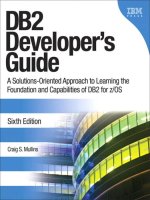
DB2 Developer’s
Guide,
Sixth Edition
ptg7913130
This page intentionally left blank
ptg7913130
DB2 Developer’s
Guide,
Sixth Edition
A Solutions-Oriented Approach to
Learning the Foundation and
Capabilities of DB2 for z/OS
Craig S. Mullins
IBM Press
Pearson plc
Upper Saddle River, NJ • Boston • Indianapolis • San Francisco
New York • Toronto • Montreal • London • Munich • Paris • Madrid
Cape Town • Sydney • Tokyo • Singapore • Mexico City
ibmpressbooks.com
ptg7913130
The author and publisher have taken care in the preparation of this book, but make no
expressed or implied warranty of any kind and assume no responsibility for errors or
omissions. No liability is assumed for incidental or consequential damages in connection
with or arising out of the use of the information or programs contained herein.
© Copyright 2012 by International Business Machines Corporation. All rights reserved.
Note to U.S. Government Users: Documentation related to restricted right. Use, duplication,
or disclosure is subject to restrictions set forth in GSA ADP Schedule Contract with IBM
Corporation.
IBM Press Program Managers: Steven M. Stansel, Ellice Uffer
Cover design: IBM Corporation
Associate Publisher: Dave Dusthimer
Marketing Manager: Stephane Nakib
Executive Editor: Mary Beth Ray
Publicist: Andrea Bledsoe
Editorial Assistant: Vanessa Evans
Senior Development Editor: Christopher Cleveland
Technical Reviewers: Willie Favero, Chuck Kosin
Managing Editor: Kristy Hart
Senior Project Editor: Lori Lyons
Copy Editor: Apostrophe Editing Services
Indexer: Brad Herriman
Compositor: Nonie Ratcliff
Proofreaders: Katherine Ruiz, Chrissy White/Language Logistics, LLC
Manufacturing Buyer: Dan Uhrig
Published by Pearson plc
Publishing as IBM Press
IBM Press offers excellent discounts on this book when ordered in quantity for bulk
purchases or special sales, which may include electronic versions and/or custom covers and
content particular to your business, training goals, marketing focus, and branding interests.
For more information, please contact
U. S. Corporate and Government Sales
1-800-382-3419
For sales outside the U. S., please contact
International Sales
ptg7913130
The following terms are trademarks of International Business Machines Corporation in
many jurisdictions worldwide:
IBM, IBM Press, DB2, z/OS, pureXML, Informix, CICS, IMS, Parallel Sysplex, Optim,
MQSeries. pureXML, DS6000, DS8000, FlashCopy, OS/390, QMF, MVS, DB2 Universal
Database, DB2 Extenders, developerWorks, RACF, WebSphere, DB2 Connect, OMEGAMON,
pureQuery, Redbooks, VTAM, Resource Measurement Facility, GDPS, System z, Distributed
Relational Database Architecture, iSeries, AS/400, AIX, zSeries, InfoSphere, Cognos, SPSS,
Clarity, and OpenPages. Netezza is a registered trademark of IBM International Group B.V.,
an IBM Company. Other product and service names might be trademarks of IBM or other
companies. A current list of IBM trademarks is available on the Web at “Copyright and
trademark information” at www.ibm.com/legal/copytrade.shtml.
Microsoft, Windows, Windows NT, and the Windows logo are trademarks of Microsoft
Corporation in the United States, other countries, or both. Java and all Java-based
trademarks and logos are trademarks or registered trademarks of Oracle and/or its affiliates.
UNIX is a registered trademark of The Open Group in the United States and other countries.
Linux is a registered trademark of Linus Torvalds in the United States, other countries, or
both.
Other company, product, or service names may be trademarks or service marks of others.
Library of Congress Cataloging-in-Publication Data
Mullins, Craig.
Db2 developer’s guide : a solutions-oriented approach to learning the foundation and
capabilities of Db2 for z/OS / Craig S. Mullins. — 6th ed.
p. cm.
Includes index.
ISBN 978-0-13-283642-5 (pbk.)
1. Database management. 2. IBM Database 2. I. Title.
QA76.9.D3M84 2012
005.75’65—dc23
2012006815
All rights reserved. This publication is protected by copyright, and permission must be
obtained from the publisher prior to any prohibited reproduction, storage in a retrieval
system, or transmission in any form or by any means, electronic, mechanical,
photocopying, recording, or likewise. For information regarding permissions, write to:
Pearson Education, Inc
Rights and Contracts Department
501 Boylston Street, Suite 900
Boston, MA 02116
Fax (617) 671 3447
ISBN-13: 978-0-13-3283642-5
ISBN-10: 0-13-283642-4
Text printed in the United States on recycled paper at Edwards Brothers Malloy, Ann Arbor,
Michigan.
First printing May 2012
ptg7913130
This book is dedicated to my mom, Donna Mullins,
and to the memory of my father, Giles R. Mullins.
Without the constant support and guidance my parents provided,
I would not have the success I enjoy today.
ptg7913130
Contents at a Glance
Introduction 1
Part I SQL Techniques, Tips, and Tricks
1 The Magic Words 3
2 Data Manipulation Guidelines 56
3 Using DB2 Functions 135
4 Using DB2 User-Defined Functions and Data Types 167
5 Data Definition Guidelines 200
6 DB2 Indexing and Hashing Guidelines 324
7 Database Change Management, Schema Evolution, and Database
Definition On Demand 353
8 Using DB2 Triggers 373
9 Large Objects and Object/Relational Databases 393
10 pureXML: Using XML in DB2 for z/OS 408
11 Supporting Temporal Data in DB2 for z/OS 428
12 DB2 Security, Authorization, and Auditing 448
Part II DB2 Application Development
13 Using DB2 in an Application Program 486
14 Dynamic SQL Programming 567
15 Program Preparation 601
16 Using DB2 Stored Procedures 656
17 DB2 and the Internet 689
Part III DB2 In-Depth
18 The Doors to DB2 704
19 Data Sharing 772
20 DB2 Behind the Scenes 792
21 The Optimizer 816
22 The Table-Based Infrastructure of DB2 874
23 Locking DB2 Data 889
Part IV DB2 Performance Monitoring
24 DB2 Performance Monitoring 928
25 Using EXPLAIN 980
26 The Five R’s 1014
27 DB2 Object Monitoring Using the DB2 Catalog and RTS 1021
Part V DB2 Performance Tuning
28 Tuning DB2’s Environment 1064
29 Tuning DB2’s Components 1089
30 DB2 Resource Governing 1143
ptg7913130
Part VI DB2 Utilities and Commands
31 An Introduction to DB2 Utilities 1152
32 Data Consistency Utilities 1176
33 Backup and Recovery Utilities 1201
34 Data Movement and Organization Utilities 1240
35 Catalog Manipulation Utilities 1289
36 Stand-Alone Utilities and Sample Programs 1314
37 DB2 Commands 1340
38 DB2 Utility and Command Guidelines 1366
39 DB2 Contingency Planning 1376
Part VII The Ideal DB2 Environment
40 Components of a Total DB2 Solution 1394
41 Organizational Issues 1423
Part VII Distributed DB2
42 DRDA 1448
43 Distributed DB2 1458
44 DB2 Connect 1473
45 Distribution Guidelines 1485
46 Data Warehousing with DB2 1506
Index 1541
DB2 Developer’s Guide, Sixth Editionxii
ptg7913130
Contents
Preface xxiii
Part I SQL Techniques, Tips, and Tricks
1 The Magic Words 3
An Overview of SQL 4
SQL Tools of the Trade 13
Static SQL 42
Dynamic SQL 44
SQL Performance Factors 45
2 Data Manipulation Guidelines 56
A Bag of Tricks 56
SQL Access Guidelines 58
Complex SQL Guidelines 90
Common Table Expressions and Recursion 110
Working with Nulls 115
Date and Time Guidelines 119
Data Modification Guidelines 125
3 Using DB2 Functions 135
Aggregate Functions 135
Scalar Functions 141
Table Functions 159
MQSeries Built-In Functions 159
XML Built-In Functions 161
The RAISE_ERROR Function 162
The CAST Operation 163
Built-In Function Guidelines 163
4 Using DB2 User-Defined Functions and Data Types 167
What Is a User-Defined Function? 167
Types of User-Defined Functions (UDFs) 168
What Is a User-Defined Data Type? 190
User-Defined Data Types (UDTs) and Strong Typing 191
ptg7913130
5 Data Definition Guidelines 200
An Overview of DB2 Database Objects 200
DB2 Databases 201
Creating and Using DB2 Table Spaces 204
DB2 Storage and STOGROUPs 239
Table Guidelines 244
General Table Guidelines 275
Normalization and Denormalization 278
Assuring Data Integrity in DB2 290
Referential Integrity 290
Views, Aliases, and Synonyms 302
Index Guidelines 313
Naming Conventions 313
Miscellaneous DDL Guidelines 322
6 DB2 Indexing and Hashing Guidelines 324
How an Index Works 324
Creating Indexes 326
DB2 Hashing and Hash Organized Tables 337
Index and Hash Guidelines 341
7 Database Change Management, Schema Evolution,
and Database Definition On Demand 353
Online Schema Changes 354
Versioning for Online Schema Changes 370
8 Using DB2 Triggers 373
What Is a Trigger? 373
Trigger Guidelines 388
9 Large Objects and Object/Relational Databases 393
Defining the Term “Object/Relational” 393
What Is a Large Object? 394
LOB Guidelines 403
DB2 Extenders 407
10 pureXML: Using XML in DB2 for z/OS 408
What Is XML? 408
pureXML 412
XML-DB2 Guidelines 425
DB2 Developer’s Guide, Sixth Editionxiv
ptg7913130
11 Supporting Temporal Data in DB2 for z/OS 428
The Need for Temporal Data 428
DB2 Temporal Support 430
Temporal Data Guidelines 446
Summary 447
12 DB2 Security, Authorization, and Auditing 448
Authorization and Privileges 448
Database Auditing 476
Using External Security (for Example, RACF, ACF2,
and Top Secret) 480
Part II DB2 Application Development
13 Using DB2 in an Application Program 486
Embedded SQL Basics 487
Embedded SQL Guidelines 489
Host Variables 504
Programming with Cursors 511
Modifying Data with Embedded SQL 525
Application Development Guidelines 527
Batch Programming Guidelines 536
Online Programming Guidelines 547
General SQL Coding Guidelines 552
Introduction to Java 554
Using REXX and DB2 563
Developing Applications Using Only SQL 565
14 Dynamic SQL Programming 567
What Is Dynamic SQL? 567
Dynamic SQL Versus Static SQL 569
The Four Classes of Dynamic SQL 576
pureQuery 588
Making Dynamic SQL More Static and Vice Versa 589
Dynamic SQL Guidelines 594
15 Program Preparation 601
Program Preparation Steps 601
Running a DB2 Program 608
Preparing a DB2 Program 609
Contents xv
ptg7913130
What Is a DBRM? 622
What Is a Plan? 622
What Is a Package? 623
What Is a Collection? 628
Versions 629
Converting DBRM-Based Plans in DB2 V10 630
Program Preparation Objects 631
Program Preparation Guidelines 632
16 Using DB2 Stored Procedures 656
What Is a Stored Procedure? 657
Implementing DB2 Stored Procedures 661
Procedural SQL 678
The Procedural DBA 683
IBM Data Studio 687
17 DB2 and the Internet 689
The Internet Phenomenon 689
Accessing DB2 over the Internet 692
Finding DB2 Information Using the Internet 695
Part III DB2 In-Depth
18 The Doors to DB2 704
DB2 Program Execution Basics 704
TSO (Time-Sharing Option) 706
CICS (Customer Information Control System) 726
IMS (Information Management System) 751
CAF (Call Attach Facility) 763
RRSAF (Recoverable Resource Manager Services Attach Facility) 767
Comparison of the Environments 768
19 Data Sharing 772
Data Sharing Benefits 772
Data Sharing Requirements 774
The DB2 Coupling Facility 778
Data Sharing Naming Conventions 782
Data Sharing Administration 783
Data Sharing Application Development Guidelines 787
Data Sharing Administration Guidelines 788
DB2 Developer’s Guide, Sixth Editionxvi
ptg7913130
20 DB2 Behind the Scenes 792
The Physical Storage of Data 792
What Makes DB2 Tick 808
Specialty Processors 812
21 The Optimizer 816
Physical Data Independence 817
How the Optimizer Works 818
Filter Factors 821
Screening 823
Access Path Strategies 824
Other Operations Performed by the Optimizer 868
22 The Table-Based Infrastructure of DB2 874
The DB2 Catalog 874
The DB2 Directory 886
23 Locking DB2 Data 889
How DB2 Manages Locking 889
Locks Versus Latches 892
Lock Duration 892
Table Space Locks 895
Table Locks 897
Page Locks 898
Row Locks 899
Lock Suspensions, Timeouts, and Deadlocks 901
Partition Independence 904
Lock Avoidance 908
Data Sharing Global Lock Management 911
LOBs and Locking 914
DB2 Locking Guidelines 916
Other DB2 Components 921
The Big Picture 922
Part IV DB2 Performance Monitoring
Defining DB2 Performance 926
Types of DB2 Performance Monitoring 927
24 DB2 Performance Monitoring 928
DB2 Traces 929
Trace Destinations 936
Contents xvii
ptg7913130
Using IFCIDs 937
Tracing Guidelines 938
Performance Monitoring and Reporting: Online and Batch 940
Monitoring and Reporting Strategy 967
Performance Profiles 970
Viewing DB2 Console Messages 972
Displaying the Status of DB2 Resources 977
Monitoring z/OS 979
25 Using EXPLAIN 980
How EXPLAIN Works 980
Access Paths and the PLAN_TABLE 982
Cost Estimates and the DSN_STATEMNT_TABLE 998
Function Resolution and the DSN_FUNCTION_TABLE 1001
Additional Explain Tables 1002
Explaining the Dynamic Statement Cache 1003
EXPLAIN Guidelines 1005
Additional Tools for Managing Access Paths 1012
26 The Five R’s 1014
Approaches to Rebinding 1014
A Best Practice Approach to Rebinding 1016
27 DB2 Object Monitoring Using the DB2 Catalog and RTS 1021
DB2 Catalog Queries 1021
Real Time Statistics 1048
Reviewing the Rules for an Effective Monitoring Strategy 1058
Part V DB2 Performance Tuning
28 Tuning DB2’s Environment 1064
Tuning the z/OS Environment 1064
Tuning the Teleprocessing Environment 1087
29 Tuning DB2’s Components 1089
Tuning the DB2 Subsystem 1089
Tuning the Database Design 1114
Tuning the Application 1116
The Causes of DB2 Performance Problems 1137
30 DB2 Resource Governing 1143
The Resource Limit Facility 1143
DB2 Developer’s Guide, Sixth Editionxviii
ptg7913130
Part VI DB2 Utilities and Commands
31 An Introduction to DB2 Utilities 1152
Generating Utility JCL 1152
Monitoring DB2 Utilities 1156
The IBM DB2 Utilities 1158
Using LISTDEF and TEMPLATE 1159
Issuing SQL Statements in DB2 Utilities 1173
32 Data Consistency Utilities 1176
The CHECK Utility 1177
The CHECK DATA Option 1177
The CHECK LOB Option 1186
The CHECK INDEX Option 1188
The REPAIR Utility 1191
The REPAIR DBD Option 1192
The REPAIR LOCATE Option 1193
The REPAIR SET Option 1196
REPAIR and Versions 1198
The REPORT Utility 1198
The DIAGNOSE Utility 1200
33 Backup and Recovery Utilities 1201
The COPY Utility 1202
The COPYTOCOPY Utility 1215
The MERGECOPY Utility 1218
The QUIESCE Utility 1220
The RECOVER Utility 1224
The REBUILD INDEX Utility 1232
The REPAIR Utility 1235
The REPORT RECOVERY Utility 1235
Backing Up and Restoring the System 1236
34 Data Movement and Organization Utilities 1240
The LOAD Utility 1240
The UNLOAD Utility 1260
The REORG Utility 1265
35 Catalog Manipulation Utilities 1289
The CATENFM Utility 1289
The CATMAINT Utility 1289
Contents xix
ptg7913130
The DSNJCNVB Utility 1290
The MODIFY RECOVERY Utility 1290
The MODIFY STATISTICS Utility 1293
The RUNSTATS Utility 1295
The STOSPACE Utility 1311
36 Stand-Alone Utilities and Sample Programs 1314
The Stand-Alone Utilities 1314
DB2 Sample Programs 1332
37 DB2 Commands 1340
DB2 Environment Commands 1340
Information-Gathering Commands 1343
Administrative Commands 1353
Environment Control Commands 1358
DSN Commands 1359
IMS Commands 1361
CICS Commands 1362
TSO Commands 1364
IRLM Commands 1364
38 DB2 Utility and Command Guidelines 1366
Utility Guidelines 1366
The Pending States 1372
39 DB2 Contingency Planning 1376
What Is a Disaster? 1376
DB2 Recovery Basics 1380
Additional DB2 Disaster Recovery Technologies 1387
DB2 Environmental Considerations 1388
DB2 Contingency Planning Guidelines 1390
Part VII The Ideal DB2 Environment
40 Components of a Total DB2 Solution 1394
DB2 Tools 1394
DB2 Tools Vendors 1420
41 Organizational Issues 1423
Education 1423
Standards and Procedures 1429
DB2 Developer’s Guide, Sixth Editionxx
ptg7913130
Operational Support 1440
Political Issues 1441
Environmental Support 1443
Tool Requirements 1443
Part VIII Distributed DB2
The Advantages of Data Distribution 1446
DB2 Data Distribution 1446
DB2 Data Warehousing 1447
42 DRDA 1448
What Is DRDA? 1448
DRDA Functions 1449
DRDA Architectures and Standards 1451
The Five DRDA Levels 1453
Putting It All Together 1455
43 Distributed DB2 1458
Distributing Data Using DB2 1458
DB2 Support for the DRDA Levels 1460
Methods of Accessing Distributed Data 1460
Packages for Static SQL 1465
Two-Phase Commit 1466
Miscellaneous Distributed Topics 1470
44 DB2 Connect 1473
An Overview of IBM DB2 Connect 1473
45 Distribution Guidelines 1485
Distribution Behind the Scenes 1485
Block Fetch 1487
Dynamic Cursor Pre-Open 1491
Distributed Performance Problems 1491
Distributed Database Design Issues 1496
Distributed Data Placement 1499
Distributed Optimization 1500
Distributed Security Guidelines 1501
Miscellaneous Distributed Guidelines 1502
Contents xxi
ptg7913130
46 Data Warehousing with DB2 1506
Defining the Basic Terms 1507
Designing a Data Warehouse 1510
Populating a Data Warehouse 1513
Accessing the Data Warehouse 1519
Managing the Data Warehouse 1520
The Big Picture 1520
IBM Data Warehousing Solutions 1521
Materialized Query Tables 1522
General Data Warehouse Guidelines 1533
DB2-Specific Data Warehousing Guidelines 1538
Index 1541
DB2 Developer’s Guide, Sixth Editionxxii
ptg7913130
Preface: A Short History of
DB2 for z/OS
Let’s go back in time…almost three decades ago…back to the wild and woolly 1980s! And
watch as our favorite DBMS, DB2, grows up over time.
Version 1 Release 1 was announced on June 7, 1983. And it became generally available
on Tuesday, April 2, 1985. I wonder if it was ready on April 1st but not released because of
April Fool’s Day? Initial DB2 development focused on the basics of making a relational
DBMS work. Early releases of DB2 were viewed by many as an “information center” DBMS,
not for production work like IMS.
Version 1 Release 2 was announced on February 4, 1986 and was released for general
availability a month later on March 7, 1986. Wow! Can you imagine waiting only a
month for a new release of DB2 these days? But that is how it happened back then. Same
thing for Version 1 Release 3, which was announced on May 19, 1987 and became GA on
June 26, 1987. DB2 V1R3 saw the introduction of date data types.
You might notice that IBM delivered “releases” of DB2 in the 1980s, whereas today
(and ever since V3) there have been only versions. Versions are major, whereas releases are
not quite as significant as a version.
Version 2 of DB2 became a reality in 1988. Version 2 Release 1 was announced in
April 1988 and delivered in September 1988. Here we start to see the gap widening again
between announcement and delivery. V2R1 was a significant release in the history of DB2.
Some mark it as the bellwether for when DB2 began to be viewed as a DBMS capable of
supporting mission critical, transaction processing workloads. Not only did V2R1 provide
many performance enhancements, but it also signaled the introduction of declarative
Referential Integrity (RI) constraints. RI was important for the acceptance of DB2 because
it helps to assure data integrity within the DBMS.
No sooner than V2R1 became GA than IBM announced Version 2 Release 2 on
October 4, 1988. But it was not until a year later that it became generally available on
September 23, 1988. DB2 V2R2 again bolstered performance in many ways. It also saw the
introduction of distributed database support (private protocol) across MVS systems.
Version 2 Release 3 was announced on September 5, 1990 and became generally avail-
able on October 25, 1991. Two significant features were added in V2R3: segmented table
spaces and packages. Segmented table spaces quickly became the de facto standard for
most DB2 data, and packages made DB2 application programs easier to support. DB2 V2R3
is also the version that beefed up distributed support with Distributed Relational Database
Architecture (DRDA). Remote unit of work distribution was not available in the initial GA
version, but IBM came out with RUOW support for DB2 V2R3 in March 1992.
DB2 Version 3 was announced in November 1993 and GA in December 1993. Now it
may look like things sped up again here, but not really. This is when the QPP program for
early support of DB2 started. QPP was announced in March 1993 and delivered to