Hackers delight
Bạn đang xem bản rút gọn của tài liệu. Xem và tải ngay bản đầy đủ của tài liệu tại đây (24.49 MB, 816 trang )
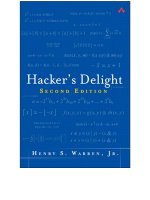
Hacker’s Delight
Second Edition
Henry S. Warren, Jr.
Upper Saddle River, NJ • Boston • Indianapolis • San Francisco
New York • Toronto • Montreal • London • Munich • Paris • Madrid
CapeTown • Sydney • Tokyo • Singapore • Mexico City
Many of the designations used by manufacturers and sellers to distinguish their products are claimed
as trademarks. Where those designations appear in this book, and the publisher was aware of a
trademark claim, the designations have been printed with initial capital letters or in all capitals.
The author and publisher have taken care in the preparation of this book, but make no expressed or
implied warranty of any kind and assume no responsibility for errors or omissions. No liability is
assumed for incidental or consequential damages in connection with or arising out of the use of the
information or programs contained herein.
The publisher offers excellent discounts on this book when ordered in quantity for bulk purchases or
special sales, which may include electronic versions and/or custom covers and content particular to
your business, training goals, marketing focus, and branding interests. For more information, please
contact:
U.S. Corporate and Government Sales
(800) 382-3419
For sales outside the United States, please contact:
International Sales
Visit us on the Web: informit.com/aw
Library of Congress Cataloging-in-Publication Data
Warren, Henry S.
Hacker’s delight / Henry S. Warren, Jr. 2nd ed.
p. cm.
Includes bibliographical references and index.
ISBN 0-321-84268-5 (hardcover : alk. paper)
1. Computer programming. I. Title.
QA76.6.W375 2013
005.1—dc23
2012026011
Copyright © 2013 Pearson Education, Inc.
All rights reserved. Printed in the United States of America. This publication is protected by
copyright, and permission must be obtained from the publisher prior to any prohibited reproduction,
storage in a retrieval system, or transmission in any form or by any means, electronic, mechanical,
photocopying, recording, or likewise. To obtain permission to use material from this work, please
submit a written request to Pearson Education, Inc., Permissions Department, One Lake Street, Upper
Saddle River, New Jersey 07458, or you may fax your request to (201) 236-3290.
ISBN-13: 978-0-321-84268-8
ISBN-10: 0-321-84268-5
Text printed in the United States on recycled paper at Courier in Westford, Massachusetts.
First printing, September 2012
To Joseph W. Gauld, my high school algebra teacher, for sparking in me a delight in the simple
things in mathematics
Contents
Foreword
Preface
CHAPTER 1. INTRODUCTION
1–1 Notation
1–2 Instruction Set and Execution Time Model
CHAPTER 2. BASICS
2–1 Manipulating Rightmost Bits
2–2 Addition Combined with Logical Operations
2–3 Inequalities among Logical and Arithmetic Expressions
2–4 Absolute Value Function
2–5 Average of Two Integers
2–6 Sign Extension
2–7 Shift Right Signed from Unsigned
2–8 Sign Function
2–9 Three-Valued Compare Function
2–10 Transfer of Sign Function
2–11 Decoding a “Zero Means 2**n” Field
2–12 Comparison Predicates
2–13 Overflow Detection
2–14 Condition Code Result of Add, Subtract, and Multiply
2–15 Rotate Shifts
2–16 Double-Length Add/Subtract
2–17 Double-Length Shifts
2–18 Multibyte Add, Subtract, Absolute Value
2–19 Doz, Max, Min
2–20 Exchanging Registers
2–21 Alternating among Two or More Values
2–22 A Boolean Decomposition Formula
2–23 Implementing Instructions for all 16 Binary Boolean Operations
CHAPTER 3. POWER-OF-2 BOUNDARIES
3–1 Rounding Up/Down to a Multiple of a Known Power of 2
3–2 Rounding Up/Down to the Next Power of 2
3–3 Detecting a Power-of-2 Boundary Crossing
CHAPTER 4. ARITHMETIC BOUNDS
4–1 Checking Bounds of Integers
4–2 Propagating Bounds through Add’s and Subtract’s
4–3 Propagating Bounds through Logical Operations
CHAPTER 5. COUNTING BITS
5–1 Counting 1-Bits
5–2 Parity
5–3 Counting Leading 0’s
5–4 Counting Trailing 0’s
CHAPTER 6. SEARCHING WORDS
6–1 Find First 0-Byte
6–2 Find First String of 1-Bits of a Given Length
6–3 Find Longest String of 1-Bits
6–4 Find Shortest String of 1-Bits
CHAPTER 7. REARRANGING BITS AND BYTES
7–1 Reversing Bits and Bytes
7–2 Shuffling Bits
7–3 Transposing a Bit Matrix
7–4 Compress, or Generalized Extract
7–5 Expand, or Generalized Insert
7–6 Hardware Algorithms for Compress and Expand
7–7 General Permutations, Sheep and Goats Operation
7–8 Rearrangements and Index Transformations
7–9 An LRU Algorithm
CHAPTER 8. MULTIPLICATION
8–1 Multiword Multiplication
8–2 High-Order Half of 64-Bit Product
8–3 High-Order Product Signed from/to Unsigned
8–4 Multiplication by Constants
CHAPTER 9. INTEGER DIVISION
9–1 Preliminaries
9–2 Multiword Division
9–3 Unsigned Short Division from Signed Division
9–4 Unsigned Long Division
9–5 Doubleword Division from Long Division
CHAPTER 10. INTEGER DIVISION BY CONSTANTS
10–1 Signed Division by a Known Power of 2
10–2 Signed Remainder from Division by a Known Power of 2
10–3 Signed Division and Remainder by Non-Powers of 2
10–4 Signed Division by Divisors ≥ 2
10–5 Signed Division by Divisors ≤ –2
10–6 Incorporation into a Compiler
10–7 Miscellaneous Topics
10–8 Unsigned Division
10–9 Unsigned Division by Divisors ≥ 1
10–10 Incorporation into a Compiler (Unsigned)
10–11 Miscellaneous Topics (Unsigned)
10–12 Applicability to Modulus and Floor Division
10–13 Similar Methods
10–14 Sample Magic Numbers
10–15 Simple Code in Python
10–16 Exact Division by Constants
10–17 Test for Zero Remainder after Division by a Constant
10–18 Methods Not Using Multiply High
10–19 Remainder by Summing Digits
10–20 Remainder by Multiplication and Shifting Right
10–21 Converting to Exact Division
10–22 A Timing Test
10–23 A Circuit for Dividing by 3
CHAPTER 11. SOME ELEMENTARY FUNCTIONS
11–1 Integer Square Root
11–2 Integer Cube Root
11–3 Integer Exponentiation
11–4 Integer Logarithm
CHAPTER 12. UNUSUAL BASES FOR NUMBER SYSTEMS
12–1 Base –2
12–2 Base –1 + i
12–3 Other Bases
12–4 What Is the Most Efficient Base?
CHAPTER 13. GRAY CODE
13–1 Gray Code
13–2 Incrementing a Gray-Coded Integer
13–3 Negabinary Gray Code
13–4 Brief History and Applications
CHAPTER 14. CYCLIC REDUNDANCY CHECK
14–1 Introduction
14–2 Theory
14–3 Practice
CHAPTER 15. ERROR-CORRECTING CODES
15–1 Introduction
15–2 The Hamming Code
15–3 Software for SEC-DED on 32 Information Bits
15–4 Error Correction Considered More Generally
CHAPTER 16. HILBERT’S CURVE
16–1 A Recursive Algorithm for Generating the Hilbert Curve
16–2 Coordinates from Distance along the Hilbert Curve
16–3 Distance from Coordinates on the Hilbert Curve
16–4 Incrementing the Coordinates on the Hilbert Curve
16–5 Non-Recursive Generating Algorithms
16–6 Other Space-Filling Curves
16–7 Applications
CHAPTER 17. FLOATING-POINT
17–1 IEEE Format
17–2 Floating-Point To/From Integer Conversions
17–3 Comparing Floating-Point Numbers Using Integer Operations
17–4 An Approximate Reciprocal Square Root Routine
17–5 The Distribution of Leading Digits
17–6 Table of Miscellaneous Values
CHAPTER 18. FORMULAS FOR PRIMES
18–1 Introduction
18–2 Willans’s Formulas
18–3 Wormell’s Formula
18–4 Formulas for Other Difficult Functions
ANSWERS TO EXERCISES
APPENDIX A. ARITHMETIC TABLES FOR A 4-BIT MACHINE
APPENDIX B. NEWTON’S METHOD
APPENDIX C. A GALLERY OF GRAPHS OF DISCRETE FUNCTIONS
C–1 Plots of Logical Operations on Integers
C–2 Plots of Addition, Subtraction, and Multiplication
C–3 Plots of Functions Involving Division
C–4 Plots of the Compress, SAG, and Rotate Left Functions
C–5 2D Plots of Some Unary Functions
Bibliography
Index
Foreword
Foreword from the First Edition
When I first got a summer job at MIT’s Project MAC almost 30 years ago, I was delighted to be able
to work with the DEC PDP-10 computer, which was more fun to program in assembly language than
any other computer, bar none, because of its rich yet tractable set of instructions for performing bit
tests, bit masking, field manipulation, and operations on integers. Though the PDP-10 has not been
manufactured for quite some years, there remains a thriving cult of enthusiasts who keep old PDP-10
hardware running and who run old PDP-10 software—entire operating systems and their applications
—by using personal computers to simulate the PDP-10 instruction set. They even write new software;
there is now at least one Web site with pages that are served up by a simulated PDP-10. (Come on,
stop laughing—it’s no sillier than keeping antique cars running.)
I also enjoyed, in that summer of 1972, reading a brand-new MIT research memo called
HAKMEM, a bizarre and eclectic potpourri of technical trivia.
1
The subject matter ranged from
electrical circuits to number theory, but what intrigued me most was its small catalog of ingenious
little programming tricks. Each such gem would typically describe some plausible yet unusual
operation on integers or bit strings (such as counting the 1-bits in a word) that could easily be
programmed using either a longish fixed sequence of machine instructions or a loop, and then show
how the same thing might be done much more cleverly, using just four or three or two carefully
chosen instructions whose interactions are not at all obvious until explained or fathomed. For me,
devouring these little programming nuggets was like eating peanuts, or rather bonbons—I just
couldn’t stop—and there was a certain richness to them, a certain intellectual depth, elegance, even
poetry.
“Surely,” I thought, “there must be more of these,” and indeed over the years I collected, and in
some cases discovered, a few more. “There ought to be a book of them.”
I was genuinely thrilled when I saw Hank Warren’s manuscript. He has systematically collected
these little programming tricks, organized them thematically, and explained them clearly. While some
of them may be described in terms of machine instructions, this is not a book only for assembly
language programmers. The subject matter is basic structural relationships among integers and bit
strings in a computer and efficient techniques for performing useful operations on them. These
techniques are just as useful in the C or Java programming languages as they are in assembly
language.
Many books on algorithms and data structures teach complicated techniques for sorting and
searching, for maintaining hash tables and binary trees, for dealing with records and pointers. They
overlook what can be done with very tiny pieces of data—bits and arrays of bits. It is amazing what
can be done with just binary addition and subtraction and maybe some bitwise operations; the fact
that the carry chain allows a single bit to affect all the bits to its left makes addition a peculiarly
powerful data manipulation operation in ways that are not widely appreciated.
Yes, there ought to be a book about these techniques. Now it is in your hands, and it’s terrific. If
you write optimizing compilers or high-performance code, you must read this book. You otherwise
might not use this bag of tricks every single day—but if you find yourself stuck in some situation
where you apparently need to loop over the bits in a word, or to perform some operation on integers
and it just seems harder to code than it ought, or you really need the inner loop of some integer or bit-
fiddly computation to run twice as fast, then this is the place to look. Or maybe you’ll just find
yourself reading it straight through out of sheer pleasure.
Guy L. Steele, Jr.
Burlington, Massachusetts
April 2002
Preface
Caveat Emptor: The cost of software
maintenance increases with the square of
the programmer’s creativity.
First Law of Programmer Creativity,
Robert D. Bliss, 1992
This is a collection of small programming tricks that I have come across over many years. Most of
them will work only on computers that represent integers in two’s-complement form. Although a 32-
bit machine is assumed when the register length is relevant, most of the tricks are easily adapted to
machines with other register sizes.
This book does not deal with large tricks such as sophisticated sorting and compiler optimization
techniques. Rather, it deals with small tricks that usually involve individual computer words or
instructions, such as counting the number of 1-bits in a word. Such tricks often use a mixture of
arithmetic and logical instructions.
It is assumed throughout that integer overflow interrupts have been masked off, so they cannot
occur. C, Fortran, and even Java programs run in this environment, but Pascal and Ada users beware!
The presentation is informal. Proofs are given only when the algorithm is not obvious, and
sometimes not even then. The methods use computer arithmetic, “floor” functions, mixtures of
arithmetic and logical operations, and so on. Proofs in this domain are often difficult and awkward to
express.
To reduce typographical errors and oversights, many of the algorithms have been executed. This is
why they are given in a real programming language, even though, like every computer language, it has
some ugly features. C is used for the high-level language because it is widely known, it allows the
straightforward mixture of integer and bit-string operations, and C compilers that produce high-
quality object code are available.
Occasionally, machine language is used, employing a three-address format, mainly for ease of
readability. The assembly language used is that of a fictitious machine that is representative of
today’s RISC computers.
Branch-free code is favored, because on many computers, branches slow down instruction fetching
and inhibit executing instructions in parallel. Another problem with branches is that they can inhibit
compiler optimizations such as instruction scheduling, commoning, and register allocation. That is,
the compiler may be more effective at these optimizations with a program that consists of a few large
basic blocks rather than many small ones.
The code sequences also tend to favor small immediate values, comparisons to zero (rather than to
some other number), and instruction-level parallelism. Although much of the code would become
more concise by using table lookups (from memory), this is not often mentioned. This is because
loads are becoming more expensive relative to arithmetic instructions, and the table lookup methods
are often not very interesting (although they are often practical). But there are exceptional cases.
Finally, I should mention that the term “hacker” in the title is meant in the original sense of an
aficionado of computers—someone who enjoys making computers do new things, or do old things in
a new and clever way. The hacker is usually quite good at his craft, but may very well not be a
professional computer programmer or designer. The hacker’s work may be useful or may be just a
game. As an example of the latter, more than one determined hacker has written a program which,
when executed, writes out an exact copy of itself.
1
This is the sense in which we use the term
“hacker.” If you’re looking for tips on how to break into someone else’s computer, you won’t find
them here.
Acknowledgments
First, I want to thank Bruce Shriver and Dennis Allison for encouraging me to publish this book. I am
indebted to many colleagues at IBM, several of whom are cited in the Bibliography. One deserves
special mention: Martin E. Hopkins, whom I think of as “Mr. Compiler” at IBM, has been relentless
in his drive to make every cycle count, and I’m sure some of his spirit has rubbed off on me. Addison-
Wesley’s reviewers have improved the book immensely. Most of their names are unknown to me, but
the review by one whose name I did learn was truly outstanding: Guy L. Steele, Jr., completed a 50-
page review that included new subject areas to address, such as bit shuffling and unshuffling, the
sheep and goats operation, and many others. He suggested algorithms that beat the ones I used. He
was extremely thorough. For example, I had erroneously written that the hexadecimal number
AAAAAAAA factors as 2 · 3 · 17 · 257 · 65537; Guy pointed out that the 3 should be a 5. He
suggested improvements to style and did not shirk from mentioning minutiae. Wherever you see
“parallel prefix” in this book, the material is due to Guy.
H. S. Warren, Jr.
Yorktown, New York
June 2012
See www.HackersDelight.org for additional material related to this book.
Chapter 1. Introduction
1–1 Notation
This book distinguishes between mathematical expressions of ordinary arithmetic and those that
describe the operation of a computer. In “computer arithmetic,” operands are bit strings, or bit
vectors, of some definite fixed length. Expressions in computer arithmetic are similar to those of
ordinary arithmetic, but the variables denote the contents of computer registers. The value of a
computer arithmetic expression is simply a string of bits with no particular interpretation. An
operator, however, interprets its operands in some particular way. For example, a comparison
operator might interpret its operands as signed binary integers or as unsigned binary integers; our
computer arithmetic notation uses distinct symbols to make the type of comparison clear.
The main difference between computer arithmetic and ordinary arithmetic is that in computer
arithmetic, the results of addition, subtraction, and multiplication are reduced modulo 2
n
, where n is
the word size of the machine. Another difference is that computer arithmetic includes a large number
of operations. In addition to the four basic arithmetic operations, computer arithmetic includes logical
and, exclusive or, compare, shift left, and so on.
Unless specified otherwise, the word size is 32 bits, and signed integers are represented in two’s-
complement form.
Expressions of computer arithmetic are written similarly to those of ordinary arithmetic, except that
the variables that denote the contents of computer registers are in bold face type. This convention is
commonly used in vector algebra. We regard a computer word as a vector of single bits. Constants
also appear in bold-face type when they denote the contents of a computer register. (This has no
analogy with vector algebra because in vector algebra the only way to write a constant is to display
the vector’s components.) When a constant denotes part of an instruction, such as the immediate field
of a shift instruction, light-face type is used.
If an operator such as “+” has bold face operands, then that operator denotes the computer’s
addition operation (“vector addition”). If the operands are light-faced, then the operator denotes the
ordinary scalar arithmetic operation. We use a light-faced variable x to denote the arithmetic value of
a bold-faced variable x under an interpretation (signed or unsigned) that should be clear from the
context. Thus, if x = 0x80000000 and y = 0x80000000, then, under signed integer interpretation, x = y
= –2
31
, x + y = – 2
32
, and x + y = 0. Here, 0x80000000 is hexadecimal notation for a bit string
consisting of a 1-bit followed by 31 0-bits.
Bits are numbered from the right, with the rightmost (least significant) bit being bit 0. The terms
“bits,” “nibbles,” “bytes,” “halfwords,” “words,” and “doublewords” refer to lengths of 1, 4, 8, 16,
32, and 64 bits, respectively.
Short and simple sections of code are written in computer algebra, using its assignment operator
(left arrow) and occasionally an if statement. In this role, computer algebra is serving as little more
than a machine-independent way of writing assembly language code.
Programs too long or complex for computer algebra are written in the C programming language, as
defined by the ISO 1999 standard.
A complete description of C would be out of place in this book, but Table 1–1 contains a brief
summary of most of the elements of C [H&S] that are used herein. This is provided for the benefit of
the reader who is familiar with some procedural programming language, but not with C. Table 1–1
also shows the operators of our computer-algebraic arithmetic language. Operators are listed from
highest precedence (tightest binding) to lowest. In the Precedence column, L means left-associative;
that is,
a • b • c = (a • b) • c
and R means right-associative. Our computer-algebraic notation follows C in precedence and
associativity.
TABLE 1–1. EXPRESSIONS OF C AND COMPUTER ALGEBR
In addition to the notations described in Table 1–1, those of Boolean algebra and of standard
mathematics are used, with explanations where necessary.
Our computer algebra uses other functions in addition to “abs,” “rem,” and so on. These are
defined where introduced.
In C, the expression x < y < z means to evaluate x < y to a 0/1-valued result, and then compare that
result to z. In computer algebra, the expression x < y < z means (x < y) & (y < z).
C has three loop control statements: while, do, and for. The while statement is written:
while (expression) statement
First, expression is evaluated. If true (nonzero), statement is executed and control returns to evaluate
expression again. If expression is false (0), the while-loop terminates.
The do statement is similar, except the test is at the bottom of the loop. It is written:
do statement while (expression)
First, statement is executed, and then expression is evaluated. If true, the process is repeated, and if
false, the loop terminates.
The for statement is written:
for (e
1
; e
2
; e
3
) statement
First, e
1
, usually an assignment statement, is executed. Then e
2
, usually a comparison, is evaluated. If
false, the for-loop terminates. If true, statement is executed. Finally, e
3
, usually an assignment
statement, is executed, and control returns to evaluate e
2
again. Thus, the familiar “do i = 1 to n” is
written:
Click here to view code image
for (i = 1; i <= n; i++)
(This is one of the few contexts in which we use the postincrement operator.)
The ISO C standard does not specify whether right shifts (“>>” operator) of signed quantities are 0-
propagating or sign-propagating. In the C code herein, it is assumed that if the left operand is signed,
then a sign-propagating shift results (and if it is unsigned, then a 0-propagating shift results, following
ISO). Most modern C compilers work this way.
It is assumed here that left shifts are “logical.” (Some machines, mostly older ones, provide an
“arithmetic” left shift, in which the sign bit is retained.)
Another potential problem with shifts is that the ISO C standard specifies that if the shift amount is
negative or is greater than or equal to the width of the left operand, the result is undefined. But, nearly
all 32-bit machines treat shift amounts modulo 32 or 64. The code herein relies on one of these
behaviors; an explanation is given when the distinction is important.
1–2 Instruction Set and Execution Time Model
To permit a rough comparison of algorithms, we imagine them being coded for a machine with an
instruction set similar to that of today’s general purpose RISC computers, such as the IBM RS/6000,
the Oracle SPARC, and the ARM architecture. The machine is three-address and has a fairly large
number of general purpose registers—that is, 16 or more. Unless otherwise specified, the registers
are 32 bits long. General register 0 contains a permanent 0, and the others can be used uniformly for
any purpose.
In the interest of simplicity there are no “special purpose” registers, such as a condition register or
a register to hold status bits, such as “overflow.” The machine has no floating-point instructions.
Floating-point is only a minor topic in this book, being mostly confined to Chapter 17.
We recognize two varieties of RISC: a “basic RISC,” having the instructions shown in Table 1–2,
and a “full RISC,” having all the instructions of the basic RISC, plus those shown in Table 1–3.
TABLE 1–2. BASIC RISC INSTRUCTION SET
TABLE 1–3. ADDITIONAL INSTRUCTIONS FOR THE “FULL RISC”
In Tables 1–2, 1–3, and 1–4, RA and RB appearing as source operands really means the contents
of those registers.
A real machine would have branch and link (for subroutine calls), branch to the address contained
in a register (for subroutine returns and “switches”), and possibly some instructions for dealing with
special purpose registers. It would, of course, have a number of privileged instructions and
instructions for calling on supervisor services. It might also have floating-point instructions.
Some other computational instructions that a RISC computer might have are identified in Table 1–
3. These are discussed in later chapters.
It is convenient to provide the machine’s assembler with a few “extended mnemonics.” These are
like macros whose expansion is usually a single instruction. Some possibilities are shown in Table
1–4.
TABLE 1–4. EXTENDED MNEMONICS
The load immediate instruction expands into one or two instructions, as required by the immediate
value I. For example, if 0 ≤ I < 2
16
, an or immediate (ori) from R0 can be used. If – 2
15
≤ I < 0, an
add immediate (addi) from R0 can be used. If the rightmost 16 bits of I are 0, add immediate shifted
(addis) can be used. Otherwise, two instructions are required, such as addis followed by ori.
(Alternatively, in the last case, a load from memory could be used, but for execution time and space
estimates we assume that two elementary arithmetic instructions are used.)
Of course, which instructions belong in the basic RISC and which belong in the full RISC is very
much a matter of judgment. Quite possibly, divide unsigned and the remainder instructions should be
moved to the full RISC category. Conversely, possibly load byte signed should be in the basic RISC
category. It is in the full RISC set because it is probably of rather low frequency of use, and because
in some technologies it is difficult to propagate a sign bit through so many positions and still make
cycle time.
The distinction between basic and full RISC involves many other such questionable judgments, but
we won’t dwell on them.
The instructions are limited to two source registers and one target, which simplifies the computer
(e.g., the register file requires no more than two read ports and one write port). It also simplifies an
optimizing compiler, because the compiler does not need to deal with instructions that have multiple
targets. The price paid for this is that a program that wants both the quotient and remainder of two
numbers (not uncommon) must execute two instructions (divide and remainder). The usual machine
division algorithm produces the remainder as a by-product, so many machines make them both
available as a result of one execution of divide. Similar remarks apply to obtaining the doubleword
product of two words.
The conditional move instructions (e.g., moveq) ostensibly have only two source operands, but in a
sense they have three. Because the result of the instruction depends on the values in RT, RA, and RB,
a machine that executes instructions out of order must treat RT in these instructions as both a use and
a set. That is, an instruction that sets RT, followed by a conditional move that sets RT, must be
executed in that order, and the result of the first instruction cannot be discarded. Thus, the designer of
such a machine may elect to omit the conditional move instructions to avoid having to consider an
instruction with (logically) three source operands. On the other hand, the conditional move
instructions do save branches.
Instruction formats are not relevant to the purposes of this book, but the full RISC instruction set
described above, with floating-point and a few supervisory instructions added, can be implemented
with 32-bit instructions on a machine with 32 general purpose registers (5-bit register fields). By
reducing the immediate fields o f compare, load, store, and trap instructions to 14 bits, the same
holds for a machine with 64 general purpose registers (6-bit register fields).
Execution Time
We assume that all instructions execute in one cycle, except for the multiply, divide, and remainder
instructions, for which we do not assume any particular execution time. Branches take one cycle
whether they branch or fall through.
The load immediate instruction is counted as one or two cycles, depending on whether one or two
elementary arithmetic instructions are required to generate the constant in a register.
Although load and store instructions are not often used in this book, we assume they take one cycle
and ignore any load delay (time lapse between when a load instruction completes in the arithmetic
unit and when the requested data is available for a subsequent instruction).
However, knowing the number of cycles used by all the arithmetic and logical instructions is often
insufficient for estimating the execution time of a program. Execution can be slowed substantially by
load delays and by delays in fetching instructions. These delays, although very important and
increasing in importance, are not discussed in this book. Another factor, one that improves execution
time, is what is called “instruction-level parallelism,” which is found in many contemporary RISC
chips, particularly those for “high-end” machines.
These machines have multiple execution units and sufficient instruction-dispatching capability to
execute instructions in parallel when they are independent (that is, when neither uses a result of the
other, and they don’t both set the same register or status bit). Because this capability is now quite
common, the presence of independent operations is often pointed out in this book. Thus, we might say
that such and such a formula can be coded in such a way that it requires eight instructions and
executes in five cycles on a machine with unlimited instruction-level parallelism. This means that if
the instructions are arranged in the proper order (“scheduled”), a machine with a sufficient number of
adders, shifters, logical units, and registers can, in principle, execute the code in five cycles.
We do not make too much of this, because machines differ greatly in their instruction-level
parallelism capabilities. For example, an IBM RS/6000 processor from ca. 1992 has a three-input
adder and can execute two consecutive add-type instructions in parallel even when one feeds the
other (e.g., an add feeding a compare, or the base register of a load). As a contrary example,
consider a simple computer, possibly for low-cost embedded applications, that has only one read
port on its register file. Normally, this machine would take an extra cycle to do a second read of the
register file for an instruction that has two register input operands. However, suppose it has a bypass
so that if an instruction feeds an operand of the immediately following instruction, then that operand is
available without reading the register file. On such a machine, it is actually advantageous if each
instruction feeds the next—that is, if the code has no parallelism.
Exercises
1. Express the loop
for (e
1
; e
2
; e
3
) statement
in terms of a while loop.
Can it be expressed as a do loop?
2. Code a loop in C in which the unsigned integer control variable i takes on all values from 0 to
and including the maximum unsigned number, 0xFFFFFFFF (on a 32-bit machine).
3. For the more experienced reader: The instructions of the basic and full RISCs defined in this
book can be executed with at most two register reads and one write. What are some common or
plausible RISC instructions that either need more source operands or need to do more than one
register write?
Chapter 2. Basics
2–1 Manipulating Rightmost Bits
Some of the formulas in this section find application in later chapters.
Use the following formula to turn off the rightmost 1-bit in a word, producing 0 if none (e.g.,
01011000 ⇒ 01010000):
x & (x – 1)
This can be used to determine if an unsigned integer is a power of 2 or is 0: apply the formula
followed by a 0-test on the result.
Use the following formula to turn on the rightmost 0-bit in a word, producing all 1’s if none (e.g.,
10100111 ⇒ 10101111):
x | (x + 1)
Use the following formula to turn off the trailing 1’s in a word, producing x if none (e.g., 10100111
⇒ 10100000):
x & (x + 1)
This can be used to determine if an unsigned integer is of the form 2
n
– 1, 0, or all 1’s: apply the
formula followed by a 0-test on the result.
Use the following formula to turn on the trailing 0’s in a word, producing x if none (e.g., 10101000
⇒ 10101111):
x | (x– 1)
Use the following formula to create a word with a single 1-bit at the position of the rightmost 0-bit
in x, producing 0 if none (e.g., 10100111 ⇒ 00001000):
¬x & (x + 1)
Use the following formula to create a word with a single 0-bit at the position of the rightmost 1-bit
in x, producing all 1’s if none (e.g., 10101000 ⇒ 11110111):
¬x | (x – 1)
Use one of the following formulas to create a word with 1’s at the positions of the trailing 0’s in x,
and 0’s elsewhere, producing 0 if none (e.g., 01011000 ⇒ 00000111):
The first formula has some instruction-level parallelism.
Use the following formula to create a word with 0’s at the positions of the trailing 1’s in x, and 0’s
elsewhere, producing all 1’s if none (e.g., 10100111 ⇒ 11111000):
¬x | (x + 1)
Use the following formula to isolate the rightmost 1-bit, producing 0 if none (e.g., 01011000 ⇒
00001000):
x & (−x)
Use the following formula to create a word with 1’s at the positions of the rightmost 1-bit and the
trailing 0’s in x, producing all 1’s if no 1-bit, and the integer 1 if no trailing 0’s (e.g., 01011000 ⇒
00001111):
x ⊕ (x − 1)
Use the following formula to create a word with 1’s at the positions of the rightmost 0-bit and the
trailing 1’s in x, producing all 1’s if no 0-bit, and the integer 1 if no trailing 1’s (e.g., 01010111 ⇒
00001111):
x ⊕ (x + 1)
Use either of the following formulas to turn off the rightmost contiguous string of 1’s (e.g.,
01011100 ==> 01000000) [Wood]:
(((x | (x − 1)) + 1) & x), or
((x & −x) + x)&x
These can be used to determine if a nonnegative integer is of the form 2
j
− 2
k
for some j ≥ k≥ 0: apply
the formula followed by a 0-test on the result.
De Morgan’s Laws Extended
The logical identities known as De Morgan’s laws can be thought of as distributing, or “multiplying
in,” the not sign. This idea can be extended to apply to the expressions of this section, and a few
more, as shown here. (The first two are De Morgan’s laws.)
As an example of the application of these formulas, ¬(x | –(x + 1)) = ¬x &¬–(x + 1) = ¬x & ((x +
1) – 1) = ¬x & x = 0.