Encyclopedia of geology, five volume set, volume 1 5 (encyclopedia of geology series) ( PDFDrive ) 452
Bạn đang xem bản rút gọn của tài liệu. Xem và tải ngay bản đầy đủ của tài liệu tại đây (161.78 KB, 1 trang )
EARTH/Orbital Variation (Including Milankovitch Cycles) 413
Figure 3 Orbital motions of Earth, showing the main Earth orbital parameters, eccentricity, obliquity, and precession of the
equinoxes.
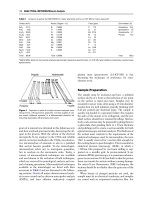
Table 2 Five leading terms for Earth’s eccentricitya
Term
g2
g4
g4
g3
g3
g5
g5
g2
g5
g2
Frequency ( 00 year 1)
Period (ky)
Amplitude
3.1996
13.6665
10.4615
13.1430
9.9677
406.182
94.830
123.882
98.607
130.019
0.0109
0.0092
0.0071
0.0059
0.0053
a
Principal eccentricity frequency components in an astronomical
solution analysed over the past 4 My. The frequency terms gi
refer to those given in Table 1.
Data from Laskar J (1999) The limits of Earth orbital calculations
for geological time scale use. Philosophical Transactions of the
Royal Society of London, Series A, Mathematical, Physical and
Engineering Sciences 357(1757): 1735 1759.
second and third strongest eccentricity components is
(g4 À g5) À (g4 À g2) ¼ (g2 À g5), which corresponds to
the $400-ky eccentricity cycle. The same modulation
is observed for the fourth and fifth strongest terms.
This type of amplitude modulation can be found in
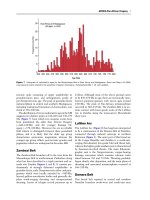
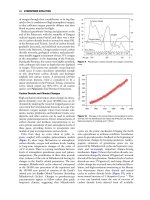
Figure 4 Earth’s orbital eccentricity over time (1.2 million
years) and frequency analysis for a 10 My time span. The peaks
in the frequency analysis correspond to the frequencies given in
Table 2; the numbers over the peaks represent the periods
(in thousands of years).
all orbital components of Earth. The nature of
eccentricity variations is illustrated in Figure 4. The
superposition of the long and short eccentricity
cycles, and their variation in amplitude, are clearly
visible. The right-hand side of the plot shows the