Old-Time Makers of Medicine, by James J. Walsh doc
Bạn đang xem bản rút gọn của tài liệu. Xem và tải ngay bản đầy đủ của tài liệu tại đây (2.24 MB, 1,207 trang )
The Project Gutenberg EBook of Old-Time
Makers of Medicine, by James J. Walsh
This eBook is for the use of anyone
anywhere at no cost and with
almost no restrictions whatsoever. You
may copy it, give it away or
re-use it under the terms of the Project
Gutenberg License included
with this eBook or online at
www.gutenberg.org
Title: Old-Time Makers of Medicine
The Story of The Students And Teachers
of the Sciences
Related to Medicine During the Middle
Ages
Author: James J. Walsh
Release Date: December 30, 2006 [EBook
#20216]
Language: English
*** START OF THIS PROJECT GUTENBERG
EBOOK OLD-TIME MAKERS OF MEDICINE ***
Produced by Suzanne Lybarger, Irma pehar
and the Online
Distributed Proofreading Team at
(This
file was produced from images generously
made available
by The Internet Archive/Canadian
Libraries)
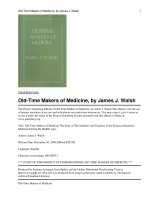
Old-Time
Makers of
Medicine
THE STORY OF THE
STUDENTS AND
TEACHERS
OF THE SCIENCES
RELATED TO MEDICINE
DURING THE MIDDLE
AGES
BY
James J. Walsh, K.C.St.G.,
M.D.
Ph.D., LL.D., Litt.D., Sc.D.
DEAN AND PROFESSOR OF NERVOUS DISEASES AND
OF THE HISTORY OF MEDICINE AT
FORDHAM UNIVERSITY SCHOOL OF MEDICINE;
PROFESSOR OF PHYSIOLOGICAL
PSYCHOLOGY AT THE CATHEDRAL COLLEGE, NEW
YORK
NEW YORK
FORDHAM UNIVERSITY PRESS
1911
Copyright 1911
JAMES J. WALSH
THE QUINN & GODEN CO. PRESS
RAHWAY, N. J.
TO
REVEREND DANIEL J. QUINN,
S.J.
The historical material here
presented was gathered for my
classes at Fordham University
School of Medicine during your
term as president of the
University. It seems only fitting
then, that when put into more
permanent form it should appear
under the patronage of your
name and tell of my cordial
appreciation of more than a
quarter of a century of valued
friendship.
"When we have thoroughly
mastered contemporary science
it is time to turn to past science;
nothing fortifies the judgment
more than this comparative
study; impartiality of mind is
developed thereby, the
uncertainties of any system
become manifest. The authority
of facts is there confirmed, and
we discover in the whole
picture a philosophic teaching
which is in itself a lesson; in
other words, we learn to know,
to understand, and to
judge."—Littré: Œuvres
d'Hippocrate, T. I, p. 477.
"There is not a single
development, even the most
advanced of contemporary
medicine, which is not to be
found in embryo in the medicine
of the olden time."—Littré:
Introduction to the Works of
Hippocrates.
"How true it is that in reading
this history one finds modern
discoveries that are anything but
discoveries, unless one
supposes that they have been
made twice."—Dujardin:
Histoire de la Chirurgie, Paris,
1774 (quoted by Gurlt on the
post title-page of his Geschichte
der Chirurgie, Berlin, 1898).
PREFACE
The material for this book was
gathered partly for lectures on the
history of medicine at Fordham
University School of Medicine, and
partly for articles on a number of
subjects in the Catholic Encyclopedia.
Some of it was developed for a series of
addresses at commencements of medical
schools and before medical societies, on
the general topic how old the new is in
surgery, medicine, dentistry, and
pharmacy. The information thus
presented aroused so much interest, the
accomplishments of the physicians and
surgeons of a period that is usually
thought quite sterile in medical science
proved, indeed, so astonishing, that I
was tempted to connect the details for a
volume in the Fordham University Press
series. There is no pretence to any
original investigation in the history of
medicine, nor to any extended
consultation of original documents. I
have had most of the great books that are
mentioned in the course of this volume in
my hands, and have given as much time
to the study of them as could be afforded
in the midst of a rather busy life, but I
owe my information mainly to the
distinguished German and French
scholars who have in recent years made
deep and serious studies of these Old
Makers of Medicine, and I have made
my acknowledgments to them in the text
as opportunity presented itself.
There is just one feature of the book
that may commend it to present-day
readers, and that is that our medieval
medical colleagues, when medicine
embraced most of science, faced the
problems of medicine and surgery and
the allied sciences that are now
interesting us, in very much the same
temper of mind as we do, and very often
anticipated our solutions of them—much
oftener, indeed, than most of us, unless
we have paid special attention to
history, have any idea of. The volume
does not constitute, then, a contribution
to that theme that has interested the last
few generations so much,—the supposed
continuous progress of the race and its
marvellous advance,—but rather
emphasizes that puzzling question, how
is it that men make important discoveries
and inventions, and then, after a time,
forget about them so that they have to be
made over again? This is as true in
medical science and in medical practice
as in every other department of human
effort. It does not seem possible that
mankind should ever lose sight of the
progress in medicine and surgery that
has been made in recent years, yet the
history of the past would seem to
indicate that, in spite of its unlikelihood,
it might well come about. Whether this is
the lesson of the book or not, I shall
leave readers to judge, for it was not
intentionally put into it.
OUR LADY'S DAY IN HARVEST, 1911.
CONTENTS
CHAPTER
PAGE
I. Introduction 1
II.
Great Physicians in
Early Christian
Times
23
III.
Great Jewish
Physicians
61
IV. Maimonides 90
V.
Great Arabian
Physicians
109
VI.
The Medical School
at Salerno
141
Constantine
VII. Africanus 163
VIII.
Medieval Women
Physicians
177
IX.
Mondino and the
Medical School of
Bologna
202
X.
Great Surgeons of the
Medieval
Universities
234
XI. Guy de Chauliac 282
XII.
Medieval Dentistry
—Giovanni of Arcoli
313
XIII.
Cusanus and the First
Suggestion of
Laboratory Methods
in Medicine
336
Basil Valentine, Last
XIV. of the Alchemists,
First of the Chemists
349
APPENDICES
I.
St. Luke the
Physician
381
II.
Science at the
Medieval
Universities
400
III.
Medieval
Popularization of
Science
427
"Of making many books there
is no end."—Eccles. xii, 12
(circa 1000 b.c.).
"The little by-play between
Socrates and Euthydemus
suggests an advanced condition
of medical literature: 'Of course,
you who have so many books
are going in for being a doctor,'
says Socrates, and then he adds,
'there are so many books on
medicine, you know.' As Dyer
remarks, whatever the quality of
these books may have been, their
number must have been great to
give point to this
chaff."—Aequanimitas, William
Osler, M.D., F.R.S., Blakistons,
Philadelphia, 1906.
"Augescunt aliae gentes, aliae
minuuntur;
Inque brevi spatio mutantur
saecla animantum,
Et, quasi cursores vitai lampada
tradunt."
—
OVID.
One nation rises to supreme
power in the world, while
another declines, and, in a brief
space of time, the sovereign
people change, transmitting, like
racers, the lamp of life to some
other that is to succeed them.
"There is one Science of
Medicine which is concerned
with the inspection of health
equally in all times, present,
past and future."
—PLATO.
I
INTRODUCTION
Under the term Old-Time Medicine
most people probably think at once of
Greek medicine, since that developed in
what we have called ancient history, and
is farthest away from us in date. As a
matter of fact, however, much more is
known about Greek medical writers than
those of any other period except the last
century or two. Our histories of
medicine discuss Greek medicine at
considerable length and practically all
of the great makers of medicine in
subsequent generations have been
influenced by the Greeks. Greek
physicians whose works have come
down to us seem nearer to us than the
medical writers of any but the last few
centuries. As a consequence we know
and appreciate very well as a rule how
much Greek medicine accomplished, but
in our admiration for the diligent
observation and breadth of view of the
Greeks, we are sometimes prone to think
that most of the intervening generations
down to comparatively recent times
made very little progress and, indeed,
scarcely retained what the Greeks had
done. The Romans certainly justify this
assumption of non-accomplishment in
medicine, but then in everything
intellectual Rome was never much better
than a weak copy of Greek thought. In
science the Romans did nothing at all
worth while talking about. All their
medicine they borrowed from the
Greeks, adding nothing of their own.
What food for thought there is in the fact,
that in spite of all Rome's material
greatness and wide empire, her world
dominance and vaunted prosperity, we
have not a single great original scientific
thought from a Roman.
Though so much nearer in time
medieval medicine seems much farther
away from us than is Greek medicine.
Most of us are quite sure that the
impression of distance is due to its
almost total lack of significance. It is
with the idea of showing that the
medieval generations, as far as was
possible in their conditions, not only
preserved the old Greek medicine for us
in spite of the most untoward
circumstances, but also tried to do
whatever they could for its development,
and actually did much more than is
usually thought, that this story of "Old-
Time Makers of Medicine" is written. It
represents a period—that of the Middle
Ages—that is, or was until recently,
probably more misunderstood than any
other in human history. The purpose of
the book is to show at least the important
headlands that lie along the stream of
medical thought during the somewhat