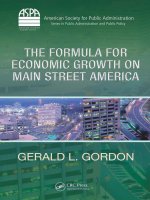
The Formula For economic GrowTh on main STreeT america pdf
Bạn đang xem bản rút gọn của tài liệu. Xem và tải ngay bản đầy đủ của tài liệu tại đây (1.94 MB, 188 trang )
Endorsements
“Local economic growth requires true leadership. Dr. Gordon’s 25
years of experience in Fairfax County have yielded the kinds of valu-
able insights that can benefit other communities.”
Steven L. Davis
Chairman, Fairfax County Economic Development Authority and
Former Senior Executive, Exxon Mobil Corporation
“As the Congressman from Virginia’s 11th Congressional District, I
was aware that the economic growth of the entire Washington, D.C.,
region, as well as that of the Commonwealth of Virginia, was largely
dependent upon what happened in Fairfax County, Virginia.”
e Honorable omas M. Davis III
Former United States Congressman
“rough a Fulbright grant for Senior Scholars, Dr. Gordon has
made invaluable contributions to the economic planning of the North
Highlands region of Scotland. His counsel to a community that is
about to lose its primary employer and financial resource has been com-
prehensive, insightful, and motivational.”
Lord Robert MacLennan
Member, British House of Lords
“Dr. Gordon has provided a comprehensive, analytic and clear look at
the importance and complexity of economic growth. His book provides
a necessary framework and concrete examples. He nicely separates facts
from opinions, and delineates both the subjective and objective aspects
of economic growth. His style makes this an important read for both
the expert and the student.”
Dr. Alan Merten
President, George Mason University, Fairfax, Virginia
“Dr. Gordon’s service as an adjunct professor at the Catholic University
of America gives our students an opportunity to hear from an acknowl-
edged expert about how local economies grow and develop. is book
will be a valuable addition to the literature in the field because it was
written by an accomplished academic and a leader in the economic
development profession.”
Dr. Phillip Henderson
Chairman, Department of Politics, Catholic University of America,
Washington, D.C.
“Fairfax County and the southeast of England have established a part-
nership that has been beneficial to both sides of the Atlantic. Fairfax
County is in the forefront of international economic development.”
Michael Dewick
Head of International Business—Americas, South East England
Development Agency
The Formula For
economic GrowTh on
main STreeT america
American Society for Public Administration
Book Series on Public Administration & Public Policy
Evan M. Berman, Ph.D.
Editor-in-Chief
Mission: Throughout its history, ASPA has sought to be true to its founding prin-
ciples of promoting scholarship and professionalism within the public service. The
ASPA Book Series on Public Administration and Public Policy publishes books that
increase national and international interest for public administration and which dis-
cuss practical or cutting edge topics in engaging ways of interest to practitioners,
policy-makers, and those concerned with bringing scholarship to the practice of pub-
lic administration.
The Formula for Economic Growth on Main Street America, Gerald L. Gordon
The New Face of Government: How Public Managers Are Forging a New
Approach to Governance, David E. McNabb
The Facilitative Leader in City Hall: Reexamining the Scope
and Contributions, James H. Svara
The Formula For
economic GrowTh on
main STreeT america
Gerald l. Gordon
American Society for Public Administration
Series in Public Administration and Public Policy
CRC Press
Taylor & Francis Group
6000 Broken Sound Parkway NW, Suite 300
Boca Raton, FL 33487-2742
© 2010 by Taylor and Francis Group, LLC
CRC Press is an imprint of Taylor & Francis Group, an Informa business
No claim to original U.S. Government works
Printed in the United States of America on acid-free paper
10 9 8 7 6 5 4 3 2 1
International Standard Book Number: 978-1-4200-9389-6 (Hardback)
This book contains information obtained from authentic and highly regarded sources. Reasonable efforts
have been made to publish reliable data and information, but the author and publisher cannot assume
responsibility for the validity of all materials or the consequences of their use. The authors and publishers
have attempted to trace the copyright holders of all material reproduced in this publication and apologize to
copyright holders if permission to publish in this form has not been obtained. If any copyright material has
not been acknowledged please write and let us know so we may rectify in any future reprint.
Except as permitted under U.S. Copyright Law, no part of this book may be reprinted, reproduced, transmit-
ted, or utilized in any form by any electronic, mechanical, or other means, now known or hereafter invented,
including photocopying, microfilming, and recording, or in any information storage or retrieval system,
without written permission from the publishers.
For permission to photocopy or use material electronically from this work, please access www.copyright.
com ( or contact the Copyright Clearance Center, Inc. (CCC), 222 Rosewood
Drive, Danvers, MA 01923, 978-750-8400. CCC is a not-for-profit organization that provides licenses and
registration for a variety of users. For organizations that have been granted a photocopy license by the CCC,
a separate system of payment has been arranged.
Trademark Notice: Product or corporate names may be trademarks or registered trademarks, and are used
only for identification and explanation without intent to infringe.
Library of Congress Cataloging‑in‑Publication Data
Gordon, Gerald L.
The formula for economic growth on Main Street America / Gerald L. Gordon.
p. cm. (American Society for Public Administration book series on public
administration & public policy)
Includes bibliographical references and index.
ISBN 978-1-4200-9389-6 (hardcover : alk. paper)
1. Economic development United States. 2. Community development United States.
3. Local government United States. I. Title. II. Series.
HC110.E44G67 2010
338.973 dc22 2009022514
Visit the Taylor & Francis Web site at
and the CRC Press Web site at
is book is dedicated to my wife and family as well as to the men
and women of the staff and commission of the Fairfax County
Economic Development Authority. eir collective wisdom,
effectiveness, and dedication are constant sources of inspiration.
ix
Contents
List of Figures xiii
List of Tables xv
Preface xvii
About the Author xxi
1 Defining Economic Growth in a Changing Business Climate 1
1.1 Introduction 1
1.2 Economic Growth in Post–World War II America 2
1.3 Changing Views of Community Economic Growth through
the 1970s, 1980s, and 1990s 9
1.4 Births and Deaths of Companies, Industries, and Regions 12
1.5 Winners and Losers: Communities at the End of the Twentieth
Century 13
1.6 Twenty-First Century Growth: Do Communities Compete in a
Zero-Sum Game? 14
1.7 A Working Definition of Local Economic Growth 16
1.8 e Relevance of Economic Growth to Today’s Communities
and Leadership 17
1.9 Concluding oughts 18
Notes 19
2 Viewing Economic Growth as Part of a Comprehensive
Community Strategy 21
2.1 Introduction 21
2.2 Static Growth: If Communities Do Not Grow, Do ey Die? 22
2.3 Building Economic Growth into the Master Plan 24
2.4 eoretical Foundations for Local Economic Growth 26
2.5 Public Policies for Economic Growth: Dos and Don’t-Dos 29
2.5.1 Tax Policies 32
2.5.2 Incentive Programs 32
x Contents
2.5.3 Exercising the Right of Eminent Domain 35
2.5.4 Communicating Success 36
2.6 Emerging Directions for Community Growth 37
2.7 Viewing Local Economic Growth from Different Perspectives 38
2.7.1 Elected Officials 38
2.7.2 Practitioners 39
2.7.3 e Residential Community 40
2.7.4 e Business Community 41
2.8 Planning for Local Economic Growth 43
2.9 Concluding oughts 44
Notes 45
3 Local Economies in Decline: How to Lose the Business Base 47
3.1 Introduction 47
3.2 e Consequences of No-Growth Policies: Jobs, the Tax Base,
and Economic Stagnation 48
3.3 Arresting Community Brain Drains 52
3.4 Community Gap Analyses 53
3.5 Where Public Policies Have Contributed to Job Losses or
Slower Job Growth 56
3.6 Concluding oughts 60
Notes 61
4 Local Economic Recovery: Growth after the Fall 63
4.1 Can Losers Become Winners? 63
4.2 Cluster Economies 64
4.3 Case Studies 65
4.3.1 Northern California: Surviving Cutbacks in
Manufacturing Jobs 65
4.3.2 Pittsburgh: Rebuilding without Steel 69
4.3.3 Seattle: Overdependence on a Single Business 74
4.3.4 Houston: Diversifying the Economic Base 78
4.3.5 Concluding oughts 82
Notes 83
5 e New Growth Economies: Attracting and Retaining the Local
Business Base 85
5.1 Making the Pro-Growth Case to Local Elected Officials 85
5.2 Marketing at Home and Abroad 87
5.3 A Tale of Two Cities: A Comparison of Long Island, New York,
and Fairfax County, Virginia 88
5.4 Other Case Studies 91
5.4.1 Austin: University-Generated Growth 91
5.4.2 Las Vegas: Policy-Making to Encourage Growth 95
Contents xi
5.4.3 Phoenix: Rising in the Southwest 97
5.5 Rural Economic Growth: Are ere Unique Lessons? 101
5.6 Regional Economic Growth: Are ere Unique Lessons? 105
5.7 Starting up Start-Ups 109
5.8 Concluding oughts 110
Notes 110
6 Can Communities Suffer from Too Much Success? 113
6.1 Introduction 113
6.2 Magnifying Existing Problems 114
6.3 Addressing New Problems 116
6.4 Managing Local Expectations 117
Notes 119
7 Will the Formula Change?: Community Economic Growth in the
Second Decade of the Millennium 121
7.1 e Growth Industries of Tomorrow 121
7.2 e Changing Components of Site Location Decisions 124
7.3 Diversification of the Local Economic Base 126
7.4 e Economics of Inclusion 128
7.5 Funding Local Economic Development: e Twin Pillars of
Sufficiency and Consistency 130
7.6 Concluding oughts 131
Notes 132
8 Conclusions 133
8.1 Introduction 133
8.2 e Historical Context for is Book 134
8.3 Afterword 140
Notes 141
Appendix 143
Bibliography 147
Index 157
xiii
List of Figures
Figure 1.1 Sun Belt population densities (per square mile) 5
Figure 1.2 Rust Belt population densities (per square mile) 6
Figure 1.3 Percentage of U.S. manufacturing employment, 1947–1987 9
Figure 4.1 Population changes, Pittsburgh: 1970–2006 71
Figure 4.2 Unemployment compensation, Pittsburgh: 1970–2006 72
Figure 4.3 Unemployment compensation, Seattle: 1970–2006 75
Figure 4.4 Population growth, Seattle: 1970–2006 76
Figure 5.1 Population growth, Austin and suburbs: 1940–2015 92
Figure 5.2 Mean per capita income, Austin: 1970–2006 93
Figure 5.3 Population growth, Las Vegas: 1970–2006 97
Figure 5.4 Mean per capita income, Las Vegas: 1970–2006 98
Figure 5.5 Total employment, Las Vegas: 1970–2006 99
Figure 5.6 Total employment, Phoenix: 1970–2006 100
Figure 5.7 Mean per capita income, Phoenix: 1970–2006 101
xv
List of Tables
Table 1.1 U.S. Home Ownership Rates 3
Table 1.2 Sun Belt Population Densities (Per Square Mile) 4
Table 1.3 Rust Belt Population Densities (Per Square Mile) 6
Table 1.4 Population Losses in Industrial Cities, 1960–2000 8
Table 2.1 Major Automakers’ Location Incentive Packages 34
Table 4.1 Population, Land Area, and Residential Density in Houston’s
Urbanized Area, 1950–1998 80
Table 4.2 Population, Land Area, and Residential Density within the
City Limits of Houston, 1950–1998 81
Table 5.1 Population Growth, Hotel Rooms, and Gaming Revenue in
Las Vegas, 1980–2008 96
xvii
Preface
It is not always evident why economic growth takes root in one area over another.
Even within a single region, some communities may outpace their neighbors in
securing the economic growth that leads to an enhanced quality of life. Although
some commonalities in these situations may be identifiable, many communities
possess similar assets and implement apparently similar economic development
plans, yet have experiences that are vastly different—perhaps even diametrically
opposed. Indeed, economic growth in the United States in the late 20th century
was marked by the dramatic rise of some communities and the equally stunning
demise of others.
ere are lessons that can be gleaned from the varied experiences of communi-
ties that are replicable elsewhere throughout the United States. ere are also fac-
tors and policies that can make the application of those lessons more or less likely
to succeed in other communities. Examples of communities where public policies
and general directions have damaged the local economic base in both the short
and long terms abound. e communities that do not shift their strategic focus
stand the risk of becoming secondary to the growth markets of tomorrow. ey
will be the suppliers, shippers, and bedroom communities that exist to support the
advancement of others.
e Formula for Economic Growth on Main Street America examines the growth
and decline of communities and identifies the key components of sustained eco-
nomic growth as well as policies and actions (or inactions) that can be precursors to
the decline of the local economic base. e case studies, derived largely from direct
experience, provide insights that will be instructive for policy makers and practi-
tioners as well as students of public administration. Readers can superimpose the
concepts highlighted herein onto real-world examples and examine the following
questions being asked today by community leaders:
What is actually meant by the term “local economic growth,” and why would ◾
anyone want it in their “own backyard”? What are the benefits and costs of
slow, dramatic, or no growth?
xviii Preface
Who have been the winners and losers in terms of economic growth, and ◾
why?
Why does the growth of some communities within a single regional market- ◾
place dramatically outpace that of their neighbors when all seem to possess
similar advantages of location, assets, and amenities?
What lessons have been learned by the case study communities that can be ◾
replicated elsewhere, and what circumstances must be in place for those les-
sons to apply?
How can smaller or mid-sized communities, or those in rural areas, benefit ◾
from these examples and effectively pursue and sustain economic growth?
What steps can the elected and administrative leadership of communities— ◾
large or small, urban or rural, growing or in decline—take to stabilize and
enhance the growth of their cities and towns over time?
In recent years, it has become clear to communities that sustained local eco-
nomic growth can enable the provision of public services for growing populations
while minimizing the tax burden for residents. In today’s environment, financial
institutions that were once believed to be rock-solid have collapsed, and federal
intervention in the financial sectors that underlie the well-being of the nation and
the world has been exercised as a last resort. Individuals have lost their savings and
companies have gone out of business. As companies fail and individuals lose their
jobs and their ability to provide for their families, communities suffer. It is gener-
ally a time of local reflection upon methods of growing the economy to avoid such
devastating impacts in the future.
Communities, in difficult economic times, lose significant tax revenues—
income taxes, property taxes, business taxes, and user fees—as the local, regional,
national, and global economic foundations crumble. And, as revenues decline, the
demand for the public services that are funded by those revenues increases. When
the unemployment rate rises, demand for welfare and other human services transfer
payment increases. A direct relationship can often be found between rising rates of
joblessness and crime. Again, this translates into increased costs for public services
at a time when the revenue base is declining. More police, fire services, and support
for families in need may be required. At the same time that the local ability to pro-
vide the necessary services is declining, the private nonprofit organizations that can
often supplement public programs may find their sources of financial support—
both public and private—also waning.
Most communities today are experiencing budgetary difficulties. e collec-
tive value of housing in the United States has declined. Real estate tax revenues
are down. Commercial properties have greater levels of vacancies than in the past,
resulting in little demand for new construction. Again, the real estate tax base is
adversely affected. Unemployment is on the rise, which means that unemployment
compensation costs are rising and income tax bases are eroding. Just as individuals’
personal investments are losing value, so are the investments of communities. is
Preface xix
creates further pressure on local governments, and they respond with layoffs of
their own, employee unpaid furloughs, and draconian budget cuts.
Some community leaders are confronting these conditions today from slightly
better positions than others. ey are the communities where the local economy
was strong prior to the general decline; those economies had higher points of per-
formance from which to decline. Local economies that were already weak—where
nonresidential tax revenues were minimal and unemployment rates high—may
now find themselves in complete disarray, with no ability to provide for what are
now not just constant levels of demand for public services of a wide variety, but
increasing levels of demand for public services.
Local economic growth must come to be regarded as de rigueur for local gov-
ernments and their elected leaders. And strong programs to pursue local eco-
nomic growth must come to be regarded not as costs, but rather as essential
investments. ese are not partisan issues. Growth enables local elected officials
to enhance the quality of life of their constituents. ese are not Democrat or
Republican issues.
e community that remains relatively strong economically will sustain itself
through adverse economic times. Localities that attempt to build an economy from
scratch at the bottom of economic cycles will confront a variety of hardships that
will affect the community and its residents. Many of the case examples used in this
book learned that lesson from difficult economic times and will weather the current
storms more effectively because they have adjusted and grown their economies, and
have created an environment that is conducive to business growth. at provides a
decent quality of life in the good times and sustenance in the bad.
e Formula for Economic Growth on Main Street America examines local eco-
nomic growth and its many iterations and implications. For communities in growth
mode and for those in decline, its lessons can help policy makers chart new courses.
xxi
About the Author
Dr. Gerald L. Gordon is the president
and chief executive officer of the Economic
Development Authority (FCEDA) in Fairfax
County, Virginia, one of the largest office space
markets in the United States. He has been
with the FCEDA for twenty-five years, dur-
ing which office space in the county grew from
32 million square feet to more than 107 mil-
lion, the job base grew from 243,000 to more
than 600,000, and the real estate tax rate was
reduced from $1.47 to $0.92. e FCEDA was
named by Site Selection Magazine as one of the
top ten economic development organizations
in North America, and in 2007, Time maga-
zine called Fairfax County “one of the great
economic success stories of our time.”
Dr. Gordon has taught at the University
of Maryland, George Mason University, the
Catholic University of America, and Virginia Commonwealth University. He has
consulted with city and state governments throughout the United States as well as
the Republic of Poland, the island of Vieques in Puerto Rico, the Scottish North
Highlands, and the Federated States of Micronesia. He has consulted with various
federal agencies, associations, businesses, nonprofit organizations, universities, the
U.S. Navy, and the United Nations. Dr. Gordon holds a bachelor’s degree from
e Citadel, a master’s degree from George Washington University, and a doctorate
from the Catholic University of America. is is his eighth book; his others include
topics ranging from strategic planning to economic development. Dr. Gordon is
the 2003 recipient of the prestigious Israel Freedom Award and, in 2006, became
the first American to address the All-Parliamentary Exports Group in the British
House of Commons. Dr. Gordon is a Fulbright senior scholar and a fellow of the
International Economic Development Council.