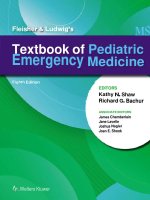
Pediatric emergency medicine trisk 4597 4597
Bạn đang xem bản rút gọn của tài liệu. Xem và tải ngay bản đầy đủ của tài liệu tại đây (75.1 KB, 1 trang )
. Accessed March 18, 2020.
Ismail S, McIntosh M, Kalynych C, et al. Impact of video discharge
instructions for pediatric fever and closed head injury from the
emergency department. J Emerg Med 2016;50(3):e177–e183.
Jang M, Plocienniczak MJ, Mehrazarin K, et al. Evaluating the impact of
translated written discharge instructions for patients with limited English
language proficiency. Int J Pediatr Otorhinolaryngol 2018;111:75–79.
Joint Commission. Advancing effective communication, cultural
competence, and patient-and family-centered care: a roadmap for
hospitals. Available online at . Accessed April
9, 2019.
Kutner M, Greenberg E, Jin Y, et al. The Health Literacy of America’s
Adults: Results From the 2003 National Assessment of Adult Literacy
(NCES 2006–483) . Washington, DC: National Center for Education
Statistics, U.S. Department of Education; 2006. Available online at
. Accessed March 18, 2020.
McDonnell WM. Pediatric emergency medicine. In: Donn SM, McAbee
GN, eds. Medicolegal Issues in Pediatrics . 7th ed. Elk Grove Village,
IL: American Academy of Pediatrics; 2011:141–152.
Meaningful
Use.
Available
online
at
/>uirementschecklist.pdf . Accessed April 8, 2019.
Navanandan N, Schmidt SK, Cabrera N, et al. The caregiver perspective on
unscheduled 72-hour return visits to pediatric acute care sites: a focus on
discharge processes. Acad Pediatr 2017;17(7):755–761.
North Carolina Program on Health Literacy. List of tools. Available online
at . Accessed April 9, 2019.
Ray M, Dayan PS, Pahalyants V, et al. Mobile health technology to
communicate discharge and follow-up information to adolescents from
the emergency department. Pediatr Emerg Care 2016;32(12):900–905.
Saidinejad M, Zorc J. Mobile and web-based education: delivering
emergency department discharge and aftercare instructions. Pediatr
Emerg Care 2014;30(3):211–216.
Samuels-Kalow ME, Stack AM, Porter SC, et al. Effective discharge
communication in the emergency department. Ann Emerg Med