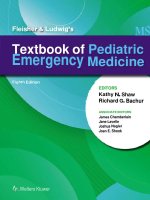
Pediatric emergency medicine trisk 2456 2456
Bạn đang xem bản rút gọn của tài liệu. Xem và tải ngay bản đầy đủ của tài liệu tại đây (100.73 KB, 1 trang )
CHAPTER 96 ■ NEONATAL EMERGENCIES
NICKIE NIFORATOS ANDESCAVAGE, DEENA BERKOWITZ
INTRODUCTION AND INITIAL ASSESSMENT
Goals of Emergency Care
The neonate is in a fragile state of transition to extrauterine life. Newborns have
limited ability to maintain temperature and glucose and they have limited
cardiopulmonary reserves to compensate for dehydration, sepsis, or other
stressors. Newborns may exhibit apnea, rather than tachypnea, in response to
hypoxia. They are immunocompromised and are unable to communicate
subjective findings. Every clinical finding is likely to be more subtle in the
neonate than in the older infant. Therefore, the goals of emergency care are to
triage and treat neonates urgently until serious disease has been ruled out, while
maintaining body temperature and serum glucose.
KEY POINTS
Newborns have very little reserve to compensate when acute illnesses
occur.
Tachypnea may be the only presenting sign of congestive heart failure.
Hypothermia, rather than fever, may be a neonate’s response to sepsis.
Weight loss is the most sensitive sign of dehydration in the newborn. A
loss greater than 10% of birth weight during the first 10 to 14 days of
life should be thoroughly investigated.
Careful attention must be paid to maintenance of temperature and
glucose in the ED.
RELATED CHAPTERS