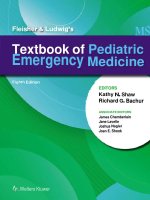
Pediatric emergency medicine trisk 1882 1882
Bạn đang xem bản rút gọn của tài liệu. Xem và tải ngay bản đầy đủ của tài liệu tại đây (71.1 KB, 1 trang )
Clinical Considerations
Clinical Recognition
Adrenal insufficiency is generally recognized in patients with general fatigue associated with
weight loss and abnormal electrolytes or more acutely in critically ill patients who
decompensate after a minor prodrome and do not respond to early interventions.
Triage
In children with known adrenal insufficiency, early assessments should focus on vital signs
and mental status.
Initial Assessment/H&P
Children with a primary adrenal defect are more likely to have had a gradual onset of
symptoms, such as general malaise, anorexia, fatigue, and weight loss. Salt craving and
postural hypotension may also have been noted. Waterhouse–Friderichsen syndrome, or acute
adrenal infarction, should be considered in a patient with fulminant sepsis and hypotension
unresponsive to vasopressors or inotropes, especially if due to meningococcemia. A child with
secondary adrenal insufficiency is more likely to have a history of neurosurgical procedures,
head trauma, CNS pathology, or chronic disease necessitating the prolonged use of
glucocorticoids.
Findings on physical examination are more likely to be characteristic of the precipitating
illness or trauma rather than specifically suggestive of adrenal insufficiency. Although a lack
of glucocorticoid and aldosterone can be associated with hypotension and dehydration, a better
clue to the possibility of adrenal insufficiency is inappropriately rapid decompensation in the
face of metabolic stress. Hyperpigmentation may be present in primary adrenal insufficiency,
especially of long duration. Red hair and peripheral eosinophilia may be noted in Addison
disease or autoimmune destruction of the adrenals.
Management/Diagnostic Testing
Biochemical evidence suggestive of adrenal insufficiency includes hyponatremia,
hyperkalemia, hypoglycemia, and hemoconcentration. Metabolic acidosis and hypercalcemia
may be present. The definitive diagnosis depends on the demonstration of an inappropriately
low level of cortisol in the serum. Blood should be obtained for the measurement of both
cortisol and ACTH at baseline if the diagnosis is suspected, but should not delay the
administration of hydrocortisone if the patient is critically ill. For stable children, cortisol
measurement can be measured 60 minutes after IV or IM administration of 0.25 mg of a
synthetic ACTH preparation (i.e., cosyntropin). Although ACTH dosing practice varies across
institutions, we recommend using weight-based dosing (15 mCg/kg) as follows:
Cosyntropin <4.17 kg: 62.5 mCg IV over 1 minute
Cosyntropin 4.17 to 8.34 kg: 125 mCg IV over 1 minute
Cosyntropin ≥8.34 kg: 250 mCg IV over 1 minute
Results are unlikely to be available on an emergency basis.
Treatment of adrenal crisis with shock is based upon rapid volume expansion and the
administration of glucocorticoids. Immediate management consists of 50 to 100 mg/m2 of