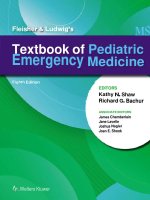
Pediatric emergency medicine trisk 2028 2028
Bạn đang xem bản rút gọn của tài liệu. Xem và tải ngay bản đầy đủ của tài liệu tại đây (105.14 KB, 1 trang )
malaise, lymphadenopathy, fever, and/or GI symptoms that evolve over several
days. Prednisone (2 mg/kg/day, maximum 80 mg) until symptoms abate (and then
a tapering schedule) has been used with success in most cases. Diphenhydramine
(5 mg/kg/day in four divided doses, max 50 mg/dose) is often given as an adjunct.
Coral snake. When coral snake wounds are present or the history or specimen
is consistent with an Eastern or Texas coral snakebite, antivenin for M. fulvius
(Wyeth) if available should be administered before development of further
symptoms. As Wyeth no longer manufactures the coral snake antivenin and there
are currently no other FDA-approved alternatives in the United States, there have
been multiple extensions of the original expiration date on vials. Hence, in the
United States, antivenin should be restricted to patients with systemic symptoms.
This antivenin is also an equine serum and requires preliminary skin testing (see
package insert), although 10% of patients can have a false-negative test. Pediatric
patients should be closely monitored for signs of anaphylaxis. The use of
antivenin in pregnancy should be considered on a case-by-case basis. The initial
recommended dosage is three to five vials by IV; an additional three to five vials
may be given as needed for signs of venom toxicity. There is no antivenin
available for the Arizona coral snake (M. euryxanthus ). Supportive care should
provide a satisfactory outcome in these cases. Constriction bands, suction and
drainage, and other local measures do not retard coral snake venom absorption,
and hence are not indicated. All patients that present to the ED with a coral
snakebite should be observed for at least 24 hours.
Exotic snakes. The clinician confronted with an exotic snakebite or a clinician
inexperienced in snakebites should consult a local medical herpetologist or the
American Association of Zoologic Parks and Aquariums and the American
Association of Poison Control Centers. These centers keep an up-to-date database
of exotic antivenoms. Access to this information is available at 800-222-1222.
Report all illegally possessed reptiles to the police or to the appropriate fish and
game agency.
Venomous lizards . The two lizards that are potentially dangerous for humans
that the emergency provider needs to be aware of are the Gila monster
(Heloderma suspectum ) of the southwestern United States and adjacent areas of
Mexico and the Mexican beaded lizard (Heloderma horridum ) of western
Mexico south to Guatemala. Their venom from submandibular glands contains
peptides, such as exendins-3 and -4, which are glucagon-like peptide-1 analogs.
Bites are typically provoked and can cause severe local pain, swelling, and
regional lymphadenopathy along with systemic symptoms, such as dizziness,
hypotension, angioedema, sweating, rigors, tinnitus, nausea, and vomiting.