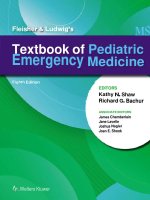
Pediatric emergency medicine trisk 1862 1862
Bạn đang xem bản rút gọn của tài liệu. Xem và tải ngay bản đầy đủ của tài liệu tại đây (101.97 KB, 1 trang )
Congenital
hypothyroidism
Hypopituitarism
Asymptomatic:
Free T4 , TSH
hypothermia,
hypoactivity, poor
feeding,
constipation,
prolonged
jaundice, large
posterior fontanel
See features listed
for adrenal
insufficiency and
hypoglycemia
0.5–0.7
mg/kg/day
divided tid
orally
L -thyroxine 10–15
μg/kg/day orally
IV, intravenous; IM, intramuscular; ACTH, adrenocorticotropic hormone; TSH, thyroid-stimulating hormone; tid, three times
daily; bid, twice per day.
DIABETIC KETOACIDOSIS
Goals of Treatment
To identify patients with DKA and initiate treatment per algorithm.
To recognize patients with cerebral edema (1%) and intervene with appropriate treatment.
CLINICAL PEARLS AND PITFALLS
Clinically significant cerebral edema is the most serious immediate risk to the child,
occurring in 1% of cases, and it remains so during the first 24 hours of therapy,
despite the more apparent issues of hypovolemia and acidosis.
The treatment for symptomatic cerebral edema is mannitol and/or 3% hypertonic
saline.
Avoid bicarbonate administration.
Current Evidence
Insulin deficiency initially leads to hyperglycemia that, once above the renal threshold of 180
mg/dL, leads to polyuria due to an osmotic diuresis. Without vigorous oral repletion at home,
the child quickly becomes hypovolemic, prompting a stress response and elevations of the
counterregulatory hormones glucagon, cortisol, growth hormone, and catecholamines. These
hormonal changes produce significant insulin resistance and stimulate glycogenolysis and
gluconeogenesis that worsens the hyperglycemia, hypovolemia, and stress response. In this
insulin-deficient state, adipose tissue is broken down in large quantities into free fatty acids,
subsequently converted into ketoacids in the liver. Ketoacids readily dissociate in the blood to
produce free hydrogen ions, and metabolic acidosis ensues. This reaction is partially