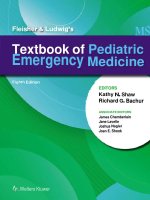
Pediatric emergency medicine trisk 2100 2100
Bạn đang xem bản rút gọn của tài liệu. Xem và tải ngay bản đầy đủ của tài liệu tại đây (71.03 KB, 1 trang )
association between thickening agents and necrotizing enterocolitis in preterm
infants. The Food and Drug Administration does not recommend thickening
agents in infants born before 37 weeks’ gestation, those who are hospitalized,
or those who were hospitalized within the past 30 days. Prone positioning has
also been found to improve symptoms, however this benefit is outweighed by
the increased risk of Sudden Infant Death Syndrome. Similarly, positioning a
patient on his or her side is also not recommended. For older children and
adolescents, initial interventions focus on lifestyle changes, such as weight
loss, avoidance of late night eating, elevation of the head of the bed, and sleep
positioning. Patients should avoid food that triggers their GERD. If
insufficient, acid suppression medications may be of benefit, after
consideration of potential side effects.
Celiac Disease
Celiac disease (CD) is an immune-mediated enteropathy triggered by the
ingestion of gluten-containing grains such as wheat, rye, and barley.
Prevalence varies between populations, however occurs in approximately
1/322 children in the United States. There are many more patients with
“silent” or “latent” disease who show histologic change in their intestinal
epithelium, but are otherwise asymptomatic. While there is a female
predominance of CD in adults, the disease occurs equally between male and
female children. CD is associated with other conditions such as type I diabetes
mellitus, IgA deficiency, autoimmune thyroiditis, Down syndrome, Turner
syndrome, and Williams syndrome. CD presents with a diverse spectrum of
disease presentations and the age-related variability in manifestations require
emergency physicians to maintain a high degree of suspicion for the disorder
when evaluating patients with a variety of complaints.
In patients with the genetic predisposition for CD, exposure to gluten
triggers an autoimmune reaction resulting in crypt hyperplasia, epithelial
lymphocytosis, increased plasma cells, and villous atrophy. Patients may
present with malabsorption, diarrhea, and failure to thrive. Other common GI
symptoms include constipation, anorexia, and recurrent abdominal pain. NonGI symptoms have also been appreciated with CD, such as anemia, joint pain,
arthritis, chronic fatigue, irritability, and other behavioral changes. CD should
also be considered in patients with dermatitis herpetiformis, dental enamel
hypoplasia, short stature, delayed puberty, osteopenia, and iron deficiency
anemia that are unresponsive to oral iron supplementation. These nonspecific