The Moral Self potx
Bạn đang xem bản rút gọn của tài liệu. Xem và tải ngay bản đầy đủ của tài liệu tại đây (1.28 MB, 249 trang )
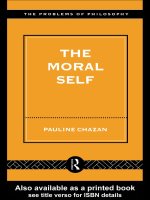
The Moral Self
What do we need in order to have morally sound relationships with
others? What does it mean for us to care for ourselves? What is the
relationship between self-love and morality?
The Moral Self addresses the question of how morality enters into our
lives. Pauline Chazan draws upon psychology, moral philosophy and
literary interpretation to rebut the view that morality’s role is to limit
desire and control self-love. Preserving the ancients’ connection
between what is good for the self and what is morally good, Chazan
argues that a certain kind of care for the self is central to moral
agency.
Her intriguing argument begins with a critical examination of the
views of Hume, Rousseau and Hegel. The constructive part of the
book takes a more unusual turn by synthesising the work of the
analyst Heinz Kohut and Aristotle into Chazan’s own positive
account, which is then illustrated by the use of Russian literature.
The Moral Self offers a dynamic, interdisciplinary slant on the
discussion of moral theory, and will be of great interest and use to
students of philosophy as well as psychology.
Pauline Chazan lectures in Philosophy at La Trobe University in
Victoria, Australia.
The Problems of Philosophy
Founding Editor: Ted Honderich
Editors: Tim Crane and Jonathan Wolff, University College London
This series addresses the central problems of philosophy. Each book gives a
fresh account of a particular philosophical theme by offering two perspectives
on the subject: the historical context and the author’s own distinctive and
original contribution.
The books are written to be accessible to students of philosophy and
related disciplines, while taking the debate to a new level.
DEMOCRACY
Ross Harrison
THE EXISTENCE OF THE
WORLD
Reinhardt Grossman
NAMING AND REFERENCE
R.J.Nelson
EXPLAINING EXPLANATION
David-Hillel Ruben
IF P, THEN Q
David H.Sanford
SCEPTICISM
Christopher Hookway
HUMAN CONSCIOUSNESS
Alistair Hannay
THE IMPLICATIONS OF
DETERMINISM
Roy Weatherford
THE INFINITE
A.W.Moore
KNOWLEDGE AND BELIEF
Frederic F.Schmitt
KNOWLEDGE OF THE
EXTERNAL WORLD
Bruce Aune
MORAL KNOWLEDGE
Alan Goldman
MIND-BODY IDENTITY
THEORIES
Cynthia Macdonald
THE NATURE OF ART
A.L.Cothey
PERSONAL IDENTITY
Harold W.Noonan
POLITICAL FREEDOM
George G.Brenkert
THE RATIONAL FOUNDATIONS
OF ETHICS
T.L.S.Sprigge
PRACTICAL REASONING
Robert Audi
RATIONALITY
Harold I.Brown
THOUGHT AND LANGUAGE
J.M.Moravcsik
THE WEAKNESS OF THE WILL
Justine Gosling
VAGUENESS
Timothy Williamson
PERCEPTION
Howard Robinson
THE NATURE OF GOD
Gerard Hughes
UTILITARIANISM
Geoffrey Scarre
THE MIND AND ITS WORLD
Gregory McCulloch
SUBSTANCE
Joshua Hoffman and Gary
S.Rosencrantz
SOCIAL REALITY
Finn Collin
The Moral Self
Pauline Chazan
London and New York
First published 1998
by Routledge
11 New Fetter Lane, London EC4P 4EE
This edition published in the Taylor & Francis e-Library, 2002.
Simultaneously published in the USA and Canada
by Routledge
29 West 35th Street, New York, NY 10001
© 1998 Pauline Chazan
All rights reserved. No part of this book may be
reprinted or reproduced or utilised in any form or by
any electronic, mechanical, or other means, now
known or hereafter invented, including photocopying
and recording, or in any information storage or
retrieval system, without permission in writing from
the publishers.
British Library Cataloguing in Publication Data
A catalogue record for this book is available from
the British Library
Library of Congress Cataloging in Publication Data
Chazan, Pauline, 1948–
The moral self/Pauline Chazan.
p. cm.—Includes bibliographical references.
1. Ethics—Methodology. 2. Moral development.
3. Ethics. I. Title.
BJ37.C43 1998
171’.p–dc21
97–40021
CIP
ISBN 0-203-00535-X Master e-book ISBN
ISBN 0-203-21686-5 (Adobe eReader Format)
ISBN 0–415–16861–9 (hbk)
ISBN 0–415–16862–7 (pbk)
I dedicate this book to the memory of my
mother and father, Mira Lipman and Falek Sobol
vii
Contents
Preface ix
Acknowledgements xi
Introduction 1
I Hume on self-valuing and moral selfhood 13
II Rousseau: the generators of self-valuing and
the constitution of the moral self 31
III Hegel: ethical self-valuing and the
constitution of the moral self 50
IV Aristotle and Kohut: converging perspectives 63
V Significant action and the self 88
VI Valuing the self and moral life 111
VII The ethical significance of love of self 127
VIII Love of self and morality: the search for
good and evil 154
Conclusion 192
Notes 199
Bibliography 226
Name index 232
Subject index 234
ix
Preface
This book began as a Ph.D. thesis, supervised in its early stages by
Michael Stocker, and then by Kimon Lycos. I am extraordinarily
fortunate to have had the opportunity to work with these two
philosophers, and I owe a great deal to both of them.
I thank Michael Stocker for the wonderful work he has done in
ethics, for it is this more than anything else which ignited my
interest in moral psychology. I also thank him for urging me to
begin The Moral Self, and for the many stimulating, productive
discussions we had in Melbourne prior to his departure for the
United States. That departure had left me concerned about the
possibility of finding another supervisor as knowledgeable and
dedicated as he.
I need not have been apprehensive: Kim Lycos’ enthusiasm
and love for philosophy infused our discussions with
excitement, and I was constantly amazed by the breadth of his
knowledge and the depth of his understanding. I am grateful
for his generosity with his time, the invaluable comments he
made on numerous drafts of my work, and the encouragement
he gave me. His death in 1995 dealt a terrible blow, not only
to the Australian philosophical community, but to all who
knew him.
I would like to thank La Trobe University for granting me a two
year Post-Doctoral Fellowship, during which time I was able to
prepare this book. I also thank members of the School of Philosophy
at La Trobe University for providing such a congenial, friendly
atmosphere in which to work.
I am grateful to a number of people who read and discussed
drafts of various chapters with me. I would like to thank John
Campbell, Christopher Cordner, Graeme Marshall, Behan
McCullagh, Dorothy Mitchell, Tim Oakley and Janna Thompson. I
Preface
x
also thank my husband, Robert Chazan, for guiding me through the
maze of self psychology.
La Trobe University
Victoria, Australia
November 1997
xi
Acknowledgements
Chapters 1 and 2 are modified versions of articles published
respectively in The Canadian Journal of Philosophy (1992) 22:45–
65; and The History of Philosophy Quarterly (1993) 10:341–54.
Material from Chapters 6 and 7 is forthcoming in an article in
Philosophia, 25. My thanks are owed to the editors and publishers
of these journals who gave me permission to use this material here.
1
Introduction
[The moral philosopher] has to show how and why the
moral ‘gaze’ on life and people is an enriching achievement
of human development.
(Lycos 1978:17)
This work is concerned with providing an answer to the question of
how we ought to conceive of the self’s entrance into the moral
domain, and of morality’s entrance into a human life. The account
provided here is in some crucial respects different from those offered
by contemporary moral theories, and it uncovers a tension between
morality and theories about morality.
Within the context of explaining how good agents behave,
contemporary theories generally agree that a preliminary prerequisite
for a moral orientation is an awareness of being one among many
others. In focusing on commitments, obligations and duties, theories
as diverse as Kantianism and utilitarianism hold that a moral
orientation requires agents to have the capacity to detach from private
desires and needs, and to focus instead on the desires and needs of
others, no matter what relationship, if any, they have to those others.
Some degree of impartiality and objectivity is seen to be required for
the very possibility of moral consciousness.
Taken further, this requirement has emerged as a requirement for
impersonal, universalisable principles and rules upon which the
recognition of duty and the performance of right actions are thought
to be founded. The requirement of impartiality can be seen in much
moral philosophy to imperceptibly blend with, and in some cases to
have been transformed into, the requirement for impersonality and
universality. Impartiality ensures that no exceptions are made in
favour of the agent herself, while impersonality and universality
further ensure that partiality is eliminated, putting in place a strong
rational influence: moral actions ought to be rationally justifiable;
Introduction
2
they ought to be performed by any rational agent in similar
circumstances; they are actions for which the weight of reason must
speak. The combination of impartiality, rationality, impersonality and
universality requires moral agents to prescind from particular desires,
needs, claims and relationships. Moral philosophy can be seen to
have abstracted from the particularity of persons and their lives and
to have focused instead on the objective features of actions, states of
affairs, and lives. Notwithstanding recent attempts to revise and make
modern theories more attractive (e.g. Herman 1996) the private or
particular concerns, interests and relationships of the self remain for
most theorists morally suspect, as needing moral justification from an
impartial and universal perspective, this perspective being regarded as
an ethical necessity.
Moral action is viewed by contemporary theories as sitting
uneasily with concern for one’s own self. Morality and self-interest
are portrayed as being diametrically opposed, and each as making
irresistible rational demands on agents. In theory, at least, morality
has been, in the struggle between morality and self, the over-
whelmingly favoured rational option. This is reflected in the fact that
a focal point of much moral theorising has been the task of justifying
morality to the rational egoist.
Theorists have sought to provide a rationally compelling answer to
the question of what the self has most reason to do. Despite being
dubious about the possibility of any rationally compelling answer,
given the conflict between the demands of egoism and morality,
Sidgwick (1929) settled for a universalistic utilitarianism. John
McDowell (1978), in claiming that moral reasons, properly
appreciated, silence self-interested reasons so that they no longer
count as reasons, might be read as giving a direct retort to Sidgwick’s
uncertainty about what the self has most reason to do. Derek Parfit
(1984) has argued that self-interest can be shown to be irrational,
since certain considerations lead us to realise that self-interested
reasons have no weight, while the weight of reason can be shown to
speak for morality. And the Kantian rational intellectual moral motive
leaves little room for any considerations pertaining to ‘dear self’.
Samuel Scheffler (1982) has allocated some rational weight to
the self’s personal perspective in moral deliberation, allowing
personal and moral concerns to each count as one kind of reason
among others. Moral thinking has been portrayed by Scheffler as
involving a kind of ‘weighing up’ procedure where the ‘rational
weight’ of different kinds of reasons has central moral importance.
Introduction
3
This model, consistent with much contemporary theory, conceives
of the business of leading a personal life and the business of
heeding morality’s requirements as being two quite separate affairs.
Sharing much common ground with Scheffler, Thomas Nagel
(1980; 1986), in arguing that a completely impersonal morality is
not a realistic human goal, has allowed the self’s personal
perspective entry into the objective, moral view. Yet personal
concerns and moral concerns remain distinct for Nagel: personal
reasons pertain to the business of leading the self’s own life,
whereas the moral remains co-extensive with the impartial and
impersonal.
In contrast to the foregoing, two important conclusions to be
drawn from the account presented in this book are, first, that a self’s
being committed to impartiality and impersonality in the way
specified by many moral theories does not sit well with a
commitment to what it is that can enable a self to achieve a moral
outlook. So instead of regarding impersonality as a standpoint that a
self can take, one where ‘one does not know who one is and how
what one observes relates to one’ (Darwall 1983:153), on the account
presented here impersonality is better understood in terms of a certain
kind of critical detachment or distancing from values and ends. But
this critical distancing does not require the self to ignore the
emotional-affective or personal aspects of its own agency in the way
that the traditional understanding of achieving an impersonal
perspective does.
A second conclusion to be drawn from The Moral Self is that a
moral theory does not need to make a conceptual distinction
between morality and self-interest in order to be coherent. This is to
say that the self can act morally well without being motivated by
what is widely regarded to be a specifically ‘moral’ (as opposed to
a self-interested) motive. Instead, it will be argued that a certain
kind of value that a moral agent places on her own self is of central
importance in explaining her moral outlook. My account will
suggest that our modern philosophical conceptions of morality fail
to account for, or to give high enough value to, elements which
encompass aspects of our own selves central to any explanation of
the development and existence of our moral orientations. Moreover,
we will see that a meaningful account of morality can be given
which does not depend on an agent’s focusing on impersonal rather
than personal considerations, an account where the main dimension
of moral assessment is located in the particularity of human
Introduction
4
relationships and experiences, and in concrete, personal responses to
other individuals. Such an account can at the same time preserve
the rationality of moral value, judgement and action.
It is an account that will show Susan Wolf’s claim (1982) that it is
not always better to be morally better as having no foundation. For
on my account morality is not a separate option for a person
alongside other possible options, but is rather something that
permeates the way in which a moral agent goes about all of her
activities. Where Wolf says that ‘Moral ideals do not make the best
personal ideals’ (1982:435), a consequence of my account is that a
person’s morality is revealed in the very enactment of her personal
ideals.
The account presented in this work has certain affinities with
Greek accounts since, according to it, an agent is able to respond in a
morally appropriate way, not as a result of taking an impartial,
impersonal view, but because of her own particular concerns, interests
and relationships: because of what she, at the moment of action, has
become. My account of the moral life has as its focal point the self’s
own interests, concerns and values, and so preserves the ancients’
connection between morality and the goodness of a human life,
between what is good for the agent and what is morally good. My
claim will be that the state of a person’s self and the moral status of
her actions are interdependent: to the extent that a person achieves
the unity of thought and desire integral to Aristotelian moral character
(the same inner psychic unity that Plato required of his philosopher-
kings), so she is able to act morally well.
Also important in my account is the moral self’s desire to have the
best possible life. It will be suggested that what is morally admirable
about an agent also benefits the agent herself. While Aristotelian and
Platonic moral agents want for themselves the best possible lives, and
while what is constitutive of the best possible life is at the same time
what leads them to act in morally good ways, morally good action is
not performed in order to achieve for themselves the best possible
life. It would be a bad misconstruction of Plato and Aristotle to take
them to be telling us that virtue is a means to happiness. Rather, they
tell us that happiness, meaningfulness, and the achievement of virtue
cannot be separated from each other. Their ethics have no room for
the rigid division into the ‘moral’ and the ‘self-interested’ of which
contemporary moral philosophy is so fond.
The account in this book is compatible with the Greek view: the
moral agent I will describe acts virtuously because she is the kind of
Introduction
5
person who has developed a particular type of perception and has
come to see the world, herself, and her place in the world, in a
certain way. Having this perception, she then has the capacity to
achieve a certain critical distancing from those values and ends which
are for her of supreme importance, and to reassess whether, given the
particular circumstances in which she finds herself, these values and
ends are ones she should here pursue.
Where contemporary theories conceive of an agent as remaining in
the moral realm by not transgressing certain principles or rules of
living, a consequence of my account is that the moral realm ought to
be conceived of as consisting of beings who possess certain positive
qualities and capacities that entitle them to enter this realm. This does
not mean that I am substituting a realm constituted by rules and
principles that are accessible to all with a realm constituted by kinds
of beings (and so a realm not accessible to all). The account
presented here does not contain any moral elitism, since the positive
qualities and capacities needed in order to enter the moral realm are
ones that are within the grasp of every person.
Among these positive qualities is singled out as crucially important
what I (following Aristotle) term ‘love of self’. A central thesis of
The Moral Self is that a certain kind of self-love is foundational for
moral agency. This challenges a widespread view of self-love as
being vulgar. Apart from being discussed in commentaries on
Aristotle, love of self is a relation to the self which has been largely
neglected in recent moral philosophy, and the account I will give of
this form of self-valuing is quite different from the accounts of self-
valuing (e.g. pride and self-esteem) that are found in the modern
literature. My account of ‘love of self’ will show that an agent’s
moral orientation is grounded in her own desires, interests and values.
Just how far outside the self the ethical ought to be taken to range
is a matter of some dispute: ‘We can represent a self-interest as much
as I’ (Williams 1985:14). Yet the ethical is almost universally
assumed to reside at some point outside the self, as a phenomenon
that lies, or as a demand that originates from, outside one’s
immediate concerns and commitments. This is an assumption that my
account calls into question. Williams (1985) has made a move in the
right direction in arguing that the range of ‘the ethical’ ought to be
broadened to include any concerns that might arise in response to the
question of how one should live. However, he still construes ‘the
moral’ in the narrow way, and my account will cast some doubt on
whether this is something with which we need to agree.
Introduction
6
Another conclusion to be drawn from my account is that the
impersonal-personal, universal-particular and objective-subjective
dichotomies do not offer a complete description of reasons a person
might have for action, and that the account of moral motivation these
dichotomies can provide is far too thin. If we conceive of morality on
the model of an impartial, impersonal theory of right, a right that is
disengaged from the particularity of leading a human life, if moral
motivation is grounded in an impersonal, impartial, objective,
universal perspective, if morality is a phenomenon that impinges
(Scheffler 1986:537) on one’s consciousness and life, rather than a
phenomenon that can constitute the very character and quality of
consciousness, then any attempt to seek a less demanding theory
(Scheffler and Nagel) or to limit the scope of morality or to challenge
its authority (Williams 1973; 1981a; 1981b; 1981c) seems to me to
be a futile exercise. If ‘morality’ is fully described by ‘impartial
morality’, if morality requires the pursuit of the impartial, impersonal
best, and if moral motivation must be grounded in impersonal
universal considerations, then if our actions fall short of fulfilling
these requirements, we are morally not very good. Nagel, Williams
and Scheffler have tried to make morality more palatable (and, with
this, to give a more feasible account of the self’s achievement of
moral personhood) by providing a rationale for limiting the
requirements of impartial morality and by legitimising the pursuit of
personal desires and aims. But none of these philosophers has
disentangled himself from certain presuppositions regarding the
nature of morality and the role it has in thought, feeling and human
life. The account in this work shows that morality does not inform a
life from a standpoint removed from that life, but that it does so such
that the personal aspects of leading a life do not lie at a point
external to and removed from the moral sphere. It will be seen that
that which leads one to recognise and act on behalf of the claims of
others does not lie outside the domain of choosing and leading a
good personal life. That is, moral personhood is not separable from
the personal aspects of leading a good life; it can be seen, rather, to
be definitive of those aspects.
A conception of morality which views the personal as being
inherent in the moral life is not a new conception: it was espoused
some twenty-eight years ago by Iris Murdoch (1970). She recognises
reasons for thought, deliberation and action which are not
encompassed by the impersonal-personal division. Her account
centres moral significance on the quality of loving attention focused
Introduction
7
upon another individual, and on the importance of one’s personal ties
to other individuals. Yet it is an account which simultaneously retains
the requirement of the ridding of selfishness in order to achieve an
ethical outlook.
I discern in Murdoch’s writings the belief that engaging in the
endless moral task she describes and finding one’s life to be
meaningful are one and the same activity. This belief is central to the
account in this book. I do not extrapolate from Murdoch’s writings
though, nor does my account hold, that a lucky consequence of
engaging in her moral task is that our lives will be meaningful.
Rather, I claim that human flourishing and morality coincide. This is
because it is via a Murdochian conception of deliberation and
contemplation that the self finds meaning in the day-to-day activities
of a life. This conception of morality is one which finds morality to
pervade every aspect of a person’s life and to condition every
encounter they have with the world. Morality, on this view, has an
internal relation to the pursuit of our projects and the forming of our
commitments; it is constitutive of their meaningfulness.
If morality is conceived of as permeating every aspect of our lives,
including the pursuit of our projects and commitments, it does not
need to be seen as the threat to our selfhood that Bernard Williams
has thought it to be. The limit on what a person is prepared to do in
the pursuit of their own ends is not best understood if it is conceived
of as the result of an impersonal and impartial recognition of
universalisable reasons and principles. I believe this limit is better
understood if it is seen as originating from the way in which the
agent has come to conceive of the world, of others, and of his own
self. It is a limit which originates in the agent’s own special
understanding of and sensitivity to certain features of the world, and
this understanding and sensitivity should be seen as an integral part
of the agent’s own self, determining his ‘being-toward-others’. I will
argue in this work that the view the moral agent has of himself is
critically important in an explanation of his moral actions, since both
the limit beyond which he is not prepared to go in pursuit of his own
ends and his ‘being-toward-others’ are seen by him as inescapable
parts of himself This moral limit, then, is one which can be seen to
pertain also to the personal standards of leading a personal life. It
will be argued that the limit a person has on what he is prepared to
do in pursuing his ends is not only closely connected with his own
view of himself, but that it is also causally dependent on the very
sense he has of his own worth. We will also see that at the same time
Introduction
8
the sense of his own worth is vulnerable to transgressions of the limit
beyond which he will not customarily go.
Rather than conceiving of moral thinking as involving a
‘weighing’ of different kinds of reasons, my account holds that if we
want to understand a person’s moral orientation, we must understand
why she has the reasons she has, and why they are reasons for her.
The claim of this book is that we must look beyond the ‘rational
weight’ of reasons, values and ends, and look rather to the nature and
constitution of the moral self. That is, instead of looking at the object
of moral understanding (beliefs, values, ends, acts) we should look
rather at the subject of understanding. We should look more closely
at what it is that makes a self into a moral self.
So a central task of this work is to look at the question of how
we should conceive of the moral self. Some crucial differences
between the account of morality I present and that of a number of
modern moral theories have their source in the way in which the
moral self is conceived. Many modern theories take it that there is a
theoretical, articulable conception of what a moral self is, from
which the limits of action arise. The moral self is conceived of in
terms of some determinate pieces of knowledge that it possesses,
and the moral limits that confront it emerge because of this
knowledge. For a Kantian, knowing that rational nature must be
respected in itself and other rational beings, draws the boundaries of
what the moral self is and is not permitted to do. For a utilitarian,
knowing that the maximisation of utility is the ultimate justification
of action presents the self with objective criteria according to which
it can be judged whether certain actions are permitted, required or
forbidden.
Where for these theories the moral ‘must’ and the moral ‘cannot’
are derived from certain determinate pieces of knowledge, my claim
in this work is that since moral understanding does not consist in a
knowledge of a determinate set of things, the moral ‘must’ and the
moral ‘cannot’ are not derived from any pieces of knowledge. On
my account, the moral self is the self that emerges in the context of
certain practices (certain kinds of critical reflection) that display a
moral understanding that it must, or that it cannot, do certain
things. This experience of ‘moral impossibility’, and the moral
understanding with which it goes hand-in-hand, is on my account
constitutive of the moral self, but the understanding in question is
not given by any theory. Ethical reflection, on my view, is not
theoretical. My account will present moral understanding as
Introduction
9
depending on the self’s own sense of justice which, I will argue, is
not something teachable. So where a number of modern moral
theories purport to tell us what kind of knowledge the moral self
has, the account I will present in this work will refuse to say that
the ethical subject has knowledge, where ‘knowledge’ is understood
as something that is teachable.
The limits on thought and action that the experience of moral
impossibility presents are (what I term) ‘internal’ or ‘built-in’ limits.
They are internal or built-in because they do not merely serve as an
external guard on action in the way that the intellectually or socially
constructed limits of many modern moral theories do, but the critical
reflection which gives rise to these limits can be seen to be the
context in which the moral self is constituted. I conceive of these
limits as being constitutive of the moral self. These limits ensure, not
merely that right acts will be done, but they can ensure that we will
have a world of people who will not be content to not be good. So I
believe that the kind of moral limits that I conceive of as being
constitutive of the moral self fit better with the nature of human
striving for nobility and goodness.
This striving for nobility and goodness should be seen as an
integral part of what it is to be human: this is an essentially
Aristotelian notion. Aristotle believed that a human being has a
determinate nature and that a happy life is one in which this nature is
fulfilled. This book shares the Aristotelian beliefs that the proper
realisation of human nature consists in a life of virtue, and that a life
of virtue and a happy life are one and the same. I discuss Aristotle in
Chapter 4.
The first three chapters are devoted to expounding and examining
the relationships that Hume, Rousseau and Hegel saw to obtain
between the value that a person places on her own self and her moral
capacity.
We will see that for both Hume and Rousseau a person could
develop a strong self-awareness and self-knowledge, and place
considerable value on himself, without ever entering the moral
domain. The Humean agent might gain ‘knowledge of his own force’
by means of the reflected impressions of various particular aspects of
himself from the environment without ever correcting his perspective
and adopting Hume’s ‘general point of view’. According to
Rousseau’s account, if we could counteract the effects of civil society
we would still not have a moral being (for this the social contract is
needed) but we could have a self with a strong centre of values. Both
Introduction
10
Hume and Rousseau see the development of a strong self with a
centre of values, and the development of moral consciousness as
being two quite separate phenomena.
Hegel’s account holds that the development of a strong self
with a secure centre of values and the development of the moral
self are one and the same development. These could not be seen
as the same development by Rousseau, since he conceives of the
self in the state of nature as an isolated self, while the self of
virtue and vice is fundamentally social. When the self enters into
a social contract and follows the general will it is transformed
from an isolated self into one that sees itself as part of a social
body: it is transformed into what is, in essence, the forerunner of
Kant’s rational beings who are members of a kingdom of ends.
And we will see that for Hume the development of the pre-moral
self and of the moral self could not be the same development.
Further, where Hume sees the self as being constructed from
something given (the reflected impressions originating in the
social environment), Hegel sees the self as the product of a more
complex developmental process. This product is regarded by him
as coinciding with the moral self. In this respect Charles Taylor’s
work (1989) might be seen to be closer to Hegel than to either
Hume or Rousseau.
This book holds in common with Hegel a developmental account
of the moral self, although it does not see the development of love of
self or morality to be necessary or inescapable in the way that Hegel
sees the appropriation of the values and reasons of Sittlichkeit to be.
My account also holds in common with Hegel the belief that
significance in human life is to be found in morality, but rejects the
Hegelian thesis that a full political community is required for
morality.
Chapter 4 looks backward to Aristotle and forward to Heinz
Kohut. It shows that the perspectives that Aristotle and Kohut’s self
psychology have on the relation that the self has to itself and to
others converge at important points. Kohut’s work is shown to
present a modern account of a central Aristotelian claim: that the
relation that a virtuous person has to her own self has priority over
her capacity to relate to others in the way that a virtuous person does.
This sets the groundwork for drawing connections between
Aristotelian ethics and the account of the moral self that I present in
the last four chapters. The relations between moral goodness, love of
self, and the kind of psychic health that Aristotle believed went hand-
Introduction
11
in-hand with virtue are introduced in this chapter. I rely on Aristotle
throughout this book, and references to his work are to the
Nicomachean Ethics.
I have chosen to discuss the accounts of Aristotle, Hume,
Rousseau and Hegel because my account of morality stands in a
continuous relation with their writings. Each of them places a great
emphasis on the importance of what it is that makes a self moral
rather than on some objective content (e.g. what it is right to do). In
fact, these philosophers, each in his own way, stand opposed to the
modern-day emphasis on objective ethical content, and each focuses
instead on the subject of moral understanding. My own opposition to
the emphasis being placed by many contemporary theorists on the
importance of some objective content for the ethical will be made
clear in Chapter 8.
In Chapter 5 I begin my account of the moral self by introducing
the concept of ‘significant’ action. It is this class of action to which I
conceive moral action as belonging. While moral action is rational
action, an understanding of an agent’s rationality will be shown to be
insufficient for an understanding of her moral actions. It will be
argued that the intentionality of ‘significant’ actions expresses a
person’s moral aspirations in a way that the intentionality of merely
rational actions does not. ‘Significant’ action will be distinguished
from ‘non-significant’ action in order to highlight certain elements
that I consider to be important in the emergence of a person’s moral
orientation. These elements include the values an agent holds, her
understanding of what is entailed by her commitment to these values,
and her capacity to re-assess this commitment in the light of her
understanding of the particular circumstances in which she finds
herself.
In retrieving some strands from the discussion of Aristotle and
Kohut in Chapter 4, Chapters 6 and 7 extend the discussion in that
chapter of the psychic health that is required for virtue, and show
that the performance of ‘significant’ actions and the exercise of
moral agency involve a certain kind of self-valuing. I term this self-
valuing ‘love of self’, but my account of this relation to the self
goes beyond what can be found in Aristotle. While I borrow the
term ‘love of self’ from Aristotle, my use of this term makes it
quite akin to what Plato called ‘caring for the soul’. These two
chapters contrast the kind of self-valuing involved in contemporary
conceptions such as self-esteem and pride, with the relation that I
call ‘love of self’.
Introduction
12
If the moral value of love of self is as great as I will suggest, then
it must exclude evil action. I take up this issue in Chapter 8, where I
show that an objection which is justified when directed at the
Hegelian account of morality is not justified when directed at my
account. I argue that Hegel’s thesis regarding the constitutive relation
between the self and the state must be rejected, and that the moral
self is not constituted in terms of some ‘other’, but that it is rather a
self for which each individual person is solely responsible. This
chapter defends the view that the development of love of self should
be seen as an important aspect of what it is to be human, as well as
being central to answering the question of how a person constitutes
himself or herself as a moral subject.