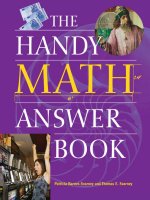
The handy math answer book
Bạn đang xem bản rút gọn của tài liệu. Xem và tải ngay bản đầy đủ của tài liệu tại đây (7.15 MB, 522 trang )
About the Authors
Thanks to science backgrounds and their numerous science publications, both
Patricia Barnes-Svarney and Thomas E. Svarney have had much more than a passing
acquaintance with mathematics.
Barnes-Svarney has been a nonfiction science and science-fiction writer for 20
years. She has a bachelor’s degree in geology and a master’s degree in geography/
geomorphology, and at one time she was planning to be a math major. BarnesSvarney has had some 350 articles published in magazines and journals and is the
author or coauthor of more than 30 books, including the award-winning New York
Public Library Science Desk Reference and Asteroid: Earth Destroyer or New
Frontier?, as well as several international best-selling children’s books. In her spare
time, she gets as much produce and herbs as she can out of her extensive gardens
before the wildlife takes over.
Thomas E. Svarney brings extensive scientific training and experience, a love of
nature, and creative artistry to his various projects. With Barnes-Svarney, he has
written extensively about the natural world, including paleontology (The Handy
Dinosaur Answer Book), oceanography (The Handy Ocean Answer Book), weather
(Skies of Fury: Weather Weirdness around the World), natural hazards (A Paranoid’s
Ultimate Survival Guide), and reference (The Oryx Guide to Natural History). His
passions include martial arts, Zen, Felis catus, and nature.
When they aren’t traveling, the authors reside in the Finger Lakes region of
upstate New York with their cats, Fluffernutter, Worf, and Pabu.
www.pdfgrip.com
The Handy Answer Book Series®
The Handy Answer Book for Kids
(and Parents)
The Handy Biology Answer Book
The Handy Bug Answer Book
The Handy Dinosaur Answer Book
The Handy Geography Answer Book
The Handy Geology Answer Book
The Handy History Answer Book
The Handy Math Answer Book
The Handy Ocean Answer Book
The Handy Physics Answer Book
The Handy Politics Answer Book
The Handy Presidents Answer Book
The Handy Religion Answer Book
The Handy Science Answer Book
The Handy Space Answer Book
The Handy Sports Answer Book
The Handy Weather Answer Book
Please visit us at www.visibleink.com.
www.pdfgrip.com
THE
HANDY
MATH
ANSWER
BOOK
www.pdfgrip.com
www.pdfgrip.com
THE
HANDY
AN SWE R
BOOK
Patricia Barnes-Svarney and Thomas E. Svarney
Detroit
www.pdfgrip.com
THE
HANDY
MATH
ANSWER
BOOK
Copyright â 2006 by Visible Ink Pressđ
This publication is a creative work fully protected by all applicable copyright laws,
as well as by misappropriation, trade secret, unfair competition, and other applicable laws.
No part of this book may be reproduced in any form without permission in writing from the publisher, except by a reviewer who wishes to quote brief passages
in connection with a review written for inclusion in a magazine or newspaper.
All rights to this publication will be vigorously defended.
Visible Ink Press®
43311 Joy Road #414
Canton, MI 48187-2075
Visible Ink Press is a trademark of Visible Ink Press LLC.
Most Visible Ink Press books are available at special quantity discounts when purchased in bulk by corporations, organizations, or groups. Customized printings,
special imprints, messages, and excerpts can be produced to meet your needs. For
more information, contact Special Markets Director, Visible Ink Press, at
www.visibleink.com.
Art Director: Mary Claire Krzewinski
Line Art: Kevin Hile
Typesetting: The Graphix Group
ISBN 1-57859-171-6
Cover images of euros used by permission of Photographer's Choice/Getty Images;
Aristotle used by permission of The Bridgeman Art Library/Getty Images; woman
at casino used by permission of Taxi/Getty Images; nautilus used by permission of
The Image Bank/Getty Images.
Back cover images of mathematician used by permission of Stone/Getty Images;
card game used by permission of The Image Bank/Getty Images.
Cataloging-in-Publication Data is on file with the Library of Congress.
Printed in the United States of America
All rights reserved
10 9 8 7 6 5 4 3 2 1
www.pdfgrip.com
Contents
xi
ACKNOWLEDGMENTS xiii
I NTRODUCTION
HISTORY
HISTORY OF MATHEMATICS …
3
What Is Mathematics? . . . Early Counting and Numbers . . .
Mesopotamian Numbers and Mathematics . . . Egyptian Numbers
and Mathematics . . . Greek and Roman Mathematics . . . Other
Cultures and Early Mathematics . . . Mathematics after the Middle
Ages . . . Modern Mathematics
MATHEMATICS THROUGHOUT
HISTORY … 37
The Creation of Zero and Pi . . . Development of Weights
and Measures . . . Time and Math in History . . .
Math and Calendars in History
vii
www.pdfgrip.com
THE BASICS
MATH BASICS …
67
Basic Arithmetic . . . All about Numbers . . . More about Numbers . . .
The Concept of Zero . . . Basic Mathematical Operations . . . Fractions
FOUNDATIONS OF MATHEMATICS …
103
Foundations and Logic . . . Mathematical and Formal Logic . . .
Axiomatic System . . . Set Theory
ALGEBRA …
131
The Basics of Algebra . . . Algebra Explained . . . Algebraic
Operations . . . Exponents and Logarithms . . . Polynomial
Equations . . . More Algebra . . . Abstract Algebra
GEOMETRY AND TRIGONOMETRY …
165
Geometry Beginnings . . . Basics of Geometry . . . Plane Geometry
. . . Solid Geometry . . . Measurements and Transformations . . .
Analytic Geometry . . . Trigonometry . . . Other Geometries
MATHEMATICAL ANALYSIS …
209
Analysis Basics . . . Sequences and Series . . . Calculus Basics . . .
Differential Calculus . . . Integral Calculus . . . Differential
Equations . . . Vector and Other Analyses
APPLIED MATHEMATICS …
243
Applied Mathematics Basics . . . Probability Theory . . . Statistics . . .
Modeling and Simulation . . . Other Areas of Applied Mathematics
viii
www.pdfgrip.com
IN
SCIENCE
AND
E NGINEERING
MATH IN THE PHYSICAL
SCIENCES … 275
CONTENTS
MATH
Physics and Mathematics . . . Classical Physics and Mathematics . . .
Modern Physics and Mathematics . . . Chemistry and Math . . .
Astronomy and Math
MATH IN THE NATURAL
SCIENCES … 295
Math in Geology . . . Math in Meteorology . . . Math in Biology . . .
Math and the Environment
MATH IN ENGINEERING …
323
Basics of Engineering . . . Civil Engineering and Mathematics . . .
Mathematics and Architecture . . . Electrical Engineering and
Materials Science . . . Chemical Engineering . . . Industrial and
Aeronautical Engineering
MATH IN COMPUTING …
347
Early Counting and Calculating Devices . . . Mechanical and
Electronic Calculating Devices . . . Modern Computers and
Mathematics . . . Applications
ix
www.pdfgrip.com
MATH ALL AROUND US
MATH IN THE HUMANITIES …
373
Math and the Fine Arts . . . Math and the Social Sciences . . .
Math, Religion, and Mysticism . . . Math in Business and
Economics . . . Math in Medicine and Law
EVERYDAY MATH …
397
Numbers and Math in Everyday Life . . . Math and the Outdoors
. . . Math, Numbers, and the Body . . . Math and the Consumer’s
Money . . . Math and Traveling
RECREATIONAL MATH …
421
Math Puzzles . . . Mathematical Games . . .
Card and Dice Games . . . Sports Numbers . . . Just for Fun
MATHEMATICAL RESOURCES …
443
Educational Resources . . . Organizations and Societies . . .
Museums . . . Popular Resources . . . Surfing the Internet
APPENDIX 1: M EASUREMENT SYSTEMS
APPENDIX 2: LOG TABLE
IN
BASE 10
APPENDIX 3: COMMON FORMULAS
SHAPES
I NDEX
AND
CONVERSION FACTORS 463
FOR THE
FOR
N UMBERS 1
THROUGH
CALCULATING AREAS
479
483
x
www.pdfgrip.com
AND
10 469
VOLUMES
OF
Introduction
“As far as the laws of mathematics refer to reality, they are not certain;
and as far as they are certain, they do not refer to reality.”
Albert Einstein
We’ve all seen it. We’ve all experienced it, many times without knowing it. It’s in the
design of a beautiful stained-glass window in the middle of an Austrian cathedral. It’s
in the large and small workings of a car, computer, or space shuttle. It’s in the innocent statement of a child asking, “How old are you?”
By now you’ve probably guessed what “it” is: mathematics.
Mathematics is everywhere. Sometimes it’s as subtle as the symmetry of a butterfly’s wings. Sometimes it’s as blatant as the U.S. debt figures displayed on a sign outside the Internal Revenue Service building in New York City.
Numbers sneak into our lives. They are used to determine a prescription for eyeglasses; they reveal blood pressure, heart rate, and cholesterol levels, too. Numbers are
used so you can follow a bus, train, or plane schedule; or they can help you figure out
when your favorite store, restaurant, or library is open. In the home, numbers are
used for recipes, figuring out the voltage on a circuit in an electric switchbox, and
measuring a room for a carpet. Probably the most familiar connection we have to
numbers is in our daily use of money. Numbers, for instance, let you know whether
you’re getting a fair deal on that morning cup of cappuccino.
The Handy Math Answer Book is your introduction to the world of numbers, from
their long history (and hints of the future) to how we use math in our everyday lives.
With more than 1,000 questions and answers in The Handy Math Answer Book (1,002,
to be mathematically precise) and over 100 photographs, 70 illustrations, and dozens
of equations to help explain or provide examples of fundamental mathematical principles, you’ll cover a lot of ground in just one book!
Handy Math is split into four sections: “The History” includes famous (and sometimes infamous) people, places, and objects of mathematical importance; “The Basics”
www.pdfgrip.com
xi
explains the various branches of mathematics, from fundamental arithmetic to complex calculus; “Math in Science and Engineering” describes how relevant math is to
such fields as architecture, the natural sciences, and even art; and “Math All Around
Us” shows how much math is part of our daily lives, including everything from balancing a checkbook to playing the slots in Las Vegas.
The subject of math—and its many connections—is immense. After all, over two
thousand years ago the Greek mathematician Euclid wrote thirteen books about
geometry and other fields of mathematics (the famous Elements). It took him six of
those volumes just to describe elementary plane geometry. Today, even more is known
about mathematics, as you’ll see in the list of resources described in the last chapter of
this book. Here we’ve provided you with everything from recommended print sources
to some of our favorite Web sites, such as “Dr. Math” and “SOS Math.” In this way,
Handy Math not only introduces you to the basics of math, but it also gives you the
resources to continue on your own mathematical journey.
Be warned: This journey is an extensive one. But you’ll soon learn that it’s satisfying and rewarding in every way. Not only will you understand what math is all about,
but you’ll appreciate the mathematical beauty that surrounds you every day. Just as it
has astounded us, we’re sure you’ll be amazed by how numbers, equations, and sundry
other mathematical constructions continue to not only define, but also influence, the
world around us.
xii
www.pdfgrip.com
Acknowledgments
S uch a work as The Handy Math Answer Book could not have been completed without
the help of many generous people. The authors would like to thank Roger Jänecke for
originating the concept for this book; Kevin Hile for his patience, great editorial work,
photo research, and line art design; Christa Gainor for always being there to answer
our questions (and her amazing knowledge of topics); Roger Matuz for his friendly
advice in helping us decide on content; Amy Keyzer and John Krol for proofreading;
Lawrence Baker for the index; Mary Claire Krzewinski for design; Marco Di Vita of the
Graphix Group for typesetting; Marty Connors for giving us the go-ahead for this project; and our agent and friend, Agnes Birnbaum, as always, for all her hard work.
Finally, the authors would like to thank the multitude of devoted mathematicians
and those in other fields who use mathematics—past, present, and future. These people have, in a direct or indirect way, helped us all better understand our world.
It would also be nice to thank those people who first made up the numbering system so long ago, but that might be stretching our thanks a bit too much. After all, we
wouldn’t be using computers or cashing checks without numbers!
xiii
www.pdfgrip.com
www.pdfgrip.com
HISTORY
www.pdfgrip.com
www.pdfgrip.com
HISTORY OF
MATHEMATICS
WHAT I S MATH E MATI C S?
What is the origin of the word “mathematics”?
According to most sources, the word “mathematics” is derived from the Latin mathmaticus and from the Greek mathe¯ matikos, meaning “mathematical.” (Other forms
include mathe¯ma, meaning “learning,” and manthanein, meaning “to learn.”)
In simple terms, what is mathematics?
Mathematics is often referred to as the science of quantity. The two traditional
branches of mathematics have been arithmetic and geometry, using the quantities of
numbers and shapes. And although arithmetic and geometry are still of major importance, modern mathematics expands the field into more complex branches by using a
greater variety of quantities.
Who were the first humans to use simple forms of mathematics?
No one really knows who first used simple forms of mathematics. It is thought that
the earliest peoples used something resembling mathematics because they would have
known the concepts of one, two, or many. Perhaps they even counted using items in
nature, such as 1, represented by the Sun or Moon; 2, their eyes or wings of a bird;
clover for 3; or legs of a fox for 4.
Archeologists have also found evidence of a crude form of mathematics in the tallying systems of certain ancient populations. These include notches in wooden sticks
or bones and piles or lines of shells, sticks, or pebbles. This is an indication that certain prehistoric peoples had at least simple, visual ways of adding and subtracting
things, but they did not yet have a numbering system such as we have today.
www.pdfgrip.com
3
EAR LY C O U NTI N G
AN D N U M B E R S
What are some examples of how
early peoples counted?
There were several different ways that
early civilizations recorded the numbers
of things. Some of the earliest archeological evidence of counting dates from
about 35000 to 20000 BCE, in which several bones bear regularly spaced notches. Most of these marked bones have
been found in western Europe, includEarly humans used all sorts of images to represent
ing in the Czech Republic and France.
numbers, including the fox, the image of which was
The purpose of the notches is unclear,
used to indicate the number 4. Stone/Getty Images.
but most scientists believe they do represent some method of counting. The marks may represent an early hunter’s number of kills; a way of keeping track of inventory (such as sheep or weapons); or a way
to track the movement of the Sun, Moon, or stars across the sky as a kind of crude
calendar.
Not as far back in time, shepherds in certain parts of West Africa counted the animals in their flocks by using shells and various colored straps. As each sheep passed,
the shepherd threaded a corresponding shell onto a white strap, until nine shells were
reached. As the tenth sheep went by, he would remove the white shells and put one on
a blue strap, representing ten. When 10 shells, representing 100 sheep, were on the
blue strap, a shell would then be placed on a red strap, a color that represented what
we would call the next decimal up. This would continue until the entire flock was
counted. This is also a good example of the use of base 10. (For more information
about bases, see “Math Basics.”)
Certain cultures also used gestures, such as pointing out parts of the body, to represent numbers. For example, in the former British New Guinea, the Bugilai culture
used the following gestures to represent numbers: 1, left hand little finger; 2, next finger; 3, middle finger; 4, index finger; 5, thumb; 6, wrist; 7, elbow; 8, shoulder; 9, left
breast; 10, right breast.
4
Another method of counting was accomplished with string or rope. For example,
in the early 16th century, the Incas used a complex form of string knots for accounting and sundry other reasons, such as calendars or messages. These recording strings
were called quipus, with units represented by knots on the strings. Special officers of
the king called quipucamayocs, or “keepers of the knots,” were responsible for making and reading the quipus.
www.pdfgrip.com
he reasons humans developed mathematics are the same reasons we use
math in our own modern lives: People needed to count items, keep track of
the seasons, and understand when to plant. Math may even have developed for
religious reasons, such as in recording or predicting natural or celestial phenomena. For example, in ancient Egypt, flooding of the Nile River would wash
away all landmarks and markers. In order to keep track of people’s lands after
the floods, a way to measure the Earth had to be invented. The Greeks took
many of the Egyptian measurement ideas even further, creating mathematical
methods such as algebra and trigonometry.
T
HISTORY OF MATHEMATICS
Why did the need for mathematics arise?
How did certain ancient cultures count large numbers?
It is not surprising that one of the earliest ways to count was the most obvious: using
the hands. And because these “counting machines” were based on five digits on each
hand, most cultures invented numbering systems using base 10. Today, we call these
base numbers—or base of a number system—the numbers that determine place values. (For more information on base numbers, see “Math Basics.”)
However, not every group chose 10. Some cultures chose the number 12 (or base
12); the Mayans, Aztecs, Basques, and Celts chose base 20, adding the ten digits of the
feet. Still others, such as the Sumerians and Babylonians, used base 60 for reasons not
yet well understood.
The numbering systems based on 10 (or 12, 20, or 60) started when people
needed to represent large numbers using the smallest set of symbols. In order to do
this, one particular set would be given a special role. A regular sequence of numbers
would then be related to the chosen set. One can think of this as steps to various
floors of a building in which the steps are the various numbers—the steps to the
first floor are part of the “first order units”; the steps to the second floor are the
“second order units”; and so on. In today’s most common units (base 10), the first
order units are the numbers 1 through 9, the second order units are 10 through 19,
and so on.
What is the connection between counting and mathematics?
Although early counting is usually not considered to be mathematics, mathematics
began with counting. Ancient peoples apparently used counting to keep track of
sundry items, such as animals or lunar and solar movements. But it was only when
agriculture, business, and industry began that the true development of mathematics
became a necessity.
www.pdfgrip.com
5
What are the names of the various base systems?
he base 10 system is often referred to as the decimal system. The base 60 system is called the sexagesimal system. (This should not be confused with the
sexadecimal system—also called the hexadecimal system—or the digital system
based on powers of 16.) A sexagesimal counting table is used to convert numbers using the 60 system into decimals, such as minutes and seconds.
T
The following table lists the common bases and corresponding number systems:
Base Number System
2
3
4
5
6
7
8
binary
ternary
quaternary
quinary
senary
septenary
octal
9
10
11
12
16
20
60
nonary
decimal
undenary
duodecimal
hexadecimal
vigesimal
sexagesimal
What is a numeral?
A numeral is a standard symbol for a number. For example, X is the Roman numeral
that corresponds to 10 in the standard Hindu-Arabic system.
What were the two fundamental ideas in the development of numerical symbols?
There were two basic principles in the development of numerical symbols: First, a certain standard sign for the unit is repeated over and over, with each sign representing
the number of units. For example, III is considered 3 in Roman numerals (see the
Greek and Roman Mathematics section below for an explanation of Roman numerals).
In the other principle, each number has its own distinct symbol. For example, “7” is the
symbol that represents seven units in the standard Hindu-Arabic numerals. (See below
for an explanation of Hindu-Arabic numbers; for more information, see “Math Basics.”)
M E S O P OTAM IAN N U M B E R S
AN D MATH E MATI C S
What was the Sumerian oral counting system?
6
The Sumerians—whose origins are debated, but who eventually settled in
Mesopotamia—used base 60 in their oral counting method. Because it required the
www.pdfgrip.com
he explanation of who the Mesopotamians were is not easy because there are
many historians who disagree on how to distinguish Mesopotamians from
other cultures and ethnic groups. In most texts, the label “Mesopotamian” refers
to most of the unrelated peoples who used cuneiform (a way of writing numbers;
see below), including the Sumerians, Persians, and so on. They are also often
referred to as Babylonians, after the city of Babylon, which was the center of
many of the surrounding empires that occupied the fertile plain between the
Tigris and Euphrates Rivers. But this area was also called Mesopotamia. Therefore, the more correct label for these people is probably “Mesopotamians.”
T
HISTORY OF MATHEMATICS
Who were the Mesopotamians?
In this text, Mesopotamians will be referred to by their various subdivisions
because each brought new ideas to the numbering systems and, eventually, mathematics. These divisions include the Sumerians, Akkadians, and Babylonians.
memorization of so many signs, the Sumerians also used base 10 like steps of a ladder
between the various orders of magnitude. For example, the numbers followed the
sequence 1, 60, 602, 603, and so on. Each one of the iterations had a specific name,
making the numbering system extremely complex.
No one truly knows why the Sumerians chose such a high base number. Theories
range from connections to the number of days in a year, weights and measurements,
and even that it was easier to use for their purposes. Today, this numbering system is
still visible in the way we tell time (hours, minutes, seconds) and in our definitions of
circular measurements (degrees, minutes, seconds).
How did the Sumerian written counting system change over time?
Around 3200 BCE, the Sumerians developed a written number system, attaching a special graphical symbol to each of the larger numbers at various intervals (1, 10, 60,
3,600, etc.). Because of the rarity of stone, and the difficulty in preserving leather,
parchment, or wood, the Sumerians used a material that would not only last but
would be easy to imprint: clay. Each symbol was written on wet clay tablets, then
baked in the hot sunlight. This is why many of the tablets are still in existence today.
The Sumerian number system changed over the centuries. By about 3000 BCE, the
Sumerians decided to turn their numbering symbols counterclockwise by 90 degrees.
And by the 27th century BCE, the Sumerians began to physically write the numbers in
a different way, mainly because they changed writing utensils from the old stylus that
was cylindrical at one end and pointed at the other to a stylus that was flat. This
change in writing utensils, but not the clay, created the need for new symbols. The
www.pdfgrip.com
7
Who were the Akkadians?
he region of Mesopotamia was once the center of the Sumerian civilization, a
culture that flourished before 3500 BCE. Not only did the Sumerians have a
counting and writing system, but they were also a progressive culture, supporting irrigation systems, a legal system, and even a crude postal service. By about
2300 BCE, the Akkadians invaded the area, emerging as the dominant culture. As
most conquerors do, they imposed their own language on the area and even
used the Sumerians’ cuneiform system to spread their language and traditions
to the conquered culture.
T
Although the Akkadians brought a more backward culture into the mix, they
were responsible for inventing the abacus, an ancient counting tool. By 2150
BCE , the Sumerians had had enough: They revolted against the Akkadian rule,
eventually taking over again.
However, the Sumerians did not maintain their independence for long. By
2000 BCE their empire had collapsed, undermined by attacks from the west by
Amorites and from the east by Elamites. As the Sumerians disappeared, they
were replaced by the Assyro-Babylonians, who eventually established their capital at Babylon.
new way of writing numbers was called cuneiform script, which is from the Latin
cuneus, meaning “a wedge” and formis, meaning “like.”
Did any cultures use more than one base number in their numbering system?
Certain cultures may have used a particular base as their dominant numbering system, such as the Sumerians’ base 60, but that doesn’t mean they didn’t use other base
numbers. For example, the Sumerians, Assyrians, and Babylonians used base 12,
mostly for use in their measurements. In addition, the Mesopotamian day was broken
into 12 equal parts; they also divided the circle, ecliptic, and zodiac into 12 sections of
30 degrees each.
What was the Babylonian numbering system?
8
The Babylonians were one of the first to use a positional system within their numbering system—the value of a sign depends on the position it occupies in a string of
signs. Neither the Sumerians nor the Akkadians used this system. The Babylonians
also divided the day into 24 hours, an hour into 60 minutes, and a minute into 60 seconds, a way of telling time that has existed for the past 4,000 years. For example, the
www.pdfgrip.com
e are most familiar with the rule of position, or place value, as it is applied
to the Hindu-Arabic numerals 1, 2, 3, 4, 5, 6, 7, 8, 9, and 0. This is because
their values depend on the place or position they occupy in a written numerical
expression. For example, the number 5 represents 5 units, 50 is 5 tens, 500 is 5
hundreds, and so on. The values of the 5s depends upon their position in the
numerical expression. It is thought that the Chinese, Indian, Mayan, and
Mesopotamian (Babylonian) cultures were the first to develop this concept of
place value.
W
HISTORY OF MATHEMATICS
What is the rule of position?
way we now write hours, minutes, and seconds is as follows: 6h, 20', 15''; the way the
Babylonians would have written this same expression (as sexagesimal fractions) was 6
20/60 15/3600.
Were there any problems with the Babylonian numbering system?
Yes. One in particular was the use of numbers that looked essentially the same. The
Babylonians conquered this problem by making sure the character spacing was different for these numbers. This ended the confusion, but only as long as the scribes writing the characters bothered to leave the spaces.
Another problem with the early Babylonian numbering system was not having a
number to represent zero. The concept of zero in a numbering system did not exist at
that time. And with their sophistication, it is strange that the early Babylonians never
invented a symbol like zero to put into the empty positions in their numbering system. The lack of this important placeholder no doubt hampered early Babylonian
astronomers and mathematicians from working out certain calculations.
Did the Babylonians finally use a symbol to indicate an empty space in
their numbers?
Yes, but it took centuries. In the meantime, scribes would not use a symbol representing an empty space in a text, but would use phrases such as “the grain is finished” at the end of a computation that indicated a zero. Apparently, the Babylonians
did comprehend the concepts of void and nothing, but they did not consider them to
be synonymous.
Around 400 BCE, the Babylonians began to record an empty space in their numbers, which were still represented in cuneiform. Interestingly, they did not seem to
view this space as a number—what we would call zero today—but merely as a placeholder.
www.pdfgrip.com
9
What happened to the Babylonians?
fter the Amorites (a Semitic people) founded Babylon, there were several
dynasties that ruled the area, including those associated with the famous
king and lawmaker, Hammurabi (1792–1750 BCE). It was periodically taken over,
including in 1594 BCE by the Kassites and in the 12th century BCE by the Assyrians. Through all these conquests, most of the Babylonian culture retained its
own distinctiveness. With the fall of the Assyrian Empire in 612 BCE, the Babylonian culture bloomed, at least until its conquest by Cyris of Persia in 539 BCE.
It eventually died out a short time after being conquered by Alexander the Great
(356–323 BCE) in 331 BCE (ironically, Alexander died in Babylon, unable to recover from a fever he contracted).
A
Who invented the symbol for zero?
Although the Babylonians determined there to be an empty space in their numbers,
they did not have a symbol for zero. Archeologists believe that a crude symbol for zero
was invented either in Indochina or India around the 7th century and by the Mayans
independently about a hundred years earlier. What was the main problem with the
invention of zero by the Mayans? Unlike more mobile cultures, they were not able to
spread the word around the world. Thus, their claim as the first people to use the symbol for zero took centuries to uncover. (For more information about zero, see “Mathematics throughout History.”)
What do we know about Babylonian mathematical tables?
Archeologists know that the Babylonians invented tables to represent various mathematical calculations. Evidence comes from two tables found in 1854 at Senkerah on
the Euphrates River (dating from 2000 BCE). One listed the squares of numbers up to
59, and the other the cubes of numbers up to 32.
The Babylonians also used a method of division based on tables and the equation
a/b ϭ a ϫ (1/b). With this equation, all that was necessary was a table of reciprocals;
thus, the discovery of tables with reciprocals of numbers up to several billion.
They also constructed tables for the equation n3 ϩ n2 in order to solve certain cubic
equations. For example, in the equation ax3 ϩ bx2 ϭ c (note: this is in our modern algebraic notation; the Babylonians had their own symbols for such an equation), they
would multiply the equation by a2, then divide it by b3 to get (ax/b)3 ϩ (ax/b)2 ϭ ca2/b3.
10
If y ϭ ax/b, then y3 ϩ y2 ϭ ca2/b3, which could now be solved by looking up the n3
ϩ table for the value of n that satisfies n3 ϩ n2 ϭ ca2/b3. When a solution was found
n2
www.pdfgrip.com