Elliptic curves
Bạn đang xem bản rút gọn của tài liệu. Xem và tải ngay bản đầy đủ của tài liệu tại đây (7.28 MB, 510 trang )
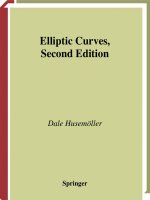
Elliptic Curves,
Second Edition
Dale Husemöller
Springer
www.pdfgrip.com
Graduate Texts in Mathematics
111
Editorial Board
S. Axler F.W. Gehring K.A. Ribet
Springer
New York
Berlin
Heidelberg
Hong Kong
London
Milan
Paris
Tokyo
www.pdfgrip.com
This page intentionally left blank
www.pdfgrip.com
Dale Husemöller
Elliptic Curves
Second Edition
With Appendices by Otto Forster, Ruth Lawrence, and
Stefan Theisen
With 42 Illustrations
www.pdfgrip.com
Dale Husemöller
Max-Planck-Institut für Mathematik
Vivatsgasse 7
D-53111 Bonn
Germany
Editorial Board:
S. Axler
Mathematics Department
San Francisco State
University
San Francisco, CA 94132
USA
F.W. Gehring
Mathematics Department
East Hall
University of Michigan
Ann Arbor, MI 48109
USA
K.A. Ribet
Mathematics Department
University of California,
Berkeley
Berkeley, CA 94720-3840
USA
Mathematics Subject Classification (2000): 14-01, 14H52
Library of Congress Cataloging-in-Publication Data
Husemöller, Dale.
Elliptic curves.— 2nd ed. / Dale Husemöller ; with appendices by Stefan Theisen, Otto Forster, and
Ruth Lawrence.
p. cm. — (Graduate texts in mathematics; 111)
Includes bibliographical references and index.
ISBN 0-387-95490-2 (alk. paper)
1. Curves, Elliptic. 2. Curves, Algebraic. 3. Group schemes (Mathematics) I. Title. II.
Series.
QA567 .H897 2002
516.3′52—dc21
2002067016
ISBN 0-387-95490-2
Printed on acid-free paper.
© 2004, 1987 Springer-Verlag New York, Inc.
All rights reserved. This work may not be translated or copied in whole or in part without the written permission of the publisher (Springer-Verlag New York, Inc., 175 Fifth Avenue, New York, NY 10010,
USA), except for brief excerpts in connection with reviews or scholarly analysis. Use in connection with
any form of information storage and retrieval, electronic adaptation, computer software, or by similar or
dissimilar methodology now known or hereafter developed is forbidden.
The use in this publication of trade names, trademarks, services marks, and similar terms, even if they
are not identified as such, is not to be taken as an expression of opinion as to whether or not they are subject to proprietary rights.
Printed in the United States of America.
9 8 7 6 5 4 3 2 1
(TXQ/EB)
SPIN 10877271
Springer-Verlag is a part of Springer Science+Business Media
springeronline.com
www.pdfgrip.com
To
Robert
and the memory of
Roger,
with whom I first learned
the meaning of collaboration
www.pdfgrip.com
This page intentionally left blank
www.pdfgrip.com
Preface to the Second Edition
The second edition builds on the first in several ways. There are three new chapters
which survey recent directions and extensions of the theory, and there are two new
appendices. Then there are numerous additions to the original text. For example, a
very elementary addition is another parametrization which the author learned from
Don Zagier y 2 = x 3 − 3αx + 2β of the basic cubic equation. This parametrization
is useful for a detailed description of elliptic curves over the real numbers.
The three new chapters are Chapters 18, 19, and 20. Chapter 18, on Fermat’s Last
Theorem, is designed to point out which material in the earlier chapters is relevant
as background for reading Wiles’ paper on the subject together with further developments by Taylor and Diamond. The statement which we call the modular curve
conjecture has a long history associated with Shimura, Taniyama, and Weil over the
last fifty years. Its relation to Fermat, starting with the clever observation of Frey
ending in the complete proof by Ribet with many contributions of Serre, was already
mentioned in the first edition. The proof for a broad class of curves by Wiles was sufficient to establish Fermat’s last theorem. Chapter 18 is an introduction to the papers
on the modular curve conjecture and some indication of the proof.
Chapter 19 is an introduction to K3 surfaces and the higher dimensional Calabi–
Yau manifolds. One of the motivations for producing the second edition was the
utility of the first edition for people considering examples of fibrings of three dimensional Calabi–Yau varieties. Abelian varieties form one class of generalizations of
elliptic curves to higher dimensions, and K3 surfaces and general Calabi–Yau manifolds constitute a second class.
Chapter 20 is an extension of earlier material on families of elliptic curves where
the family itself is considered as a higher dimensional variety fibered by elliptic
curves. The first two cases are one dimensional parameter spaces where the family is
two dimensional, hence a surface two dimensional surface parameter spaces where
the family is three dimensional. There is the question of, given a surface or a three
dimensional variety, does it admit a fibration by elliptic curves with a finite number
of exceptional singular fibres. This question can be taken as the point of departure
for the Enriques classification of surfaces.
www.pdfgrip.com
viii
Preface to the Second Edition
There are three new appendices, one by Stefan Theisen on the role of Calabi–
Yau manifolds in string theory and one by Otto Forster on the use of elliptic curves
in computing theory and coding theory. In the third appendix we discuss the role of
elliptic curves in homotopy theory. In these three introductions the reader can get a
clue to the far-reaching implications of the theory of elliptic curves in mathematical
sciences.
During the final production of this edition, the ICM 2002 manuscript of Mike
Hopkins became available. This report outlines the role of elliptic curves in homotopy theory. Elliptic curves appear in the form of the Weierstasse equation and its
related changes of variable. The equations and the changes of variable are coded in
an algebraic structure called a Hopf algebroid, and this Hopf algebroid is related to
a cohomology theory called topological modular forms. Hopkins and his coworkers
have used this theory in several directions, one being the explanation of elements
in stable homotopy up to degree 60. In the third appendix we explain how what we
described in Chapter 3 leads to the Weierstrass Hopf algebroid making a link with
Hopkins paper.
Max-Planck-Institut făur Mathematik
Bonn, Germany
Dale Husemăoller
www.pdfgrip.com
Preface to the First Edition
The book divides naturally into several parts according to the level of the material,
the background required of the reader, and the style of presentation with respect to
details of proofs. For example, the first part, to Chapter 6, is undergraduate in level,
the second part requires a background in Galois theory and the third some complex
analysis, while the last parts, from Chapter 12 on, are mostly at graduate level. A
general outline of much of the material can be found in Tate’s colloquium lectures
reproduced as an article in Inventiones [1974].
The first part grew out of Tate’s 1961 Haverford Philips Lectures as an attempt to
write something for publication closely related to the original Tate notes which were
more or less taken from the tape recording of the lectures themselves. This includes
parts of the Introduction and the first six chapters. The aim of this part is to prove,
by elementary methods, the Mordell theorem on the finite generation of the rational
points on elliptic curves defined over the rational numbers.
In 1970 Tate returned to Haverford to give again, in revised form, the original
lectures of 1961 and to extend the material so that it would be suitable for publication.
This led to a broader plan for the book.
The second part, consisting of Chapters 7 and 8, recasts the arguments used in
the proof of the Mordell theorem into the context of Galois cohomology and descent
theory. The background material in Galois theory that is required is surveyed at the
beginnng of Chapter 7 for the convenience of the reader.
The third part, consisting of Chapters 9, 10, and 11, is on analytic theory. A
background in complex analysis is assumed and in Chapter 10 elementary results on
p-adic fields, some of which were introduced in Chapter 5, are used in our discussion of Tate’s theory of p-adic theta functions. This section is based on Tates 1972
Haverford Philips Lectures.
Max-Planck-Institut făur Mathematik
Bonn, Germany
Dale Husemăoller
www.pdfgrip.com
This page intentionally left blank
www.pdfgrip.com
Acknowledgments to the Second Edition
Stefan Theisen, during a period of his work on Calabi–Yau manifolds in conjunction
with string theory, brought up many questions in the summer of 1998 which lead to
a renewed interest in the subject of elliptic curves on my part.
Otto Forster gave a course in Munich during 2000–2001 on or related to elliptic
curves. We had discussions on the subject leading to improvements in the second
edition, and at the same time he introduced me to the role of elliptic curves in cryptography.
A reader provided by the publisher made systematic and very useful remarks on
everything including mathematical content, exposition, and English throughout the
manuscript.
Richard Taylor read a first version of Chapter 18, and his comments were of
great use. F. Oort and Don Zagier offered many useful suggestions for improvement
of parts of the first edition. In particular the theory of elliptic curves over the real
numbers was explained to me by Don.
With the third appendix T. Bauer, M. Joachim, and S. Schwede offered many
useful suggestions.
During this period of work on the second edition, I was a research professor
from Haverford College, a visitor at the Max Planck Institute for Mathematics in
Bonn, a member of the Graduate College and mathematics department in Munich,
and a member of the Graduate College in Măunster. All of these connections played
a significant role in bringing this project to a conclusion.
Max-Planck-Institut făur Mathematik
Bonn, Germany
Dale Husemăoller
www.pdfgrip.com
This page intentionally left blank
www.pdfgrip.com
Acknowledgments to the First Edition
Being an amateur in the field of elliptic curves, I would have never completed a
project like this without the professional and moral support of a great number of persons and institutions over the long period during which this book was being written.
John Tate’s treatment of an advanced subject, the arithmetic of elliptic curves,
in an undergraduate context has been an inspiration for me during the last 25 years
while at Haverford. The general outline of the project, together with many of the
details of the exposition, owe so much to Tate’s generous help.
The E.N.S. course by J.-P. Serre of four lectures in June 1970 together with two
Haverford lectures on elliptic curves were very important in the early development
of the manuscript. I wish to thank him also for many stimulating discussions. Elliptic curves were in the air during the summer seasons at the I.H.E.S. around the
early 1970s. I wish to thank P. Deligne, N. Katz, S. Lichtenbaum, and B. Mazur for
many helpful conversations during that period. It was the Haverford College Faculty
Research Fund that supported many times my stays at the I.H.E.S.
During the year 1974–5, the summer of 1976, the year 1981–2, and the spring
of 1986, I was a guest of the Bonn Mathematics Department SFB and later the Max
Planck Institute. I wish to thank Professor F. Hirzebruch for making possible time
to work in a stimulating atmosphere and for his encouragement in this work. An
early version of the first half of the book was the result of a Bonn lecture series on
Elliptische Kurven. During these periods, I profited frequently from discussions with
G. Harder and A. Ogg.
Conversations with B. Gross were especially important for realizing the final
form of the manuscript during the early 1980s. I am very thankful for his encouragement and help. In the spring of 1983 some of the early chapters of the book were used
by K. Rubin in the Princeton Junior Seminar, and I thank him for several useful suggestions. During the same time, J. Coates invited me to an Oberwolfach conference
on elliptic curves where the final form of the manuscript evolved.
During the final stages of the manuscript, both R. Greenberg and R. Rosen read
through the later chapters, and I am grateful for their comments. I would like to
thank P. Landweber for a very careful reading of the manuscript and many useful
comments.
www.pdfgrip.com
xiv
Acknowledgments to the First Edition
Ruth Lawrence read the early chapters along with working the exercises. Her
contribution was very great with her appendix on the exercises and suggested improvements in the text. I wish to thank her for this very special addition to the book.
Free time from teaching at Haverford College during the year 1985–1986 was
made possible by a grant from the Vaughn Foundation. I wish to express my gratitude
to Mr. James Vaughn for this support, for this project as well as others, during this
difficult last period of the preparation of the manuscript.
Max-Planck-Institut făur Mathematik
Bonn, Germany
Dale Husemăoller
www.pdfgrip.com
Contents
Preface to the Second Edition . . . . . . . . . . . . . . . . . . . . . . . . . . . . . . . . . . . . . . vii
Preface to the First Edition . . . . . . . . . . . . . . . . . . . . . . . . . . . . . . . . . . . . . . . .
ix
Acknowledgments to the Second Edition . . . . . . . . . . . . . . . . . . . . . . . . . . . . .
xi
Acknowledgments to the First Edition . . . . . . . . . . . . . . . . . . . . . . . . . . . . . . . xiii
Introduction to Rational Points on Plane Curves . . . . . . . . . . . . . . . . . . . . . .
1
Rational Lines in the Projective Plane . . . . . . . . . . . . . . . . . . . . . . . . . .
2
Rational Points on Conics . . . . . . . . . . . . . . . . . . . . . . . . . . . . . . . . . . .
3
Pythagoras, Diophantus, and Fermat . . . . . . . . . . . . . . . . . . . . . . . . . . .
4
Rational Cubics and Mordell’s Theorem . . . . . . . . . . . . . . . . . . . . . . .
5
The Group Law on Cubic Curves and Elliptic Curves . . . . . . . . . . . .
6
Rational Points on Rational Curves. Faltings and the Mordell
Conjecture . . . . . . . . . . . . . . . . . . . . . . . . . . . . . . . . . . . . . . . . . . . . . . . .
7
Real and Complex Points on Elliptic Curves . . . . . . . . . . . . . . . . . . . .
8
The Elliptic Curve Group Law on the Intersection of Two Quadrics
in Projective Three Space . . . . . . . . . . . . . . . . . . . . . . . . . . . . . . . . . . . .
1
2
Elementary Properties of the Chord-Tangent Group Law
on a Cubic Curve . . . . . . . . . . . . . . . . . . . . . . . . . . . . . . . . . . . . . . . . . . . .
1
Chord-Tangent Computational Methods on a
Normal Cubic Curve . . . . . . . . . . . . . . . . . . . . . . . . . . . . . . . . . . . . . . . .
2
Illustrations of the Elliptic Curve Group Law . . . . . . . . . . . . . . . . . . .
3
The Curves with Equations y 2 = x 3 + ax and y 2 = x 3 + a . . . . . . .
4
Multiplication by 2 on an Elliptic Curve . . . . . . . . . . . . . . . . . . . . . . . .
5
Remarks on the Group Law on Singular Cubics . . . . . . . . . . . . . . . . .
1
2
4
7
10
13
17
19
20
23
23
28
34
38
41
Plane Algebraic Curves . . . . . . . . . . . . . . . . . . . . . . . . . . . . . . . . . . . . . . . 45
1
Projective Spaces . . . . . . . . . . . . . . . . . . . . . . . . . . . . . . . . . . . . . . . . . . . 45
2
Irreducible Plane Algebraic Curves and Hypersurfaces . . . . . . . . . . . 47
www.pdfgrip.com
xvi
Contents
3
4
Elements of Intersection Theory for Plane Curves . . . . . . . . . . . . . . .
Multiple or Singular Points . . . . . . . . . . . . . . . . . . . . . . . . . . . . . . . . . .
50
52
Appendix to Chapter 2: Factorial Rings and Elimination Theory . . . .
1
Divisibility Properties of Factorial Rings . . . . . . . . . . . . . . . . . . . . . . .
2
Factorial Properties of Polynomial Rings . . . . . . . . . . . . . . . . . . . . . . .
3
Remarks on Valuations and Algebraic Curves . . . . . . . . . . . . . . . . . . .
4
Resultant of Two Polynomials . . . . . . . . . . . . . . . . . . . . . . . . . . . . . . . .
57
57
59
60
61
3
Elliptic Curves and Their Isomorphisms . . . . . . . . . . . . . . . . . . . . . . . . .
1
The Group Law on a Nonsingular Cubic . . . . . . . . . . . . . . . . . . . . . . .
2
Normal Forms for Cubic Curves . . . . . . . . . . . . . . . . . . . . . . . . . . . . . .
3
The Discriminant and the Invariant j . . . . . . . . . . . . . . . . . . . . . . . . . . .
4
Isomorphism Classification in Characteristics = 2, 3 . . . . . . . . . . . . .
5
Isomorphism Classification in Characteristic 3 . . . . . . . . . . . . . . . . . .
6
Isomorphism Classification in Characteristic 2 . . . . . . . . . . . . . . . . . .
7
Singular Cubic Curves . . . . . . . . . . . . . . . . . . . . . . . . . . . . . . . . . . . . . .
8
Parameterization of Curves in Characteristic Unequal to 2 or 3 . . . . .
65
65
67
70
73
75
76
80
82
4
Families of Elliptic Curves and Geometric Properties
of Torsion Points . . . . . . . . . . . . . . . . . . . . . . . . . . . . . . . . . . . . . . . . . . . . .
1
The Legendre Family . . . . . . . . . . . . . . . . . . . . . . . . . . . . . . . . . . . . . . .
2
Families of Curves with Points of Order 3: The Hessian Family . . . .
3
The Jacobi Family . . . . . . . . . . . . . . . . . . . . . . . . . . . . . . . . . . . . . . . . . .
4
Tate’s Normal Form for a Cubic with a Torsion Point . . . . . . . . . . . . .
5
An Explicit 2-Isogeny . . . . . . . . . . . . . . . . . . . . . . . . . . . . . . . . . . . . . . .
6
Examples of Noncyclic Subgroups of Torsion Points . . . . . . . . . . . . .
85
85
88
91
92
95
101
5
6
Reduction mod p and Torsion Points . . . . . . . . . . . . . . . . . . . . . . . . . . . .
1
Reduction mod p of Projective Space and Curves . . . . . . . . . . . . . . . .
2
Minimal Normal Forms for an Elliptic Curve . . . . . . . . . . . . . . . . . . .
3
Good Reduction of Elliptic Curves . . . . . . . . . . . . . . . . . . . . . . . . . . . .
4
The Kernel of Reduction mod p and the p-Adic Filtration . . . . . . . .
5
Torsion in Elliptic Curves over Q: Nagell–Lutz Theorem . . . . . . . . .
6
Computability of Torsion Points on Elliptic Curves from Integrality
and Divisibility Properties of Coordinates . . . . . . . . . . . . . . . . . . . . . .
7
Bad Reduction and Potentially Good Reduction . . . . . . . . . . . . . . . . .
8
Tate’s Theorem on Good Reduction over the Rational Numbers . . . .
103
103
106
109
111
115
Proof of Mordell’s Finite Generation Theorem . . . . . . . . . . . . . . . . . . . .
1
A Condition for Finite Generation of an Abelian Group . . . . . . . . . . .
2
Fermat Descent and x 4 + y 4 = 1 . . . . . . . . . . . . . . . . . . . . . . . . . . . . .
3
Finiteness of (E(Q) : 2E(Q)) for E = E[a, b] . . . . . . . . . . . . . . . . . .
4
Finiteness of the Index (E(k) : 2E(k)) . . . . . . . . . . . . . . . . . . . . . . . . .
5
Quasilinear and Quasiquadratic Maps . . . . . . . . . . . . . . . . . . . . . . . . . .
6
The General Notion of Height on Projective Space . . . . . . . . . . . . . . .
125
125
127
128
129
132
135
118
120
122
www.pdfgrip.com
Contents
7
8
7
xvii
The Canonical Height and Norm on an Elliptic Curve . . . . . . . . . . . . 137
The Canonical Height on Projective Spaces over Global Fields . . . . 140
Galois Cohomology and Isomorphism Classification
of Elliptic Curves over Arbitrary Fields . . . . . . . . . . . . . . . . . . . . . . . . . .
1
Galois Theory: Theorems of Dedekind and Artin . . . . . . . . . . . . . . . .
2
Group Actions on Sets and Groups . . . . . . . . . . . . . . . . . . . . . . . . . . . .
3
Principal Homogeneous G-Sets and the First Cohomology Set
H 1 (G, A) . . . . . . . . . . . . . . . . . . . . . . . . . . . . . . . . . . . . . . . . . . . . . . . . .
4
Long Exact Sequence in G-Cohomology . . . . . . . . . . . . . . . . . . . . . . .
5
Some Calculations with Galois Cohomology . . . . . . . . . . . . . . . . . . . .
6
Galois Cohomology Classification of Curves with Given j-Invariant
148
151
153
155
8
Descent and Galois Cohomology . . . . . . . . . . . . . . . . . . . . . . . . . . . . . . . .
1
Homogeneous Spaces over Elliptic Curves . . . . . . . . . . . . . . . . . . . . .
2
Primitive Descent Formalism . . . . . . . . . . . . . . . . . . . . . . . . . . . . . . . . .
3
Basic Descent Formalism . . . . . . . . . . . . . . . . . . . . . . . . . . . . . . . . . . . .
157
157
160
163
9
Elliptic and Hypergeometric Functions . . . . . . . . . . . . . . . . . . . . . . . . . .
1
Quotients of the Complex Plane by Discrete Subgroups . . . . . . . . . . .
2
Generalities on Elliptic Functions . . . . . . . . . . . . . . . . . . . . . . . . . . . . .
3
The Weierstrass ℘-Function . . . . . . . . . . . . . . . . . . . . . . . . . . . . . . . . . .
4
The Differential Equation for ℘(z) . . . . . . . . . . . . . . . . . . . . . . . . . . . .
5
Preliminaries on Hypergeometric Functions . . . . . . . . . . . . . . . . . . . .
6
Periods Associated with Elliptic Curves: Elliptic Integrals . . . . . . . . .
167
167
169
171
174
179
183
10 Theta Functions . . . . . . . . . . . . . . . . . . . . . . . . . . . . . . . . . . . . . . . . . . . . .
1
Jacobi q-Parametrization: Application to Real Curves . . . . . . . . . . . .
2
Introduction to Theta Functions . . . . . . . . . . . . . . . . . . . . . . . . . . . . . . .
3
Embeddings of a Torus by Theta Functions . . . . . . . . . . . . . . . . . . . . .
4
Relation Between Theta Functions and Elliptic Functions . . . . . . . . .
5
The Tate Curve . . . . . . . . . . . . . . . . . . . . . . . . . . . . . . . . . . . . . . . . . . . .
6
Introduction to Tate’s Theory of p-Adic Theta Functions . . . . . . . . . .
189
189
193
195
197
198
203
Modular Functions . . . . . . . . . . . . . . . . . . . . . . . . . . . . . . . . . . . . . . . . . . .
1
Isomorphism and Isogeny Classification of Complex Tori . . . . . . . . .
2
Families of Elliptic Curves with Additional Structures . . . . . . . . . . . .
3
The Modular Curves X(N), X1 (N), and X0 (N) . . . . . . . . . . . . . . . . . . .
4
Modular Functions . . . . . . . . . . . . . . . . . . . . . . . . . . . . . . . . . . . . . . . . .
5
The L-Function of a Modular Form . . . . . . . . . . . . . . . . . . . . . . . . . . . .
6
Elementary Properties of Euler Products . . . . . . . . . . . . . . . . . . . . . . .
7
Modular Forms for 0 (N ), 1 (N ), and (N ) . . . . . . . . . . . . . . . . . . .
8
Hecke Operators: New Forms . . . . . . . . . . . . . . . . . . . . . . . . . . . . . . . .
9
Modular Polynomials and the Modular Equation . . . . . . . . . . . . . . . .
209
209
211
215
220
222
224
227
229
230
11
143
143
146
www.pdfgrip.com
xviii
Contents
12 Endomorphisms of Elliptic Curves . . . . . . . . . . . . . . . . . . . . . . . . . . . . . .
1
Isogenies and Division Points for Complex Tori . . . . . . . . . . . . . . . . .
2
Symplectic Pairings on Lattices and Division Points . . . . . . . . . . . . .
3
Isogenies in the General Case . . . . . . . . . . . . . . . . . . . . . . . . . . . . . . . .
4
Endomorphisms and Complex Multiplication . . . . . . . . . . . . . . . . . . .
5
The Tate Module of an Elliptic Curve . . . . . . . . . . . . . . . . . . . . . . . . . .
6
Endomorphisms and the Tate Module . . . . . . . . . . . . . . . . . . . . . . . . . .
7
Expansions Near the Origin and the Formal Group . . . . . . . . . . . . . . .
233
233
235
237
241
245
246
248
13 Elliptic Curves over Finite Fields . . . . . . . . . . . . . . . . . . . . . . . . . . . . . . .
1
The Riemann Hypothesis for Elliptic Curves over a Finite Field . . . .
2
Generalities on Zeta Functions of Curves over a Finite Field . . . . . . .
3
Definition of Supersingular Elliptic Curves . . . . . . . . . . . . . . . . . . . . .
4
Number of Supersingular Elliptic Curves . . . . . . . . . . . . . . . . . . . . . . .
5
Points of Order p and Supersingular Curves . . . . . . . . . . . . . . . . . . . .
6
The Endomorphism Algebra and Supersingular Curves . . . . . . . . . . .
7
Summary of Criteria for a Curve To Be Supersingular . . . . . . . . . . . .
8
Tate’s Description of Homomorphisms . . . . . . . . . . . . . . . . . . . . . . . . .
9
Division Polynomial . . . . . . . . . . . . . . . . . . . . . . . . . . . . . . . . . . . . . . . .
253
253
256
259
263
265
266
268
270
272
14 Elliptic Curves over Local Fields . . . . . . . . . . . . . . . . . . . . . . . . . . . . . . .
1
The Canonical p-Adic Filtration on the Points of an Elliptic Curve
over a Local Field . . . . . . . . . . . . . . . . . . . . . . . . . . . . . . . . . . . . . . . . . .
2
The N´eron Minimal Model . . . . . . . . . . . . . . . . . . . . . . . . . . . . . . . . . . .
ˇ
3
Galois Criterion of Good Reduction of N´eron–Ogg–Safareviˇ
c .....
4
Elliptic Curves over the Real Numbers . . . . . . . . . . . . . . . . . . . . . . . . .
275
15
Elliptic Curves over Global Fields and -Adic Representations . . . . . .
1
Minimal Discriminant Normal Cubic Forms
over a Dedekind Ring . . . . . . . . . . . . . . . . . . . . . . . . . . . . . . . . . . . . . . .
2
Generalities on -Adic Representations . . . . . . . . . . . . . . . . . . . . . . . .
ˇ
3
Galois Representations and the N´eron–Ogg–Safareviˇ
c Criterion in
the Global Case . . . . . . . . . . . . . . . . . . . . . . . . . . . . . . . . . . . . . . . . . . . .
4
Ramification Properties of -Adic Representations of Number
ˇ
Fields: Cebotarev’s
Density Theorem . . . . . . . . . . . . . . . . . . . . . . . . . .
5
Rationality Properties of Frobenius Elements in -Adic
Representations: Variation of . . . . . . . . . . . . . . . . . . . . . . . . . . . . . . .
6
Weight Properties of Frobenius Elements in -Adic
Representations: Faltings’ Finiteness Theorem . . . . . . . . . . . . . . . . . .
ˇ
7
Tate’s Conjecture, Safareviˇ
c’s Theorem, and Faltings’ Proof . . . . . . .
8
Image of -Adic Representations of Elliptic Curves: Serre’s Open
Image Theorem . . . . . . . . . . . . . . . . . . . . . . . . . . . . . . . . . . . . . . . . . . . .
275
277
280
284
291
291
293
296
298
301
303
305
307
www.pdfgrip.com
Contents
xix
16 L-Function of an Elliptic Curve and Its Analytic Continuation . . . . . .
1
Remarks on Analytic Methods in Arithmetic . . . . . . . . . . . . . . . . . . . .
2
Zeta Functions of Curves over Q . . . . . . . . . . . . . . . . . . . . . . . . . . . . . .
3
Hasse–Weil L-Function and the Functional Equation . . . . . . . . . . . . .
4
Classical Abelian L-Functions and Their Functional Equations . . . . .
5
Grăossencharacters and Hecke L-Functions . . . . . . . . . . . . . . . . . . . . . .
6
Deuring’s Theorem on the L-Function of an Elliptic Curve with
Complex Multiplication . . . . . . . . . . . . . . . . . . . . . . . . . . . . . . . . . . . . .
7
Eichler–Shimura Theory . . . . . . . . . . . . . . . . . . . . . . . . . . . . . . . . . . . . .
8
The Modular Curve Conjecture . . . . . . . . . . . . . . . . . . . . . . . . . . . . . . .
309
309
310
312
315
318
17 Remarks on the Birch and Swinnerton–Dyer Conjecture . . . . . . . . . . .
1
The Conjecture Relating Rank and Order of Zero . . . . . . . . . . . . . . . .
2
Rank Conjecture for Curves with Complex Multiplication I, by
Coates and Wiles . . . . . . . . . . . . . . . . . . . . . . . . . . . . . . . . . . . . . . . . . . .
3
Rank Conjecture for Curves with Complex Multiplication II, by
Greenberg and Rohrlich . . . . . . . . . . . . . . . . . . . . . . . . . . . . . . . . . . . . .
4
Rank Conjecture for Modular Curves by Gross and Zagier . . . . . . . .
5
Goldfeld’s Work on the Class Number Problem and Its Relation to
the Birch and Swinnerton–Dyer Conjecture . . . . . . . . . . . . . . . . . . . . .
6
The Conjecture of Birch and Swinnerton–Dyer on the Leading Term
7
Heegner Points and the Derivative of the L-function at s = 1, after
Gross and Zagier . . . . . . . . . . . . . . . . . . . . . . . . . . . . . . . . . . . . . . . . . . .
8
Remarks On Postscript: October 1986 . . . . . . . . . . . . . . . . . . . . . . . . .
325
325
18 Remarks on the Modular Elliptic Curves Conjecture and
Fermat’s Last Theorem . . . . . . . . . . . . . . . . . . . . . . . . . . . . . . . . . . . . . . .
1
Semistable Curves and Tate Modules . . . . . . . . . . . . . . . . . . . . . . . . . .
2
The Frey Curve and the Reduction of Fermat Equation to Modular
Elliptic Curves over Q . . . . . . . . . . . . . . . . . . . . . . . . . . . . . . . . . . . . . .
3
Modular Elliptic Curves and the Hecke Algebra . . . . . . . . . . . . . . . . .
4
Hecke Algebras and Tate Modules of Modular Elliptic Curves . . . . .
5
Special Properties of mod 3 Representations . . . . . . . . . . . . . . . . . . . .
6
Deformation Theory and -Adic Representations . . . . . . . . . . . . . . . .
7
Properties of the Universal Deformation Ring . . . . . . . . . . . . . . . . . . .
8
Remarks on the Proof of the Opposite Inequality . . . . . . . . . . . . . . . .
9
Survey of the Nonsemistable Case of the Modular Curve Conjecture
19
Higher Dimensional Analogs of Elliptic Curves:
Calabi–Yau Varieties . . . . . . . . . . . . . . . . . . . . . . . . . . . . . . . . . . . . . . . . .
1
Smooth Manifolds: Real Differential Geometry . . . . . . . . . . . . . . . . .
2
Complex Analytic Manifolds: Complex Differential Geometry . . . . .
3
Kăahler Manifolds . . . . . . . . . . . . . . . . . . . . . . . . . . . . . . . . . . . . . . . . . . .
4
Connections, Curvature, and Holonomy . . . . . . . . . . . . . . . . . . . . . . . .
5
Projective Spaces, Characteristic Classes, and Curvature . . . . . . . . . .
321
322
324
326
327
328
328
329
330
331
333
334
335
336
338
339
339
341
342
342
345
347
349
352
356
361
www.pdfgrip.com
xx
Contents
6
7
8
9
10
11
Characterizations of Calabi–Yau Manifolds: First Examples . . . . . . .
Examples of Calabi–Yau Varieties from Toric Geometry . . . . . . . . . .
Line Bundles and Divisors: Picard and N´eron–Severi Groups . . . . . .
Numerical Invariants of Surfaces . . . . . . . . . . . . . . . . . . . . . . . . . . . . . .
Enriques Classification for Surfaces . . . . . . . . . . . . . . . . . . . . . . . . . . .
Introduction to K3 Surfaces . . . . . . . . . . . . . . . . . . . . . . . . . . . . . . . . . .
366
369
371
374
377
378
20 Families of Elliptic Curves . . . . . . . . . . . . . . . . . . . . . . . . . . . . . . . . . . . . .
1
Algebraic and Analytic Geometry . . . . . . . . . . . . . . . . . . . . . . . . . . . . .
2
Morphisms Into Projective Spaces Determined by Line Bundles,
Divisors, and Linear Systems . . . . . . . . . . . . . . . . . . . . . . . . . . . . . . . . .
3
Fibrations Especially Surfaces Over Curves . . . . . . . . . . . . . . . . . . . . .
4
Generalities on Elliptic Fibrations of Surfaces Over Curves . . . . . . .
5
Elliptic K3 Surfaces . . . . . . . . . . . . . . . . . . . . . . . . . . . . . . . . . . . . . . . .
6
Fibrations of 3 Dimensional Calabi–Yau Varieties . . . . . . . . . . . . . . .
7
Three Examples of Three Dimensional Calabi–Yau Hypersurfaces
in Weight Projective Four Space and Their Fibrings . . . . . . . . . . . . . .
383
384
387
390
392
395
397
400
Appendix I: Calabi–Yau Manifolds and String Theory . . . . . . . . . . . . . . . . . 403
Stefan Theisen
Why String Theory? . . . . . . . . . . . . . . . . . . . . . . . . . . . . . . . . . . . . . . . . . . . . .
Basic Properties . . . . . . . . . . . . . . . . . . . . . . . . . . . . . . . . . . . . . . . . . . . . . . . .
String Theories in Ten Dimensions . . . . . . . . . . . . . . . . . . . . . . . . . . . . . . . . .
Compactification . . . . . . . . . . . . . . . . . . . . . . . . . . . . . . . . . . . . . . . . . . . . . . . .
Duality . . . . . . . . . . . . . . . . . . . . . . . . . . . . . . . . . . . . . . . . . . . . . . . . . . . . . . . .
Summary . . . . . . . . . . . . . . . . . . . . . . . . . . . . . . . . . . . . . . . . . . . . . . . . . . . . . .
403
404
406
407
409
411
Appendix II: Elliptic Curves in Algorithmic Number Theory and
Cryptography . . . . . . . . . . . . . . . . . . . . . . . . . . . . . . . . . . . . . . . . . . . . . . . 413
Otto Forster
1
Applications in Algorithmic Number Theory . . . . . . . . . . . . . . . . . . . .
1.1
Factorization . . . . . . . . . . . . . . . . . . . . . . . . . . . . . . . . . . . . . . . .
1.2
Deterministic Primality Tests . . . . . . . . . . . . . . . . . . . . . . . . . .
2
Elliptic Curves in Cryptography . . . . . . . . . . . . . . . . . . . . . . . . . . . . . .
2.1
The Discrete Logarithm . . . . . . . . . . . . . . . . . . . . . . . . . . . . . . .
2.2
Diffie–Hellman Key Exchange . . . . . . . . . . . . . . . . . . . . . . . . .
2.3
Digital Signatures . . . . . . . . . . . . . . . . . . . . . . . . . . . . . . . . . . . .
2.4
Algorithms for the Discrete Logarithm . . . . . . . . . . . . . . . . . .
2.5
Counting the Number of Points . . . . . . . . . . . . . . . . . . . . . . . .
2.6
Schoof’s Algorithm . . . . . . . . . . . . . . . . . . . . . . . . . . . . . . . . . .
2.7
Elkies Primes . . . . . . . . . . . . . . . . . . . . . . . . . . . . . . . . . . . . . . .
References . . . . . . . . . . . . . . . . . . . . . . . . . . . . . . . . . . . . . . . . . . . . . . . . . . . . .
413
413
415
417
417
417
418
419
421
421
423
424
www.pdfgrip.com
Contents
xxi
Appendix III: Elliptic Curves and Topological Modular Forms . . . . . . . . . . 425
1
2
3
4
5
6
Categories in a Category . . . . . . . . . . . . . . . . . . . . . . . . . . . . . . . . . . . . .
Groupoids in a Category . . . . . . . . . . . . . . . . . . . . . . . . . . . . . . . . . . . . .
Cocategories over Commutative Algebras: Hopf Algebroids . . . . . . .
The Category WT(R) and the Weierstrass Hopf Algebroid . . . . . . . . .
Morphisms of Hopf Algebroids: Modular Forms . . . . . . . . . . . . . . . .
The Role of the Formal Group in the Relation Between Elliptic
Curves and General Cohomology Theory . . . . . . . . . . . . . . . . . . . . . .
7
The Cohomology Theory or Spectrum tmf . . . . . . . . . . . . . . . . . . . . . .
References . . . . . . . . . . . . . . . . . . . . . . . . . . . . . . . . . . . . . . . . . . . . . . . . . . . . .
427
429
431
434
438
441
443
444
Appendix IV: Guide to the Exercises . . . . . . . . . . . . . . . . . . . . . . . . . . . . . . . . 445
Ruth Lawrence
References . . . . . . . . . . . . . . . . . . . . . . . . . . . . . . . . . . . . . . . . . . . . . . . . . . . . . . 465
List of Notation . . . . . . . . . . . . . . . . . . . . . . . . . . . . . . . . . . . . . . . . . . . . . . . . . . 479
Index . . . . . . . . . . . . . . . . . . . . . . . . . . . . . . . . . . . . . . . . . . . . . . . . . . . . . . . . . . . 481
www.pdfgrip.com
This page intentionally left blank
www.pdfgrip.com
Introduction to Rational Points on Plane Curves
This introduction is designed to bring up some of the main issues of the book in an
informal way so that the reader with only a minimal background in mathematics can
get an idea of the character and direction of the subject.
An elliptic curve, viewed as a plane curve, is given by a nonsingular cubic equation. We wish to point out what is special about the class of elliptic curves among all
plane curves from the point of view of arithmetic. In the process the geometry of the
curve also enters the picture.
For the first considerations our plane curves are defined by a polynomial equation
in two variables f (x, y) = 0 with rational coefficients. The main invariant of this f
is its degree, a natural number. In terms of plane analytic geometry there is a curve
C f which is the locus of this equation in the x, y-plane, that is, C f is defined as the
set of (x, y) ∈ R2 satisfying f (x, y) = 0. To emphasize that the locus consists of
points with real coordinates (so is in R2 ), we denote this real locus by C f (R) and
consider C f (R) ⊂ R2 .
Since some curves C f , like for example f (x, y) = x 2 + y 2 + 1, have an empty
real locus C f (R), it is always useful to work also with the complex locus C f (C)
contained in C2 even though it cannot be completely pictured geometrically. For
geometric considerations involving the curve, the complex locus C f (C) plays the
central role.
For arithmetic the locus of special interest is the set C f (Q) of rational points
(x, y) ∈ Q2 satisfying f (x, y) = 0, that is, points whose coordinates are rational
numbers. The fundamental problem of this book is the description of this set C f (Q).
An elementary formulation of this problem is the question whether or not C f (Q) is
finite or even empty.
This problem is attacked by a combination of geometric and arithmetic arguments using the inclusions C f (Q) ⊂ C f (R) ⊂ C f (C). A locus C f (Q) can be
compared with another locus C g (Q), which is better understood, as we illustrate for
lines where deg( f ) = 1 and conics where deg( f ) = 2. In the case of cubic curves
we introduce an internal operation.
In terms of the real locus, curves of degree 1, degree 2, and degree 3 can be
pictured respectively as follows.
www.pdfgrip.com
2
Introduction to Rational Points on Plane Curves
or
degree 1
degree 2
degree 3
§1. Rational Lines in the Projective Plane
Plane curves C f can be defined for any nonconstant complex polynomial with complex coefficients f (x, y) ∈ C[x, y] by the equation f (x, y) = 0. For a nonzero constant k the equations f (x, y) = 0 and k f (x, y) = 0 have the same solutions and define the same plane curve C f = Ck f . When f has complex coefficients, there is only
a complex locus defined. If f has real coefficients or if f differs from a real polynomial by a nonzero constant, then there is also a real locus with C f (R) ⊂ C f (C).
Such curves are called real curves.
(1.1) Definition. A rational plane curve or a curve defined over Q is one of the form
C f where f (x, y) is a polyomial with rational coefficients.
This is an arithmetic definition of rational curve, and it should not be confused
with the geometric definition of rational curve or variety. We will not use the geometric concept.
In the case of a rational plane curve C f we have rational, real, and complex points
C f (Q) ⊂ C f (R) ⊂ C f (C) or loci.
A polynomial of degree 1 has the form f (x, y) = a + bx + cy. We assume the
coefficients are rational numbers and begin by describing the rational line C f (Q).
For c nonzero we can set up a bijective correspondence between rational points on
the line C f and on the x-axis using intersections with vertical lines.
The rational point (x, 0) on the x-axis corresponds to the rational point
(x, −(1/c)(a + bx))
on C f . When b is nonzero, the points on the rational line C f (Q) can be put in
bijective correspondence with the rational points on the y-axis using intersections
with horizontal lines. Observe that the vertical or horizontal lines relating rational
points are themselves rational lines.