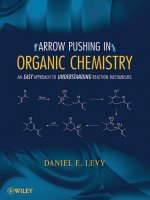
Arrow pushing in organic chemistry an easy approach to understanding reaction mechanisms
Bạn đang xem bản rút gọn của tài liệu. Xem và tải ngay bản đầy đủ của tài liệu tại đây (33.79 MB, 614 trang )
Copyright © 2017. John Wiley & Sons, Incorporated. All rights reserved.
Levy, Daniel E.. Arrow-Pushing in Organic Chemistry : An Easy Approach to Understanding Reaction Mechanisms, John Wiley & Sons, Incorporated, 2017. ProQuest Ebook Central,
/>Created from ucalgary-ebooks on 2020-12-21 15:04:49.
www.pdfgrip.com
Copyright © 2017. John Wiley & Sons, Incorporated. All rights reserved.
TableofContents
Cover
TitlePage
Preface
Acknowledgements
AbouttheAuthor
Chapter1:Introduction
1.1DEFINITIONOFARROWPUSHING
1.2FUNCTIONALGROUPS
1.3NUCLEOPHILESANDLEAVINGGROUPS
1.4SUMMARY
PROBLEMS
Chapter2:FreeRadicals
2.1WHATAREFREERADICALS?
2.2HOWAREFREERADICALSFORMED?
2.3FREERADICALSTABILITY
2.4WHATTYPESOFREACTIONSINVOLVEFREERADICALS?
2.5SUMMARY
PROBLEMS
Chapter3:Acids
3.1WHATAREACIDS?
3.2WHATISRESONANCE?
3.3HOWISACIDITYMEASURED?
3.4RELATIVEACIDITIES
3.5INDUCTIVEEFFECTS
3.6INDUCTIVEEFFECTSANDRELATIVEACIDITIES
3.7RELATIVEACIDITIESOFHYDROCARBONS
3.8SUMMARY
PROBLEMS
Chapter4:BasesandNucleophiles
4.1WHATAREBASES?
4.2WHATARENUCLEOPHILES?
Levy, Daniel E.. Arrow-Pushing in Organic Chemistry : An Easy Approach to Understanding Reaction Mechanisms, John Wiley & Sons, Incorporated, 2017. ProQuest Ebook Central,
/>Created from ucalgary-ebooks on 2020-12-21 15:04:49.
www.pdfgrip.com
4.3LEAVINGGROUPS
4.4SUMMARY
PROBLEMS
Chapter5:SN2SubstitutionReactions
5.1WHATISANSN2REACTION?
5.2WHATARELEAVINGGROUPS?
5.3WHERECANSN2REACTIONSOCCUR?
5.4SN2′REACTIONS
5.5SUMMARY
PROBLEMS
Chapter6:SN1SubstitutionReactions
6.1WHATISANSN1REACTION?
Copyright © 2017. John Wiley & Sons, Incorporated. All rights reserved.
6.2HOWARESN1REACTIONSINITIATED?
6.3THECARBOCATION
6.4CARBOCATIONREARRANGEMENTS
6.5SUMMARY
PROBLEMS
Chapter7:EliminationReactions
7.1E1ELIMINATIONS
7.2E1cBELIMINATIONS
7.3E2ELIMINATIONS
7.4HOWDOELIMINATIONREACTIONSWORK?
7.5E1cBELIMINATIONSVERSUSE2ELIMINATIONS
7.6SUMMARY
PROBLEMS
Chapter8:AdditionReactions
8.1ADDITIONOFHALOGENSTODOUBLEBONDS
8.2MARKOVNIKOV’SRULE
8.3ADDITIONSTOCARBONYLS
8.4SUMMARY
PROBLEMS
Chapter9:Carbenes
9.1WHATARECARBENES?
Levy, Daniel E.. Arrow-Pushing in Organic Chemistry : An Easy Approach to Understanding Reaction Mechanisms, John Wiley & Sons, Incorporated, 2017. ProQuest Ebook Central,
/>Created from ucalgary-ebooks on 2020-12-21 15:04:49.
www.pdfgrip.com
9.2HOWARECARBENESFORMED?
9.3REACTIONSWITHCARBENES
Copyright © 2017. John Wiley & Sons, Incorporated. All rights reserved.
9.4CARBENESVERSUSCARBENOIDS
9.5SUMMARY
PROBLEMS
Chapter10:PericyclicReactions
10.1WHATAREPERICYCLICREACTIONS?
10.2ELECTROCYCLICREACTIONS
10.3CYCLOADDITIONREACTIONS
10.4SIGMATROPICREACTIONS
10.5SUMMARY
PROBLEMS
Chapter11:MovingForward
11.1FUNCTIONALGROUPMANIPULATIONS
11.2NAMEREACTIONS
11.3REAGENTS
11.4FINALCOMMENTS
PROBLEMS
Appendix1:pKaValuesofProtonsAssociatedwithCommonFunctionalGroups
Appendix2:AnswersandExplanationstoProblems
Appendix3:StudentReactionGlossary
Index
PeriodicTableofElements
EndUserLicenseAgreement
ListofTables
Chapter11
Table11.1Namereactionsandreactiontypesusefulformodificationandexpansionof
organicstructures.
Table11.2Reagentclassesandassociatedproperties.
ListofIllustrations
Chapter01
Levy, Daniel E.. Arrow-Pushing in Organic Chemistry : An Easy Approach to Understanding Reaction Mechanisms, John Wiley & Sons, Incorporated, 2017. ProQuest Ebook Central,
/>Created from ucalgary-ebooks on 2020-12-21 15:04:49.
www.pdfgrip.com
Scheme1.1ExampleoftheWittigreaction.
Scheme1.2ExampleoftheDiels–Alderreaction.
Scheme1.3Exampleofatinhydridedehalogenation.
Figure1.1Examplesofchemicalbonds.
Figure1.2Examplesofchemicalbondsandlonepairs.
Scheme1.4Illustrationofhomolyticcleavage.
Scheme1.5Illustrationofheterolyticcleavage.
Scheme1.6Illustrationofaconcertedreaction(Coperearrangement).
Scheme1.7IllustrationofarrowpushingappliedtotheCoperearrangement.
Scheme1.8Applicationofarrowpushingtohomolyticcleavageusingsinglebarbed
arrows.
Scheme1.9Applicationofarrowpushingtoheterolyticcleavageusingdouble
barbedarrows.
Figure1.3Commonorganicfunctionalgroups.
Figure1.4Howfunctionalgroupsinfluencepolarity.
Scheme1.10Exampleofanucleophilicreaction.
Chapter02
Figure2.1Tetheredballmodelforbondstrain.
Figure2.2Tetheredballmodelforbreakingbonds.
Copyright © 2017. John Wiley & Sons, Incorporated. All rights reserved.
Figure2.3Translationoftetheredballmodeltoanions,cations,andfreeradicals.
Figure2.4Commonfreeradicals.
Figure2.5Formationofradicalionsviaelectrontransfer.
Scheme2.1HomolyticcleavageofNbromosuccinimide.
Figure2.6Commonfreeradicalinitiators.
Figure2.7Conjugatedaromaticringsystemsformradicalanionsmorereadily.
Scheme2.2Freeradicalsreadilypairformingcovalentbonds.
Figure2.8Molecularstructuresofgraphiteanddiamond.
Figure2.9Orderoffreeradicalstability.
Figure2.10Hydrogenatomsorbitalscandonateelectrondensitytoadjacentcentersof
electrondeficiencyascanheteroatomsbearingloneelectronpairs.
Scheme2.3Examplesofbrominationreactions.
Levy, Daniel E.. Arrow-Pushing in Organic Chemistry : An Easy Approach to Understanding Reaction Mechanisms, John Wiley & Sons, Incorporated, 2017. ProQuest Ebook Central,
/>Created from ucalgary-ebooks on 2020-12-21 15:04:49.
www.pdfgrip.com
Scheme2.4Arrowpushingmechanismforbrominationofmethane.
Scheme2.5Allylicandbenzylicbromination(halogenation).
Scheme2.6Freeradicalsstabilizedbyconjugationcanformmultipleproducts.
Figure2.11Commonorganicpolymers.
Scheme2.7Freeradicalformationofpolystyrene.
Scheme2.8Terminationofpolystyrenefreeradicalpolymerization.
Scheme2.9Examplesofoxidativefunctionalgrouptransformations.
Scheme2.10Mechanismforautoxidationofisobutane.
Chapter03
Scheme3.1Generalrepresentationofaciddissociation.
Figure3.1Solventeffectsonaciddissociation.
Figure3.2Commonpolarandnonpolarorganicsolvents.
Scheme3.2Dissociationofacarboxylicacidformingaprotonandacarboxylate
anion.
Scheme3.3Resonanceformsofthecarboxylateanion.
Scheme3.4Rationalizationofthecarboxylateanionresonanceformsusingarrow
pushing.
Scheme3.5Dimethylmalonatedoesnotspontaneouslyliberatemalonateanions.
Scheme3.6Potassiumtertbutoxidepartiallydeprotonatesdimethylmalonate.
Copyright © 2017. John Wiley & Sons, Incorporated. All rights reserved.
Scheme3.7Resonanceformsofthemalonateanionrationalizedusingarrowpushing.
Figure3.3Definitionoftheequilibriumconstant( Keq ).
Figure3.4KaistheKeqspecificallyrelatedtodissociationofacids.
Figure3.5DefinitionofpH.
Figure3.6DefinitionofpKa.
Figure3.7pKavaluesarerelatedtopH.
Figure3.8TheHenderson–Hasselbalchequation.
Figure3.9Inaperfectequilibrium,pKa = pH.
Figure3.10Representativefunctionalgroupswithassociatedacidicprotons.
Figure3.11Representativefunctionalgroupswithadjacentacidicprotons.
Scheme3.8Resonancecapabilitiesofcarboxylicacidscomparedtoalcohols.
Levy, Daniel E.. Arrow-Pushing in Organic Chemistry : An Easy Approach to Understanding Reaction Mechanisms, John Wiley & Sons, Incorporated, 2017. ProQuest Ebook Central,
/>Created from ucalgary-ebooks on 2020-12-21 15:04:49.
www.pdfgrip.com
Figure3.12CommoncarboxylicacidsandtheirrespectivepKavalues.
Scheme3.9Esterscanbedeprotonatedαtoestercarbonyls.
Scheme3.10Rationalizationoftheacidityofprotonsαtoestercarbonyls.
Scheme3.11Electronwithdrawinggroupsincreaseaciditybyincreasinganionic
stability.
Scheme3.12Electrondonatinggroupsdecreaseaciditybydecreasinganionic
stability.
Figure3.13Commonelectronwithdrawinggroupsandelectrondonatinggroups.
Figure3.14pKavaluesassociatedwithalcoholsincreaseasalkylbranchingincreases.
Scheme3.13Aminesandalcoholscanbothbedeprotonated.
Scheme3.14HydrocarbonscanbedeprotonatedandhavemeasurablepKavalues.
Chapter04
Scheme4.1Generalrepresentationofbasesreactingwithacids.
Figure4.1Commonbasesusedinorganicchemistry.
Scheme4.2Equilibriumbetweenmethylacetateandtriethylamine.
Scheme4.3Equilibriumbetweenmethylacetateandpotassiumtertbutoxide.
Scheme4.4Equilibriumbetweenmethylacetateandphenyllithium.
Scheme4.5Aminebasicityisrelatedtothenitrogenlonepair.
Scheme4.6Alcoholandetheroxygenscanbeprotonated.
Copyright © 2017. John Wiley & Sons, Incorporated. All rights reserved.
Scheme4.7Carboxylicacidsandesterscanbeprotonated.
Scheme4.8Aldehydesandketonescanbeprotonated.
Scheme4.9Carbonylbasedfunctionalgroupsdelocalizechargesthroughresonance.
Scheme4.10Protonatedcarbonylbasedfunctionalgroupsdelocalizetheirpositive
charges.
Scheme4.11Protonatedcarbonylbasedfunctionalgroupsaresusceptibletoreaction
withnucleophiles.
Figure4.2Representativenucleophilesandtheircorrespondingacidforms.
Figure4.3Relationshipbetweennucleophilicity,electronegativity,andbasicityas
illustratedusingfirstrowelements.
Figure4.4Theorderofincreasingnucleophilicityofhalideionsisinfluencedby
polarizinginfluencessuchassolventeffects.
Figure4.5Solventshellssurroundhardbasesmoreclosely,makingthemlessreactive
Levy, Daniel E.. Arrow-Pushing in Organic Chemistry : An Easy Approach to Understanding Reaction Mechanisms, John Wiley & Sons, Incorporated, 2017. ProQuest Ebook Central,
/>Created from ucalgary-ebooks on 2020-12-21 15:04:49.
www.pdfgrip.com
nucleophilescomparedwithsoftbases.
Figure4.6StericeffectscanoverridetheinfluenceofpKavaluesonnucleophilicity.
Scheme4.12Exampleofanucleophilicreaction.
Chapter05
Scheme5.1RepresentationofanSN2reaction.
Figure5.1Enantiomersaremirrorimages,notsuperimposableanddependentuponthe
tetrahedralarrangementofcarbonatomsubstituents.
Scheme5.2MechanisticexplanationofSN2reactions.
Scheme5.3SN2reactionsproceedwhenincomingnucleophilesaremorenucleophilic
thanoutgoingleavinggroups.
Scheme5.4SN2reactionsdonotproceedwhenincomingnucleophilesareless
nucleophilicthanoutgoingleavinggroups.
Figure5.2Chloromethanebearsapartialnegativechargeontheelectronegative
chlorineatomandapartialpositivechargeonthecarbonatom.
Figure5.3Thecarbon–chlorinebondinchloromethaneispolarized.
Scheme5.5Understandingthedirectionofbondpolarityallowsidentificationof
reactionsite,trajectoryofnucleophile,andidentificationoftheleavinggroup.
Scheme5.6StericbulkslowsdownreactionratesforSN2reactions.
Scheme5.7Resonanceformscanbeusedtorationalizethestabilityofcationsadjacent
tositesofbondunsaturation.
Copyright © 2017. John Wiley & Sons, Incorporated. All rights reserved.
Figure5.4Partialchargescanbedelocalizedthroughunsaturatedbonds.
Scheme5.8ComparisonofSN2andSN2′reactionsasexplainedwitharrowpushing.
Scheme5.9CompetingSN2andSN2′reactionmechanismscanleadtoproduct
mixtures.
Chapter06
Scheme6.1TheinitialphaseofanSN1reactioninvolvesdissociationofaleaving
groupfromthestartingmoleculegeneratingacarbocation.
Scheme6.2ThesecondphaseofanSN1reactioninvolvesreactionofacarbocation
withanucleophilegeneratinganewproduct.
Scheme6.3SolvolysisoftertbutylbromideinmethanolproducesMTBEviaanS
mechanism.
Scheme6.4Explanationofthesolvolysisoftertbutylbromideinmethanolusing
Levy, Daniel E.. Arrow-Pushing in Organic Chemistry : An Easy Approach to Understanding Reaction Mechanisms, John Wiley & Sons, Incorporated, 2017. ProQuest Ebook Central,
/>Created from ucalgary-ebooks on 2020-12-21 15:04:49.
N1
www.pdfgrip.com
arrowpushing.
Scheme6.5MethanolwillnotreactwithtertbutylbromideviaanS
N2mechanism.
Figure6.1Fullysubstitutedcarbonatomspresentsubstituentsintetrahedral
arrangements.
Figure6.2sOrbitalsaresphericalandporbitalsareshapedlikehourglasses.
Figure6.3Hybridorbitalsresultfromcombinationsofsandporbitals.
Figure6.4Likesubstituents,lonepairsinfluencemoleculargeometry.
Figure6.5Differentorbitalhybridizationsresultsindifferentmoleculargeometries.
Figure6.6sp2Hybridizedcarbocationspossesstrigonalplanargeometries.
Scheme6.6ThestereochemicalcoursesofSN2reactionsaredefinedbythe
stereochemicalconfigurationofthestartingmaterials—oneproductisformed.
Scheme6.7ThestereochemicalidentitiesofstartingmaterialssubjectedtoSN1
reactionsarelostduetotheplanarityofreactivecarbocations—twoproductsare
formed.
Figure6.7Tertiarycarbocationsaremorestablethansecondarycarbocations,and
secondarycarbocationsaremorestablethanprimarycarbocations.
Figure6.8Hydrogenatomsorbitalscandonateelectrondensitytoadjacentcationic
centersascanheteroatomsbearingloneelectronpairs.
Figure6.9Heteroatomsstabilizecarbocationsbetterthanhyperconjugationeffects.
Figure6.10Allyliccarbocationsaremorestablethansecondarycarbocations.
Copyright © 2017. John Wiley & Sons, Incorporated. All rights reserved.
Figure6.11Tertiarycarbocationsaremorestablethanallyliccarbocations.
Figure6.12Hyperconjugationoccurswhenacarbon–hydrogenbondliesinthesame
planeasacarbocation’svacantporbital.
Figure6.13Hyperconjugationcanbeviewedasformationofa“pseudodouble
bond.”
Scheme6.8Hyperconjugationleadstomigrationofhydrogenatomsthrougha1,2
hydrideshift.
Scheme6.9Rearrangementsvia1,2hydrideshiftsgeneratemorestablecarbocations
fromlessstablecarbocations.
Scheme6.10Thepinacolrearrangement.
Scheme6.11Thepinacolrearrangementproceedsthroughsolvolysismediatedcation
formation.
Scheme6.121,2Hydrideshiftswillnotoccurwhentheproductcationislessstable
Levy, Daniel E.. Arrow-Pushing in Organic Chemistry : An Easy Approach to Understanding Reaction Mechanisms, John Wiley & Sons, Incorporated, 2017. ProQuest Ebook Central,
/>Created from ucalgary-ebooks on 2020-12-21 15:04:49.
www.pdfgrip.com
thanthestartingcation.
Scheme6.13Alkylmigrationsoccurwhentheresultingcarbocationismorestablethan
thestartingcarbocation.
Scheme6.14Conclusionofthepinacolrearrangementinvolvesmigrationofthe
positivechargetotheadjacentoxygenatomfollowedbydeprotonation.
Chapter07
Figure7.1Hyperconjugationoccurswhenacarbon–hydrogenbondliesinthesame
planeasacarbocation’svacantporbital.
Figure7.2Hyperconjugationcanbeviewedasformationofa“pseudodoublebond.”
Scheme7.1Dissociationofaprotonthroughhyperconjugationcompletesthefinalstage
ofanE1eliminationmechanism.
Scheme7.2E1mechanismsexplainadditionalproductsobservedduringSN1
reactions.
Scheme7.3Solvolysisof2bromo2,3dimethylpentaneinmethanolleadsto
formationofuptosixdifferentproductsviamultiplemechanisticpathways.
Scheme7.4Generalrepresentationofbases(BorB−)reactingwithacids(HA)
formingconjugatebases(A−).
Scheme7.5Formationoftheconjugatebaseandassociatedresonancestructure
resultingfromthereactionof2iodomethyldimethylmalonatewithsodiumhydride.
Scheme7.6βEliminationoftheiodidecompletestheE1cBmechanismconvertingthe
2iodomethyldimethylmalonateanionto2methylidenedimethylmalonate.
Copyright © 2017. John Wiley & Sons, Incorporated. All rights reserved.
Scheme7.7Reactionof2iodomethyldimethylmalonatewithanucleophileresultsin
predominantformationoftheE1cBeliminationproduct.
Scheme7.8SN2substitutionreactionscanoccurincompetitionwithE2elimination
reactions.
Figure7.3Tertiarycarbocationsaremorestablethansecondarycarbocations,and
secondarycarbocationsaremorestablethanprimarycarbocations.
Figure7.4Whenacarbon–hydrogen(orcarbonalkyl)bondisalignedwithanempty
porbital,1,2hydride/alkylshiftsandE1eliminationsarefavorable.
Figure7.5Whenacarbon–hydrogenbondoranegativelychargedorbitalisaligned
transperiplanarwithacarbonleavinggroupbond,E2eliminationsandE1cB
eliminationsarefavorable.
Scheme7.9E2eliminationsdependuponthepresenceoftransperiplanar
relationships.
Scheme7.10MechanisticprogressionofE2eliminations.
Levy, Daniel E.. Arrow-Pushing in Organic Chemistry : An Easy Approach to Understanding Reaction Mechanisms, John Wiley & Sons, Incorporated, 2017. ProQuest Ebook Central,
/>Created from ucalgary-ebooks on 2020-12-21 15:04:49.
www.pdfgrip.com
Scheme7.11Iftransperiplanarrelationshipscanbeestablished,E2elimination
productscanform.
Chapter08
Scheme8.1Additionofbrominetoethylene.
Scheme8.2Molecularbrominereactswithdoublebondsgeneratingabromoniumion
andabromideanion.
Scheme8.3Bromoniumionspossesselectrophiliccarbonatoms.
Scheme8.4Nucleophilicreactionbetweenabromideanionandabromoniumion
generates1,2dibromoalkanes.
Scheme8.5Proticacidscanaddacrossdoublebonds.
Scheme8.6Doublebondscanbecomeprotonatedunderacidicconditions.
Scheme8.7Nucleophilesaddtoprotonatedolefins.
Scheme8.8Multiplepotentialproductsarepossiblefromadditionofproticacids
acrossdoublebonds.
Scheme8.9Protonationofpropeneintroducescationiccharactertobothprimaryand
secondarycenters.
Figure8.1Whileunsubstitutedolefinsarenonpolar,carbonylsarepolar.
Scheme8.10Nucleophilescanaddtocarbonylstoformalcohols.
Scheme8.11Additionofnucleophilestocarbonylscanbereversible.
Scheme8.12Productsresultingfromadditionofnucleophilestoacetone.
Copyright © 2017. John Wiley & Sons, Incorporated. All rights reserved.
Scheme8.13Carbonylscanbecomeprotonated.
Scheme8.14Additionofnucleophilestocarbonylscanoccurunderacidicconditions.
Scheme8.15Additionofnucleophilestosimplecarbonylsresultsin1,2additions.
Figure8.2ComparisonofSN2andSN2′reactionsasexplainedwitharrowpushing.
Scheme8.16Additionofnucleophilestoα,βunsaturatedcarbonylgroupsas
explainedusingarrowpushing.
Scheme8.17Additionofnucleophilestoα,βunsaturatedcarbonylscanresultin1,4
additions.
Scheme8.18α,βUnsaturatedcarbonylsystemscanbesequentiallysubjectedto1,4
additionsand1,2additions.
Figure8.3Unlikemostcarbonylbasedfunctionalgroups,nonconjugatedesterscan
reactwithnucleophilesandretainthecarbonylunit.
Scheme8.19Theaddition–eliminationmechanismillustratedwitharrowpushing.
Levy, Daniel E.. Arrow-Pushing in Organic Chemistry : An Easy Approach to Understanding Reaction Mechanisms, John Wiley & Sons, Incorporated, 2017. ProQuest Ebook Central,
/>Created from ucalgary-ebooks on 2020-12-21 15:04:49.
www.pdfgrip.com
Figure8.4Functionalgroupscapableofparticipatinginaddition–elimination
reactions.
Chapter09
Figure9.1Structuralrepresentationsofcarbenesusingdotnotation,inclusionof
orbitalsandrepresentativeillustrationofneutralizingcharges.
Scheme9.1Chloroformcanbedeprotonatedinthepresenceofstrongbases.
Scheme9.2αEliminationversusβelimination.
Figure9.2Generalrepresentationofdiazocompoundsandresonanceforms.
Scheme9.3Decompositionofdiazocompoundsleadstocarbeneformation.
Figure9.3Representationofcarbenedimerization.
Scheme9.4Reactionofdichlorocarbenewiththetrichloromethylanion.
Scheme9.5Reactionoftheethylacetatecarbenewithethyldiazoacetate.
Scheme9.6ExampleofcyclopropaneformationbyintramolecularSN2reaction.
Figure9.4Hyperconjugationcanbeviewedasa“protonationofadoublebond.”
Scheme9.7Thecarbeneemptyporbitalcandirectlyinteractwithanolefinleadingto
cyclopropaneringformation.
Scheme9.8Carbeneadditionstoolefinsgeneratesynproducts.
Scheme9.9Dichlorocarbeneproducesdifferentproductsfromcisandtransolefins.
Copyright © 2017. John Wiley & Sons, Incorporated. All rights reserved.
Figure9.5Reactionofcis2butenewithdichlorocarbeneproducesthesameproduct
frombothtopandbottomapproachesofdichlorocarbene.
Figure9.6Reactionoftrans2butenewithdichlorocarbeneresultsinformationof
enantiomers.
Scheme9.10Cyclopropanationproductsareinfluencedbythetrajectory(topvs.
bottom)ofthecarbeneandbythespatialorientationofthecarbene.
Scheme9.11CarbeneO—HinsertionreactionsarecomplementarytotheWilliamson
EtherSynthesis.
Figure9.7Examplebasemediatedsidereactionsavoidedusingcarbeneinsertion
reactions.
Scheme9.12Formationofacarbenoidonreactionofethyldiazoacetatewith
rhodium(II)acetate.
Chapter10
Figure10.1Cyclictransitionstatesenableprogressionofpericyclicreactions.
Figure10.2σBondsandπbondscomprisemolecularorbitalsformedfromthe
Levy, Daniel E.. Arrow-Pushing in Organic Chemistry : An Easy Approach to Understanding Reaction Mechanisms, John Wiley & Sons, Incorporated, 2017. ProQuest Ebook Central,
/>Created from ucalgary-ebooks on 2020-12-21 15:04:49.
www.pdfgrip.com
overlapofsorbitals,porbitals,andcombinationsthereof.
Scheme10.1Electrocyclicconversionofcis1,3,5hexatrieneto1,3
cyclohexadiene.
Figure10.3Substitutionpatternscanimpacttherateandsuccessofelectrocyclic
reactions.
Scheme10.2Electrocyclicreactionsinvolvingfourmemberedrings,eight
memberedrings,andbicyclicringsystems.
Scheme10.3Stereochemicalcoursesforelectrocyclicreactionsformingsix
memberedandeightmemberedrings.
Scheme10.4Diels–Alderreactionwith1,2butadieneandethylene.
Figure10.4Diene–dienophileorientationsforDiels–Alderreactionprogression.
Scheme10.5Diels–Alderreactionbetweencyclopentadieneandacrolein.
Figure10.5ExampledienesanddienophilesusefulinDiels–Alderreactions.
Scheme10.6Enereactionwithpropyleneandethylene.
Scheme10.7Enereactionbetween1buteneandacrylonitrile.
Scheme10.8Intramolecularenereactionscanformsubstitutedringsystems.
Figure10.6Examplesofdipolarmoleculesanddipolarfunctionalgroups.
Scheme10.9Examplesof1,3dipolarcycloadditions.
Figure10.71,3Dipolescanapproachdipolarophileintwopossibleorientations.
Scheme10.10Mechanisticpathwayforozonolysisreactions.
Copyright © 2017. John Wiley & Sons, Incorporated. All rights reserved.
Scheme10.11Coperearrangementof1,5hexadiene.
Scheme10.12Coperearrangementof3methyl1,5hexadiene.
Scheme10.13OxyCoperearrangementof3hydroxy1,5hexadiene.
Scheme10.14Claisenrearrangementofallylphenylether.
Scheme10.15MultipleClaisenrearrangementscanbeusedtogeneratephenol
structureswithmultiplesubstitutions.
Scheme10.16Allylacetatecanbeconvertedintoasilylketeneacetalprecursorforthe
Ireland–Claisenrearrangement.
Scheme10.17TheIreland–Claisenrearrangementgeneratescarboxylicacidswith
terminaldoublebonds.
Scheme10.18ExampleoftheJohnson–Claisenrearrangement.
Figure10.8Examplesoforthoesters.
Levy, Daniel E.. Arrow-Pushing in Organic Chemistry : An Easy Approach to Understanding Reaction Mechanisms, John Wiley & Sons, Incorporated, 2017. ProQuest Ebook Central,
/>Created from ucalgary-ebooks on 2020-12-21 15:04:49.
www.pdfgrip.com
Scheme10.19MechanismfortheJohnson–Claisenrearrangement.
Chapter11
Scheme11.1Additionofbromineacrossadoublebond.
Scheme11.2Markovnikovadditionofhydrobromicacidacrossadoublebond.
Figure11.1FunctionalgroupsavailablefromalkylhalidesviaSN1andSN2
mechanisms.
Scheme11.3Conversionofalcoholstoethers—theWilliamsonethersynthesis.
Figure11.2Transformationsofcarboxylicacidstoestersandamides.
Figure11.3Transformationsofesterstocarboxylicacidsandamides.
Figure11.4Transformationsofaldehydesandketonestoimines,oximes,andenamines.
Figure11.5Oxidativeandreductiveconversionsoffunctionalgroups.
Scheme11.4TheDiels–Alderreaction.
Scheme11.5TheCoperearrangement.
Scheme11.6TheClaisenrearrangement.
Scheme11.7Thepinacolrearrangement.
Scheme11.8TheFavorskiirearrangement.
Scheme11.9Thealdolcondensation.
Scheme11.10TheRobinsonannulation.
Scheme11.11Alkylationandacylationreactionsadjacenttocarbonyls.
Copyright © 2017. John Wiley & Sons, Incorporated. All rights reserved.
Scheme11.12TheFriedel–Craftsacylation.
Scheme11.13TheWittigreaction.
Scheme11.14TheHorner–Emmonsreaction.
Scheme11.15Acation–πcyclization.
Scheme11.16TheGrignardreaction.
Scheme11.17FormationofGrignardreagentsinvolvesoxidativeaddition.
Scheme11.18TheSuzukireaction.
Scheme11.19SimplifiedSuzukireactionmechanism.
Scheme11.20TheMichaeladdition.
Levy, Daniel E.. Arrow-Pushing in Organic Chemistry : An Easy Approach to Understanding Reaction Mechanisms, John Wiley & Sons, Incorporated, 2017. ProQuest Ebook Central,
/>Created from ucalgary-ebooks on 2020-12-21 15:04:49.
www.pdfgrip.com
ArrowPushinginOrganicChemistry
AnEasyApproachtoUnderstandingReaction
Mechanisms
SecondEdition
DanielE.Levy
Copyright © 2017. John Wiley & Sons, Incorporated. All rights reserved.
Levy, Daniel E.. Arrow-Pushing in Organic Chemistry : An Easy Approach to Understanding Reaction Mechanisms, John Wiley & Sons, Incorporated, 2017. ProQuest Ebook Central,
/>Created from ucalgary-ebooks on 2020-12-21 15:06:30.
www.pdfgrip.com
Copyright © 2017. John Wiley & Sons, Incorporated. All rights reserved.
TableofContents
Cover
TitlePage
Preface
Acknowledgements
AbouttheAuthor
Chapter1:Introduction
1.1DEFINITIONOFARROWPUSHING
1.2FUNCTIONALGROUPS
1.3NUCLEOPHILESANDLEAVINGGROUPS
1.4SUMMARY
PROBLEMS
Chapter2:FreeRadicals
2.1WHATAREFREERADICALS?
2.2HOWAREFREERADICALSFORMED?
2.3FREERADICALSTABILITY
2.4WHATTYPESOFREACTIONSINVOLVEFREERADICALS?
2.5SUMMARY
PROBLEMS
Chapter3:Acids
3.1WHATAREACIDS?
3.2WHATISRESONANCE?
3.3HOWISACIDITYMEASURED?
3.4RELATIVEACIDITIES
3.5INDUCTIVEEFFECTS
3.6INDUCTIVEEFFECTSANDRELATIVEACIDITIES
3.7RELATIVEACIDITIESOFHYDROCARBONS
3.8SUMMARY
PROBLEMS
Chapter4:BasesandNucleophiles
4.1WHATAREBASES?
4.2WHATARENUCLEOPHILES?
Levy, Daniel E.. Arrow-Pushing in Organic Chemistry : An Easy Approach to Understanding Reaction Mechanisms, John Wiley & Sons, Incorporated, 2017. ProQuest Ebook Central,
/>Created from ucalgary-ebooks on 2020-12-21 15:06:41.
www.pdfgrip.com
4.3LEAVINGGROUPS
4.4SUMMARY
PROBLEMS
Chapter5:SN2SubstitutionReactions
5.1WHATISANSN2REACTION?
5.2WHATARELEAVINGGROUPS?
5.3WHERECANSN2REACTIONSOCCUR?
5.4SN2′REACTIONS
5.5SUMMARY
PROBLEMS
Chapter6:SN1SubstitutionReactions
6.1WHATISANSN1REACTION?
Copyright © 2017. John Wiley & Sons, Incorporated. All rights reserved.
6.2HOWARESN1REACTIONSINITIATED?
6.3THECARBOCATION
6.4CARBOCATIONREARRANGEMENTS
6.5SUMMARY
PROBLEMS
Chapter7:EliminationReactions
7.1E1ELIMINATIONS
7.2E1cBELIMINATIONS
7.3E2ELIMINATIONS
7.4HOWDOELIMINATIONREACTIONSWORK?
7.5E1cBELIMINATIONSVERSUSE2ELIMINATIONS
7.6SUMMARY
PROBLEMS
Chapter8:AdditionReactions
8.1ADDITIONOFHALOGENSTODOUBLEBONDS
8.2MARKOVNIKOV’SRULE
8.3ADDITIONSTOCARBONYLS
8.4SUMMARY
PROBLEMS
Chapter9:Carbenes
9.1WHATARECARBENES?
Levy, Daniel E.. Arrow-Pushing in Organic Chemistry : An Easy Approach to Understanding Reaction Mechanisms, John Wiley & Sons, Incorporated, 2017. ProQuest Ebook Central,
/>Created from ucalgary-ebooks on 2020-12-21 15:06:41.
www.pdfgrip.com
9.2HOWARECARBENESFORMED?
9.3REACTIONSWITHCARBENES
Copyright © 2017. John Wiley & Sons, Incorporated. All rights reserved.
9.4CARBENESVERSUSCARBENOIDS
9.5SUMMARY
PROBLEMS
Chapter10:PericyclicReactions
10.1WHATAREPERICYCLICREACTIONS?
10.2ELECTROCYCLICREACTIONS
10.3CYCLOADDITIONREACTIONS
10.4SIGMATROPICREACTIONS
10.5SUMMARY
PROBLEMS
Chapter11:MovingForward
11.1FUNCTIONALGROUPMANIPULATIONS
11.2NAMEREACTIONS
11.3REAGENTS
11.4FINALCOMMENTS
PROBLEMS
Appendix1:pKaValuesofProtonsAssociatedwithCommonFunctionalGroups
Appendix2:AnswersandExplanationstoProblems
Appendix3:StudentReactionGlossary
Index
PeriodicTableofElements
EndUserLicenseAgreement
ListofTables
Chapter11
Table11.1Namereactionsandreactiontypesusefulformodificationandexpansionof
organicstructures.
Table11.2Reagentclassesandassociatedproperties.
ListofIllustrations
Chapter01
Levy, Daniel E.. Arrow-Pushing in Organic Chemistry : An Easy Approach to Understanding Reaction Mechanisms, John Wiley & Sons, Incorporated, 2017. ProQuest Ebook Central,
/>Created from ucalgary-ebooks on 2020-12-21 15:06:41.
www.pdfgrip.com
Scheme1.1ExampleoftheWittigreaction.
Scheme1.2ExampleoftheDiels–Alderreaction.
Scheme1.3Exampleofatinhydridedehalogenation.
Figure1.1Examplesofchemicalbonds.
Figure1.2Examplesofchemicalbondsandlonepairs.
Scheme1.4Illustrationofhomolyticcleavage.
Scheme1.5Illustrationofheterolyticcleavage.
Scheme1.6Illustrationofaconcertedreaction(Coperearrangement).
Scheme1.7IllustrationofarrowpushingappliedtotheCoperearrangement.
Scheme1.8Applicationofarrowpushingtohomolyticcleavageusingsinglebarbed
arrows.
Scheme1.9Applicationofarrowpushingtoheterolyticcleavageusingdouble
barbedarrows.
Figure1.3Commonorganicfunctionalgroups.
Figure1.4Howfunctionalgroupsinfluencepolarity.
Scheme1.10Exampleofanucleophilicreaction.
Chapter02
Figure2.1Tetheredballmodelforbondstrain.
Figure2.2Tetheredballmodelforbreakingbonds.
Copyright © 2017. John Wiley & Sons, Incorporated. All rights reserved.
Figure2.3Translationoftetheredballmodeltoanions,cations,andfreeradicals.
Figure2.4Commonfreeradicals.
Figure2.5Formationofradicalionsviaelectrontransfer.
Scheme2.1HomolyticcleavageofNbromosuccinimide.
Figure2.6Commonfreeradicalinitiators.
Figure2.7Conjugatedaromaticringsystemsformradicalanionsmorereadily.
Scheme2.2Freeradicalsreadilypairformingcovalentbonds.
Figure2.8Molecularstructuresofgraphiteanddiamond.
Figure2.9Orderoffreeradicalstability.
Figure2.10Hydrogenatomsorbitalscandonateelectrondensitytoadjacentcentersof
electrondeficiencyascanheteroatomsbearingloneelectronpairs.
Scheme2.3Examplesofbrominationreactions.
Levy, Daniel E.. Arrow-Pushing in Organic Chemistry : An Easy Approach to Understanding Reaction Mechanisms, John Wiley & Sons, Incorporated, 2017. ProQuest Ebook Central,
/>Created from ucalgary-ebooks on 2020-12-21 15:06:41.
www.pdfgrip.com
Scheme2.4Arrowpushingmechanismforbrominationofmethane.
Scheme2.5Allylicandbenzylicbromination(halogenation).
Scheme2.6Freeradicalsstabilizedbyconjugationcanformmultipleproducts.
Figure2.11Commonorganicpolymers.
Scheme2.7Freeradicalformationofpolystyrene.
Scheme2.8Terminationofpolystyrenefreeradicalpolymerization.
Scheme2.9Examplesofoxidativefunctionalgrouptransformations.
Scheme2.10Mechanismforautoxidationofisobutane.
Chapter03
Scheme3.1Generalrepresentationofaciddissociation.
Figure3.1Solventeffectsonaciddissociation.
Figure3.2Commonpolarandnonpolarorganicsolvents.
Scheme3.2Dissociationofacarboxylicacidformingaprotonandacarboxylate
anion.
Scheme3.3Resonanceformsofthecarboxylateanion.
Scheme3.4Rationalizationofthecarboxylateanionresonanceformsusingarrow
pushing.
Scheme3.5Dimethylmalonatedoesnotspontaneouslyliberatemalonateanions.
Scheme3.6Potassiumtertbutoxidepartiallydeprotonatesdimethylmalonate.
Copyright © 2017. John Wiley & Sons, Incorporated. All rights reserved.
Scheme3.7Resonanceformsofthemalonateanionrationalizedusingarrowpushing.
Figure3.3Definitionoftheequilibriumconstant( Keq ).
Figure3.4KaistheKeqspecificallyrelatedtodissociationofacids.
Figure3.5DefinitionofpH.
Figure3.6DefinitionofpKa.
Figure3.7pKavaluesarerelatedtopH.
Figure3.8TheHenderson–Hasselbalchequation.
Figure3.9Inaperfectequilibrium,pKa = pH.
Figure3.10Representativefunctionalgroupswithassociatedacidicprotons.
Figure3.11Representativefunctionalgroupswithadjacentacidicprotons.
Scheme3.8Resonancecapabilitiesofcarboxylicacidscomparedtoalcohols.
Levy, Daniel E.. Arrow-Pushing in Organic Chemistry : An Easy Approach to Understanding Reaction Mechanisms, John Wiley & Sons, Incorporated, 2017. ProQuest Ebook Central,
/>Created from ucalgary-ebooks on 2020-12-21 15:06:41.
www.pdfgrip.com
Figure3.12CommoncarboxylicacidsandtheirrespectivepKavalues.
Scheme3.9Esterscanbedeprotonatedαtoestercarbonyls.
Scheme3.10Rationalizationoftheacidityofprotonsαtoestercarbonyls.
Scheme3.11Electronwithdrawinggroupsincreaseaciditybyincreasinganionic
stability.
Scheme3.12Electrondonatinggroupsdecreaseaciditybydecreasinganionic
stability.
Figure3.13Commonelectronwithdrawinggroupsandelectrondonatinggroups.
Figure3.14pKavaluesassociatedwithalcoholsincreaseasalkylbranchingincreases.
Scheme3.13Aminesandalcoholscanbothbedeprotonated.
Scheme3.14HydrocarbonscanbedeprotonatedandhavemeasurablepKavalues.
Chapter04
Scheme4.1Generalrepresentationofbasesreactingwithacids.
Figure4.1Commonbasesusedinorganicchemistry.
Scheme4.2Equilibriumbetweenmethylacetateandtriethylamine.
Scheme4.3Equilibriumbetweenmethylacetateandpotassiumtertbutoxide.
Scheme4.4Equilibriumbetweenmethylacetateandphenyllithium.
Scheme4.5Aminebasicityisrelatedtothenitrogenlonepair.
Scheme4.6Alcoholandetheroxygenscanbeprotonated.
Copyright © 2017. John Wiley & Sons, Incorporated. All rights reserved.
Scheme4.7Carboxylicacidsandesterscanbeprotonated.
Scheme4.8Aldehydesandketonescanbeprotonated.
Scheme4.9Carbonylbasedfunctionalgroupsdelocalizechargesthroughresonance.
Scheme4.10Protonatedcarbonylbasedfunctionalgroupsdelocalizetheirpositive
charges.
Scheme4.11Protonatedcarbonylbasedfunctionalgroupsaresusceptibletoreaction
withnucleophiles.
Figure4.2Representativenucleophilesandtheircorrespondingacidforms.
Figure4.3Relationshipbetweennucleophilicity,electronegativity,andbasicityas
illustratedusingfirstrowelements.
Figure4.4Theorderofincreasingnucleophilicityofhalideionsisinfluencedby
polarizinginfluencessuchassolventeffects.
Figure4.5Solventshellssurroundhardbasesmoreclosely,makingthemlessreactive
Levy, Daniel E.. Arrow-Pushing in Organic Chemistry : An Easy Approach to Understanding Reaction Mechanisms, John Wiley & Sons, Incorporated, 2017. ProQuest Ebook Central,
/>Created from ucalgary-ebooks on 2020-12-21 15:06:41.
www.pdfgrip.com
nucleophilescomparedwithsoftbases.
Figure4.6StericeffectscanoverridetheinfluenceofpKavaluesonnucleophilicity.
Scheme4.12Exampleofanucleophilicreaction.
Chapter05
Scheme5.1RepresentationofanSN2reaction.
Figure5.1Enantiomersaremirrorimages,notsuperimposableanddependentuponthe
tetrahedralarrangementofcarbonatomsubstituents.
Scheme5.2MechanisticexplanationofSN2reactions.
Scheme5.3SN2reactionsproceedwhenincomingnucleophilesaremorenucleophilic
thanoutgoingleavinggroups.
Scheme5.4SN2reactionsdonotproceedwhenincomingnucleophilesareless
nucleophilicthanoutgoingleavinggroups.
Figure5.2Chloromethanebearsapartialnegativechargeontheelectronegative
chlorineatomandapartialpositivechargeonthecarbonatom.
Figure5.3Thecarbon–chlorinebondinchloromethaneispolarized.
Scheme5.5Understandingthedirectionofbondpolarityallowsidentificationof
reactionsite,trajectoryofnucleophile,andidentificationoftheleavinggroup.
Scheme5.6StericbulkslowsdownreactionratesforSN2reactions.
Scheme5.7Resonanceformscanbeusedtorationalizethestabilityofcationsadjacent
tositesofbondunsaturation.
Copyright © 2017. John Wiley & Sons, Incorporated. All rights reserved.
Figure5.4Partialchargescanbedelocalizedthroughunsaturatedbonds.
Scheme5.8ComparisonofSN2andSN2′reactionsasexplainedwitharrowpushing.
Scheme5.9CompetingSN2andSN2′reactionmechanismscanleadtoproduct
mixtures.
Chapter06
Scheme6.1TheinitialphaseofanSN1reactioninvolvesdissociationofaleaving
groupfromthestartingmoleculegeneratingacarbocation.
Scheme6.2ThesecondphaseofanSN1reactioninvolvesreactionofacarbocation
withanucleophilegeneratinganewproduct.
Scheme6.3SolvolysisoftertbutylbromideinmethanolproducesMTBEviaanS
mechanism.
Scheme6.4Explanationofthesolvolysisoftertbutylbromideinmethanolusing
Levy, Daniel E.. Arrow-Pushing in Organic Chemistry : An Easy Approach to Understanding Reaction Mechanisms, John Wiley & Sons, Incorporated, 2017. ProQuest Ebook Central,
/>Created from ucalgary-ebooks on 2020-12-21 15:06:41.
N1
www.pdfgrip.com
arrowpushing.
Scheme6.5MethanolwillnotreactwithtertbutylbromideviaanS
N2mechanism.
Figure6.1Fullysubstitutedcarbonatomspresentsubstituentsintetrahedral
arrangements.
Figure6.2sOrbitalsaresphericalandporbitalsareshapedlikehourglasses.
Figure6.3Hybridorbitalsresultfromcombinationsofsandporbitals.
Figure6.4Likesubstituents,lonepairsinfluencemoleculargeometry.
Figure6.5Differentorbitalhybridizationsresultsindifferentmoleculargeometries.
Figure6.6sp2Hybridizedcarbocationspossesstrigonalplanargeometries.
Scheme6.6ThestereochemicalcoursesofSN2reactionsaredefinedbythe
stereochemicalconfigurationofthestartingmaterials—oneproductisformed.
Scheme6.7ThestereochemicalidentitiesofstartingmaterialssubjectedtoSN1
reactionsarelostduetotheplanarityofreactivecarbocations—twoproductsare
formed.
Figure6.7Tertiarycarbocationsaremorestablethansecondarycarbocations,and
secondarycarbocationsaremorestablethanprimarycarbocations.
Figure6.8Hydrogenatomsorbitalscandonateelectrondensitytoadjacentcationic
centersascanheteroatomsbearingloneelectronpairs.
Figure6.9Heteroatomsstabilizecarbocationsbetterthanhyperconjugationeffects.
Figure6.10Allyliccarbocationsaremorestablethansecondarycarbocations.
Copyright © 2017. John Wiley & Sons, Incorporated. All rights reserved.
Figure6.11Tertiarycarbocationsaremorestablethanallyliccarbocations.
Figure6.12Hyperconjugationoccurswhenacarbon–hydrogenbondliesinthesame
planeasacarbocation’svacantporbital.
Figure6.13Hyperconjugationcanbeviewedasformationofa“pseudodouble
bond.”
Scheme6.8Hyperconjugationleadstomigrationofhydrogenatomsthrougha1,2
hydrideshift.
Scheme6.9Rearrangementsvia1,2hydrideshiftsgeneratemorestablecarbocations
fromlessstablecarbocations.
Scheme6.10Thepinacolrearrangement.
Scheme6.11Thepinacolrearrangementproceedsthroughsolvolysismediatedcation
formation.
Scheme6.121,2Hydrideshiftswillnotoccurwhentheproductcationislessstable
Levy, Daniel E.. Arrow-Pushing in Organic Chemistry : An Easy Approach to Understanding Reaction Mechanisms, John Wiley & Sons, Incorporated, 2017. ProQuest Ebook Central,
/>Created from ucalgary-ebooks on 2020-12-21 15:06:41.
www.pdfgrip.com
thanthestartingcation.
Scheme6.13Alkylmigrationsoccurwhentheresultingcarbocationismorestablethan
thestartingcarbocation.
Scheme6.14Conclusionofthepinacolrearrangementinvolvesmigrationofthe
positivechargetotheadjacentoxygenatomfollowedbydeprotonation.
Chapter07
Figure7.1Hyperconjugationoccurswhenacarbon–hydrogenbondliesinthesame
planeasacarbocation’svacantporbital.
Figure7.2Hyperconjugationcanbeviewedasformationofa“pseudodoublebond.”
Scheme7.1Dissociationofaprotonthroughhyperconjugationcompletesthefinalstage
ofanE1eliminationmechanism.
Scheme7.2E1mechanismsexplainadditionalproductsobservedduringSN1
reactions.
Scheme7.3Solvolysisof2bromo2,3dimethylpentaneinmethanolleadsto
formationofuptosixdifferentproductsviamultiplemechanisticpathways.
Scheme7.4Generalrepresentationofbases(BorB−)reactingwithacids(HA)
formingconjugatebases(A−).
Scheme7.5Formationoftheconjugatebaseandassociatedresonancestructure
resultingfromthereactionof2iodomethyldimethylmalonatewithsodiumhydride.
Scheme7.6βEliminationoftheiodidecompletestheE1cBmechanismconvertingthe
2iodomethyldimethylmalonateanionto2methylidenedimethylmalonate.
Copyright © 2017. John Wiley & Sons, Incorporated. All rights reserved.
Scheme7.7Reactionof2iodomethyldimethylmalonatewithanucleophileresultsin
predominantformationoftheE1cBeliminationproduct.
Scheme7.8SN2substitutionreactionscanoccurincompetitionwithE2elimination
reactions.
Figure7.3Tertiarycarbocationsaremorestablethansecondarycarbocations,and
secondarycarbocationsaremorestablethanprimarycarbocations.
Figure7.4Whenacarbon–hydrogen(orcarbonalkyl)bondisalignedwithanempty
porbital,1,2hydride/alkylshiftsandE1eliminationsarefavorable.
Figure7.5Whenacarbon–hydrogenbondoranegativelychargedorbitalisaligned
transperiplanarwithacarbonleavinggroupbond,E2eliminationsandE1cB
eliminationsarefavorable.
Scheme7.9E2eliminationsdependuponthepresenceoftransperiplanar
relationships.
Scheme7.10MechanisticprogressionofE2eliminations.
Levy, Daniel E.. Arrow-Pushing in Organic Chemistry : An Easy Approach to Understanding Reaction Mechanisms, John Wiley & Sons, Incorporated, 2017. ProQuest Ebook Central,
/>Created from ucalgary-ebooks on 2020-12-21 15:06:41.
www.pdfgrip.com
Scheme7.11Iftransperiplanarrelationshipscanbeestablished,E2elimination
productscanform.
Chapter08
Scheme8.1Additionofbrominetoethylene.
Scheme8.2Molecularbrominereactswithdoublebondsgeneratingabromoniumion
andabromideanion.
Scheme8.3Bromoniumionspossesselectrophiliccarbonatoms.
Scheme8.4Nucleophilicreactionbetweenabromideanionandabromoniumion
generates1,2dibromoalkanes.
Scheme8.5Proticacidscanaddacrossdoublebonds.
Scheme8.6Doublebondscanbecomeprotonatedunderacidicconditions.
Scheme8.7Nucleophilesaddtoprotonatedolefins.
Scheme8.8Multiplepotentialproductsarepossiblefromadditionofproticacids
acrossdoublebonds.
Scheme8.9Protonationofpropeneintroducescationiccharactertobothprimaryand
secondarycenters.
Figure8.1Whileunsubstitutedolefinsarenonpolar,carbonylsarepolar.
Scheme8.10Nucleophilescanaddtocarbonylstoformalcohols.
Scheme8.11Additionofnucleophilestocarbonylscanbereversible.
Scheme8.12Productsresultingfromadditionofnucleophilestoacetone.
Copyright © 2017. John Wiley & Sons, Incorporated. All rights reserved.
Scheme8.13Carbonylscanbecomeprotonated.
Scheme8.14Additionofnucleophilestocarbonylscanoccurunderacidicconditions.
Scheme8.15Additionofnucleophilestosimplecarbonylsresultsin1,2additions.
Figure8.2ComparisonofSN2andSN2′reactionsasexplainedwitharrowpushing.
Scheme8.16Additionofnucleophilestoα,βunsaturatedcarbonylgroupsas
explainedusingarrowpushing.
Scheme8.17Additionofnucleophilestoα,βunsaturatedcarbonylscanresultin1,4
additions.
Scheme8.18α,βUnsaturatedcarbonylsystemscanbesequentiallysubjectedto1,4
additionsand1,2additions.
Figure8.3Unlikemostcarbonylbasedfunctionalgroups,nonconjugatedesterscan
reactwithnucleophilesandretainthecarbonylunit.
Scheme8.19Theaddition–eliminationmechanismillustratedwitharrowpushing.
Levy, Daniel E.. Arrow-Pushing in Organic Chemistry : An Easy Approach to Understanding Reaction Mechanisms, John Wiley & Sons, Incorporated, 2017. ProQuest Ebook Central,
/>Created from ucalgary-ebooks on 2020-12-21 15:06:41.