SAT test 4
Bạn đang xem bản rút gọn của tài liệu. Xem và tải ngay bản đầy đủ của tài liệu tại đây (1.75 MB, 59 trang )
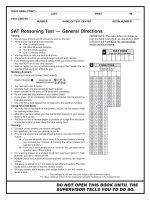
SAT Reasoning Test — General Directions
YOUR NAME (PRINT)
LAST FIRST MI
TEST CENTER
NUMBER NAME OF TEST CENTER ROOM NUMBER
IMPORTANT: The codes below are unique to
your test book. Copy them on your answer sheet
in boxes 8 and 9 and fi ll in the corresponding
circles exactly as shown.
A
B
C
D
E
F
G
H
I
J
K
L
M
N
O
P
Q
R
S
T
U
V
W
X
Y
Z
A
B
C
D
E
F
G
H
I
J
K
L
M
N
O
P
Q
R
S
T
U
V
W
X
Y
Z
0
1
2
3
4
5
6
7
8
9
0
1
2
3
4
5
6
7
8
9
0
1
2
3
4
5
6
7
8
9
A
B
C
D
E
F
G
H
I
J
K
L
M
N
O
P
Q
R
S
T
U
V
W
X
Y
Z
A
B
C
D
E
F
G
H
I
J
K
L
M
N
O
P
Q
R
S
T
U
V
W
X
Y
Z
FORM CODE
8
(Copy and grid as on
back of test book.)
DO NOT OPEN THIS BOOK UNTIL THE
SUPERVISOR TELLS YOU TO DO SO.
Timing
• You will have 3 hours and 45 minutes to work on this test.
• There are ten separately timed sections:
᭤ One 25-minute essay
᭤ Six other 25-minute sections
᭤ Two 20-minute sections
᭤ One 10-minute section
• You may work on only one section at a time.
• The supervisor will tell you when to begin and end each section.
• If you fi nish a section before time is called, check your work on that section.
You may NOT turn to any other section.
• Work as rapidly as you can without losing accuracy. Don’t waste time on
questions that seem too diffi cult for you.
Marking Answers
• Be sure to mark your answer sheet properly.
• You must use a No. 2 pencil.
• Carefully mark only one answer for each question.
• Make sure you fi ll the entire circle darkly and completely.
• Do not make any stray marks on your answer sheet.
• If you erase, do so completely. Incomplete erasures may be scored as
intended answers.
• Use only the answer spaces that correspond to the question numbers.
Using Your Test Book
• You may use the test book for scratchwork, but you will not receive credit
for anything written there.
• After time has been called, you may not transfer answers to your answer
sheet or fi ll in circles.
• You may not fold or remove pages or portions of a page from this book,
or take the book or answer sheet from the testing room.
Scoring
• For each correct answer, you receive one point.
• For questions you omit, you receive no points.
• For a wrong answer to a multiple-choice question, you lose one-fourth of
a point.
᭤ If you can eliminate one or more of the answer choices as wrong,
you increase your chances of choosing the correct answer and
earning one point.
᭤ If you can’t eliminate any choice, move on. You can return to the
question later if there is time.
• For a wrong answer to a student-produced response (“grid-in”) math
question, you don’t lose any points.
• Multiple-choice and student-produced response questions are machine
scored.
• The essay is scored on a 1 to 6 scale by two different readers. The total
essay score is the sum of the two readers’ scores.
• Off-topic essays, blank essays, and essays written in ink will receive a
score of zero.
The passages for this test have been adapted from published material.
The ideas contained in them do not necessarily represent the opinions of the College Board.
TEST FORM
9
(Copy from back of test book.)
-2-
You may use this space to make notes for your essay. Remember, however, that you
will receive credit ONLY for what is written on your answer sheet.
_________________________________________________________________________
N
N
N
O
O
O
T
T
T
E
E
E
S
S
S
O
O
O
N
N
N
L
L
L
Y
Y
Y
W
W
W
r
r
r
i
i
i
t
t
t
e
e
e
e
e
e
s
s
s
s
s
s
a
a
a
y
y
y
o
o
o
n
n
n
a
a
a
n
n
n
s
s
s
w
w
w
e
e
e
r
r
r
s
s
s
h
h
h
e
e
e
e
e
e
t
t
t
!
!
!
-3-
ESSAY
Time — 25 minutes
Turn to page 2 of your answer sheet to write your ESSAY.
The essay gives you an opportunity to show how effectively you can develop and express ideas. You should, therefore, take
care to develop your point of view, present your ideas logically and clearly, and use language precisely.
Your essay must be written on the lines provided on your answer sheet—you will receive no other paper on which to write.
You will have enough space if you write on every line, avoid wide margins, and keep your handwriting to a reasonable size.
Remember that people who are not familiar with your handwriting will read what you write. Try to write or print so that what
you are writing is legible to those readers.
Important Reminders:
• A pencil is required for the essay. An essay written in ink will receive a score of zero.
• Do not write your essay in your test book. You will receive credit only for what you write on your
answer sheet.
• An off-topic essay will receive a score of zero.
You have twenty-five minutes to write an essay on the topic assigned below.
Think carefully about the issue presented in the following excerpt and the assignment below.
People’s lives are the result of the choices they make—or fail to make. The path one takes in life
is not arbitrary. Choices and their consequences determine the course of every person’s life. All
people, whatever their circumstances, make the choices on which their lives depend.
Assignment: Are people’s lives the result of the choices they make? Plan and write an essay in which you develop your
point of view on this issue. Support your position with reasoning and examples taken from your reading,
studies, experience, or observations.
BEGIN WRITING YOUR ESSAY ON PAGE 2 OF THE ANSWER SHEET.
If you finish before time is called, you may check your work on this section only.
Do not turn to any other section in the test.
-4-
SECTION 2
Time — 25 minutes
20 Questions
Turn to Section 2 (page 4) of your answer sheet to answer the questions in this section.
Directions: For this section, solve each problem and decide which is the best of the choices given. Fill in the corresponding
circle on the answer sheet. You may use any available space for scratchwork.
1. The total cost of
5 equally priced notebooks is
$12.50.
If the cost per notebook is reduced by $1,
how much will
3 of these notebooks cost at the new
rate?
(A)
$4.50
(B)
$5.00
(C)
$6.50
(D)
$7.50
(E)
$9.50
2.
If
2
64 0,x − = which of the following could be a
value of
?x
(A)
8−
(B)
4−
(C)
0
(D)
16
(E)
32
-5-
3. The digits of the positive three-digit integer n are
7, 8, and 9. How many possible values are there
for
?n
(A) Three
(B) Four
(C) Six
(D) Eight
(E) Nine
4. In the figure above, WOY∠ and XOZ∠ each have
measure
80 .° If 45,r = what is the value of ?t
(A)
125
(B)
80
(C)
55
(D)
50
(E)
45
5. In the figure above, if the coordinates of points X and
Y are added together, the result will be the coordinate
of a point between which two consecutive integers?
(A)
3− and 2−
(B)
2− and 1−
(C)
1− and 0
(D)
0 and 1
(E)
2 and 3
6. In a sequence of numbers, the first number is 4 and
each number after the first is
1 more than 5 times the
preceding number. What is the third number in the
sequence?
(A)
16
(B)
21
(C)
94
(D)
96
(E)
106
-6-
7. It took Kia 6 hours to drive from Ashton to Farley,
passing through Belville, Clinton, Dryden, and
Edgewood on the way. The graph above shows where
she was along the route during the
6 hours of the trip.
According to the graph, approximately how long, in
hours, did it take Kia to drive from Dryden to
Edgewood?
(A)
1
(B)
1
2
2
(C)
3
(D)
1
3
2
(E)
1
4
2
8. If the average of
4
and
j
is 6 and the average of 10
and
k is 10, what is the average of j and ?k
(A)
5
(B)
6
(C)
8
(D)
9
(E)
10
9. Which of the following could be the graph in the
xy -plane of the function () 2 3?fx x=+
(A)
(B)
(C)
(D)
(E)
-7-
10. If n is a positive odd integer, then (1)(2)nn++
could equal which of the following?
(A)
10
(B)
15
(C)
20
(D)
25
(E)
30
11.
Point S is the point with the greatest y -coordinate on
the semicircle shown above. What is the
x -coordinate
of point
?R
(A)
5.5−
(B)
4−
(C)
3.5−
(D)
3−
(E)
2.5−
12. For 12 bottles of shampoo of various brands, the cost
and volume of each are displayed in the scatterplot
above, and the line of best fit for the data is shown. Of
the following, which is closest to the average
(arithmetic mean) cost per ounce for the
12 bottles?
(A)
$0.06
(B)
$0.09
(C)
$0.12
(D)
$0.15
(E)
$0.18
-8-
13. The graph of a quadratic function and the graph of a
linear function in the
xy -plane can intersect in at most
how many points?
(A) One
(B) Two
(C) Three
(D) Four
(E) More than four
14. If the length of LM is 7 and the length of MN is 8,
which of the following could be the length of
?LN
(A)
23
(B)
22
(C)
17
(D)
16
(E)
14
15. If a and b are positive integers and
()
93 3,
ab
= what
is
a in terms of ?b
(A) 2b
−
(B)
1b −
(C)
b
(D) 1b
+
(E)
2b +
16. The tin can in the figure above is a cylinder that is 8
inches high and has a base of radius
3 inches. Of 5
pencils with lengths
6 inches,
1
8
2
inches, 9 inches,
1
10
2
inches, and 12 inches, how many CANNOT fit
entirely inside the can?
(A) One
(B) Two
(C) Three
(D) Four
(E) Five
-9-
17. When the number
k
is multiplied by 5, the result is
the same as when
5 is added to .k What is the value
of
4?k
(A)
4
5
(B) 1
(C)
5
4
(D) 4
(E) 5
18.
A circle (not drawn) passes through point A in the
figure above. What could be the total number of points
of intersection of this circle and
?ABC∆
I. 1
II. 3
III.
4
(A) I only
(B) II only
(C) I and II only
(D) II and III only
(E) I, II, and III
-10-
19.
The function f graphed above is defined for
36.x−≤ ≤ For which of the following values of x
is
() ()?f xfx<
(A)
3−
(B)
2−
(C)
1−
(D)
1
(E)
5
20. If x and y are numbers such that (9)(9)0,xy+ −=
what is the smallest possible value of
22
?x y+
(A)
0
(B)
9
(C)
18
(D)
81
(E)
162
STOP
If you finish before time is called, you may check your work on this section only.
Do not turn to any other section in the test.
-11-
NO TEST MATERIAL ON THIS PAGE
-12-
SECTION 4
Time — 25 minutes
24 Questions
Turn to Section 4 (page 5) of your answer sheet to answer the questions in this section.
Directions:
For each question in this section, select the best answer from among the choices given and fill in the corresponding
circle on the answer sheet.
Each sentence below has one or two blanks, each blank
indicating that something has been omitted. Beneath
the sentence are five words or sets of words labeled A
through E. Choose the word or set of words that, when
inserted in the sentence, best fits the meaning of the
sentence as a whole.
Example:
Hoping to the dispute, negotiators proposed
a compromise that they felt would be to both
labor and management.
(A) enforce . . useful
(B) end . . divisive
(C) overcome . . unattractive
(D) extend . . satisfactory
(E) resolve . . acceptable
1. The architect advised tearing down the old structure,
since he did not consider it sufficiently to
the heavy winds of the tropical storm the peninsula was
expecting.
(A) flimsy . . forestall
(B) hardy . . forecast
(C) robust . . withstand
(D) noteworthy . . justify
(E) ramshackle . . repel
2. When x-rays were discovered around the turn of the
twentieth century, doctors quickly began to their
newfound ability to diagnose maladies by peering
beneath the surface of the human body.
(A) bequeath (B) deny
(C) exploit (D) finesse
(E) divulge
3. Though he was fascinated by the behavior of
others, Darek was, by contrast, the model of in
his own comportment.
(A) hedonistic . . recklessness
(B) unorthodox . . conformity
(C) restless . . agitation
(D) egotistical . . extremity
(E) unwieldy . . rigidity
-13-
4. Teachers who consider cartoons and comic books
harmful to students’ literacy skills often use class time
to these media.
(A) deride (B) rationalize
(C) vindicate (D) foster
(E) annotate
5. Because he had decided not to himself through
the sales of his new product, the inventor anonymously
donated all profits to charity.
(A) compromise (B) invigorate
(C) impoverish (D) aggrandize
(E) debilitate
6. Once he had sufficient information,
Randall felt confident in publishing his daring article
incriminating the local politician.
(A) written . . substantial
(B) believed . . sensational
(C) obtained . . corroborating
(D) reported . . hackneyed
(E) discovered . . contradicting
7. Since her personal pleas had failed to make her noisy
neighbors change their ways, the homeowner felt that
her only was to notify the police.
(A) backlash (B) recourse
(C) bromide (D) reckoning
(E) forbearance
8. Despite pressure from reporters to discuss the scandal
in which Senator Scottsdale was currently , the
press secretary would not the details of the
senator’s upcoming public address.
(A) imbued . . rescind
(B) connected . . consort
(C) entangled . . repeal
(D) embroiled . . divulge
(E) compliant . . quash
-14-
The passages below are followed by questions based on their content; questions following a pair of related passages may also
be based on the relationship between the paired passages. Answer the questions on the basis of what is stated or implied in the
passages and in any introductory material that may be provided.
Questions 9-12 are based on the following passages.
Modern historians use the terms
“feudalism” and “manorialism” to refer to
the ways that medieval European societies
were organized.
Passage 1
“Feudalism” is one of those words that
have taken on so many extended and
figurative meanings that the original
meaning has been obscured. Today any
oppressive government, greedy
5
landholder, or brutal exploiter of labor is
called feudal—always with disapproval.
This is unfair to feudalism. The word is
also often confused with the “manorial
system,” which tied peasants to the land
10
they worked. Feudalism is a total
organization of society. It is a scheme of
political organization, based in law and
overlapping with social and economic
organization.
15
Passage 2
Older historians used the term “feudalism”
for the whole medieval social order, which
was a peasant society dominated by a
military, land-owning aristocracy. Modern
usage generally restricts the word to the
20
network of relations between tenants and
lords within the aristocracy. The system
governing the peasant’s relation to the
lord, which was the economic foundation
of medieval society, is usually designated
25
the “manorial system.” The relationships
embodied in the feudal and manorial
systems were simple enough in theory:
In the manorial system, a peasant labored
for a lord in return for land of his own; in
30
the feudal system, a lord held lands from
the king or the overlord in return for
supplying soldiers on demand.
9. Which of the following is closest to what the author of
Passage 1 means by the phrase “This is unfair to
feudalism” (line 8)?
(A) “Feudalism” should not be used figuratively.
(B) “Feudalism” should not be used to refer to a
system of government.
(C) Those who lived in feudal societies would
disapprove of the way the term is currently used.
(D) “Feudalism” should not necessarily have only
negative connotations.
(E) “Feudalism” has been misused to the extent that
the term no longer has a meaning.
10. The word “extended” in line 2 most nearly means
(A) prolonged
(B) expanded
(C) removed
(D) allocated
(E) intensive
11. According to the author of Passage 2, the term
“manorial” refers to
(A) the whole medieval social order
(B) the relationships among the members of the
medieval aristocracy
(C) the economic relationship between medieval
peasants and lords
(D) the exchange of military protection for land
ownership
(E) the system of laws governing overlords
12. Compared with the tone of Passage 1, the tone of
Passage 2 is more
(A) objective
(B) disdainful
(C) lively
(D) unsympathetic
(E) argumentative
Line
-15-
Questions 13-24 are based on the following passage.
In the following excerpt from a novel,
Samuel Tyne, a Canadian of Ghanaian
descent, returns to work at the Canadian
Ministry of Economics after attending his
uncle’s funeral.
His overt melancholy aggravated
his boss, for it made Samuel hard to
approach. Just a glance into Samuel’s
cubicle gave his co-workers much to gloat
about. It seemed a wonder he was such
5
an exacting employee, with the swift but
pitiful stride that brought him,
disillusioned, to the threshold of every
meeting. Yet he was so indispensable in
that ministry that his co-workers regretted
10
every slur they flung at him, lest the
slights drive him to suicide. For not only
would the department collapse without his
doting, steady logic to balance it, but it
seemed at times that the entire Canadian
15
economy depended on the reluctant, soft-
wristed scribbling he did in his green
ledger.
There Samuel sat each day,
painfully tallying his data, his pencil
20
poised like a scalpel in his hand, frowning
at the gruesome but inevitable task ahead
of him. Dwarfed by a monstrous blue
suit, Samuel would finger the mournful
pre-war bowler that never left his head.
25
And it was such an earnest sight, such an
intimate window into a man whose nature
seemed to be all windows—people
wondered if he actually had a public self—
that he might have been the only man in
30
the world to claim vulnerability as his
greatest asset.
The day after the funeral, Samuel
returned to work to find a note from his
bosses on his desk: Come See Us.
35
What could they possibly
reprimand him for? He was a fast and
diligent worker, with enough gumption to
use a little imaginative reasoning when
some economic nuisance called for it. He
40
was punctual and tidy, not overly familiar
with his co-workers; quite simply, the best
employee they had. Rather than
indignation, though, Samuel only felt fear.
To buy himself time, he crumpled a few
45
clean papers from his ledger, and walked
the narrow aisles between cubicles to
throw them in the hallway garbage bin.
He returned to find both bosses,
Dombey and Son
*
, as he’d nicknamed
50
them, at his desk. Dombey’s German
sense of humor failed to translate, at least
to Samuel, who always overdid his laugh
to mask confusion. Son, whose current
prestige was pure nepotism, looked at
55
Samuel with the coldness that cloaked all
of his dealings, as if he knew he was inept
and needed to compensate.
“Tyne,” Dombey said, “we need to
talk about the Olds account.”
60
Samuel pinched the brim of his hat
with his thumbs. “Ah, yes. Sorry, yes. I
think, sir, I handed that in before I took
day leave for my uncle’s funeral.”
“It contains a dreadful error,” said
65
Son, blinking violently behind his glasses.
He jerked the report at Samuel.
There it was, plain as day, on page
six. A miscalculation Samuel must have
made while thinking about Jacob’s death
70
and the house. He stood there, hat in
hand, aghast.
“We realize,” continued Son, “that
the job sometimes gets stressful. That,
per se, there are times when one cannot
75
always be as on-the-ball as is required.
But this defies all. Not only is it not up to
standard, it’s downright misleading.”
That was the way Son spoke, as
though he hadn’t mastered the
80
bureaucratic language, wielding phrases
such as “per se” and “not up to standard”
like the residue of some management
handbook. Even Dombey seemed
perplexed by this at times.
85
The muscle in Samuel’s cheek
trembled. He nodded.
“We understand you’ve just
suffered a big loss, Samuel,” said
Dombey, “but as you know this is a
90
federal workplace. What would happen,
say, if you made this kind of error daily?
Now, we’re certainly not saying that you
do. But what would happen? I’ll tell you
what would happen. You’d have ladies
95
collapsing in ten-hour lines just to get a
loaf of bread to feed their families. You’d
have children skipping school because
there aren’t enough clothes to go around.
Line
-16-
Babies dying without milk. Old folks
100
crumbling in their rockers. It’d be
pandemonium with a capital P—
depression. We are the economy. We
answer to the prime minister. There is no
room for error here.” Dombey scratched
105
his head and looked wistful. “Oh, don’t
look so glum.”
Again, Samuel nodded.
Son, fearing his role in the
reprimand unnecessary, added, “We are,
110
of course, deeply sorry for your loss, but
you must remember our country is in your
hands.”
Dombey frowned at Son, and the
two men walked off. When they left,
115
Samuel heard through the divider the
rude laughter of Sally Mather. His face
burning, he sat at his desk, and picking up
his green ledger, tried to make up for the
ten minutes lost time.
120
* Dombey and Son is a novel by the English writer
Charles Dickens.
13. In line 20, the word “painfully” is closest in meaning to
(A) laboriously
(B) critically
(C) sensitively
(D) harmfully
(E) acutely
14. In line 22, the word “gruesome” is closest in meaning
to
(A) shocking
(B) repugnant
(C) frightening
(D) crude
(E) sensational
15. The second paragraph implies that Tyne’s clothes
make him appear which of the following?
(A) Casual
(B) Pathetic
(C) Stylish
(D) Proud
(E) Inappropriate
16. Tyne’s attitude at work could best be described as
(A) sinister and calculating
(B) happy and ambitious
(C) insubordinate and stubborn
(D) cheerful and obedient
(E) professional and morose
17. The phrase “whose nature seemed to be all windows”
in lines 27-28 suggests that
(A) Tyne’s colleagues all had different opinions of
him
(B) Tyne behaved in many inconsistent ways
(C) Tyne’s true feelings were easy to observe
(D) Tyne did not appear to be a solid person
(E) Tyne always talked about himself to his
colleagues
18. In line 41, the word “familiar” is closest in meaning to
(A) common
(B) expected
(C) forward
(D) natural
(E) recognizable
19. The description of Tyne’s job performance in lines 37-
43 primarily serves to
(A) illustrate that Tyne enjoyed doing his job
(B) imply that Tyne deserves a promotion
(C) suggest that Tyne’s work habits are generally
beyond reproach
(D) indicate that Tyne’s bosses will probably not
discipline him
(E) demonstrate that Tyne’s bosses have always liked
him
20. The gesture in lines 45-48 (“To buy…bin”) is meant
primarily to indicate Tyne’s
(A) desire to look busy
(B) unwillingness to meet with his bosses
(C) avoidance of work
(D) attempt to escape punishment
(E) dissatisfaction with his surroundings
-17-
21. The narrator most likely refers to Tyne’s second boss
only as “Son” throughout the passage in order to
(A) imply that his authority is undeserved
(B) indicate his official title at work
(C) reinforce his position of power
(D) suggest a friendship between him and Tyne
(E) portray him as an approachable manager
22. The narrator suggests that Son’s comment to Tyne in
lines 110-113 demonstrates
(A) genuine concern for Tyne’s loss
(B) a misunderstanding of Tyne’s situation
(C) a disagreement with Dombey about the error
(D) a desire to be seen as important
(E) an effort to help Tyne improve his performance
23. Tyne’s response to his bosses’ reprimand could best be
characterized as
(A) defensive
(B) passionate
(C) rude
(D) submissive
(E) deceitful
24. The author mentions the “rude laughter of Sally
Mather” in line 117 primarily in order to
(A) indicate that most of Tyne’s colleagues dislike
him
(B) imply that Sally Mather has reported Tyne’s error
to his bosses
(C) underscore the humiliation Tyne is experiencing
(D) show that Tyne’s bosses wanted his colleagues to
know about his error
(E) suggest that Tyne’s bosses are making fun of him
STOP
If you finish before time is called, you may check your work on this section only.
Do not turn to any other section in the test.
-18-
SECTION 5
Time — 25 minutes
35 Questions
Turn to Section 5 (page 5) of your answer sheet to answer the questions in this section.
Directions:
For each question in this section, select the best answer from among the choices given and fill in the corresponding
circle on the answer sheet.
The following sentences test correctness and effectiveness
of expression. Part of each sentence or the entire sentence
is underlined; beneath each sentence are five ways of
phrasing the underlined material. Choice A repeats the
original phrasing; the other four choices are different. If
you think the original phrasing produces a better sentence
than any of the alternatives, select choice A; if not, select
one of the other choices.
In making your selection, follow the requirements of
standard written English; that is, pay attention to grammar,
choice of words, sentence construction, and punctuation.
Your selection should result in the most effective
sentence—clear and precise, without awkwardness or
ambiguity.
EXAMPLE:
Laura Ingalls Wilder published her first book
and she was sixty-five years old then.
(A) and she was sixty-five years old then
(B) when she was sixty-five
(C) at age sixty-five years old
(D) upon the reaching of sixty-five years
(E) at the time when she was sixty-five
1. Unlike with many animals
, humans do not swim by
instinct.
(A) with many animals
(B) what many animals do
(C) many animals
(D) many animals who do it
(E) many animals do
2. First run in 1867 and still taking place every summer,
the Belmont Stakes, a horse race for thoroughbred
three-year-olds, was
one of the oldest races in the
United States.
(A) was
(B) is
(C) were
(D) are
(E) has been
3. Folklore scholars think of fables probably originating
among the Semitic peoples of the Middle East, moving
first to India and then west to Greece.
(A) of fables probably originating
(B) of fables that probably originated
(C) that the fable’s origins were probably
(D) that the origin of fables probably was
(E) that fables probably originated
4. Althea Gibson, the first African American tennis
player that they recognized as
a world champion,
began playing amateur tennis in the 1940’s.
(A) that they recognized as
(B) that was recognized to be
(C) recognized because she was
(D) to be recognized as
(E) recognizing her as
-19-
5. Societies acting through their governments make the
rules to state
which acts are illegal, but although war is
the most violent of human activities, it has not been
declared illegal by any of the world’s governments or
their agencies.
(A) to state
(B) stating
(C) when they state
(D) that are stating
(E) where they state
6. The 2003 Nobel Peace Prize was awarded to Shirin
Ebadi, an Iranian lawyer, writer, and teacher, she
gained prominence as an advocate for democracy and
human rights.
(A) teacher, she gained
(B) teacher, she had gained
(C) teacher, gaining
(D) teacher who gained
(E) teacher having gained
7. Because its early history is not fully known, origami,
the art of folding objects out of paper without cutting,
pasting, or decorating, seems to have developed from
the older art of folding cloth.
(A) Because
(B) In that
(C) Since
(D) Although
(E) As
8. One of the most popular singers of his time, more than
twenty languages were mastered by Paul Robeson,
allowing him to perform classical repertory, spirituals,
and folk songs from around the world.
(A) more than twenty languages were mastered by
Paul Robeson, allowing him to perform
(B) Paul Robeson’s mastery of more than twenty
languages allowed him to perform
(C) mastering more than twenty languages allowed
Paul Robeson to perform
(D) his mastery of more than twenty languages
allowed Paul Robeson to be performing
(E) Paul Robeson mastered more than twenty
languages, allowing him to perform
9. Babe Ruth is regarded by many having been the
greatest baseball player in history, and he remains
arguably the most celebrated figure in North American
sports.
(A) having been
(B) that he was
(C) for being
(D) to be
(E) as
10. Digital technology, as every marketer knows, is
synonymous to
speed, precision, and the future.
(A) to
(B) of
(C) with
(D) for
(E) through
11. After carefully studying both of the articles, Dr.
Rodriguez and Nurse Alba found that the only
difference between them were their titles
.
(A) them were their titles
(B) them were the titles
(C) the articles were the titles
(D) the articles was that of the titles
(E) the articles was their titles
-20-
The following sentences test your ability to recognize
grammar and usage errors. Each sentence contains either
a single error or no error at all. No sentence contains more
than one error. The error, if there is one, is underlined
and lettered. If the sentence contains an error, select the
one underlined part that must be changed to make the
sentence correct. If the sentence is correct, select choice E.
In choosing answers, follow the requirements of standard
written English.
EXAMPLE:
The other
A
delegates and
him
B
immediately
C
accepted the resolution
drafted by
D
the
neutral states.
No error
E
12.
At
A
the meeting of the planning board, the
councilwoman
assured
B
her constituents that she
was
C
active
D
seeking a long-term solution to the city’s
parking problem.
No error
E
13. Used in sculpture, carving
is the process
A
of reducing
substances such as stone, wood, or ivory
to a
B
desired shape
C
by cutting or
to chip
D
away unnecessary
parts.
No error
E
14. New York City is
an important
A
center of American
Buddhism, in part
because
B
its residents
included
C
immigrants
from most
D
of the countries that have
strong Buddhist traditions.
No error
E
15.
In addition to
A
being
B
a talented pianist and composer,
Béla Bartók was a
respected
C
musicologist
who wrote
D
several books on Hungarian, Slovakian, and Romanian
folk music.
No error
E
16. Whereas the caterpillars
of most
A
butterflies are
harmless, moth caterpillars
caused
B
an enormous
amount of
damage to
C
plants, forest and shade trees,
clothing,
and
D
household goods.
No error
E
17.
Homing pigeons can
navigate over
A
long distances,
employing
B
their sense of smell to ascertain their initial
location and using
the position
C
of the Sun
determining
D
the direction in which they must fly.
No error
E
18.
Salt is valued not only because of
its properties
A
as a
condiment and preservative,
but also
B
because
they are
C
essential to
the health of
D
humans and
animals.
No error
E
-21-
19.
After
A
two terms in the Texas State Senate, Barbara
Jordan
elected
B
to the United States House of
Representatives,
where
C
she
served
D
from 1973 to
1979.
No error
E
20. A sweetener, normally
either
A
sugar or syrup,
are used
B
in almost all bread
for taste
C
or
as
D
an aid to yeast
growth.
No error
E
21. Willie Dixon's
upbeat blues
A
compositions helped
usher in the Chicago blues sound during the 1950’s and
have become
B
standard numbers for the many young
rock groups
trying to
C
achieve popularity
during
D
the
1960’s.
No error
E
22.
When
A
the Spanish conquistadors reached Peru in
1532,
they encountered
B
the vast empire of the Incas,
it extended
C
along the Pacific coast of South America
from modern Ecuador to central Chile and
inland across
D
the Andes.
No error
E
23. Unlike
her
A
best friend Margie,
making
B
the varsity
soccer team
as
C
a freshman, Jill
did not
D
make the team
until her junior year.
No error
E
24. Although the precise date and place of the origin of
baseball are
hotly debated
A
, it is
beyond dispute
B
that
the New York City boroughs of Manhattan and
Brooklyn
play
C
an important role in
its
D
early
development.
No error
E
25. By 2003,
more than
A
684,000 students in the United
States had enrolled in charter schools, publicly funded
schools
that pledged
B
better academic results and were
unencumbered by
C
many of the regulations
governing
D
ordinary public schools.
No error
E
26. The common cold,
like
A
chickenpox, measles, and
many other
B
viral diseases,
can be spread
C
both before
and after
their
D
symptoms emerge.
No error
E
-22-
27.
Although
A
he had never played organized sports,
whenever Justin,
who was
B
uncommonly tall,
attends
C
a basketball game, fans would
ask him for
D
an
autograph.
No error
E
28.
From
A
its modest beginnings as a series of brief
vignettes
and
B
its establishment as the longest-running
prime-time comedy series on television,
The Simpsons
has transformed
the way that
C
both audiences and
television programmers
view
D
the animated sitcom.
No error
E
29. Venezuela
devotes
A
a higher percentage
of its budget
B
to education
than do
C
other large Latin American
countries
such as
D
Mexico and Brazil.
No error
E
-23-
Directions: The following passage is an early draft of an
essay. Some parts of the passage need to be rewritten.
Read the passage and select the best answers for the
questions that follow. Some questions are about particular
sentences or parts of sentences and ask you to improve
sentence structure or word choice. Other questions ask you
to consider organization and development. In choosing
answers, follow the requirements of standard written
English.
Questions 30-35 are based on the following passage.
(1)
Aristotle was a great philosopher and scientist.
(2) Aristotle lived in Greece over 2300 years ago.
(3) Aristotle was extraordinarily curious about the world
around him.
(4) He was also a master at figuring out how
things worked.
(5) Aristotle passed it on to his pupil
Theophrastus.
(6) Theophrastus was famous among his contemporaries
as the co-founder of the Lyceum, a school in Greece, he is
best known today as "the father of botany."
(7) Botany is
the branch of science dealing with plants.
(8) Two famous books he wrote were Natural History of
Plants
and Reasons for Vegetable Growth. (9) His books
were translated from Greek into Latin in 1483—1800 years
after he wrote them—they influenced thousands of readers.
(10) Theophrastus made accurate observations about all
aspects of plant life, including plant structure, plant
diseases, seed use, and medicinal properties.
(11) He even
described the complex process of plant reproduction
correctly, hundreds of years before it was formally proven.
(12) In 1694 Rudolph Jakob Camerarius used experiments
to show how plants reproduced. (13) According to some
accounts, Theophrastus did his research in a garden he
maintained at his school which was called the Lyceum.
(14) But Theophrastus also wrote about plants that grew
only in other countries, which he heard about from
returning soldiers.
(15) By comparing these plants to plants
he grew in his garden, Theophrastus established principles
that are still true today.
30. Which of the following is the best version of the
underlined portion of sentence 1 and sentence 2
(reproduced below)?
Aristotle was a great philosopher and scientist.
Aristotle lived in Greece over 2300 years ago.
(A) philosopher and a scientist, living
(B) philosopher and scientist who lived
(C) philosopher, and, as a scientist, lived
(D) philosopher and scientist; Aristotle lived
(E) philosopher, scientist, and lived
31.
What would best replace "it" in sentence 5?
(A) that
(B) them
(C) these traits
(D) the world
(E) his things
32.
What word should be inserted between "Greece," and
"he" in sentence 6 (reproduced below)?
Theophrastus was famous among his contemporaries
as the co-founder of the Lyceum, a school in Greece,
he is best known today as "the father of botany."
(A) and
(B) but
(C) for
(D) thus
(E) moreover
33.
Which sentence should be inserted between sentence 8
and sentence 9?
(A) Theophrastus's ideas had a lasting impact.
(B) Theophrastus's books were instantly successful.
(C) The first book is still studied today in botany
classes.
(D) They challenged the conclusions of Aristotle.
(E) Theophrastus also taught botany to hundreds of
students.
-24-
34. Which revision appropriately shortens sentence 13
(reproduced below)?
According to some accounts, Theophrastus did his
research in a garden he maintained at his school which
was called the Lyceum.
(A) Delete "his school which was called".
(B) Delete "According to some accounts,".
(C) Delete "in a garden he maintained".
(D) Replace "According to some accounts" with
"Therefore".
(E) Replace "Theophrastus" with "he".
35. The third paragraph would be improved by the deletion
of which sentence?
(A) Sentence 10
(B) Sentence 11
(C) Sentence 12
(D) Sentence 14
(E) Sentence 15
STOP
If you finish before time is called, you may check your work on this section only.
Do not turn to any other section in the test.
-25-
NO TEST MATERIAL ON THIS PAGE