Tài liệu Practical Database Programming With Visual C#.NET- P5 pptx
Bạn đang xem bản rút gọn của tài liệu. Xem và tải ngay bản đầy đủ của tài liệu tại đây (1.46 MB, 50 trang )
4.9 C# 3.0 Language Enhancement for LINQ 223
tion of compositional APIs that have equal expressive power of query languages in
domains such as relational databases and XML.
Compared with C# 2.0, signifi cant enhancements have been added into C# 3.0, and
these enhancements are mainly developed to support the Language - Integrated Query.
LINQ is a series of language extensions that supports data querying in a type - safe way; it
is released with the latest version Visual Studio, Visual Studio.NET 2008. The data to be
queried, which we have discussed in the previous sections in this chapter, can take the
form of objects (LINQ to Objects), databases (LINQ - enabled ADO.NET, which includes
LINQ to SQL, LINQ to DataSet, and LINQ to Entities), XML (LINQ to XML), and
so on.
In addition to those general LINQ topics, special improvements on LINQ are
made for C# and involved in C# 3.0. The main components of these improvements
include:
• Lambda expressions
• Extension methods
• Implicitly typed local variables
• Query expressions
Let ’ s have a detailed discussion of these topics one by one.
4.9.1 Lambda Expressions
Lambda expressions are a language feature that is similar in many ways to anonymous
methods. In fact, if lambda expressions had been developed and implemented into the
language fi rst, there would have been no need for anonymous methods. The basic idea
of using lambda expressions is that you can treat code as data. In the early version C#,
such as C# 1.0, it is very common to pass strings, integers, reference types, and so on to
methods so that the methods can work on those values. Anonymous methods and lambda
expressions extend the range of the values to include code blocks. This concept is common
in functional programming.
The syntax of lambda expressions can be expressed as a comma - delimited list of
parameters with the lambda operator (= > ) followed by an expression. For more compli-
cated lambda expressions, a statement block can be followed after the lambda operator.
A simple example of lambda expression used in C# looks like:
x = > y
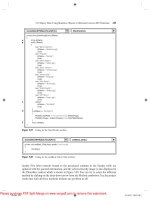
foreach (var fi in facultyUpdates.Elements("facultyUpdate"))
{
Faculty faculty = db.Faculties.
First(f => f.faculty_id == (string)fi.Element("faculty_id"));
faculty.Phone = (string)fi.Element("phone");
}
db.SubmitChanges();
Figure 4.67 Piece of sample code to read and update database.
c04.indd 223c04.indd 223 2/11/2010 11:52:26 AM2/11/2010 11:52:26 AM
Please purchase PDF Split-Merge on www.verypdf.com to remove this watermark.
224 Chapter 4 Introduction to Language-Integrated Query (LINQ)
where x on the left side of the lambda operator is the input parameter and the y on the
right side of the lambda operator is the output parameter. The data type of both the input
and the output parameters should be explicitly indicated by the delegate. Therefore the
lambda expressions are closely related to delegate. This lambda expression can be read
as input x and output y . The syntax of this kind of simple lambda expressions can be
written as:
(param1, param2, … . paramN) = > output
A parenthesis should be used to cover all input parameters.
For more complicated lambda expressions, a statement block should be adopted. An
example of this kind of syntax is shown below:
(x, y) = > { if (x > y) return x; else return y; }
Note that the data type of both the input and the output parameters must be identical
with those types defi ned in the delegate. For example, in the previous sample expression
x = > y, if the input x is defi ned as a string, and the output is defi ned as an integer by the
delegate, the output must be converted to an integer type by using the following lambda
expression:
x = > y.Length
where Length is a method to convert the input from a string to an integer.
Another example of using lambda expressions to perform LINQ query is:
IEnumerable < Faculty > faculty =
EnumerableExtensions.Where(faculties, f = > f.faculty_name ==
“Ying Bai”);
Here the SQO method Where() is used as a fi lter in this query. The input is an object
with a type of faculties, and the output is a string variable. The compiler is able to infer that
“ f ” refers to a faculty because the fi rst parameter of the Where() method is
IEnumerable< Faculty > , such that T must, in fact, be Faculty . Using this knowledge,
the compiler also verifi es that Faculty has a faculty_name member. Finally, there is no
return key word specifi ed. In the syntactic form, the return member is omitted but this is
merely syntactic convenience. The result of the expression is still considered to be the
return value.
Lambda expressions also support a more verbose syntax that allows you to specify
the types explicitly, as well as execute multiple statements. An example of this kind of
syntax is:
return EnumerableExtensions.Where(faculties, (Faculty f) = >
{string id =faculty_id; return f.faculty_id = id;});
Here the EnumerableExtensions class is used to allow us to access and use the static
method Where() since all SQO methods are static methods defi ned in either Enumerable
or Queryable classes. As you know, a static method is defi ned as a class method and can
be accessed and used by each class in which that method is defi ned. Is that possible
for us to access a static method from an instance of that class? Generally, this will be
considered as a stupid question since that is impossible. Is there any way to make it pos-
c04.indd 224c04.indd 224 2/11/2010 11:52:26 AM2/11/2010 11:52:26 AM
Please purchase PDF Split-Merge on www.verypdf.com to remove this watermark.
4.9 C# 3.0 Language Enhancement for LINQ 225
sible? The answer is maybe. To get that question answered correctly, let ’ s go to the
next topic.
4.9.2 Extension Methods
Regularly, static methods can only be accessed and used by classes in which those static
methods are defi ned. For example, all SQO methods, as we discussed in Sections 4.1.3
and 4.1.4 , are static methods defi ned in either Enumerable or Queryable classes and can
be accessed by those classes directly. But those static methods cannot be accessed by any
instance of those classes. Let ’ s use an example to make this story clear.
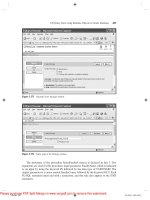
Figure 4.68 shows a piece of code that defi nes both class and instance methods.
In this example, the method ConvertToUpper() is an instance method and
ConvertToLower() is a class method. To call these methods, different calling strategy
must be utilized. To call and execute the instance method ConvertToUpper(), one must
fi rst create a new instance of the class Conversion, and then call that method. To call and
execute the class method ConvertToLower(), one can directly call it with the class name
prefi xed in front of that method. Figure 4.69 shows a piece of code to call these two
methods.
In some situations, the query would become very complicated if one wants to call
those static methods from any instance of those classes. To solve this complex issue,
extension methods are developed to simplify the query structures and syntax.
To declare an extension method from existing static method, just add the keyword
this to the fi rst argument of that static method. For example, to make the class method
public static class Convertion
{
public string ConvertToUpper(string input)
{
return input.ToUpper();
}
public static string ConvertToLower(string input)
{
return input.ToLower();
}
}
Figure 4.68 Example of defi ning class and instance method.
// call instance method ConvertToUpper.
// first create a new instance of the class Conversion
Conversion conv = new Conversion();
string instResult = conv.ConvertToUpper(“conversion”);
// call class method ConvertToLower.
string classResult = Conversion.ConvertToLower(“CONVERSION”);
Figure 4.69 Example of calling class and instance method.
c04.indd 225c04.indd 225 2/11/2010 5:16:05 PM2/11/2010 5:16:05 PM
Please purchase PDF Split-Merge on www.verypdf.com to remove this watermark.
226 Chapter 4 Introduction to Language-Integrated Query (LINQ)
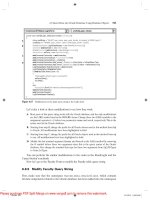
ConvertToLower() an extension method, add the keyword this to the fi rst argument of
that method, as shown in Figure 4.70 .
Now the class method ConvertToLower() has been converted to an extension method
and can be accessed by any instance of the class Conversion.
The extension methods have the following important properties:
1. The extension method will work as an instance method of any object with the same type
as the extension method ’ s fi rst argument ’ s data type.
2. The extension methods can only be declared in static classes.
3. Both the class and the extension method are prefi xed by the keyword static .
Refer to Figure 4.70 . The extension method ConvertToLower() has a data type of
string since the fi rst argument ’ s type is string. This method is declared in a static class
Conversion, and both class and this method are prefi xed by the keyword static .
4.9.3 Implicitly Typed Local Variables
In LINQ query, there ’ s another language feature known as implicitly typed local variables
(or var for short) that instructs the compiler to infer the type of a local variable. As you
know, with the addition of anonymous types to C#, a new problem becomes a main
concern, which is that if a variable is being instantiated that is an unnamed type, as in an
anonymous type, what type variable would you assign it to? LINQ queries belong to
strongly typed queries with two popular types: IEnumerable < T > and IQueryable < T > , as
we discussed at the beginning of this chapter. Figure 4.71 shows an example of this kind
of variable with an anonymous type.
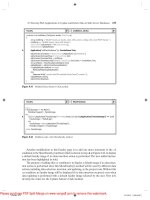
A compiling error will be encountered when this piece of code is compiled since the
data type of the variable faculty is not indicated. In C# 3.0 language enhancement for
public static class Convertion
{
// declare the class method ConvertToLower to extension method.
public static string ConvertToLower(this string input)
{
return input.ToLower();
}
}
Figure 4.70 Declare the class method ConvertToLower to extension method.
public static class Main()
{
// declare an anonymous type variable.
faculty = new { faculty_id = “B78880”, faculty_name = “Ying Bai” };
Console.WriteLine(“faculty information {0}, {1}”, faculty.faculty_id + “. “ + faculty.faculty_name);
}
Figure 4.71 Declare an anonymous type variable.
c04.indd 226c04.indd 226 2/11/2010 5:16:05 PM2/11/2010 5:16:05 PM
Please purchase PDF Split-Merge on www.verypdf.com to remove this watermark.
4.9 C# 3.0 Language Enhancement for LINQ 227
LINQ, a new terminology, implicitly typed local variable var , is developed to solve this
kind of anonymous type problem. Refer to Figure 4.72 , where the code written in Figure
4.71 is rewritten.
This time there would be no error if you compile this piece of code since the keyword
var informs the compiler to implicitly infer the variable type from the variable ’ s initializer.
In this example, the initializer for this implicitly typed variable faculty is a string collec-
tion. This means that all implicitly typed local variables are statically type checked at the
compile time, therefore an initializer is required to allow the compiler to implicitly infer
the type from it.
The implicitly typed local variables mean that those variables are just local within a
method, for example, the faculty is valid only inside the main() method in the previous
example. It is impossible for them to escape the boundaries of a method, property,
indexer, or other block because the type cannot be explicitly stated, and var is not legal
for fi elds or parameter types.
Another important terminology applied in C# 3.0 language enhancement for LINQ
is the object initializers. Object initializers basically allow the assignment of multiple
properties or fi elds in a single expression. For example, a common pattern for object
creation is shown in Figure 4.73 .
In this example, there is no constructor of Faculty that takes a faculty id, name, offi ce,
and title; however, there are four properties, faculty_id, faculty_name, offi ce, and title,
which can be set once an instance faculty is created. Object initializers allow to create a
new instance with all necessary initializations being performed at the same time as the
instantiation process.
4.9.4 Query Expressions
To perform any kind of LINQ query, such as LINQ to Objects, LINQ to ADO.NET, or
LINQ to XML, a valid query expression is needed. The query expressions implemented
in C# 3.0 have a syntax that is closer to SQL statements and are composed of some
clauses. One of the most popular query expressions is the foreach statement. As this
public static class Main()
{
// declare an anonymous type variable.
var faculty = new { faculty_id = “B78880”, faculty_name = “Ying Bai” };
Console.WriteLine(“faculty information {0}, {1}”, faculty.faculty_id + “. “ + faculty.faculty_name);
}
Figure 4.72 Declare an anonymous type variable using implicitly typed local variable.
Faculty faculty = new Faculty();
faculty.faculty_id = “B78880”;
faculty.faculty_name = “Ying Bai”;
faculty.office = “MTC-211”;
faculty.title = “Associate Professor”;
Figure 4.73 Example of using the object initializer.
c04.indd 227c04.indd 227 2/11/2010 11:52:27 AM2/11/2010 11:52:27 AM
Please purchase PDF Split-Merge on www.verypdf.com to remove this watermark.
228 Chapter 4 Introduction to Language-Integrated Query (LINQ)
foreach is executed, the compiler converts it into a loop with calls to methods such as
GetEnumerator() and MoveNext(). The main advantage of using the foreach loop to
perform the query is that it provides a signifi cant simplicity in enumerating through
arrays, sequences, and collections and return the terminal results in an easy way. A typical
syntax of query expression is shown in Figure 4.74 .
Generally, a query expression is composed of two blocks. The top block in Figure
4.74 is the from - clause block and the bottom block is the query - body block. The from -
clause block only takes charge of the data query information (no query results), but the
query - body block performs the real query and contains the real query results.
Referring to syntax represented in Figure 4.74 , the following components should be
included in a query expression:
• A query variable must be defi ned fi rst in either explicitly (IEnumerable < T > ) or implicitly (var).
• A query expression can be represented in either query syntax or method syntax.
• A query expression must start with a from clause, and must end with a select or group clause.
Between the fi rst from clause and the last select or group clause, it can contain one or more
of these optional clauses: where , orderby , join , let , and even additional from clauses.
In all LINQ queries (including LINQ to DataSet), all of clauses will be converted to
the associated SQO methods, such as From(), Where(), OrderBy(), Join(), Let(), and
Select(), as the queries are compiled. Refer to Table 4.1 to get the most often used
Standard Query Operators and their defi nitions.
In LINQ, a query variable is always strongly typed, and it can be any variable that
stores a query instead of the results of a query. More specifi cally, a query variable is
always an enumerable type that will produce a sequence of elements when it is iterated
over in a foreach loop or a direct call to its method IEnumerator.MoveNext.
A very detailed discussion about the query expression has been provided in Sections
4.5.1.1 and 4.5.1.2 in this Chapter. Refer to those sections to get more details on this topic.
Before we can fi nish this chapter, a real query example implemented in our project
is shown in Figure 4.75 .
4.10 CHAPTER SUMMARY
Language - Integrated Query (LINQ), which is built on .NET Frameworks 3.5, is a new
technology released with Visual Studio.NET 2008 by Microsoft. LINQ is designed to
var query_variable = from [identifier] in [data source]
let [expression]
where [boolean expression]
order by [[expression](ascending/descending)], [optionally repeat]
select [expression]
group [expression] by [expression] into [expression]
foreach (var range_variable in query_variable)
{
//pick up or retrieve back each element from the range_variable….
}
Figure 4.74 Typical syntax of query expression.
c04.indd 228c04.indd 228 2/11/2010 11:52:27 AM2/11/2010 11:52:27 AM
Please purchase PDF Split-Merge on www.verypdf.com to remove this watermark.
4.10 Chapter Summary 229
query general data sources represented in different formats, such as Objects, DataSet,
SQL Server database, Entities, and XML. The innovation of LINQ bridges the gap
between the world of objects and the world of data.
An introduction to LINQ general programming guide is provided in the fi rst part
of this chapter. Some popular interfaces widely used in LINQ, such as IEnumerable,
IEnumerable < T > , IQueryable, and IQueryable < T > , and Standard Query Operators
(SQO) including the deferred and nondeferred SQO, are discussed in that part.
An introduction to LINQ Query is given in the second section in this chapter.
Following this introduction, a detailed discussion and analysis about LINQ implemented
for different data sources is provided based on the sequence listed below.
1. Architecture and components of LINQ
2. LINQ to Objects
3. LINQ to DataSet
4. LINQ to SQL
5. LINQ to Entities
6. LINQ to XML
7. C# 3.0 language enhancement for LINQ
Both literal introductions and actual examples are provided for each part listed above
to give readers not only a general and global picture about LINQ technique applied for
different data, but also practical and real feeling about the program codes developed to
realize the desired functionalities.
Twelve real projects are provided in this chapter to help readers to understand and
follow up on all techniques discussed in this chapter.
After fi nishing this chapter, readers should be able to:
• Understand the basic architecture and components implemented in LINQ.
• Understand the functionalities of Standard Query Operators.
• Understand general interfaces implemented in LINQ, such as LINQ to Objects, LINQ to
DataSet, LINQ to SQL, LINQ to Entities, and LINQ to XML.
• Understand the C# 3.0 language enhancement for LINQ.
• Design and build real applications to apply LINQ queries to perform data actions to all
different data sources.
static void Main()
{
IEnumerable<Faculty> faculty = db.Faculties.Where(f => f.faculty_id == "D.*",
f => f.college == “U.*”,
f => f.title == “Associate Professor”);
// Execute the query to produce the results
foreach (Faculty fi in faculty)
{
Console.WriteLine("{0}\n{1}\n{2}\n{3}\n{4}", f.faculty_name, f.title, f.office, f.phone, f.email);
}
}
Figure 4.75 Real example of query expression.
c04.indd 229c04.indd 229 2/11/2010 11:52:27 AM2/11/2010 11:52:27 AM
Please purchase PDF Split-Merge on www.verypdf.com to remove this watermark.
230 Chapter 4 Introduction to Language-Integrated Query (LINQ)
• Develop and build applications to apply C# 3.0 language enhancement for LINQ to perform
all different queries to data sources.
Starting with the next chapter, we will concentrate on the database programming
with Visual C#.NET using real projects.
HOMEWORK
I. True/False Selections
____ 1. LINQ queries are built based on. NET Frameworks 3.5.
____ 2. Most popular interfaces used for LINQ queries are IEnumerable, IEnumerable < T > ,
IQueryable, and IQueryable < T > .
____ 3. IEnumerable interface is used to convert data type of data source to IEnumerable < T > ,
which can be implemented by LINQ queries.
____ 4. IEnumerable interface is inherited from the class IQueryable.
____ 5. All Standard Query Operator methods are static methods defi ned in the IEnumerable
class.
____ 6. IEnumerable and IQueryable interfaces are mainly used for the nongeneric collections
supported by the earlier versions of C#, such as C# 1.0 or earlier.
____ 7. All LINQ query expressions can only be represented as query syntax.
____ 8. All LINQ query expressions will be converted to the Standard Query Operator methods
during the compile time by CLR.
____ 9. The query variable used in LINQ queries contains both the query information and the
returned query results.____
___ 10. LINQ to SQL, LINQ to DataSet, and LINQ to Entities belong to LINQ to ADO.NET.
II. Multiple Choices
1. The difference between the interfaces IEnumerable and IEnumerable < T > is that the former is
mainly used for ______, but the latter is used for _______.
a. Nongeneric collections, generic collections
b. Generic collections, nongeneric collections
c. All collections, partial collections
d. .NET Frameworks 2.0,. NET Frameworks 3.5
2. The query variable used in LINQ queries contains ________.
a. Query information and query results
b. Query information
c. Query results
d. Standard Query Operator
3. All Standard Query Operator (SQO) methods are defi ned as _______; this means that these
methods can be called either as class methods or as instance methods.
a. Class methods
b. Instance methods
c. Variable methods
d. Extension methods
c04.indd 230c04.indd 230 2/11/2010 11:52:27 AM2/11/2010 11:52:27 AM
Please purchase PDF Split-Merge on www.verypdf.com to remove this watermark.
Homework 231
4. One of the SQO methods, the AsEnumerable() operator method, is used to convert the data
type of the input object from _______ to _______.
a. IQuerable < T > , IEnumrable < T >
b. IEnumerable < T > , IEnumerable < T >
c. Any, IEnumerable < T >
d. All of the above
5. LINQ to Objects is used to query any sequences or collections that are either explicitly or
implicitly compatible with _________ sequences or ________ collections.
a. IQuerable, IQuerable < T >
b. IEnumerable, IENumerable < T >
c. Deferred SQO, non - deferred SQO
d. Generic, nongeneric
6. LINQ to DataSet is built on the _________ architecture. The codes developed by using that
version of ADO.NET will continue to function in a LINQ to DataSet application without
modifi cations.
a. ADO.NET 2.0
b. ADO.NET 3.0
c. ADO.NET 3.5
d. ADO.NET 4.0
7. Two popular LINQ to SQL Tools, ________ and _______, are widely used in developing appli-
cations of using LINQ to SQL.
a. Entity Data Model, Entity Data Model Designer
b. IEnumerable, IEnumerable < T >
c. SQLMetal, Object Relational Designer
d. IQueryable, IQueryable < T >
8. LINQ to SQL query is performed on classes that implement the _________ interface. Since the
________ interface is inherited from the ________ with additional components, therefore the
LINQ to SQL queries have additional query operators.
a. IEnumerable < T > , IEnumerable < T > , IQueryable < T >
b. IEnumerable < T > , IQueryable < T > , IEnumerable
< T >
c. IQueryable < T > , IEnumerable
< T > , IQueryable < T >
d. IQueryable < T > , IQueryable < T > , IEnumerable < T >
9. LINQ to Entities queries are performed under the control of the ___________ and the
__________.
a. .NET Frameworks 3.5, ADO.NET 3.5
b. ADO.NET 3.5 Entity Framework, ADO.NET 3.5 Entity Framework Tools
c. IEnumerable < T > , IQueryable < T >
d. Entity Data Model, Entity Data Model Designer
10. To access and implement ADO.NET 3.5 EF and ADO.NET 3.5 EFT, developers need to
understand the ____________, which is a core of ADO.NET 3.5 EF.
a. SQLMetal
b. Object Relational Designer
c. Generic collections
d. Entity Data Model
c04.indd 231c04.indd 231 2/11/2010 11:52:27 AM2/11/2010 11:52:27 AM
Please purchase PDF Split-Merge on www.verypdf.com to remove this watermark.
232 Chapter 4 Introduction to Language-Integrated Query (LINQ)
11. Lambda expressions, which are represented by ________, are a language feature that is similar
in many ways to _________ methods.
a. = > , Standard Query Operator
b. = > , anonymous
c. = > , Generic collection
d. = > , IQuerable
12. Extension methods are defi ned as those methods that can be called as either ________ methods
or ___________ methods.
a. Class, instance
b. IEnumerable < T > , IQueryable < T >
c. Generic, nongeneric
d. Static, dynamic
13. In LINQ queries, the data type var is used to defi ne a(n) ____________, and the real data type
of that variable can be inferred by the __________ during the compiling time.
a. Generic variable, debugger
b. Implicitly typed local variable, compiler
c. Nongeneric variable, builder
d. IEnumerable < T > variable, loader
14. In LINQ queries, the query expression must start with a ________ clause, and must end with
a ___________ or _________ clause.
a. begin, select, end
b. select, where, orderby
c. from, select, group
d. query variable, range variable, foreach loop
15. The DataContext is a class that is used to establish a ________ between your project and your
database. In addition to this role, the DataContext also provides the function to _______ opera-
tions of the Standard Query Operators to the SQL statements that can be run in real
databases.
a. Relationship, perform
b. Reference, translate
c. Generic collections, transform
d. Connection, convert
III. Exercises
1. Explain the architecture and components of LINQ, and illustrate the functionality of these
using a block diagram.
2. Explain the execution process of a LINQ query using the foreach statement.
3. Explain the defi nitions and functionalities of the Standard Query Operator methods.
4. Explain the relationship between the LINQ query expressions and Standard Query Operator
methods
5. Explain the defi
nitions and functionalities of IEnumerable, IEnumerable < T > ,
IQueryable, and
IQueryable< T > interfaces.
6. Explain the components and procedure used to performe LINQ to SQL queries.
c04.indd 232c04.indd 232 2/11/2010 11:52:27 AM2/11/2010 11:52:27 AM
Please purchase PDF Split-Merge on www.verypdf.com to remove this watermark.
Homework 233
7. A query used for LINQ to Objects, which is represented by a query syntax, is shown in Figure
4.76 . Try to convert this query expression to a method syntax.
8. Illustrate the procedure of creating each entity class for each data table in our sample database
CSE_DEPT.mdf by using the Object Relational Designer, and adding a connection to the
selected database using the DataContext class or the derived class from the DataContext class.
9. Explain the difference between the class method and the instance method, and try to illustrate
the functionality of an extension method and how to build an extension method by using an
example.
10. List three steps of performing the LINQ to DataSet queries.
List<string> fruits = new List<string> { "apple", "banana", "mango", "orange",
"blueberry", "grape", "strawberry" };
var query = from fruit in fruits
where fruit.Length < 6
select fruit;
foreach (string f in query)
Console.WriteLine(f);
Figure 4.76
c04.indd 233c04.indd 233 2/11/2010 11:52:27 AM2/11/2010 11:52:27 AM
Please purchase PDF Split-Merge on www.verypdf.com to remove this watermark.
c04.indd 234c04.indd 234 2/11/2010 11:52:27 AM2/11/2010 11:52:27 AM
Please purchase PDF Split-Merge on www.verypdf.com to remove this watermark.
Chapter 5
Data Selection Query
with Visual C #. NET
235
Compared to Visual Studio 2005, Visual Studio 2008 adds more new components to
simplify data accessing, inserting, and updating functionalities for database development
and applications. First of all, Visual Studio 2005 was built based on the .NET Framework
2.0, but Visual Studio 2008 is based on .NET Framework 3.5. Quite a number of new
features such as Windows Communication Foundation (WCF), Windows Presentation
Foundation (WPF), and Language Integrated Query (LINQ) have been added to Visual
Studio 2008. In addition to these features, Visual Studio 2008 also adds design time tools
and more server controls for richer User Interfaces (UIs) and better communication
between the client - side code and the server. These new components and features are very
helpful and the runtime features have been available in Community Technology Previews
(CTPs) for a while. Of all those features, one of the most important features added by
Visual Studio 2008 is the LINQ for the database access and data source applications.
Because of that, Visual Studio.NET 2008 greatly reduces the programming load and the
number of query program codes to provide signifi cant assistance to people who are new
to database programming with Visual Studio.
Starting from Visual Studio 2005, Microsoft provides quite a few design tools and
wizards to help users build and develop database programming easily and effi ciently. The
most popular design tools and wizards are:
• Data Components in the Toolbox Window
• Wizards in the Data Source Window
These design tools and wizards are still implemented in Visual Studio 2008, and they
can be accessed and used by any .NET - compatible programming language such as Visual
C++, Visual Basic, Visual J#, and Visual C#. The Toolbox window in Visual Studio 2008
contains data components that enable you to quickly and easily build simple database
applications without needing to touch very complicated coding issues. Combine these
data components with wizards, which are located in the Data Source wizard and related
to ADO.NET, and one can easily develop binding relationships between the data source
and controls on the Visual C# windows form object. Furthermore one can build simple
Practical Database Programming With Visual C#.NET, by Ying Bai
Copyright © 2010 the Institute of Electrical and Electronics Engineers, Inc.
c05.indd 235c05.indd 235 2/11/2010 2:57:21 PM2/11/2010 2:57:21 PM
Please purchase PDF Split-Merge on www.verypdf.com to remove this watermark.
236 Chapter 5 Data Selection Query with Visual C#.NET
Visual C# project to navigate, scan, retrieve, and manipulate data stored in the data
source with a few lines of codes.
This chapter is divided to two parts: Part I provides a detailed description and discus-
sion on how to use Visual Studio 2008 tools and wizards to build simple but effi cient
database applications without touching complicated coding in the Visual C# environment.
In Part II, a more in - depth discussion on how to develop advanced database applica-
tions while using runtime objects is presented. More complicated coding technology
is provided in this part. The data query using the LINQ technology is discussed in
both parts with project examples. Five real examples are provided in detail to enable
readers to have a clear picture of the development of professional database applica-
tions in simple and effi cient ways. This chapter concentrates only on the data query
applications.
In this chapter, you will:
• Learn and understand the most useful tools and wizards used in developing data query
applications.
• Learn and understand how to connect a database with different components provided in
data providers, and confi gure this connection with wizards.
• Learn and understand how to use BindingSource object to display database tables ’ contents
using DataGridView.
• Learn and understand how to bind a DataSet (data source) to various controls in the
windows form object.
• Learn and understand how to confi gure and edit DataAdapter to build special queries.
• Learn and understand how to retrieve data using the LINQ technology from the data source
to simplify and improve the effi ciency of the data querying.
• Build and execute simple dynamic data query commands to retrieve desired data.
To successfully complete this chapter, you need to understand topics such as the
fundamentals of databases, which was introduced in Chapter 2 , and ADO.NET, which
was discussed in Chapter 3 . Also three sample databases developed in Chapter 2 , which
are CSE_DEPT.accdb, CSE_DEPT.mdf, and CSE_DEPT of the Oracle Database 10g,
will be used through this chapter.
PART I DATA QUERY WITH VISUAL STUDIO DESIGN
TOOLS AND WIZARDS
Before we consider the Visual Studio 2008 tools and wizards, a preview of a completed
sample database application is necessary. This preview can give readers a feeling of how
a database application works and what it can do. The database used for this project is
Access 2007.
5.1 COMPLETED SAMPLE DATABASE APPLICATION EXAMPLE
This sample application is composed of fi ve forms, titled LogIn, Selection, Faculty,
Student, and Course forms. This example is designed to map the Computer Science and
c05.indd 236c05.indd 236 2/11/2010 2:57:21 PM2/11/2010 2:57:21 PM
Please purchase PDF Split-Merge on www.verypdf.com to remove this watermark.
5.1 Completed Sample Database Application Example 237
Engineering (CSE) Department in a university and allow users to scan and browse all
information about the department, including the faculty, courses taught by selected
faculty, students, and courses taken by the associated student.
Each form, except the Selection form, is associated with one or two data tables in a
sample database CSE_DEPT.accdb, which was developed in Chapter 2 . The relationship
between the form and tables is shown in Table 5.1 .
Controls on each form are bound to the associated fi elds in certain data tables located
in the CSE_DEPT database. As the project runs, a data query will be executed via a
dynamic SQL statement that is built during the confi guration of each TableAdapter in
the Data Source wizard. The retrieved data will be displayed on the associated controls
that have been bound to those data fi elds.
Go to the accompanying site at />database and browse to the folder DBProjects\ Chapter 5 to fi nd the project,
SampleWizards Solution\SampleWizards Project , to locate an executable fi le:
SampleWizards Project.exe . Double - click on this fi le to run it.
As the project runs, a login form will be displayed to ask users to enter username
and password, which shown in Figure 5.1 . Enter ybai and reback as username and pass-
word. Then click on the LogIn button to call the LogIn TableAdapter to execute a query
to pick up a record that matches the username and password entered by the user from
the LogIn table located in the CSE_DEPT database.
If a matched record is found based on the username and password, this means that
the login is successful and the next window form, Selection, will be displayed to allow the
user to select and retrieve the desired information for the selected faculty, course, or
student, which is shown in Figure 5.2 .
Table 5.1 Relationship between the Form and Data Table
Visual C# Form Tables in Sample Database
LogIn LogIn
Faculty Faculty
Course Course
Student Student, StudentCourse
Figure 5.1 LogIn form.
c05.indd 237c05.indd 237 2/11/2010 2:57:21 PM2/11/2010 2:57:21 PM
Please purchase PDF Split-Merge on www.verypdf.com to remove this watermark.
238 Chapter 5 Data Selection Query with Visual C#.NET
Select the default information — Faculty Information — by clicking on the OK button,
and the Faculty form appears as shown in Figure 5.3 .
The faculty information query is controlled by two ComboBox controls, Faculty
Name and Query Method, and two Button controls, Select and Back. By using the Faculty
Name ComboBox control, the user can select the desired faculty name to retrieve back
all related information. By using the Query Method ComboBox, one can select the
desired query method, either the TableAdapter or the LINQ method. All faculty names
in the CSE department are listed in a combobox control on the form. To query all infor-
mation for the selected faculty, click on the Select button to execute a prebuilt dynamic
query. All information of the selected faculty, which is stored in the Faculty table in the
database, will be fetched from the database and refl ected on fi ve label controls in the
Faculty form, as shown in Figure 5.3 .
The faculty photo will also be displayed in a PictureBox control in the form.
The Back button is used to return to the Selection form to enable users to make
other selections to obtain the associated information.
Click on the Back button to return to the Selection form, and then select the Course
Information item to open the Course form. Select the desired faculty name from the
ComboBox control, and click on the Select button to retrieve all courses that are repre-
sented by the related course ID and taught by this faculty. All retrieved courses are
displayed in the Course ListBox, as shown in Figure 5.4 .
Figure 5.2 Selection form.
Figure 5.3 Faculty form.
c05.indd 238c05.indd 238 2/11/2010 2:57:22 PM2/11/2010 2:57:22 PM
Please purchase PDF Split-Merge on www.verypdf.com to remove this watermark.
5.2 Visual Studio.NET 2008 Design Tools and Wizards 239
Note that when you select the specifi ed course ID by clicking on it from the Course
list, all information related to that selected course — such as the course title, course sched-
ule, classroom, credits, and course enrollment — will be refl ected on each associated
textbox control under the Course Information frame control.
Two query methods are available to this query, TableAdapter or LINQ. One can
select any method by clicking on it from the Query Method ComboBox control.
Click on the Back button to return to the Selection form and select the Student
Information to open the Student form. You can continue to work on this form to see
what will happen to this form.
In the following sections, we will show how to design and build this demo project
step by step by using Visual C# 2008 and SQL Server 2005 database. It is very easy to
develop a similar project using the different database such as the Microsoft Access and
Oracle. The only thing you need to do is to select the different Data Source when you
connect your project to the database you desired.
5.2 VISUAL STUDIO. NET 2008 DESIGN TOOLS AND WIZARDS
When developing and building a Windows application that needs to interface to a data-
base, a powerful and simple way is to use design tools and wizards provided by Visual
Studio. The size of the coding process can be signifi cantly reduced, and the procedures
can also be greatly simplifi ed. Now let ’ s fi rst take a look at the components in the Toolbox
window.
5.2.1 Data Design Tools in Toolbox Window
Each database - related Windows application contains three components that can be
used to develop a database application using the data controls in the Toolbox: DataSet,
Figure 5.4 Course form.
c05.indd 239c05.indd 239 2/11/2010 2:57:26 PM2/11/2010 2:57:26 PM
Please purchase PDF Split-Merge on www.verypdf.com to remove this watermark.
240 Chapter 5 Data Selection Query with Visual C#.NET
BindingSource, and TableAdapter. Two other useful components are the DataGridView
and the BindingNavigator. All of these components, except the TableAdapter, are located
in the Toolbox window as shown in Figure 5.5 .
Compared with Visual Studio 2003, in which only three components —
DataConnection, DataAdapter, and DataSet — were used to perform data operations for
a data - driven Visual C# application, Visual Studio 2008 made some modifi cations.
5.2.1.1 DataSet
A DataSet object can be considered as a container, and it is used to hold data from one
or more data tables. It maintains the data as a group of data tables with optional relation-
ships defi ned between those tables. The defi nition of the DataSet class is a generic idea,
which means that it is not tied to any specifi c type of database. Data can be loaded into
a DataSet by using a TableAdapter from many different databases such as Microsoft
Access, Microsoft SQL Server, Oracle, Microsoft Exchange, Microsoft Active Directory,
or any OLE DB or ODBC - compliant database when your application begins to run or
the Form_Load() method is called if one used an DataGridView object.
Although not tied to any specifi c database, the DataSet class is designed to contain
relational tabular data as one would fi nd in a relational database. Each table included in
the DataSet is represented in the DataSet as a DataTable. The DataTable can be con-
sidered as a direct mapping to the real table in the database. For example, the LogIn data
table, LogInDataTable, can be mapped to the real table LogIn in the CSE_DEPT data-
base. The relationship between any table is realized in the DataSet as a DataRelation
object. The DataRelation object provides the information that relates a child table to a
parent table via a foreign key. A DataSet can hold any number of tables with any number
of relationships defi ned between tables. From this point of view, a DataSet can be con-
sidered as a mini - database engine. It can contain all information on tables it holds such
as the column name and data type, all relationships between tables, and, more important,
it contains most management functionalities of the tables such as browse, select, insert,
update, and delete data from tables.
A DataSet is a container and it keeps its data or tables in memory as XML fi les. In
Visual Studio.NET 2003, when one wanted to edit the structure of a DataSet, one had
to edit an XML Schema or XSD fi le. Although there is a visual designer, the terminology
and user interface were not consistent with a DataSet and its constituent objects.
With Visual Studio 2008, one can easily edit the structure of a DataSet and make
any changes to the structure of that DataSet by using the Dataset Designer in the Data
Source window. More important, one can graphically manipulate the tables and queries
Figure 5.5 Data components in Toolbox window.
c05.indd 240c05.indd 240 2/11/2010 2:57:28 PM2/11/2010 2:57:28 PM
Please purchase PDF Split-Merge on www.verypdf.com to remove this watermark.
5.2 Visual Studio.NET 2008 Design Tools and Wizards 241
in a manner more directly tied to the DataSet rather than having to deal with an XML
Schema (XSD).
Therefore, the DataSet object is a very powerful component that can contain multiple
data tables with all information related to those tables. By using this object, one can easily
browse, access, and manipulate data stored in it. We will explore this component in more
detail in the following sections when a real project is built.
When your build a data - driven project and set up a connection between your C#
project and a database using the ADO.NET, the DataTables in the DataSet can be popu-
lated with data from your database by using data query methods or the Fill() method.
From this point of view, you can consider the DataSet as a data source , and it contains
all mapped data from the database you connected to your project.
Refer to Figure 5.6 for a global picture of the DataSet and other components in the
Toolbox window to obtain more detailed ideas on this subject.
5.2.1.2 DataGridView
The next useful data component defi ned in the Toolbox window is the DataGridView.
Like its name, you can consider the DataGridView as a view container, and it can be used
to bind data from your database and display the data in a tabular or a grid format. You
can use the DataGridView control to show read - only views of a small amount of data, or
you can scale it to show editable views of very large sets of data. The DataGridView
control provides many properties that enable you to customize the appearance of the view
and properties that allow you to modify the column headers and the data displayed in the
grid format. You can also easily customize the appearance of the DataGridView control
by choosing among different properties. Many types of data stores can be used as a data-
base, or the DataGridView control can operate with no data source bound to it.
By default, a DataGridView control has the following properties:
• Automatically displays column headers and row headers that remain visible as users scroll
the table vertically.
• Has a row header that contains a selection indicator for the current row.
• Has a selection rectangle in the fi rst cell.
• Has columns that can be automatically resized when the user double - clicks on the column
dividers.
DataT
DataGridView
VC# Form Window
DataT
DataSet
TableAdapter
Database
DataT
BindingSource
TableAdapter
BindingNavigator
DataTable
Figure 5.6 Relationship between data components.
c05.indd 241c05.indd 241 2/11/2010 2:57:29 PM2/11/2010 2:57:29 PM
Please purchase PDF Split-Merge on www.verypdf.com to remove this watermark.
242 Chapter 5 Data Selection Query with Visual C#.NET
• Automatically supports visual styles on Windows XP and the Windows Server 2003 family
when the EnableVisualStyles method is called from the application ’ s Main method.
Refer to Figure 5.6 to get a relationship between the DataGridView and other data
components. A more detailed description on how to use the DataGridView control to
bind and display data in Visual C# will be provided in Section 5.5 .
5.2.1.3 BindingSource
The BindingSource component has two functionalities. First, it provides a layer of indi-
rection when binding the controls on a form in the data source. This is accomplished by
binding the BindingSource component to your data source, and then binding the controls
on your form to the BindingSource component. All further interactions with the data,
including navigating, sorting, fi ltering, and updating, are accomplished with calls to the
BindingSource component. Second, the BindingSource component can act as a strongly
typed data source. Adding a type to the BindingSource component with the Add method
creates a list of that type.
Basically, the BindingSource control works as a bridge to connect the data bound
controls on your Visual C# forms with your data source (DataSet). The BindingSource
control can also be considered as a container object that holds all mapped data from the
data source. As a data - driven project runs, the DataSet will be fi lled with data from the
database by using a TableAdapter. Also the BindingSource control will create a set of
data that are mapped to those fi lled data in the DataSet. The BindingSource control can
hold this set of mapped data and create a one - to - one connection between the DataSet
and the BindingSource. This connection is very useful when you perform data binding
between controls on the Visual C# form and data in the DataSet. Basically, you set up a
connection between your controls on the Visual C# form and those mapped data in the
BindingSource object. As your project runs and the data are needed to be refl ected on
the associated controls, a request to BindingSource is issued and the BindingSource
control will control the data accessing to the data source (DataSet) and data updating in
those controls. For instance, the DataGridView control will send a request to the
BindingSource control when a column sorting action is performed, and the latter will
communicate with the data source to complete this sorting.
When performing a data binding in Visual Studio, you need to bind the data refer-
enced by the BindingSource control to the DataSource property of your controls on the
forms.
5.2.1.4 BindingNavigator
The BindingNavigator control allows the user to scan and browse all records stored in
the data source (DataSet) one by one in sequence. The BindingNavigator component
provides a standard UI with buttons and arrows to enable users to navigate to the fi rst
and the previous records as well as the next and the last records in the data source. It
also provides textbox controls to display how many records existed in the current data
table and the current displayed record ’ s index.
As shown in Figure 5.6 , the BindingNavigator is also bound to the BindingSource
component as other components are. When the user clicks on either the Previous or the
Next button on the BindingNavigator UI, a request is sent to the BindingSource for the
c05.indd 242c05.indd 242 2/11/2010 2:57:29 PM2/11/2010 2:57:29 PM
Please purchase PDF Split-Merge on www.verypdf.com to remove this watermark.
5.2 Visual Studio.NET 2008 Design Tools and Wizards 243
previous or the next record, and, in turn, this request is sent to the data source for picking
up the desired data.
5.2.1.5 TableAdapter
From Figure 5.6 , one can fi nd that a TableAdapter is equivalent to an adapter, and it just
works as a connection media between the database and DataSet and between the
BindingSource and the DataSet. This means that the TableAdapter has double function-
alities when it works as different roles for the different purposes. For example, as you
develop your data - driven applications using the design tools, the data in the database will
be populated to the mapped tables in the DataSet using the TableAdapter ’ s Fill() method.
The TableAdapter also works as an adapter to coordinate the data operations between
the BindingSource and the DataSet when the data - bound controls in Visual C# need to
be fi lled or updated.
Prior to Visual Studio 2005, the Data Adapter was the only link between the DataSet
and the database. If a change is needed to the data in the DataSet, you need to use a
different Data Adapter for each table in the DataSet and have to call the Update method
of each Data Adapter.
The TableAdapter was introduced in Visual Studio 2005 and you cannot fi nd this
component in the Toolbox window. The TableAdapter belongs to the designer - generated
component that connects your DataSet objects with their underlying databases, and it
will be created automatically when you add and confi gure new data sources via design
tools such as the Data Source Confi guration Wizard.
The TableAdapter is similar to the DataAdapter in that both components can handle
the data operations between DataSet and the database, but the TableAdapter can contain
multiple queries to support multiple tables from the database, allowing one TableAdapter
to perform multiple queries to your DataSet. Another important difference between the
TableAdapter and the Data Adapter is that each TableAdapter is a unique class that is
automatically generated by Visual Studio to work with only the fi elds you have selected
for a specifi c database object.
The TableAdapter class contains queries used to select data from your database. Also
it contains different methods to allow users to fi ll the DataSet with some dynamic param-
eters in your project with data from the database. You can also use the TableAdapter to
build different SQL statements such as Insert, Update, and Delete based on the different
data operations. A more detailed exploration and implementation of TableAdapter with
a real example will be provided in the following sections.
5.2.2 Data Design Wizards in Data Source Window
Starting with Visual Studio 2005, two new Integrated Development Environment (IDE)
features, the Data Sources Window and the Data Source Confi guration Wizard, are
added to assist you in setting up data access by using the new classes, such as DataConnector
and TableAdapter.
The Data Sources window is used to display the data sources or available databases
in your project. You can use the Data Sources window to directly create a user interface
(consisting of data - bound controls) by dragging items from the Data Sources window
c05.indd 243c05.indd 243 2/11/2010 2:57:29 PM2/11/2010 2:57:29 PM
Please purchase PDF Split-Merge on www.verypdf.com to remove this watermark.
244 Chapter 5 Data Selection Query with Visual C#.NET
onto Visual C# forms in your project. Each item inside the Data Sources window has a
drop - down control list where you can select the type of control to create prior to dragging
it onto a form. You can also customize the control list with additional controls, such as
controls that you have created. A more detailed description on how to use the Data
Sources window to develop a data - driven project is provided in Section 5.4 .
5.2.2.1 Add New Data Source
The fi rst time you create a new data - driven application project in the Visual C# 2008
environment, there is no data source that has been added to your project, and, therefore,
the Data Source window is blank with no data source in there. For example, you can
create a new Visual C# 2008 Windows application by selecting File|New| Project menu
items and select the DataSource as the project name. After this new project is created
and opened, you can fi nd the Data Sources window by clicking on the Data menu item
from the menu bar, which is shown in Figure 5.7 .
To open the Data Sources window, click the Data|Show Data Sources item. Because
you have no previous database connected to this new project, the opened Data Sources
window is blank. To add a new data source or database to this new project, you can click
on the Add New Data Source link from the Data Sources window.
Once you click on the Add New Data Source link from the Data Sources window to
add a new data source, the Data Source Confi guration Wizard will be displayed. You
need to use this wizard to select the database you want connected to your new project.
5.2.2.2 Data Source Confi guration Wizard
The opened Data Source Confi guration Wizard is shown in Figure 5.8 . By using the
Data Source Confi guration Wizard, you can select the data source or database you want
Data Item
Data Sources window
Figure 5.7 Data Sources window.
c05.indd 244c05.indd 244 2/11/2010 2:57:29 PM2/11/2010 2:57:29 PM
Please purchase PDF Split-Merge on www.verypdf.com to remove this watermark.
5.2 Visual Studio.NET 2008 Design Tools and Wizards 245
connected to your new project. The Data Source Confi guration Wizard supports three
types of data sources. The fi rst option, Database, allows you to select a data source from
a database server on your local computer or on a network server. The examples for this
kind of data sources are Microsoft Access 2007, SQL Server 2005 Express, SQL Server
2005, or Oracle Database 10g XE. This option also allows you to choose either an. MDF
SQL Server database fi le or a Microsoft Access .MDB or .ACCDB fi le. The difference
between a SQL Server database and a SQL Server database fi le is that the former is a
complete database that integrates the database management system with data tables to
form a body or a package, but the latter is only a database fi le. The second option, Web
Service, enables you to select a data source that is located at a Web service. The third
option, Object, allows you to bind your user interface to one of your own database classes.
Click on the Next button after you have selected your desired source, and the next
step in the Data Source Confi guration Wizard allows you to either select an existing data
connection or create a new connection to your data source, which is shown in Figure 5.9 .
When you run this wizard for the fi rst time, there is no preexisting database connec-
tions available, but on subsequent uses of the wizard you can reuse previously created
connections. To make a new connection, click on the New Connection button, and the
Add Connection dialog is displayed, which is shown in Figure 5.10 a.
You can select different types of the data source by clicking on the Change button.
The Change Data Source dialog is displayed as you do that, which is shown in Figure
5.10 b. Six popular data sources can be chosen based on your application:
1. Microsoft Access Database File
2. Microsoft ODBC Data Source
3. Microsoft SQL Server
Figure 5.8 Data Source Confi guration Wizard.
c05.indd 245c05.indd 245 2/11/2010 2:57:30 PM2/11/2010 2:57:30 PM
Please purchase PDF Split-Merge on www.verypdf.com to remove this watermark.
246 Chapter 5 Data Selection Query with Visual C#.NET
Figure 5.9 Next step in the Data Source Confi guration Wizard.
(
a
)(
b
)
Figure 5.10 Add Connection and Change Data Source dialogs.
c05.indd 246c05.indd 246 2/11/2010 2:57:31 PM2/11/2010 2:57:31 PM
Please purchase PDF Split-Merge on www.verypdf.com to remove this watermark.
5.2 Visual Studio.NET 2008 Design Tools and Wizards 247
4. Microsoft SQL Server Compact 3.5
5. Microsoft SQL Server Database File
6. Oracle Database.
The second option is to allow users to select any kind data source that is compatible
with a Microsoft ODBC data source. The fi fth option is for users who select a SQL Server
2005 Express as the data source.
For example, if you want to connect your new project with a Microsoft Access data-
base named CSE_DEPT.accdb, you need to keep the default Data Source selection,
Microsoft Access Database File selected, and then click on the OK button to return to
the Add Connection dialog. Click on the Browse button to locate and select the database
fi le CSE_DEPT.accdb. You can click on the Test Connection button to test your connec-
tion. A Test connection succeeded message will be displayed if your connection is correct,
which is shown in Figure 5.11 . Click on the OK button to close the Test Connection
MessageBox.
The next step in this wizard allows you to save the connection string to the applica-
tion confi guration fi le named app.confi g in your new Visual C# 2008 project. You can
save this connection string for your further usage if you want to use the same connection
again for your other applications later.
When you click on the OK and then the Next button to continue to the next step, a
message box will be displayed to ask you if you want to save this data source into your
new project, which is shown in Figure 5.12 .
The advantage of saving a data source into your project is that you can integrate your
project with the data source together to make a complete application. In this way, you are
free to worry about any connection problem between your project and your data source,
and they are one body and easy to be portable. The disadvantage is that the size of your
project will be increased, and more memory space is needed to save your application.
The next confi guration step, which is shown in Figure 5.13 , allows you to select the
database objects for this data source. Although you can select any number of tables,
Figure 5.11 Add Connection Dialog and the Test Connection MessageBox.
c05.indd 247c05.indd 247 2/11/2010 2:57:33 PM2/11/2010 2:57:33 PM
Please purchase PDF Split-Merge on www.verypdf.com to remove this watermark.