Tài liệu The New C Standard- P4 ppt
Bạn đang xem bản rút gọn của tài liệu. Xem và tải ngay bản đầy đủ của tài liệu tại đây (777.88 KB, 100 trang )
5.2.1 Character sets
223
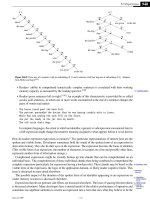
Table 221.2:
Relative frequency (most common to least common, with parenthesis used to bracket extremely rare letters) of letter
usage in various human languages (the English ranking is based on the British National Corpus). Based on Kelk.
[729]
Language Letters
English etaoinsrhldcumfpgwybvkxjqz
French esaitnrulodcmpộvqfbghjxốyờzõỗợựụỷùkởw
Norwegian erntsilakodgmvfupbhứjyồổcwzx(q)
Swedish eantrsildomkgvọfhupồửbcyjxwzộq
Icelandic anriestulgmkfhvoỏỵớdjúbyổỳửpộ
`
ycxwzq
Hungarian eatlnskomzrigỏộydbvhj
ofupửúcuớỳỹxw(q)
222
The representation of each member of the source and execution basic character sets shall t in a byte. basic char-
acter set
t in a byte
Commentary
This is a requirement on the implementation. The denition of character already species that it ts in a byte.
59 character
single-byte
However, a character constant has type
int
; which could be thought to imply that the value representation of
883 character
constant
type
characters need not t in a byte. This wording claries the situation. The representation of members of the
basic execution character set is also required to be a nonnegative value.
478 basic char-
acter set
positive if stored in
char object
C
++
1.7p1
A byte is at least large enough to contain any member of the basic execution character set and . . .
This requirement reverses the dependency given in the C Standard, but the effect is the same.
Common Implementations
On hosts where characters have a width 16 or 32 bits, that choice has usually been made because of
addressability issues (pointers only being able to point at storage on 16- or 32-bit address boundaries). It is
not usually necessary to increase the size of a byte because of representational issues to do with the character
set.
In the EBCDIC character set, the value of
a
is 129 (in Ascii it is 97). If the implementation-dened
value of
CHAR_BIT
is 8, then this character, and some others, will not be representable in the type
signed
307 CHAR_BIT
macro
char
(in most implementations the representation actually used is the negative value whose least signicant
eight bits are the same as those of the corresponding bits in the positive value, in the character set). In such
implementations the type char will need to have the same representation as the type unsigned char.
The ICL 1900 series used a 6-bit byte. Implementing this requirement on such a host would not have
been possible.
Coding Guidelines
A general principle of coding guidelines is to recommend against the use of representation information. In
569.1 represen-
tation in-
formation
using
this case the standard is guaranteeing that a character will t within a given amount of storage. Relying on
this requirement might almost be regarded as essential in some cases.
Example
1 void f(void)
2 {
3 char C_1 = W; /
*
Guaranteed to fit in a char.
*
/
4 char C_2 = $; /
*
Not guaranteed to fit in a char.
*
/
5 signed char C_3 = W; /
*
Not guaranteed to fit in a signed char.
*
/
6 }
June 24, 2009 v 1.2
5.2.1 Character sets
224
223
In both the source and execution basic character sets, the value of each character after 0 in the above list ofdigit characters
contiguous
decimal digits shall be one greater than the value of the previous.
Commentary
This is a requirement on the implementation. The Committee realized that a large number of existing
programs depended on this statement being true. It is certainly true for the two major character sets used in
the English-speaking world, Ascii, EBCDIC, and all of the human language digit encodings specified in
Unicode, see Table 797.1. The Committee thus saw fit to bless this usage.
Not only is it possible to perform relational comparisons on the digit characters (e.g,
’0’<’1’
is always
true) but arithmetic operations can also be performed (e.g.,
’0’+1 == ’1’
). A similar statement for the
alphabetic characters cannot be made because it would not be true for at least one character set in common
use (e.g., EBCDIC).
C
++
The above wording has been proposed as the response to C
++
DR #173.
Other Languages
Most languages that have not recently had their specifications updated do not specify any representational
properties for the values of their execution character sets. Java specifies the use of the Unicode character set
(newer versions of the language specify newer versions of the Unicode Standard; all of which are the same
as Ascii for their first 128 values), so this statement also holds true. Ada specifies the subset of ISO 10646
known as the Basic Multilingual Plane (the original language standard specified ISO 646).
ISO 10646 28
Coding Guidelines
This requirement on an implementation provides a guarantee of representation information that developers
can make use of (e.g., in relational comparisons, see Table 866.3). The following are suggested wordings for
deviations from the guideline recommendation dealing with making use of representation information.
represen-
tation in-
formation
using
569.1
Dev
569.1
An integer character constant denoting a digit character may appear in the visible source as the operand
of an additive operator.
Example
1 #include <stdio.h>
2
3 extern char c_glob = ’4’;
4
5 int main(void)
6 {
7 if (’0’ + 3 == ’3’)
8 printf("Sentence 221 is TRUE\n");
9
10 if (c_glob < ’5’)
11 printf("Sentence 221 may be TRUE\n");
12 if (c_glob < 53) /
*
’5’ == 53 in ASCII
*
/
13 printf("Sentence 221 does not apply\n");
14 }
224
In source files, there shall be some way of indicating the end of each line of text;end-of-line
representation
v 1.2 June 24, 2009
5.2.1 Character sets
227
Commentary
This is a requirement on the implementation.
The C library makes a distinction between text and binary files. However, there is no requirement that
source files exist in either of these forms. The worst-case scenario: In a host environment that did not have
a native method of delimiting lines, an implementation would have to provide/define its own convention
and supply tools for editing such files. Some integrated development environments do define their own
conventions for storing source files and other associated information.
C
++
The C
++
Standard does not specify this level of detail (although it does refer to end-of-line indicators,
2.1p1n1).
Common Implementations
Unicode Technical Report #13: “Unicode newline guidelines” discusses the issues associated with repre-
senting new-lines in files. The ISO 6429 standard also defines NEL (NExt Line, hexadecimal 0x85) as
an end-of-line indicator. The Microsoft Windows convention is to indicate this end-of-line with a carriage
return/line feed pair, \r\n (a convention that goes back through CP/M to DEC RT-11); the Unix convention is
to use a single line feed character \n; the MacIntosh convention is to use the carriage return character, \r.
Some mainframes implement a form of text files that mimic punched cards by having fixed-length lines.
Each line contains the same number of characters, often 80. The space after the last user-written character is
sometimes padded with spaces, other times it is padded with null characters.
225
this International Standard treats such an end-of-line indicator as if it were a single new-line character.
Commentary
The standard is not interested in the details of the byte representation of end-of-line on storage media. It
116 transla-
tion phase
1
makes use of the concept of end-of-line and uses the conceptual simplification of treating it as if it were a
single character.
C
++
2.1p1n1
. . . (introducing new-line characters for end-of-line indicators) . . .
226
In the basic execution character set, there shall be control characters representing alert, backspace, carriage
basic execution
character set
control characters
return, and new line.
Commentary
This is a requirement on the implementation.
These characters form part of the set of 96 execution character set members (counting the null character)
defined by the standard, plus new line which is introduced in translation phase 1. However, these characters
221 basic execu-
tion character
set
116 transla-
tion phase
1
are not in the basic source character set, and are represented in it using escape sequences.
866 escape se-
quence
syntax
Other Languages
Few other languages include the concept of control characters, although many implementations provide
semantics for them in source code (they are usually mapped exactly from the source to the execution character
set). Java defines the same control characters as C and gives them their equivalent Ascii values. However, it
does not define any semantics for these characters.
Common Implementations
ECMA-48 Control Functions for Coded Character Sets, Fifth Edition (available free from their Web site,
) was fast-tracked as the third edition of ISO/IEC 6429. This
standard defines significantly more control functions than those specified in the C Standard.
June 24, 2009 v 1.2
5.2.1 Character sets
228
227
If any other characters are encountered in a source file (except in an identifier, a character constant, a string
literal, a header name, a comment, or a preprocessing token that is never converted to a token), the behavior
is undefined.
Commentary
The standard does not prohibit such characters from occurring in a source file outright. The Committee was
aware of implementations that used such characters to extend the language. For instance, the use of the
@
character in an object definition to specify its address in storage.
The list of exceptions is extensive. The only usage remaining, for such characters, is as a punctuator. Any
other character has to be accepted as a preprocessing token. It may subsequently, for instance, be stringized.
#
operator
1950
It is the attempt to convert this preprocessing token into a token where the undefined behavior occurs.
preprocess-
ing token
converted to token
137
C90
Support for additional characters in identifiers is new in C99.
C
++
2.1p1
Any source file character not in the basic source character set (2.2) is replaced by the universal-character-name
that designates that character.
The C
++
Standard specifies the behavior and a translator is required to handle source code containing such a
character. A C translator is permitted to issue a diagnostic and fail to translate the source code.
Other Languages
Most languages regard the appearance of an unknown character in the source as some form of error. Like C,
most language implementations support additional characters in string literals and comments.
Common Implementations
Most implementations generate a diagnostic, either when the preprocessing token containing one of these
characters is converted to a token, or as a result of the very likely subsequent syntax violation. Some
implementations
[728]
define the @ character to be a token, its usual use being to provide the syntax for
specifying the address at which an object is to be placed in storage. It is generally followed by an integer
constant expression.
Coding Guidelines
An occurrence of a character outside of the basic source character set, in one of these contexts, is most likely
to be a typing mistake and is very likely to be diagnosed by the translator. The other possibility is that such
characters were intended to be used because use is being made of an extension. This issue is discussed
elsewhere.
extensions
cost/benefit
95.1
Example
1 static int glob @ 0x100; /
*
Put glob at location 0x100.
*
/
228
A letter is an uppercase letter or a lowercase letter as defined above;letter
Commentary
This defines the term letter.
There is a third kind of case that characters can have, titlecase (a term sometimes applied to words where
the first letter is in uppercase, or titlecase, and the other letters are in lowercase). In most instances titlecase
is the same as uppercase, but there are a few characters where this is not true; for instance, the titlecase of the
Unicode character U01C9, lj, is U01C8, Lj, and its uppercase is U01C7, LJ.
v 1.2 June 24, 2009
5.2.1.1 Trigraph sequences
232
C90
This definition is new in C99.
229
in this International Standard the term does not include other characters that are letters in other alphabets.
Commentary
All implementations are required to support the basic source character set to which this terminology applies.
Annex D lists those universal character names that can appear in identifiers. However, they are not referred
to as letters (although they may well be regarded as such in their native language).
The term letter assumes that the orthography (writing system) of a language has an alphabet. Some
792 orthography
orthographies, for instance Japanese, don’t have an alphabet as such (let alone the concept of upper- and
lowercase letters). Even when the orthography of a language does include characters that are considered
to be matching upper and lowercase letters by speakers of that language (e.g., æ and Æ, å and Å), the C
Standard does not define these characters to be letters.
C
++
The definition used in the C
++
Standard, 17.3.2.1.3 (the footnote applies to C90 only), implies this is also
true in C
++
.
Coding Guidelines
The term letter has a common usage meaning in a number of different languages. Developers do not often
use this term in its C Standard sense. Perhaps the safest approach for coding guideline documents to take is
to avoid use of this term completely.
230
The universal character name construct provides a way to name other characters.
Commentary
In theory all characters on planet Earth and beyond. In practice, those defined in ISO 10646.
28 ISO 10646
C90
Support for universal character names is new in C99.
Other Languages
Other language standards are slowly moving to support ISO 10646. Java supports a similar concept.
Common Implementations
Support for these characters is relatively new. It will take time before similarities between implementations
become apparent.
231
Forward references: universal character names (6.4.3), character constants (6.4.4.4), preprocessing direc-
tives (6.10), string literals (6.4.5), comments (6.4.9), string (7.1.1).
5.2.1.1 Trigraph sequences
232
trigraph se-
quences
replaced by
All occurrences in a source file Before any other processing takes place, each occurrence of one of the
following sequences of three characters (called trigraph sequences
12)
) are replaced with the corresponding
single character.
Commentary
Trigraphs were an invention of the C committee. They are a method of supporting the input (into source files,
not executing programs) and the printing of some C source characters in countries whose alphabets, and
keyboards, do not include them in their national character set. Digraphs, discussed elsewhere, are another
916 digraphs
sequence of characters that are replaced by a corresponding single character.
The \? escape sequence was introduced to allow sequences of ?s to occur within string literals.
895 string literal
syntax
The wording was changed by the response to DR #309.
June 24, 2009 v 1.2
5.2.1.1 Trigraph sequences
234
Other Languages
Until recently many computer languages did not attempt to be as worldly as C, requiring what might be called
an Ascii keyboard. Pascal specifies what it calls lexical alternatives for some lexical tokens. The character
sequences making up these lexical alternatives are only recognized in a context where they can form a single,
complete token.
Common Implementations
On the Apple MacIntosh host, the notation
’????’
is used to denote the unknown file type. Translators in
this environment often disable trigraphs by default to prevent unintended replacements from occurring.
233
trigraph se-
quences
mappings
??= # ??) ] ??! |
??( [ ??’ ^ ??< }
??/ \ ??< { ??- ~
Commentary
The above sequences were chosen to minimize the likelihood of breaking any existing, conforming, C source
code.
Other Languages
Many languages use a small subset, or none, of these problematic source characters, reducing the potential
severity of the problem. The Pascal standard specifies
(.
and
.)
as alternative lexical representations of
[
and ] respectively.
Common Implementations
Recognizing trigraph sequences entails a check against every character read in by the translator. Performance
profiling of translators has shown that a large percentage of time is spent in the lexer. A study by Waite
[1469]
found 41% of total translation time was spent in a handcrafted lexer (with little code optimization performed
by the translator). An automatically produced lexer, the lex tool was used, consumed 3 to 5 as much time.
One vendor, Borland, who used to take pride, and was known, for the speed at which their translators
operated, did not include trigraph processing in the main translator program. A stand-alone utility was
provided to perform trigraph processing. Those few programs that used trigraphs needed to be processed by
this utility, generating a temporary file that was processed by the main translator program. While using this
pre-preprocessor was a large overhead for programs that used trigraphs, performance was not degraded for
source code that did not contain them.
Usage
There are insufficient trigraphs in the visible form of the
.c
files to enable any meaningful analysis of the
usage of different trigraphs to be made.
234
No other trigraph sequences exist.trigraph se-
quences
no other
Commentary
The set of characters for which trigraphs were created to provide an alternative spelling are known, and
unlikely to be extended.
Coding Guidelines
Although no other trigraph sequences exist, sequences of two adjacent questions marks in string literals
may lead to confusion. Developers may be unsure about whether they represent a trigraph or not. Using the
escape sequence \? on at least one of these questions marks can help clarify the intent.
Example
1 char
*
unknown_trigraph = "??++";
2 char
*
cannot_be_trigraph = "?\? ";
v 1.2 June 24, 2009
5.2.1.2 Multibyte characters
238
Usage
The visible form of the
.c
files contained 593 (
.h
10) instances of two question marks (i.e.,
??
) in string
literals that were not followed by a character that would have created a trigraph sequence.
235
Each ? that does not begin one of the trigraphs listed above is not changed.
Commentary
Two ?s followed by any other character than those listed above is not a trigraph.
Common Implementations
No implementation is known to define any other sequence of ?s to be replaced by other characters.
Coding Guidelines
No other trigraph sequences are defined by the standard, have been notified for future addition to the standard,
or used in known implementations. Placing restrictions on other uses of other sequences of
?
s provides no
benefit.
236
EXAMPLE 1
??=define arraycheck(a,b) a??(b??) ??!??! b??(a??)
becomes
#define arraycheck(a,b) a[b] || b[a]
Commentary
This example was added by the response to DR #310 and is intended to show a common trigraph usage.
237
EXAMPLE 2 The following source line
printf("Eh???/n");
becomes (after replacement of the trigraph sequence ??/)
printf("Eh?\n");
Commentary
This illustrates the sometimes surprising consequences of trigraph processing.
5.2.1.2 Multibyte characters
238
The source character set may contain multibyte characters, used to represent members of the extended
multibyte
character
source contain
character set.
Commentary
The mapping from physical source file multibyte characters to the source character set occurs in translation
60 multibyte
character
phase 1. Whether multibyte characters are mapped to UCNs, single characters (if possible), or remain as
116 transla-
tion phase
1
multibyte characters depends on the model used by the implementation.
115 UCN
models of
C
++
The representations used for multibyte characters, in source code, invariably involve at least one character
that is not in the basic source character set:
2.1p1
Any source file character not in the basic source character set (2.2) is replaced by the universal-character-name
that designates that character.
The C
++
Standard does not discuss the issue of a translator having to process multibyte characters during
translation. However, implementations may choose to replace such characters with a corresponding universal-
character-name.
June 24, 2009 v 1.2
5.2.1.2 Multibyte characters
241
Other Languages
Most programming languages do not contain the concept of multibyte characters.
Common Implementations
Support for multibyte characters in identifiers, using a shift state encoding, is sometimes seen as an ex-
tension. Support for multibyte characters in this context using UCNs is new in C99. The most common
universal
charac-
ter name
syntax
815
implementations have been created to support the various Japanese character sets.
Coding Guidelines
The standard does not define how multibyte characters are to be represented. Any program that contains
them is dependent on a particular implementation to do the right thing. Converting programs that existed
before support for universal character names became available may not be economically viable.
Some coding guideline documents recommend against the use of characters that are not specified in the C
Standard. Simply prohibiting multibyte characters because they rely on implementation-defined behavior
ignores the cost/benefit issues applicable to the developers who need to read the source. These are complex
issues for which your author has insufficient experience with which to frame any applicable guideline
recommendations.
239
The execution character set may also contain multibyte characters, which need not have the same encoding
as for the source character set.
Commentary
Multibyte characters could be read from a file during program execution, or even created by assigning byte
values to contiguous array elements. These multibyte sequences could then be interpreted by various library
functions as representing certain (wide) characters.
The execution character set need not be fixed at translation time. A program’s locale can be changed
at execution time (by a call to the
setlocale
function). Such a change of locale can alter how multibyte
characters are interpreted by a library function.
C
++
There is no explicit statement about such behavior being permitted in the C
++
Standard. The C header
<wchar.h>
(specified in Amendment 1 to C90) is included by reference and so the support it defines for
multibyte characters needs to be provided by C
++
implementations.
Other Languages
Most languages do not include library functions for handling multibyte characters.
Coding Guidelines
Use of multibyte characters during program execution is an applications issue that is outside the scope of
these coding guidelines.
240
For both character sets, the following shall hold:
Commentary
This is a set of requirements that applies to an implementation. It is the minimum set of guaranteed
requirements that a program can rely on.
Coding Guidelines
The set of requirements listed in the following C-sentences is fairly general. Dealing with implementations
that do not meet the requirements listed in these sentences is outside the scope of these coding guidelines.
241
— The basic character set shall be present and each character shall be encoded as a single byte.
v 1.2 June 24, 2009
5.2.1.2 Multibyte characters
243
Commentary
This is a requirement on the implementation. It prevents an implementation from being purely multibyte-
based. The members of the basic character set are guaranteed to always be available and fit in a byte.
222 basic char-
acter set
fit in a byte
Common Implementations
An implementation that includes support for an extended character set might choose to define
CHAR_BIT
to
216 extended
character set
307 CHAR_BIT
macro
be 16 (most of the commonly used characters in ISO 10646 are representable in 16 bits, each in UTF-16; at
28 ISO 10646
28 UTF-16
least those likely to be encountered outside of academic research and the traditional Chinese written on Hong
Kong). Alternatively, an implementation may use an encoding where the members of the basic character set
are representable in a byte, but some members of the extended character set require more than one byte for
their encoding. One such representation is UTF-8.
28 UTF-8
242
— The presence, meaning, and representation of any additional members is locale-specific.
Commentary
On program startup the execution locale is the
"C"
locale. During execution it can be set under program
control. The standard is silent on what the translation time locale might be.
Common Implementations
The full Ascii character set is used by a large number of implementations.
Coding Guidelines
It often comes as a surprise to developers to learn what characters the C Standard does not require to be
provided by an implementation. Source code readability could be affected if any of these additional members
appear within comments and cannot be meaningfully displayed. Balancing the benefits of using additional
members against the likelihood of not being able to display them is a management issue.
The use of any additional members during the execution of a program will be driven by the user require-
ments of the application. This issue is outside the scope of these coding guidelines.
243
— A multibyte character set may have a state-dependent encoding, wherein each sequence of multibyte
multibyte
character
state-dependent
encoding
shift state
characters begins in an initial shift state and enters other locale-specific shift states when specific multibyte
characters are encountered in the sequence.
Commentary
State-dependent encodings are essentially finite state machines. When a state encoding, or any multibyte
encoding, is being used the number of characters in a string literal is not the same as the number of bytes
encountered before the null character. There is no requirement that the sequence of shift states and characters
representing an extended character be unique.
215 extended
characters
There are situations where the visual appearance of two or more characters is considered to be a single
combining
characters
character. For instance, (using ISO 10646 as the example encoding), the two characters LATIN SMALL
LETTER O (U+006F) followed by COMBINING CIRCUMFLEX ACCENT (U+0302) represent the grapheme
cluster (the ISO 10646 term
[334]
for what might be considered a user character)
ô
not the two characters
o ^
. Some languages use grapheme clusters that require more than one combining character, for instance
ô
¯
. Unicode (not ISO 10646) defines a canonical accent ordering to handle sequences of these combining
characters. The so-called combining characters are defined to combine with the character that comes
immediately before them in the character stream. For backwards compatibility with other character encodings,
and ease of conversion, the ISO 10646 Standard provides explicit codes for some accent characters; for
instance, LATIN SMALL LETTER O WITH CIRCUMFLEX (U+00F4) also denotes ô.
A character that is capable of standing alone, the
o
above, is known as a base character. A character that
modifies a base character, the
ô
above, is known as a combining character (the visible form of some combining
characters are called diacritic characters). Most character encodings do not contain any combining characters,
and those that do contain them rarely specify whether they should occur before or after the modified base
June 24, 2009 v 1.2
5.2.1.2 Multibyte characters
243
character. Claims that a particular standard require the combining character to occur before the base character
it modifies may be based on a misunderstanding. For instance, ISO/IEC 6937 specifies a single-byte
encoding for base characters and a double-byte encoding for some visual combinations of (diacritic + base)
Latin letter. These double-byte encodings are precomposed in the sense that they represent a single character;
there is no single-byte encoding for the diacritic character, and the representation of the second byte happens
to be the same as that of the single-byte representation of the corresponding base character (e.g., 0xC14F
represents LATIN CAPITAL LETTER O WITH GRAVE and 0xC16F represents LATIN SMALL LETTER O
WITH GRAVE).
C90
The C90 Standard specified implementation-defined shift states rather than locale-specific shift states.
C
++
The definition of multibyte character, 1.3.8, says nothing about encoding issues (other than that more than
one byte may be used). The definition of multibyte strings, 17.3.2.1.3.2, requires the multibyte characters to
begin and end in the initial shift state.
Common Implementations
Most methods for state-dependent encoding are based on ISO/IEC 2022:1994 (identical to the standard
ISO 2022
ECMA-35 “Character Code Structure and Extension Techniques”, freely available from their Web site,
). This uses a different structure than that specified in ISO/IEC 10646–1. The
encoding method defined by ISO 2022 supports both 7-bit and 8-bit codes. It divides these codes up into
control characters (known as C0 and C1) and graphics characters (known as G0, G1, G2, and G3). In the
initial shift state the C0 and G0 characters are in effect.
Table 243.1:
Commonly seen ISO 2022 Control Characters. The alternative values for SS2 and SS3 are only available for 8-bit
codes.
Name Acronym Code Value Meaning
Escape ESC 0x1b Escape
Shift-In SI 0x0f Shift to the G0 set
Shift-Out SO 0x0e Shift to the G1 set
Locking-Shift 2 LS2 ESC 0x6e Shift to the G2 set
Locking-Shift 3 LS3 ESC 0x6f Shift to the G3 set
Single-Shift 2 SS2 ESC 0x4e, or 0x8e Next character only is in G2
Single-Shift 3 SS3 ESC 0x4f, or 0x8f Next character only is in G3
Some of the control codes and their values are listed in Table 243.1. The codes SI, SO, LS2, and LS3 are
known as locking shifts. They cause a change of state that lasts until the next control code is encountered. A
stream that uses locking shifts is said to use stateful encoding.
ISO 2022 specifies an encoding method: it does not specify what the values within the range used for
graphic characters represent. This role is filled by other standards, such as ISO 8859. A C implementation
ISO 8859 24
that supports a state-dependent encoding chooses which character sets are available in each state that it
supports (the C Standard only defines the character set for the initial shift state).
Table 243.2: An implementation where G1 is ISO 8859–1, and G2 is ISO 8891–7 (Greek).
Encoded values 0x62 0x63 0x64 0x0e 0xe6 0x1b 0x6e 0xe1 0xe2 0xe3 0x0f
Control character SO LS2 SI
Graphic character a b c æ α β γ
Having to rely on implicit knowledge of what character set is intended to be used for G1, G2, and so on, is
not always satisfactory. A method of specifying the character sets in the sequence of bytes is needed. The
v 1.2 June 24, 2009
5.2.1.2 Multibyte characters
244
ESC control code provides this functionality by using two or more following bytes to specify the character
set (ISO maintains a registry of coded character sets). It is possible to change between character sets without
any intervening characters. Table 243.3 lists some of the commonly used Japanese character sets.
C source code written by Japanese developers probably has the highest usage of shift sequences. There are
several JIS (Japanese Industrial Standard) documents specifying representations for such sequences. Shift
JIS (developed by Microsoft) belies its name and does not involve shift sequences that use a state-dependent
encoding.
Table 243.3: ESC codes for some of the character sets used in Japanese.
Character Set Byte Encoding Visible Ascii Representation
JIS C 6226–1978 1B 24 40 <ESC> $ @
JIS X 0208–1983 1B 24 42 <ESC> $ B
JIS X 0208–1990 1B 26 40 1B 24 42 <ESC> & @ <ESC> $ B
JIS X 0212–1990 1B 24 28 44 <ESC> $ ( D
JIS-Roman 1B 28 4A <ESC> ( J
Ascii 1B 28 42 <ESC> ( B
Half width Katakana 1B 28 49 <ESC> ( I
Table 243.4: A JIS encoding of the character sequence かな漢字(“kana and kanji”).
Encoded values 0x1b 0x24 0x42 0x242b 0x244a 0x3441 0x3b7a 0x1b 0x28 0x4a
Control character <ESC> $ B <ESC> ( J
Graphic character か な 漢 字
Ascii characters $+ $J 4A ;z
Coding Guidelines
Developers do not need to remember the numerical values for extended characters. The editor, or program
development environment, used to create the source code invariably looks after the details (generating any
escape sequences and the appropriate byte values for the extended character selected by the developer). How
these tools decide to encode multibyte character sequences is outside the scope of these coding guidelines.
It is usually possible to express an extended character in a minimal number of bytes using a particular
state-dependent encoding. The extent to which developers might create fixed-length data structures on the
assumption that multibyte characters will not contain any redundant shift sequences is outside the scope of
2017 footnote
152
this book. The value of the
MB_LEN_MAX
macro places an upper limit on the number of possible redundant
313
MB_LEN_MAX
shift sequences.
Example
1 #include <stdio.h>
2
3 char
*
p1 = "^[$B$3$l$OF|K\8lI=8=^[(J"; /
*
^[$BF|K\8lJ8;zNs^[(J
*
/
4 char
*
p2 = "^[$B$3$l$OF|1Q^[(Jmixed^[$BJ8;zNs^[(J"; /
*
Ascii + ^[$BF|K\8l^[(J
*
/
5 char
*
p3 = "^[$B$3$l$OH>3Q^[(J^N6@6E^O^[$B$H^[(JASCII^[$B:.9g^[(J";
6
7 int main(void)
8 {
9 printf("%s^[$B$H^[(J%s^[$B$H^[(J%s\n", p1, p2, p3);
10 }
244
While in the initial shift state, all single-byte characters retain their usual interpretation and do not alter the
shift state.
June 24, 2009 v 1.2
5.2.1.2 Multibyte characters
247
Commentary
The implementation of a stateful encoding has to pick a special character, which is not in the basic character
set, to indicate the start of a shift sequence. When not in the initial shift state, it is very unlikely that single
bytes will be interpreted the same way as when in the initial shift state.
C
++
The C
++
Standard does not explicitly specify this requirement.
Common Implementations
The ESC character, 0x1b, is commonly used to indicate the start of a shift sequence.
245
12) The trigraph sequences enable the input of characters that are not defined in the Invariant Code Set as
footnote
12
described in ISO/IEC 646, which is a subset of the seven-bit US ASCII code set.
Commentary
When trigraphs are used, it is possible to write C source code that contains only those characters that are in
the Invariant Code Set of ISO/IEC 646.
C90
The C90 Standard explicitly referred to the 1983 version of ISO/IEC 646 standard.
246
The interpretation for subsequent bytes in the sequence is a function of the current shift state.
Commentary
This wording is really a suggestion for the design of multibyte shift states (it is effectively describing the
processing performed by finite state machines, which is what a shift state encoding is). Being able to interpret
a byte independent of the current shift state would indicate that the sequence of bytes that resulted in the
current state were redundant.
The specification of the macro
MB_LEN_MAX
requires that the maximum number of bytes needed to handle
MB_LEN_MAX
313
a supported multibyte character be provided. It may, or may not, be possible to represent some redundant
shift sequence within the available bytes. The standard does not explicitly require or prohibit support for
redundant shift sequences.
C
++
A set of virtual functions for handling state-dependent encodings, during program execution, is discussed in
Clause 22, Localization library. But, this requirement is not specified.
Common Implementations
Implementations usually use a simple finite state machine, often automatically generated, to handle the
mapping of shift states into their execution character value. The extent to which sequences of redundant shift
sequences is supported will depend on the implementation.
Coding Guidelines
The sequence of bytes in a shift sequence are usually generated via some automated process. For this reason
a guideline recommending against the use of redundant shift sequences is unlikely to be enforceable, and
none is given.
247
— A byte with all bits zero shall be interpreted as a null character independent of shift state.byte
all bits zero
Commentary
This is a requirement on the implementation. This requirement makes it possible to search for the end of
a string without needing any knowledge of the encoding that has been used. For instance, string-handling
functions can copy multibyte characters without interpreting their contents.
v 1.2 June 24, 2009
5.2.1.2 Multibyte characters
250
C
++
2.2p3
. . . , plus a null character (respectively, null wide character), whose representation has all zero bits.
While the C
++
Standard does not rule out the possibility of all bits zero having another interpretation in other
contexts, other requirements (17.3.2.1.3.1p1 and 17.3.2.1.3.2p1) restrict these other contexts, as do existing
character set encodings.
248
— A byte with all bits zero shall not occur in the second or subsequent bytes of a Such a byte shall not occur
multibyte
character
end in initial
shift state
as part of any other multibyte character.
Commentary
This is a requirement on the implementation. The effect of this requirement is that partial multibyte characters
cannot be created (otherwise the behavior is undefined). A null character can only exist outside of the
sequence of bytes making up a multibyte character. For source files this requirement follows from the
requirement to end in the initial shift state. During program execution this requirement means that library
250 token
shift state
functions processing multibyte characters do not need to concern themselves with handling partial multibyte
characters at the end of a string.
The wording was changed by the response to DR #278 (it is a requirement on the implementation that
forbids a two-byte character from having a first, or any, byte that is zero).
C
++
This requirement can be deduced from the definition of null terminated byte strings, 17.3.2.1.3.1p1, and null
terminated multibyte strings, 17.3.2.1.3.2p1.
249
For source files, the following shall hold:
Commentary
These C-sentences specify requirements on a program. A program that violates them exhibits undefined
behavior.
Use of multibyte characters can involve locale-specific and implementation-defined behaviors. A source
44 locale-
specific
behavior
42
implementation-
defined
behavior
file does not affect the conformance status of any program built using it, provided its use of multibyte
characters either involves locale-specific behavior or the implementation-defined behavior does not affect
program output (e.g., they appear in comments).
Coding Guidelines
The creation of multibyte characters within source files is usually handled by an editor. The developer
involvement in the process being the selection of the appropriate character. In such an environment the
developer has no control over the byte sequences used. A guideline recommending against such usage is
likely to be impractical to implement and none is given.
250
— An identifier, comment, string literal, character constant, or header name shall begin and end in the initial
token
shift state
shift state.
Commentary
These are the only tokens that can meaningfully contain a multibyte character. A token containing a multibyte
character should not affect the processing of subsequent tokens. Without this requirement a token that did
not end in the initial shift state would be likely to affect the processing of subsequent tokens.
C90
Support for multibyte characters in identifiers is new in C99.
June 24, 2009 v 1.2
5.2.2 Character display semantics
252
C
++
In C
++
all characters are mapped to the source character set in translation phase 1. Any shift state encoding
transla-
tion phase
1
116
will not exist after translation phase 1, so the C requirement is not applicable to C
++
source files.
Coding Guidelines
The fact that many multibyte sequences are created automatically, by an editor, can make it very difficult for
a developer to meet this requirement. A developer is unlikely to intentionally end a preprocessing token,
created using a multibyte sequence, in other than the initial state. A coding guideline is unlikely to be of
benefit.
251
— An identifier, comment, string literal, character constant, or header name shall consist of a sequence of
valid multibyte characters.
Commentary
What is a valid multibyte character? This decision can only be made by a translator, should it chose to accept
multibyte characters.
In C90 it was relatively easy to lexically process a source file containing multibyte characters. The
context in which these characters occurred often meant that a lexer simply had to look for the character that
terminated the kind of token being processed (unless that character occurred as part of a multibyte character).
Identifier tokens do not have a single termination character. This means that it is not possible to generalise
support for multibyte characters in identifiers across all translators. It is possible that source containing a
multibyte character identifier supported by one translator will cause another translator to issue a diagnostic.
C90
Support for multibyte characters in identifiers is new in C99.
C
++
In C
++
all characters are mapped to the source character set in translation phase 1. Any shift state encoding
transla-
tion phase
1
116
will not exist after translation phase 1, so the C requirement is not applicable to C
++
source files.
Coding Guidelines
In some cases source files can contain multibyte characters and be translated by translators that have no
knowledge of the structure of these multibyte characters. The developer is relying on the translator ignoring
them in comments containing their native language, or simply copying the character sequence in a string
literal into the program image. In other cases, for instance identifiers, knowledge of the encoding used for
the multibyte character set is likely to be needed by a translator.
Ensuring that a translator capable of handling any multibyte characters occurring in the source is used, is a
configuration-management issue that is outside the scope of these coding guidelines.
5.2.2 Character display semantics
Commentary
There is no guarantee that a character display will exist on any hosted implementation. If such a device is
character display
semantics
supported by an implementation, this clause specifies its attributes.
C
++
Clause 18 mentions “display as a wstring” in Notes:. But, there is no other mention of display semantics
anywhere in the standard.
Common Implementations
Most Unix-based environments contain a database of terminal capabilities, the so-called termcap database.
[1332]
termcap
database
This database provides information to the host on a large number of terminal capabilities and characteristics.
Knowing the display device currently being used (this usually relies on the user setting an environment
variable) enables the database to be queried for device attribute information. This information can then be
used by an application to handle its output to display devices. There is a similar database of information on
printer characteristics.
v 1.2 June 24, 2009
5.2.2 Character display semantics
254
252
The active position is that location on a display device where the next character output by the
fputc
function
would appear.
Commentary
This defines the term active position; however, the term current cursor position is more commonly used by
developers.
The wide character output functions act as if fputc is called.
C
++
C
++
has no concept of active position. The
fputc
function appears in "Table 94" as one of the functions
supported by C
++
.
Other Languages
Most languages don’t get involved in such low-level I/O details.
253
The intent of writing a printing character (as defined by the
isprint
function) to a display device is to display a
graphic representation of that character at the active position and then advance the active position to the next
position on the current line.
Commentary
The standard specifies an intent, not a requirement. Some devices produce output that cannot be erased later
(e.g., printing to paper) while other devices always display the last character output at a given position (e.g.,
VDUs). The ability of printers to display two or more characters at the same position is sometimes required.
For instance, programs wanting to display the
ô
character on a wide variety of printers might generate the
sequence o, backspace, ^ (all of these characters are contained in the invariant subset of ISO 646).
The intended behavior describes the movement of the active position, not the width of the character
displayed. There is nothing in this definition to prevent the writing of one character affecting previously
written characters (which can occur in Arabic). This specification implies that the positions are a fixed width
apart.
The graphic representation of a character is known as a glyph.
58 glyph
C
++
The C
++
Standard does not discuss character display semantics.
Common Implementations
In some oriental languages, character glyphs can usually be organized into two groups, one being twice the
width as the other. Implementations in these environments often use a fixed width for each glyph, creating
empty spaces between some glyph pairs.
Some orthographies, which use an alphabetic representation, contain single characters that use what
appears to be two characters in their visual representation. For instance, the character denoted by the Unicode
value U00C6 is Æ, and the character denoted by the Unicode value U01C9 is lj. Both representations are
considered to be a single character (the former is also a single letter, while the latter is two letters).
Coding Guidelines
The concept of active position is useful for describing the basic set of operations supported by the C Standard.
The applications’ requirements for displaying characters may, or may not, be feasible within the functionality
provided by the standard; this is a top-level application design issue. How characters appear on a display
device is an application user interface issue that is outside the scope of this book.
254
The direction of writing is locale-specific. writing direction
locale-specific
June 24, 2009 v 1.2
5.2.2 Character display semantics
256
Commentary
Although left-to-right is used by many languages, this direction is not the only one used. Arabic uses
right-to-left (also Hebrew, Urdu, and Berber). In Japanese it is possible for the direction to be from top
to bottom with the lines going right-to-left (mainland Chinese has the columns going from left-to-right,
in Taiwan it goes right-to-left), or left-to-right with the lines going top to bottom (the same directional
conventions as English)
There is no requirement that the direction of writing always be the same direction, for instance, braille
alternates in direction between adjacent lines (known as boustrophedron), as do Egyptian hieroglyphs, Mayan,
and Hittite. Some Egyptian hieroglyphic characters can face either to the left or right (e.g.,
˜
or
˜
),
information that readers can use to deduce the direction in which a line should be read.
Some applications need to simultaneously handle locales where the direction of writing is different, for
instance, a word processor that supports the use of Hebrew and English in the same document. This level of
support is outside the scope of the C Standard.
C
++
The C
++
Standard does not discuss character display semantics.
Coding Guidelines
The direction of writing is an application issue. Any developer who is concerned with the direction of writing
will, of necessity, require a deeper involvement with this topic than the material covered by the C Standard or
these coding guidelines.
Example
The direction of writing can change during program execution. For instance, in a word processor that handles
both English and Arabic or Hebrew, the character sequence ABCdefGHJ (using lowercase to represent
English and uppercase to represent Arabic/Hebrew) might appear on the display as JHGdefCBA.
255
If the active position is at the final position of a line (if there is one), the behavior of the display device is
unspecified.
Commentary
The Committee recognized that there is no commonality of behavior exhibited by existing display devices
when the final position on a line is reached.
C
++
The C
++
Standard does not discuss character display semantics.
Common Implementations
Some display devices wrap onto the next line, effectively generating an extra new-line character. Other
devices write all subsequent characters, up to the next new-line character, at the final position. On some
displays, writing to the bottom right corner of a display has an effect other than displaying the character
output, for instance, clearing the screen or causing it to scroll. The
termcap
and
ncurses
both provide
configuration options that specify whether writing to this display location has the desired effect.
Coding Guidelines
Organizing the characters on a display device is an application domain issue. The fact that the C Standard does
not provide a defined method of handling the situation described here needs to be dealt with, if applicable,
during the design process. This is outside the scope of these coding guidelines.
256
Alphabetic escape sequences representing nongraphic characters in the execution character set are intended
to produce actions on display devices as follows:
Commentary
This is the behavior of Ascii terminals enshrined in the C Standard.
Rationale
v 1.2 June 24, 2009
5.2.2 Character display semantics
258
To avoid the issue of whether an implementation conforms if it cannot properly effect vertical tabs (for instance),
the Standard emphasizes that the semantics merely describe intent.
These escape sequences can also be output to files. The data values written to a file may depend on whether
the stream was opened in text or binary mode.
C
++
The C
++
Standard does not discuss character display semantics.
Other Languages
Java provides a similar set of functionality to that described here.
Common Implementations
Most display devices are capable of handling most of the functions described here.
Coding Guidelines
A program cannot assume that any of the functionality described will occur when the escape sequence is sent
to a display device. The root cause for the variability in support for the intended behaviors is the variability
of the display devices. In most cases an implementation’s action is to send the binary representation of
the escape sequence to the device. The manufacturers of display devices are aware of their customers
expectations of behavior when these kinds of values are received.
There is little that coding guidelines can recommend to help reduce the dependency on display devices.
The design guidelines of creating individual functions to perform specific operations on display devices and
isolating variable implementation behaviors in one place are outside the scope of these coding guidelines.
257
\a (alert) Produces an audible or visible alert without changing the active position.
Commentary
The intent of an alert is to draw attention to some important event, such as a warning message that the host
is to be shut down, or that some unexpected situation has occurred. A program running as a background
process (a concept that is not defined by the C Standard) may not have a display device attached (does a tree
falling in a forest with nobody to hear it make a noise?).
C
++
Alert appears in Table 5, 2.13.2p3. There is no other description of this escape sequence, although the C
behavior might be implied from the following wording:
17.4.1.2p3
The facilities of the Standard C Library are provided in 18 additional headers, as shown in Table 12:
Common Implementations
Most implementations provide an audible alert. On display devices that don’t have a mechanism for producing
a sound, a visible alert might be to temporarily blank the screen or to temporarily increase the brightness of
the screen.
Coding Guidelines
Programs that produce too many alerts run the risk of having them ignored. The human factor involved in
producing alerts are outside of the scope of these coding guidelines. Issues such as a display device not
being able to produce an audible alert because its speaker is broken, is also outside the scope of these coding
guidelines.
258
\b (backspace) Moves the active position to the previous position on the current line. backspace
escape sequence
Commentary
The standard specifies that the active position is moved. It says nothing about what might happen to any
character displayed prior to the backspace at the new current active position.
June 24, 2009 v 1.2
5.2.2 Character display semantics
260
Common Implementations
Some devices erase any character displayed at the previous position.
C
++
Backspace appears in Table 5, 2.13.2p3. There is no other description of this escape sequence, although the
C behavior might be implied from the following wording:
17.4.1.2p3
The facilities of the Standard C Library are provided in 18 additional headers, as shown in Table 12:
Example
1 #include <stdio.h>
2
3 int main(void)
4 {
5 printf("h\bHello \b World\n");
6 }
259
If the active position is at the initial position of a line, the behavior of the display device is unspecified.
Commentary
Some terminals have input locking states. In such cases an unspecified behavior put the display device into a
state where it no longer displays characters written to it.
C90
If the active position is at the initial position of a line, the behavior is unspecified.
This wording differs from C99 in that it renders the behavior of the program as unspecified. The program
simply writes the character; how the device handles the character is beyond its control.
C
++
The C
++
Standard does not discuss character display semantics.
Common Implementations
The most common implementation behavior is to ignore the request leaving the active position unchanged.
Some VDUs have the ability to wrap back to the final position on the preceding line.
Coding Guidelines
While it may be technically correct to specify that the behavior of the display device as unspecified, it does
indirectly affect the output behavior of a program in that subsequent output may not appear on that display
device.
260
\f (form feed) Moves the active position to the initial position at the start of the next logical page.
Commentary
Whatever a page, logical or otherwise, is. This concept is primarily applied to printers. The functionality
page
logical
to move to the start of the next page, from anywhere on the current page, is generally provided by printer
vendors. Programs might use this functionality since it frees them from needing to know the number of lines
on a page (provided the minimum needed to support the generated output is available).
C
++
Form feed appears in Table 5, 2.13.2p3. There is no other description of this escape sequence, although the C
behavior might be implied from the following wording:
17.4.1.2p3
v 1.2 June 24, 2009
5.2.2 Character display semantics
263
The facilities of the Standard C Library are provided in 18 additional headers, as shown in Table 12:
Coding Guidelines
Use of this escape sequence could remove the need for a program to be aware of the number of lines on the
page of the display device being written. However, it does place a dependency on the characteristics of the
display device being known to the host executing the program, or on the device itself, to respond to the data
termcap
database
sent to it.
261
\n (new line) Moves the active position to the initial position of the next line. new-line
escape sequence
Commentary
What happens to the preceding lines is not specified. For instance, whether the display device scrolls lines or
wraps back to the top of any screen. The standard is silent on the issue of display devices that only support
one line. For instance, do the contents of the previous line disappear?
C
++
New line appears in Table 5, 2.13.2p3. There is no other description of this escape sequence, although the C
behavior might be implied from the following wording:
17.4.1.2p3
The facilities of the Standard C Library are provided in 18 additional headers, as shown in Table 12:
Other Languages
Some languages provide a library function that produces the same effect.
Common Implementations
On some hosts the new-line character causes more than one character to be sent to the display device (e.g.,
carriage return, line feed).
A printing device may simply move the media being printed on. A VDU may display characters on some
previous line (wrapping to the start of the screen). On some display devices (usually memory-mapped ones),
the start of a new line is usually indicated by an end-of-line character appearing at the end of the previous
line. On other display devices, a fixed amount of storage is allocated for the characters that may occur on
224 end-of-line
representation
each line. In this case the end of line is not stored as a character in the display device.
Coding Guidelines
Issues, such as handling lines that are lost when a new line is written or display devices that contain a single
line, are outside the scope of these coding guidelines.
262
\r (carriage return) Moves the active position to the initial position of the current line. carriage return
escape sequence
Commentary
The behavior might be viewed as having the same effect as writing the appropriate number of backspace
characters. However, the effect of writing a backspace character might be to erase the previous character,
while a carriage return does not cause the contents of a line to be erased. Like backspace, the standard says
258 backspace
escape sequence
nothing about the effect of writing characters at the position on a line that has previously been written to.
C
++
Carriage return appears in Table 5, 2.13.2p3. There is no other description of this escape sequence, although
the C behavior might be implied from the following wording:
17.4.1.2p3
The facilities of the Standard C Library are provided in 18 additional headers, as shown in Table 12:
June 24, 2009 v 1.2
5.2.2 Character display semantics
265
263
\t (horizontal tab) Moves the active position to the next horizontal tabulation position on the current line.horizontal tab
escape sequence
Commentary
Horizontal tabulation positions are provided by vendors of display devices as a convenient method of aligning
data, on different lines, into columns. In some cases they can remove the need for a program to count the
number of characters that have been written. The C Standard does not provide a method for controlling the
location of horizontal tabulation positions. Neither does a program have any method of finding out which
positions they occupy.
C
++
Horizontal tab appears in Table 5, 2.13.2p3. There is no other description of this escape sequence, although
the C behavior might be implied from the following wording:
17.4.1.2p3
The facilities of the Standard C Library are provided in 18 additional headers, as shown in Table 12:
Common Implementations
The location of tabulation positions on a line are usually controlled by the display device. There may be a
limited number that can be configured on a line. Configuring a horizontal tab position every eight active
positions from the start of the line is a common default. Many hosts allow the default setting to be changed,
and some users actively make use of this configuration option.
Coding Guidelines
A commonly seen application problem is the assumption, by the developer, of where the horizontal tabulation
positions occur on a display device. However, the handling display devices are outside the scope of these
coding guidelines.
264
If the active position is at or past the last defined horizontal tabulation position, the behavior of the display
device is unspecified.
Commentary
The standard does not specify how many horizontal tabulation positions must be supported by an implemen-
tation, if any.
C90
If the active position is at or past the last defined horizontal tabulation position, the behavior is unspecified.
Common Implementations
Some implementations do not move the active position when the last defined horizontal tabulation position
has been reached; others treat writing such a character as being equivalent to writing a single white-space
character at this position. In some cases the behavior is to move the active position to the first horizontal
tabulation position on the next line.
265
\v (vertical tab) Moves the active position to the initial position of the next vertical tabulation position.vertical tab
escape sequence
Commentary
Although the standard recognizes that the direction of writing is locale-specific, it says nothing about the
order in which lines are organized. The vertical tab (and new line) escape sequence move the active position
in the same line direction. There is no escape sequence for moving the active position in the opposite
direction, similar to backspace for movement within a line.
The concept of vertical tabulation implicitly invokes the concept of current page. This concept is primarily
applied to printers, while the dimensions of a page might be less variable than a terminal. Before laser
page
logical
260
printers were invented, it was very important to ensure that output occurred in a controlled, top-down fashion.
v 1.2 June 24, 2009
5.2.2 Character display semantics
268
C
++
Vertical tab appears in Table 5, 2.13.2p3. There is no other description of this escape sequence, although the
C behavior might be implied from the following wording:
17.4.1.2p3
The facilities of the Standard C Library are provided in 18 additional headers, as shown in Table 12:
Common Implementations
In most implementations a vertical tab moves the active position to the next line, with the relative position
within the line staying the same.
266
If the active position is at or past the last defined vertical tabulation position, the behavior of the display device
is unspecified.
Commentary
The intended behavior is likely to vary between terminals and printers.
C90
If the active position is at or past the last defined vertical tabulation position, the behavior is unspecified.
Common Implementations
Many display devices do not define vertical tabulation positions; this escape sequence simply causes the
active position to move to the next line. The behavior is the same as when a new line escape sequence is
written at the end of a page, or screen.
267
Each of these escape sequences shall produce a unique implementation-defined value which can be stored
escape sequence
fit in char object
in a single char object.
Commentary
These escape sequences are defined to be members of the basic execution character set and also to fit in a
221 basic execu-
tion character
set
byte.
222 basic char-
acter set
fit in a byte
The mapping to this implementation-defined value occurs at translation time. The execution time value
actually received by the display device is outside the scope of the standard. The library function
fputc
could
map the value represented by these single char object into any sequence of bytes necessary.
C
++
This requirement can be deduced from 2.2p3.
Other Languages
Java explicitly defines the values of the escape sequences it specifies.
Common Implementations
The specified escape sequences are available in the Ascii character set (and thus also in ISO 10646).
28 ISO 10646
268
The external representations in a text file need not be identical to the internal representations, and are outside
the scope of this International Standard.
Commentary
The Committee recognizes that host file systems may use a representation for text files that is different from
that used for binary files. The output functions will know the mode with which a stream was opened and can
process the bytes written appropriately. There is a guarantee for binary files, which does not hold for text
files, that the bytes written out shall compare equal to the same bytes read back in again.
June 24, 2009 v 1.2
5.2.3 Signals and interrupts
270
C
++
The C
++
Standard does not get involved in such details.
Common Implementations
The external representation of a text file is usually the same as that used to hold a C source file. The
representation of the new line escape sequence is usually the same as that for end-of-line, which is not always
end-of-line
representation
224
a single character.
From an executing program’s point of view, on hosts that support output redirection, there may be no
distinction made between a display device and a text file. However, the driver for a display device may
respond differently for some characters.
269
Forward references: the isprint function (7.4.1.8), the fputc function (7.19.7.3).
5.2.3 Signals and interrupts
270
Commentary
signal
Rationale
Signals are difficult to specify in a system-independent way. The C89 Committee concluded that about the
only thing a strictly conforming program can do in a signal handler is to assign a value to a volatile static
variable which can be written uninterruptedly and promptly return.
. . .
A second signal for the same handler could occur before the first is processed, and the Standard makes no
guarantees as to what happens to the second signal.
WG14/N748
A pole exception is the same as a divide-by-zero exception: a finite non-zero floating-point number divided by a
zero floating-point number.
Currently, various standards define the following exceptions for the indicated sample floating-point operations.
For LIA–2, there are other operations that produce the same exceptions.
LIA < Standard > IEEE
Exception LIA-1 LIA-2 IEEE-754/IEC-559 Exception
undefined 0.0 / 0.0 sqrt(-1.0) 0.0 / 0.0 invalid
1.0 / 0.0 log(-1.0) infinity / infinity
infinity - infinity
0.0
*
infinity
sqrt(-1.0)
pole (not yet) log(0.0) 1.0 / 0.0 division by
zero
floating_ max
*
max exp(max) max
*
max overflow
overflow max / min max / min
max + max max + max
underflow min
*
min exp(-max) min
*
min underflow
min / max min / max
In the above table, 1.0/0.0 is a shorthand notation for any non-zero finite floating-point number divided by a zero
floating-point number; max is the maximum floating-point number (
FLT_MAX
,
DBL_MAX
,
LDBL_MAX
); min is the
minimum floating-point number (
FLT_MIN
,
DBL_MIN, LDBL_MIN
);
log
() and
exp
() are mathematical library
routines.
v 1.2 June 24, 2009
5.2.3 Signals and interrupts
271
We believe that LIA–1 should be revised to match LIA-2, IEC-559 and IEEE-754 in that 1.0/0.0 should be a
pole exception and 0.0/0.0 should be an undefined exception.
C
++
The C
++
Standard specifies, Clause 15 Exception handling, a much richer set of functionality for dealing
with exceptional behaviors. While it does not go into the details contained in this C subclause, they are likely,
of necessity, to be followed by a C
++
implementation.
Other Languages
Some languages (e.g., Ada, Java, and PL/1) define statements that can be used to control how exceptions and
signals are to be handled. After over 30 years floating point exception handling has finally been specified in
the Fortran Standard.
[660]
A few languages include functionality for handling signals and interrupts, but most
ignore these issues.
Common Implementations
Implementations are completely at the mercy of what signals are supported by the host environment and
what interrupts are generated by the processor. Gould (Encore) PowerNode treated both floating-point and
integer overflow as being the same.
Coding Guidelines
This subclause lists those minimum characteristics of a program image needed to support signals and
interrupts. Such support by the implementations is only half of the story. A program that makes use of
signals has to organize its behavior appropriately. Techniques for writing programs to handle signals, or even
ensuring that they are thread-safe are outside the scope of these coding guidelines.
271
Functions shall be implemented such that they may be interrupted at any time by a signal, or may be called
by a signal handler, or both, with no alteration to earlier, but still active, invocations’ control flow (after the
interruption), function return values, or objects with automatic storage duration.
Commentary
This is a requirement on the implementation. An implementation may provide a mechanism for the developer
to switch off interrupts within time-critical functions. Although such usage is an extension to the standard, it
cannot be detected in a strictly conforming program.
How could an implementation’s conformance to this requirement be measured? A program running under
an implementation that supports some form of external interrupt, for instance
SIGINT
, might be executed a
large number of times, the signal handler recording where the program was interrupted (this would require
functionality not defined in the standard). Given sufficient measurements, a statistical argument could be
used to show that an implementation did not support this requirement. A nonprogrammatic approach would
be to verify the requirement by understanding how the generated machine code interacted with the host
processor and the characteristics of that processor.
This wording is not as restrictive on the implementation as it first looks. The only signal that an
implementation is required to support is the one caused by a call to the
raise
function. Requiring that
any developer-written functions be callable from a signal handler restricts the calling conventions that may
be used in such a handler to be compatible with the general conventions used by an implementation. This
simplifies the implementation, but places a burden on time-critical applications where the calling overhead
may be excessive.
C
++
This implementation requirement is not specified in the C
++
Standard (1.9p9).
Other Languages
Most languages don’t explicitly say anything about the interruptibility of a function.
June 24, 2009 v 1.2
5.2.3 Signals and interrupts
272
Common Implementations
Few if any host processors allow execution of instructions to be interrupted. The boundary at the completion
of one instruction and starting another is where interrupts are usually responded to. In the case of pipelined
processors, there are two commonly seen behaviors. Some processors wait until the instructions currently
in the pipeline have completed execution, while others flush the instructions currently in the pipeline. An
example of an instruction that causes an interrupt to be raised after it has only partially completed is one that
accesses storage, if the access causes a page fault (causing the instruction to be suspended while the accessed
page is swapped into storage). Another case is performing an access to storage using a misaligned address,
or an invalid address. In these cases the instruction may never successfully complete.
External, nonprocessor-based interrupts are usually only processed once execution of the current instruction
is complete. Some processors have instructions that can take a relatively long time to execute, for instance,
instructions that copy large numbers of bytes between two blocks of memory. Depending on the design
requirements on interrupt latency, some processors allow these instructions to be interrupted, while others do
not.
Some implementations
[1370]
require that functions called by a signal handler preserve information about
the state of the execution environment, such as register contents. Developers are required to specify (often by
using a keyword in the declaration, such as
interrupt
) which functions must save (and restore on return)
this information.
272
All such objects shall be maintained outside the function image (the instructions that compose the executable
object storage
outside function
image
representation of a function) on a per-invocation basis.
Commentary
This is a requirement on the implementation (although the as-if rule might be invoked). The model being
described is effectively a stack-based approach to the calling of functions and the handling of storage for
objects they define (the actual storage allocation could use a real stack or simulate one using allocated
storage).
Storing objects in the function image, or simply having a preallocated area of storage for them, would pre-
vent a function from being called recursively (having more than one call to a function in the process of being
executed at the same time is a recursive invocation, however the invocation occurred). An implementation is
required to support recursive function calls. This requirement prevents implementations using a technique
function call
recursive
1026
that was once commonly used (primarily by implementations of other languages), but can have different
execution time semantics when recursive calls are made.
C
++
The C
++
Standard does not contain this requirement.
Other Languages
Most languages require support for recursive function calls, implying this requirement.
function call
recursive
1026
Common Implementations
Modern processors try to separate code (function image) and data (object definitions). Accesses to the two
have different characteristics, which affects the design of caches for them (often implemented as two separate
cache areas on the chip). Independently of processor support, the host environment (operating system) may
mark certain areas of storage as having execute-only permission. Attempts to read or write to such storage,
from an executing program, often leads to a signal being raised.
Applications targeted at a freestanding environment rarely involve recursive function calls. Storage may
also be at a premium and hardware stack support limited (the Intel 8051
[635]
is limited to a 128-byte stack).
Some hosts allocate fixed areas, in static storage, for objects local to functions. A call tree, built at link-time,
can be used to work out which storage areas can be shared by overlaying those objects whose lifetimes do
not overlap, reducing the fixed execution time memory overhead associated with such a design.
v 1.2 June 24, 2009
5.2.4 Environmental limits
272
Many processors have span-dependent load and store instructions. That is, a short-form (measured in
number of bytes) that can only load (or store) from/to storage locations whose address has a small offset
relative to a base address, while a long-form supports larger offsets. When storage usage needs to be
minimized, it may be possible to use a short-form instruction to access storage locations in the function
image. The usual technique used is to reserve storage for objects after an unconditional branch instruction,
which is accessed by the instructions close (within the range supported by the short-form instruction) to those
locations.
[1193]
Coding Guidelines
While implementations might be required to allocate objects outside of a function image, developers have
been known to write code to store values in a program image. In those few cases where values are stored in
this way, the developers involved are very aware of what they are doing. A guideline recommendation serves
no purpose.
Example
The following is one possible method that might be used to store data in a program image.
1 #include <stdio.h>
2
3 extern int always_zero = 0;
4 static int
*
code_ptr;
5
6 void f(void)
7 {
8 /
*
9
*
No static object declarations in this function ;-)
10
*
/
11 if (always_zero == 1) /
*
create some dead code
*
/
12 {
13 /
*
14
*
Pad out with enough code to create storage for an int.
15
*
A smart optimizer is the last thing we need here.
16
*
/
17 always_zero++;
18 always_zero++;
19 }
20
21 (
*
code_ptr)++;
22 printf("This function has been called %d times.\n",
*
code_ptr);
23 }
24
25 void init(void)
26 {
27 /
*
28
*
The value 16 is the offset of the dead code from the start of the
29
*
function. Change to suit your local instruction sizes (this works
30
*
for gcc on an Intel x86). We also need to make sure that the
31
*
pointer to int is correctly aligned. A reliable guess is that
32
*
the alignment is a multiple of the object size.
33
*
/
34 code_ptr=(int
*
)((((int)(char
*
)f) + 16) & ~(sizeof(int)-1));
35
*
code_ptr=0;
36 }
37
38 int main(void)
39 {
40 init();
41 for (int index=0; index < 10; index++)
42 f();
43 }
June 24, 2009 v 1.2